
Influencer marketing in gaming is set to deliver major impact in 2026. With a vast, highly engaged audience and strong trust in creators, it’s driving both engagement and sales. The numbers speak for themselves: the global gaming market is on track to hit $386 billion this year.
But success isn’t just about partnering with creators. It’s also about timing. Should you launch your influencer campaign before release, at launch, or post-launch?
Each stage plays a distinct role: pre-launch builds hype and anticipation, launch campaigns turn excitement into downloads, and post-launch efforts sustain engagement and retention.
Understanding when to activate influencers is key to maximizing both reach and results.
Let’s break down the pros and cons of each stage and determine how to build a strategy for different goals.
Pre-Launch: Building Hype in Advance
Pre-Launch is the period before a game's official release, when the product is not yet available to the general public.
Goals of This Stage:
Building Interest and Anticipation
- Why it matters: Attention in gaming is highly competitive. Games that enter the market with existing awareness perform significantly better in early sales and platform visibility.
- Impact: Strong anticipation increases launch-day conversions, media coverage, and algorithmic visibility on stores like Steam or console marketplaces.
Typical performance indicators:
- Views and engagement rate (likes/comments ratio)
- Social media mentions
- Community growth (Discord members, followers)
- Brand awareness lift
- Search volume growth for the game name
High-profile releases illustrate this dynamic clearly.
Titles that generate significant anticipation before launch often convert that momentum into immediate commercial success.
Black Myth: Wukong sold 10 million copies within its first 3 days, while God of War: Ragnarök reached 5 million sales in its first week, underscoring how sustained pre-launch marketing and audience buildup can translate into exceptional opening-week demand.
By contrast, Highguard entered the market with minimal public awareness. Apart from its announcement during The Game Awards, very little information about the game circulated beforehand, leaving the gaming community with limited exposure prior to release. And the reactions to the reveal were as one would imagine.
@ichibadass HighGuard reveal at The Game Awards #TheGameAwards #Gaming #fypシ
The outcome illustrates the risks of launching without sustained pre-release visibility. Despite its January 26, 2026, launch, the developers later confirmed that the game would shut down only 45 days after release, highlighting how limited awareness can translate into weak early traction and short product lifecycles.
Collecting Wishlists and Pre-Registrations
- Why it matters: Wishlists are one of the strongest predictors of launch success, especially on PC platforms. They represent high purchase intent.
- Impact: Platforms use wishlist volume as a ranking signal, increasing visibility in recommendations and featured sections.
Typical metrics:
- Cost per wishlist (CPW)
- Wishlist conversion rate to purchases (often 10–25% on launch for successful campaigns)
- Pre-registration numbers for mobile games
- Email or subscriber list growth
Rough industry benchmarks suggest:
- 50k–100k wishlists → solid indie launch potential
- 200k+ wishlists → strong commercial performance likely
- Influencer campaigns on Twitch can drive a 30-40% conversion rate to wishlists.
Introducing the Audience to the Game’s Concept
- Why it matters: New players need education. If players don’t understand gameplay or value proposition, conversion drops dramatically.
- Impact: Clear positioning reduces friction at launch and increases player trust.
Metrics to track:
- Engagement time on gameplay videos
- Comments/questions about mechanics (clarity indicator)
- Demo completion rate
- Click-through rate from influencer content
Early Positioning of Genre and Unique Features
- Why it matters: Influencers help shape the narrative around a game – whether it’s “the next cozy hit,” “a hardcore strategy game,” or “a competitive shooter.” Early framing influences media coverage and community perception.
- Impact: Strong positioning leads to more relevant audiences and higher retention after launch.
Metrics:
- Audience overlap with target genre communities
- Sentiment analysis around key features
- Share of voice vs competitors in the same genre
Pre-Launch Is Less Effective If:
- Development is unstable, or features may change significantly.
- The game depends heavily on “instant experience” rather than concept.
- You cannot maintain consistent communication before release.
Launch: Maximum Reach on Day One
Launch is the moment the game enters the market – the most competitive and expensive stage.
Goals of This Stage:
Maximum Reach
- Why it matters: Launch momentum strongly affects store rankings, press coverage, and platform algorithms. Many platforms prioritize early engagement signals.
- Impact: Higher reach → more installs → more visibility → feedback loop growth.
Metrics:
- Unique reach across influencer campaigns
- Impressions and total watch time
- Peak concurrent viewers
- Store page traffic spikes
Games that trend during launch often receive 3–10x more organic visibility through platform recommendations such as the App Store's "Apps of the Day" and the Steam Discovery Queue.
Driving Initial Sales
- Why it matters: Early revenue determines ROI, investor perception, and future support.
- Impact: Strong early sales extend marketing lifespan and attract additional players through popularity signals.
Metrics:
- Day-1/Week-1 revenue
- Conversion rate from influencer traffic
- Cost per acquisition (CPA)
- Install volume
- Revenue per user (ARPU)
Influencer-driven launches can generate 20–50% of total launch sales in many modern campaigns.
Getting Into Trends and Recommendations
- Why it matters: Algorithms reward rapid spikes in activity.
- Impact: Trending status dramatically reduces future marketing costs by increasing organic discovery.
Metrics:
- Store ranking position
- Trending page placement
- Recommendation engine exposure
- Share rate and virality metrics
Social Proof
- Why it matters: Players are more likely to buy when they see others playing and enjoying the game.
- Impact: Reduces purchase hesitation and increases conversion rates.
Metrics:
- Concurrent player counts
- Streaming category ranking
- Review volume and rating velocity
- Engagement rate on influencer content
Launch-Focused Strategy Is Risky When:
- Servers may not scale.
- Game depth is revealed only after long play.
- Budget cannot support high influencer rates.
- There’s strong competition from major releases.
Post-Launch: Extending the Game’s Lifecycle
Post-Launch is the period after release, when focus shifts from hype to retention and growth.
Goals of This Stage:
Attracting New Audiences
- Why it matters: Most games experience declining interest after launch. Continuous exposure sustains growth.
- Impact: Lower acquisition costs and steady player base growth.
Metrics:
- New player acquisition rate
- Cost per acquisition (usually lower than launch)
- Organic traffic share
- Returning traffic from influencer content
Bringing Back Churned Players
- Why it matters: Retention is cheaper than acquisition. Returning players typically spend more and engage longer.
- Impact: Higher lifetime value and healthier community.
Metrics:
- Re-engagement rate
- Player retention (D7, D30, D90)
- Reactivation campaigns performance
- Returning user revenue
Even a 5% increase in retention can raise profits significantly in live-service games.
Promoting Updates and Events
- Why it matters: Updates create new marketing moments after launch.
- Impact: Extends relevance and generates recurring revenue opportunities.
Metrics:
- Update adoption rate
- Event participation
- Content engagement spikes
- DLC or expansion sales
Building a Community
- Why it matters: Strong communities increase retention, organic marketing, and long-term growth.
- Impact: Players become advocates and content creators themselves.
Metrics:
- Community size and activity
- User-generated content volume
- Engagement in tournaments or events
- Player lifetime value (LTV)
Post-Launch Is Less Effective If:
- The game has a short lifecycle by design.
- No meaningful updates are planned.
- The core experience lacks replayability.
Influencer Timing Is a Growth Strategy – Not a Campaign Choice
Influencer Marketing in Gaming is not about choosing between pre-launch, launch, or post-launch – it’s about orchestrating player demand across the entire product lifecycle.
Each phase solves a different business challenge:
- Pre-Launch reduces market risk by validating demand, building awareness, and shaping player expectations before release.
- Launch maximizes commercial impact by converting attention into installs, revenue, and algorithmic visibility.
- Post-Launch drives long-term profitability by increasing retention, player lifetime value, and community-driven growth.
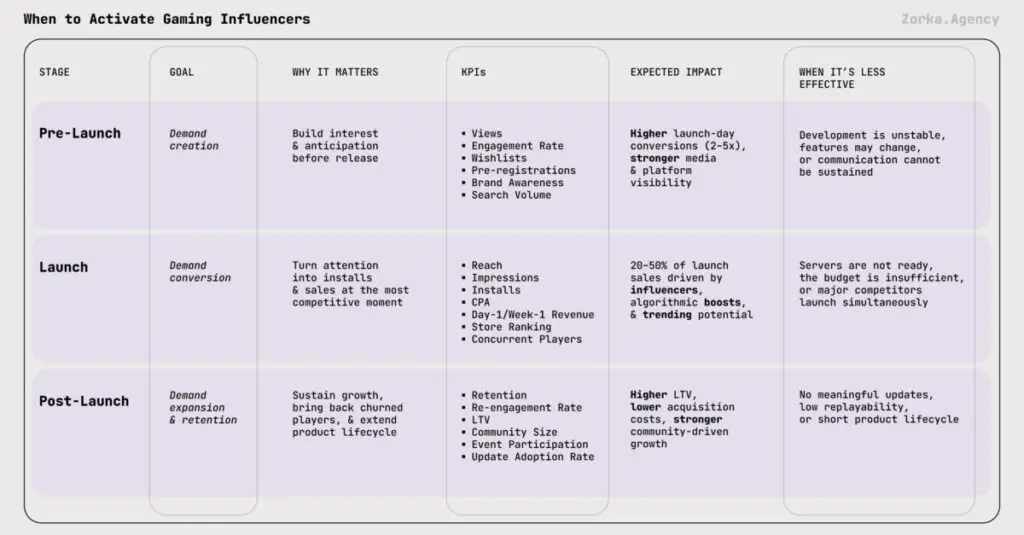
When used together, these phases form a continuous growth engine rather than isolated marketing activities. Pre-launch builds momentum, launch captures it, and post-launch sustains it.
Projects that rely on a single-stage influencer push typically face predictable problems: weak launch visibility, unstable sales curves, or rapid player churn. In contrast, games that integrate influencers throughout development and live operations create stronger market positioning, more predictable revenue, and longer product lifecycles.
From a business perspective, the strategic role of influencers evolves across stages:
- Before release → demand creation
- At release → demand conversion
- After release → demand expansion and retention
The most successful studios no longer treat influencers as a short-term promotional channel, but as long-term partners in shaping perception, community, and player experience. In a market where attention is scarce and competition is constant, sustainable success belongs to games that manage influence continuously – not just at launch.
Ultimately, the real question is not when to work with influencers, but what business outcome you want to drive at each stage of the game’s lifecycle.


