

Kuli is an AI influencer marketing agentic platform founded in 2024, with headquarters in San Francisco and operations in Paris. The company focuses on a specific gap in the influencer marketing workflow: the time-intensive process of manually reviewing creator content to determine brand fit.
Its core premise centers on replacing surface-level filtering with content-level analysis powered by multimodal AI.
Rather than relying on traditional discovery filters such as follower count, engagement rate, or audience demographics alone, Kuli analyzes actual video content across TikTok, Instagram, and YouTube. The agent evaluates visual style, messaging, tone, and brand mentions, enabling brands to search for creators based on what they genuinely communicate through their content.
The result is a system designed to compress campaign timelines and improve creator alignment. Kuli positions itself as an AI agent embedded within influencer workflows, supporting discovery, vetting, campaign execution, and performance analysis from a single interface.
Pricing
Kuli operates on a custom pricing model, with plans tailored to mid-market and enterprise brands.
Pricing structure: Upon request, with customizable monthly plans
Free trial: Available
The agent offers two entry points.
- The first allows teams to test discovery using natural language prompts, returning creator matches based on content analysis with immediate previews.
- The second unlocks full platform access, including campaign tracking, competitor analysis, multi-creator comparison, trend insights, and data exports.
Kuli acts as an execution and intelligence platform rather than a standalone discovery tool. Teams running ongoing influencer programs will extract more value than those running isolated campaigns.
The Details
Kuli Features Rating
- Brief-Based Creator Discovery
- Multimodal Video Vetting
- Brand Context and Fit Scoring
- Contextual Brand Safety Monitoring
- Lookalike Creator Recommendations
- Post-Level Creative Diagnostics
- Competitor Creator Intelligence
- Trend and Comment Radar
- Scheduled Research and Outreach Drafts
- Shopify-Connected Campaign Measurement
Kuli replaces the standard influencer discovery workflow with a system that starts from intent rather than filters. Instead of building queries through dropdowns or keyword tags, users describe the type of creator they need.
For this review, we asked Kuli's AI agent to find beauty creators with fewer than 100K followers.
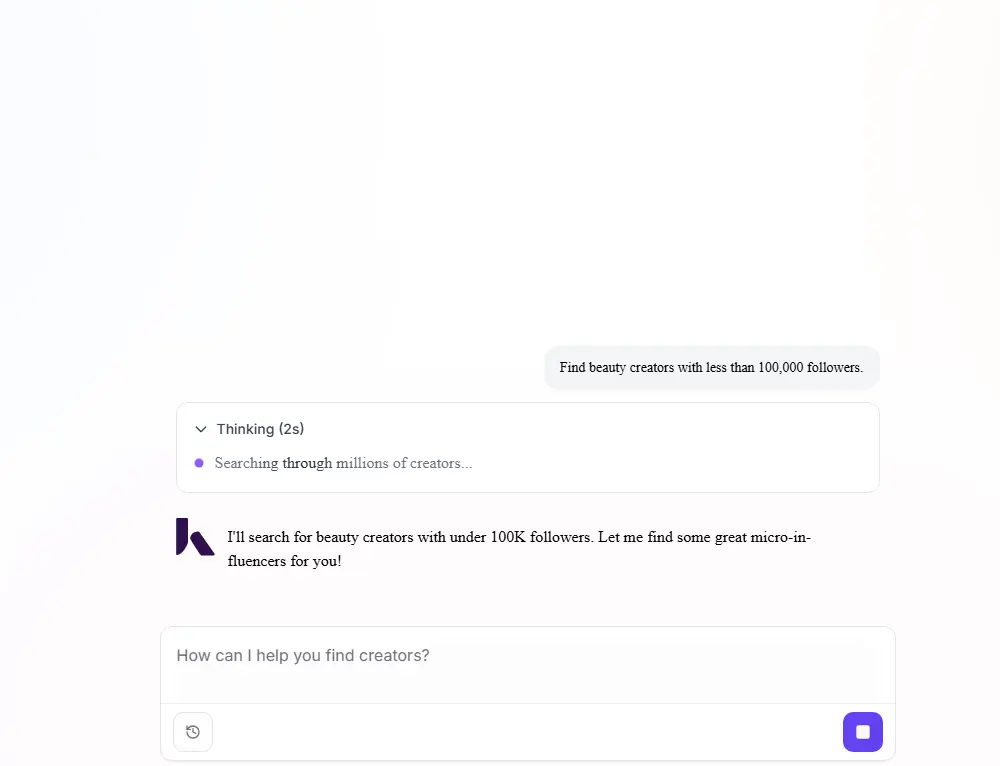
The AI agent processes that input against analyzed video content, returning creators whose output matches the requested style, tone, and messaging. This removes the need to manually validate whether a creator actually produces the type of content a campaign requires.
Here's the final output from our request:
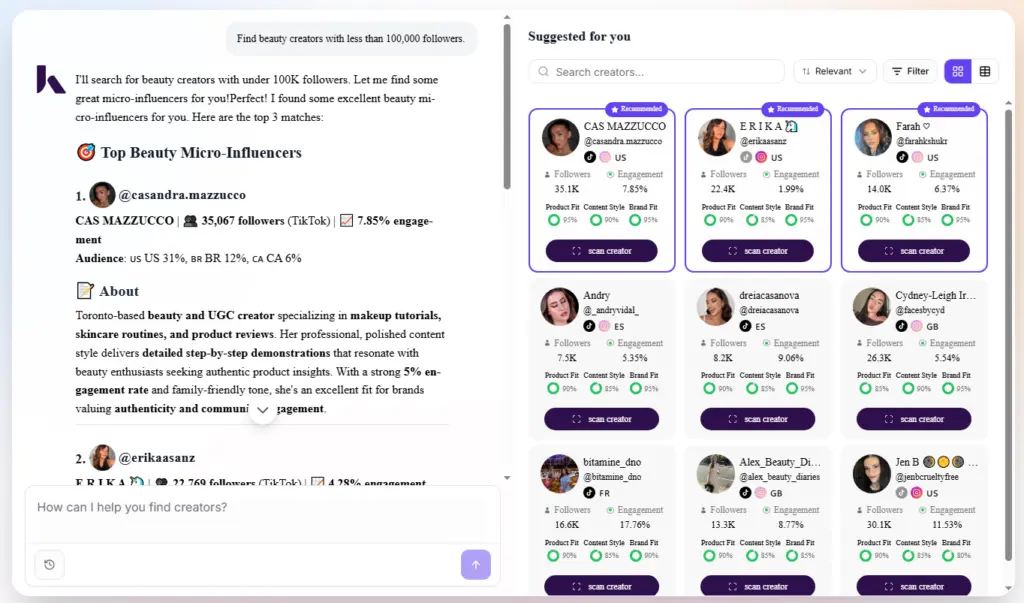
So how does this process actually work? Well, the underlying mechanism is continuous video analysis. Kuli's AI agent scans creator content frame by frame and converts it into structured signals. Visual elements, spoken language, brand mentions, and narrative patterns are indexed so they can be queried later.
That dataset becomes the foundation for discovery, but it also extends into evaluation. When a creator is surfaced, the AI agent already understands how that creator communicates, what formats they use, and how consistent their content is over time.
That same dataset is used to validate audience and performance assumptions. Instead of separating discovery from analytics, Kuli connects them. Audience quality, engagement patterns, and authenticity checks are evaluated alongside content.
The agentic platform does not treat these as isolated metrics. It aligns them with content output, which reduces the risk of selecting creators who perform well numerically but do not fit the campaign context.
The vetting process is automated and ongoing. Creator content is continuously monitored, allowing the agent to flag changes in tone, messaging, or brand alignment. This is particularly relevant for campaigns that run over longer periods, where a creator’s output may shift after onboarding.
Risk detection is tied directly to content rather than keywords, which makes it more precise in identifying potential issues.
Campaign execution builds directly on top of discovery. Once creators are selected, the agent supports outreach, brief preparation, and performance tracking without requiring separate tools. Campaign data is structured around the same content signals used in discovery.
Each post is analyzed in context, then benchmarked against similar content and competitor campaigns. Performance is not treated as an isolated metric but as part of a broader content landscape.
Kuli also introduces predictive modeling into the workflow. Based on historical data and comparable campaigns, the agent estimates expected performance before activation. This allows teams to assess potential outcomes during the planning phase rather than relying solely on post-campaign reporting.
The objective is to reduce trial-and-error cycles and improve decision-making before budget is allocated.
Competitor analysis is integrated into the same system. The platform tracks which creators competitors are working with, what formats they are using, and how those campaigns perform. Because this is based on content analysis rather than declared partnerships, it provides a clearer view of what is actually being published. Trend identification works in the same way, with the agent surfacing formats and topics that are gaining traction within a niche based on observed content patterns.
The operational impact comes from consolidation. Tasks that are typically spread across discovery tools, spreadsheets, analytics dashboards, and manual review processes are handled within one system.
The time savings reported by the company are tied to removing repetitive work such as scrolling through profiles, reviewing posts individually, and compiling creator lists manually. Campaign timelines are reduced because validation happens during discovery rather than after.
The platform’s structure is built for teams running multiple campaigns or managing large creator pools. Parallel analysis allows multiple creators to be evaluated against the same criteria at once, which speeds up shortlisting. Brand context can be applied to refine recommendations, ensuring that results are aligned with specific campaign requirements rather than generic matches.
Conclusion
Kuli is a content analysis platform applied to influencer marketing. Its core function is to replace manual creator evaluation with AI-driven video analysis, allowing brands to select creators based on actual content rather than surface metrics.
The agentic platform is best suited for mid-market and enterprise brands running continuous influencer programs where speed and accuracy directly impact performance. It reduces the time required to launch campaigns and improves alignment between brand requirements and creator output.
Teams looking to optimize creator selection, reduce manual workload, and integrate discovery with performance analysis will find the platform aligned with those goals.