
- Google has overhauled its Search results page to make sponsored ads more clearly labeled and easier to manage.
- A new “Hide sponsored results” button allows users to temporarily collapse paid listings and view only organic results.
- Ads are now grouped under a persistent “Sponsored results” label that remains visible as users scroll.
- The redesign reflects mounting regulatory and user pressure for ad transparency in digital search environments.
- While aimed at improving user experience, the update could influence advertiser strategies and click-through performance.
The update groups all paid results under a single visible “Sponsored” tag and allows users to hide them entirely.
Google has rolled out one of its most notable Search interface updates in years, introducing a redesigned ad labeling system and a new level of user control over sponsored results. The change consolidates all paid text ads under a single “Sponsored results” tag—one that stays fixed as users scroll—and adds a “Hide sponsored results” feature for those who prefer to focus solely on organic listings.
Announced by Omkar Muralidharan, Google’s Vice President of Product Management and Data Science, the redesign aims to make Search more intuitive while upholding Google’s “industry-leading standards for ad label prominence.” It represents a visible shift in how Google balances its commercial model with growing expectations for transparency and control.
“Every day, billions of people turn to Google Search for information, and our goal is to help them find it seamlessly,” Muralidharan said. “We’re updating how we show ads on Search to make navigation easier while maintaining clear labeling for sponsored content.”
The update is rolling out globally across desktop and mobile, encompassing all text ads and Shopping ads.
What’s Changing in Google Search
Under the new format, text ads are no longer scattered among organic listings or marked individually with small “Ad” tags. Instead, Google now groups them in one clearly defined section, introduced by a prominent “Sponsored results” header. This label remains visible as users scroll, reinforcing clarity around which listings are paid.
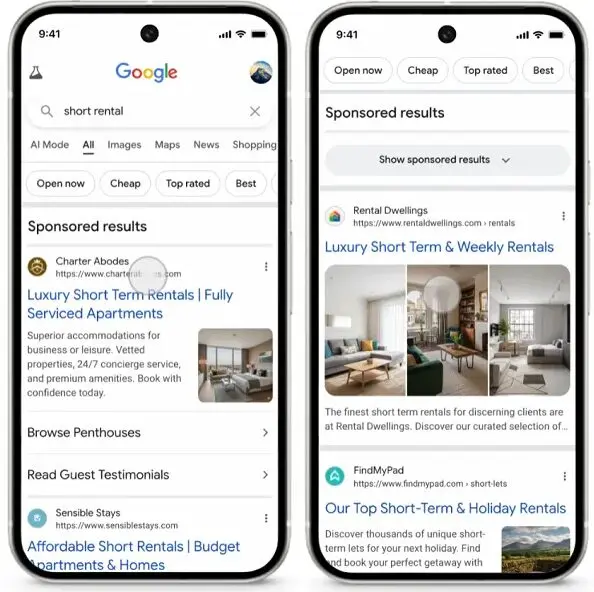
Crucially, users can now collapse this section entirely with a single click on the “Hide sponsored results” control. This feature temporarily removes paid listings from view, leaving only organic search results visible on the page. While the number and size of ads remain the same—Google continues to cap groupings at four per section—the new layout creates a more structured experience and a clear visual distinction between commercial and organic content.
The change also applies to other ad formats, including Shopping ads, which now appear under unified “Sponsored products” labeling.
However, Google confirmed that this visibility toggle is not a permanent preference setting. Users will need to re-hide sponsored results each time they conduct a new search.
Why Google Is Making This Change
The update comes at a time when public and regulatory scrutiny around digital advertising has intensified. Google’s advertising business—which accounts for the majority of its revenue—has faced persistent criticism for blending sponsored and organic listings too closely, creating confusion among users.
By offering a transparent, user-driven control, Google appears to be proactively addressing calls for clarity from both regulators and consumer advocacy groups. It also aligns with the company’s broader UX direction, prioritizing ease of navigation and ethical design principles within its interfaces.
Muralidharan emphasized that the change is not intended to reduce ad exposure but to improve the user journey:
“We’re upholding our standards for ad label prominence and making it easier for users to understand what they’re seeing at a glance.”
Internally, Google found through testing that users navigated the top of the results page more efficiently when sponsored content was clearly grouped and labeled.
A Step Toward Ethical Ad Presentation
The redesign reflects a broader shift in how major digital platforms present paid content. As AI systems and personalized feeds dominate discovery, clarity and consent have become core components of responsible product design.
Google’s move echoes an industry-wide recognition that the future of advertising depends on trust, not just targeting. By giving users a tangible sense of control—without dismantling its ad ecosystem—Google aims to balance commercial performance with accountability.
The new “Sponsored” label also unifies the visual hierarchy of Search, helping users quickly distinguish between commercial, algorithmic, and organic information sources. This coherence is increasingly essential as Search continues to evolve beyond text-based queries into multimodal, AI-enhanced experiences.


