
Mega influencer pricing has become one of the biggest budgeting challenges in modern influencer marketing. A single sponsored post from a creator with 1M+ followers can cost anywhere from $10,000 to well over $100,000, depending on the platform, campaign scope, licensing rights, and creator demand.
Top YouTube creators frequently charge $20,000 to $50,000+ per sponsored integration, while large TikTok campaigns can climb even higher once brands add usage rights and cross-platform distribution.
Brands continue paying those premiums because mega creators deliver something smaller influencers often cannot: massive reach at internet scale.
Our research shows that follower size remains the single biggest factor brands use when selecting influencers, with roughly 67.3% of marketers prioritizing audience scale during creator selection.
Campaigns featuring creators like MrBeast, Charli D'Amelio, and Khaby Lame can generate millions of impressions within hours, turning influencer campaigns into large-scale media buys rather than simple social collaborations.
Reach alone, however, no longer explains pricing. Audience quality, engagement decline at scale, production complexity, paid usage rights, and exclusivity agreements all influence what brands actually pay.
In this guide, we’ll break down how mega influencer pricing works across Instagram, TikTok, and YouTube, what drives six-figure creator deals, and when these partnerships genuinely make sense for brands.
- What Is a Mega Influencer?
- How Much Do Mega Influencers Charge?
- Mega Influencer Rates by Platform
- The Biggest Factors Driving Mega Influencer Pricing
- Are Mega Influencers Worth the Cost?
- Mega Influencers Dominate Reach
- How Brands Should Evaluate Mega Influencers Before Paying
- Mega Influencer Pricing Is About More Than Follower Count
- Frequently Asked Questions
What Is a Mega Influencer?
Mega influencers are creators and social media personalities with audiences exceeding 1 million followers or subscribers on platforms like Instagram, TikTok, and YouTube.
Unlike traditional celebrities who later build social audiences, mega influencers typically grow their audiences directly through platform-native content creation, audience engagement, and algorithmic reach.
Mega creators operate at a scale that resembles modern media companies more than individual content creators. Many work with editors, producers, talent managers, brand partnership teams, photographers, and strategists to aid the content production workflow.
These workflows allow mega influencers to publish content across multiple platforms while managing large sponsorship campaigns, licensing agreements, and long-term brand partnerships simultaneously.
|
Mega Influencer Segment |
Typical Follower Range |
Common Characteristics |
| Lower Mega | 1M–5M | Large platform reach, recurring brand deals, professional content production |
| Mid Mega | 5M–20M | Cross-platform visibility, global audiences, premium sponsorship pricing |
| Upper Mega | 20M+ | Celebrity-level influence, massive reach, enterprise-scale partnerships |
Platform dynamics also shape how mega influencers monetize their audiences.
A mega YouTube creator may focus heavily on long-form sponsorship integrations and merchandise ecosystems, while TikTok mega creators frequently monetize through sponsored campaigns, affiliate commerce, Spark Ads licensing, and trend-driven activations.
Instagram mega creators often combine premium lifestyle branding with cross-platform campaign distribution and ambassador partnerships.
What Is the Biggest Advantage When Working With Mega Influencers?
Reach remains the primary advantage mega influencers offer brands. A single creator can generate millions of impressions across multiple platforms within days, making mega influencers especially valuable for:
- major product launches
- mass awareness campaigns
- global brand visibility
- retail expansion campaigns
- cultural marketing moments
- prestige positioning
With an average engagement rate of around 1.97%, mega influencers can produce dramatically more total interactions than most smaller creators combined.
Mega creators, therefore, function more as large-scale media distribution channels, and their primary value comes from speed of reach, cultural visibility, and mass exposure.
How Much Do Mega Influencers Charge?
Mega influencer pricing varies dramatically depending on the platform, campaign scope, content format, usage rights, exclusivity terms, and creator demand.
Here’s what brands typically pay mega influencers in 2026.
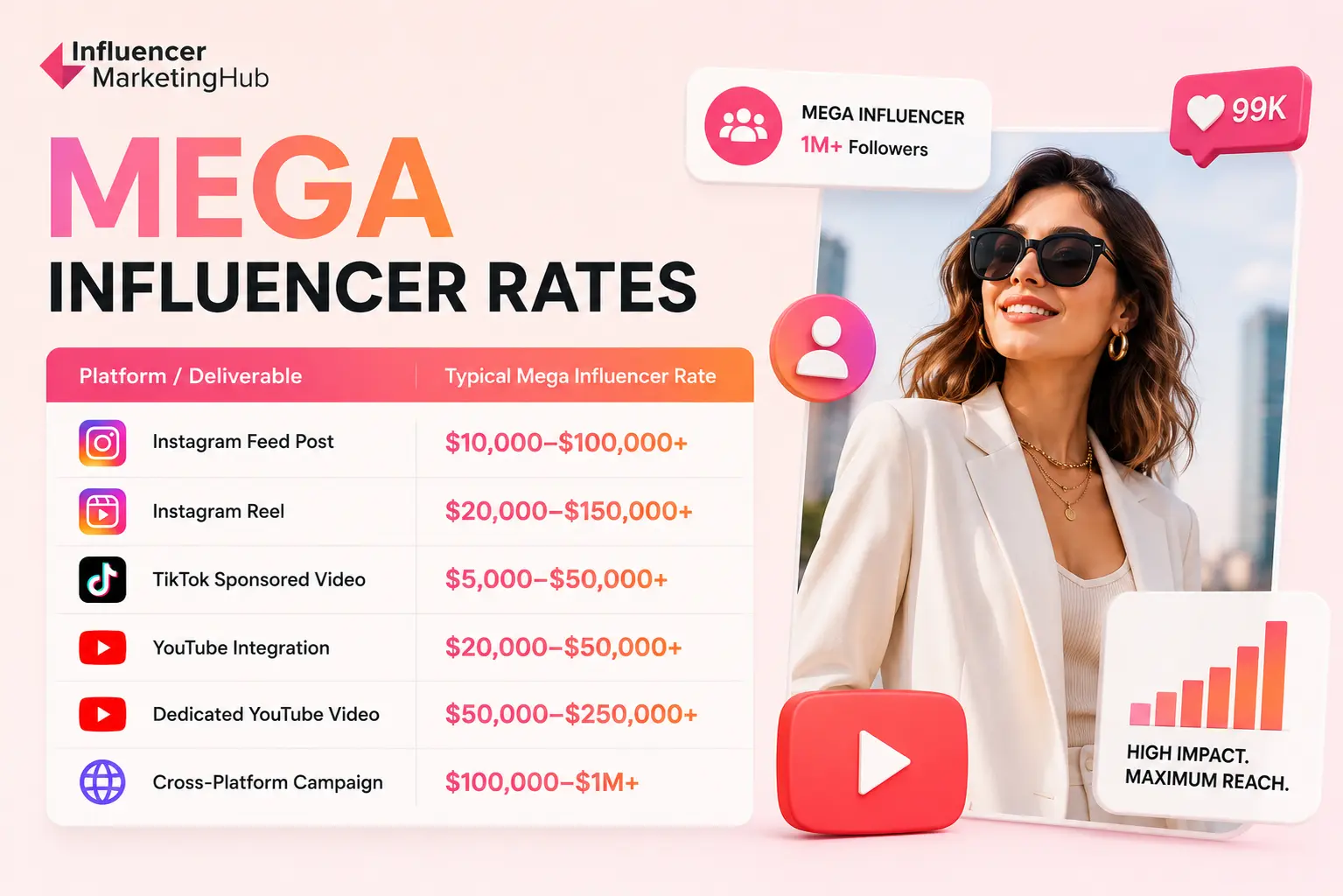
However, large creator campaigns rarely follow standardized pricing formulas.
A gaming creator with 3 million YouTube subscribers may charge substantially more than a lifestyle creator with 10 million Instagram followers because audience intent, average views, conversion history, and sponsorship demand all affect pricing differently.
Content format also matters heavily. Dedicated YouTube sponsorships typically cost far more than short-form TikTok integrations because long-form videos require significantly more scripting, filming, editing, and audience retention planning.
Instagram Reels frequently command premium pricing over static posts due to stronger discoverability and higher video engagement.
Campaign structure creates another major pricing difference. A one-off sponsored TikTok video may cost $15,000, while a broader campaign involving:
- Instagram distribution
- Paid usage rights
- Spark Ads licensing
- Exclusivity clauses
- Event appearances
- Long-term ambassador agreements
can increase the total deal value into six or seven figures very quickly.
Mega Influencer Rates by Platform
Mega influencer pricing changes significantly depending on the platform, content format, audience behavior, and campaign expectations involved. Let's go over the platform-specific rates these influencers typically charge.
Instagram Mega Influencer Rates
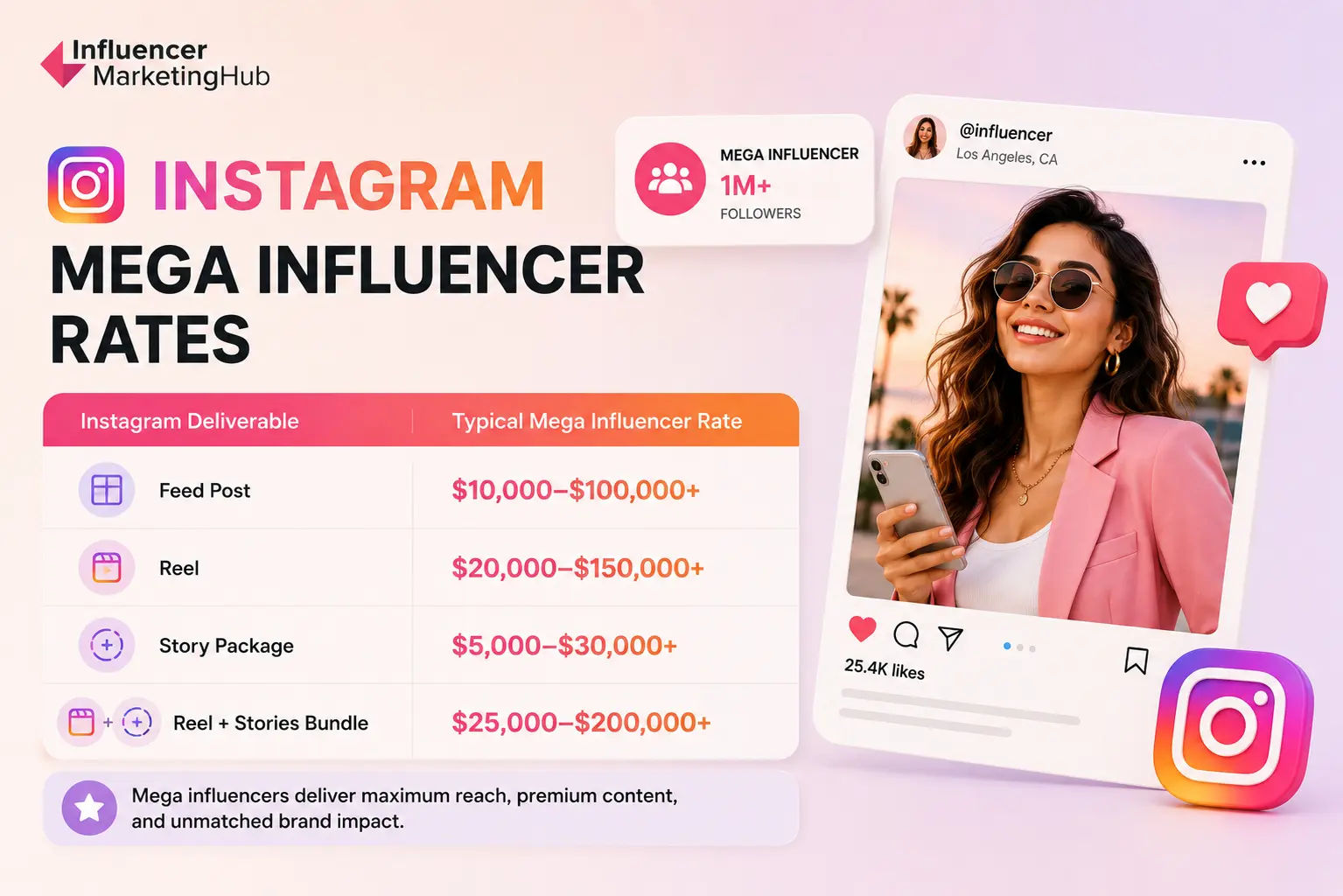
Instagram remains one of the most expensive platforms for mega influencer partnerships, particularly in beauty, fashion, luxury, fitness, and lifestyle categories. Mega creators with highly curated personal brands often command premium pricing because brands are not only buying reach, but also aspirational positioning and visual association.
Mega Instagram creators typically charge between $10,000 and $100,000+ for a sponsored feed post. Reels often cost even more, with many campaigns falling between $20,000 and $150,000+ because short-form video requires significantly more production work and tends to generate stronger discoverability through Instagram’s recommendation system.
Story campaigns generally start around $5,000 and can exceed $30,000+ once brands request multiple frames, swipe-up links, launch coordination, or affiliate integrations.
Bundled campaigns combining Reels and Stories frequently reach $25,000 to more than $200,000, depending on the creator’s audience size, engagement quality, exclusivity requirements, and paid media rights.
Our benchmarks also show that Instagram Reels frequently command 1.2x to 1.5x the price of standard image posts due to higher engagement and stronger platform distribution.
Campaign pricing rises substantially once brands add:
- Paid usage rights
- Whitelisting permissions
- Exclusivity clauses
- Multi-post deliverables
- Launch-day scheduling
- Cross-platform reposting
Luxury beauty and fashion creators frequently sit at the highest end of Instagram pricing because audience purchasing power and prestige positioning heavily influence campaign value.
Want More Detailed Instagram Pricing Benchmarks?
Our full Instagram Influencer Rates guide breaks down creator pricing by follower tier, content format, engagement level, and campaign structure so brands can benchmark Instagram budgets more accurately.
TikTok Mega Influencer Rates
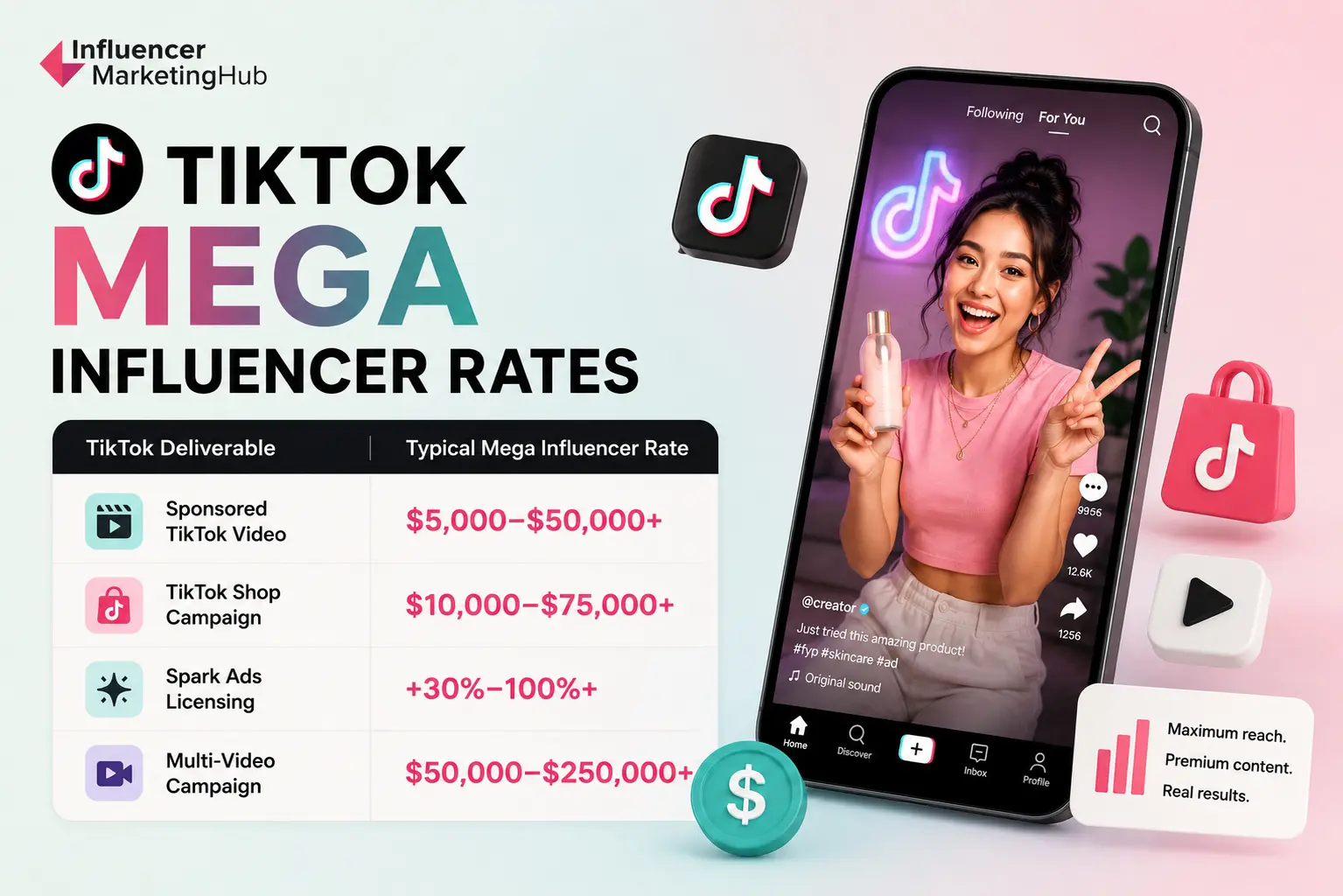
TikTok mega influencer pricing tends to fluctuate more heavily because campaign performance depends strongly on algorithmic reach, watch behavior, and trend momentum.
Viral content distribution allows creators to generate massive exposure quickly, making top-performing TikTok creators especially valuable during product launches, trend activations, and TikTok Shop campaigns.
Sponsored TikTok videos from mega creators generally range from $5,000 to more than $50,000 per post, depending on average views, engagement consistency, and conversion history.
TikTok Shop campaigns often cost even more, with many brands spending between $10,000 and $75,000+ for creators capable of driving measurable sales through affiliate commerce and live shopping integrations.
Pricing increases substantially once creators license content for Spark Ads campaigns. Many mega creators charge an additional 30% to more than 100% for paid amplification rights because brands frequently reuse creator content in performance advertising campaigns.
Larger multi-video TikTok campaigns regularly exceed $50,000 to $250,000+, especially when brands combine:
- Multiple videos
- Affiliate integrations
- Paid media licensing
- Exclusivity terms
- Launch coordination
- Cross-platform reposting
Our research also notes that roughly 67.3% of brands still prioritize follower count during influencer selection despite TikTok’s algorithm heavily rewarding engagement and watch behavior.
Want Better TikTok Campaign Budget Benchmarks?
Our TikTok Influencer Rates guide explains how pricing changes across creator tiers, TikTok Shop campaigns, Spark Ads agreements, and long-term partnerships.
YouTube Mega Influencer Rates
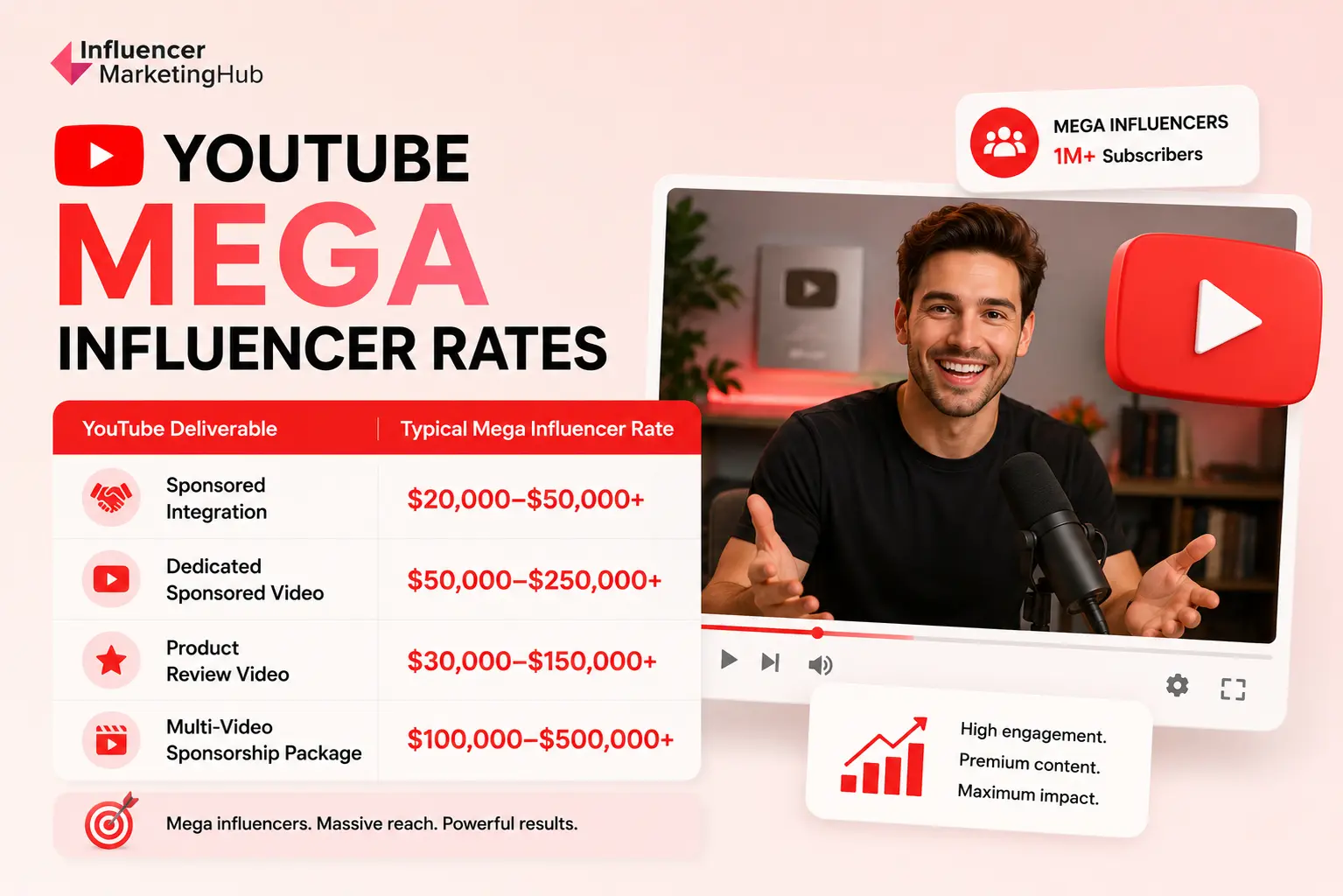
YouTube sponsorships frequently command the highest baseline creator rates because long-form video requires significantly more production effort and delivers longer audience attention spans than most short-form social content.
Mega YouTube creators generally charge between $20,000 and $50,000+ for sponsored integrations inserted into existing videos. Dedicated sponsored videos cost substantially more because the creator builds the full video concept around the sponsoring brand.
Those campaigns regularly range between $50,000 and $250,000+, depending on audience size, average views, production quality, and niche.
Product review videos also command premium pricing, particularly in technology, gaming, software, finance, and consumer electronics categories, where audiences actively seek purchasing recommendations. Many of these campaigns fall between $30,000 and $150,000+, depending on production complexity and expected viewership.
Long-term sponsorship packages combining multiple YouTube videos can quickly exceed $100,000 to $500,000+, especially when campaigns include:
- Integrated sponsorships
- Dedicated uploads
- Shorts distribution
- Affiliate agreements
- Usage rights
- Paid media licensing
Long-form YouTube sponsorships continue generating views, clicks, and conversions months after publication, which gives the platform a stronger evergreen value than most short-form creator campaigns.
Need More YouTube Sponsorship Pricing Data?
Our YouTube Influencer Rates guide covers dedicated sponsorships, integrations, CPM pricing logic, usage rights, and production-based pricing factors in greater detail.
Cross-Platform Mega Influencer Campaign Rates
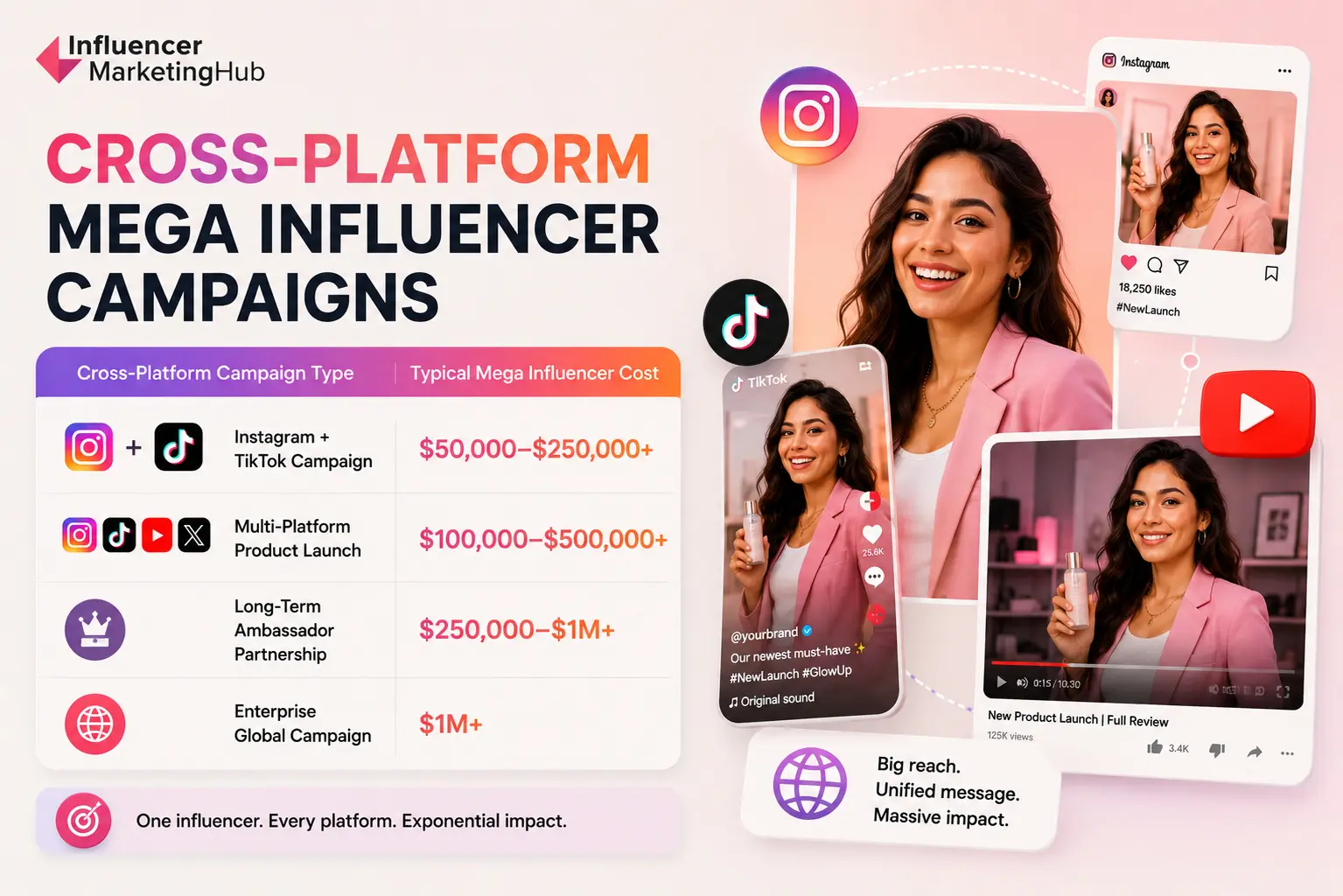
Many mega creators now operate as full-scale multi-platform media brands rather than platform-specific influencers. Brands increasingly structure campaigns across Instagram, TikTok, YouTube, Shorts, livestreams, and podcasts simultaneously to maximize audience reach and reinforce messaging across multiple channels.
Cross-platform Instagram and TikTok campaigns regularly cost between $50,000 and $250,000+, while broader multi-platform product launches frequently exceed $100,000 to $500,000, depending on campaign duration and deliverable volume.
Long-term ambassador partnerships often range from $250,000 to more than $1 million, once campaigns include:
- Recurring deliverables
- Paid usage rights
- Exclusivity agreements
- Event appearances
- Affiliate integrations
- Retail launch support
- Paid media licensing
Enterprise global campaigns featuring top-tier mega creators can easily exceed seven figures once brands combine large-scale distribution rights, production requirements, and long-term commercial agreements.
At this level, influencer partnerships function more like media buys than traditional creator collaborations. Brands are often paying for large-scale visibility, cultural relevance, retail momentum, and long-term brand association rather than engagement metrics alone.
The Biggest Factors Driving Mega Influencer Pricing
Mega influencer pricing becomes far less predictable once creators cross the 1 million follower threshold. At this level, brands are often negotiating large-scale media partnerships rather than simple sponsored posts.
|
Pricing Factor |
Typical Cost Impact |
Why It Matters |
| Paid Usage Rights | +30%–200%+ | Brands reuse creator content across paid media and owned channels |
| Exclusivity Clauses | +25%–150%+ | Creators lose competing sponsorship opportunities |
| Production Complexity | Higher base pricing | Large creators often use editors, producers, and production teams |
| Cross-Platform Distribution | Significant price increase | More deliverables and broader audience reach |
| Audience Geography | Higher CPM premiums | U.S. and Western European audiences carry higher advertising value |
| Creator Demand | Premium pricing leverage | Top creators have limited campaign availability |
| Brand Safety Requirements | Additional review costs | Enterprise campaigns require approvals and revision workflows |
| Live Appearances or Events | $25,000–$250,000+ add-ons | Physical attendance expands campaign scope significantly |
Paid Usage Rights and Licensing
Usage rights represent one of the largest hidden cost drivers in mega influencer campaigns. Standard sponsorship fees usually only cover posting content on the creator’s own channels. Brands often want much more than that.
Many enterprise campaigns require:
- Paid social usage rights
- TikTok Spark Ads licensing
- Meta whitelisting
- Ecommerce usage
- Retail media placement
- Email marketing rights
- Landing page usage
A mega creator charging $50,000 for an Instagram Reel may increase the total deal value substantially once the brand requests multi-channel licensing rights. Longer licensing windows generally increase costs even further because creators lose control over how long their image and content remain attached to the campaign.
Exclusivity Clauses Increase Costs Quickly
Exclusivity agreements become significantly more expensive at the mega influencer level because top creators regularly work with multiple major brands simultaneously. A creator agreeing not to work with competing brands for 3 to 6 months may be giving up several high-value sponsorship opportunities during that period.
Beauty, luxury fashion, gaming, fitness, fintech, and technology brands frequently negotiate strict exclusivity terms during launches and seasonal campaigns. Those restrictions commonly increase pricing by 25% to more than 150%, depending on campaign length and category competitiveness.
Production Complexity and Media-Scale Content
Mega influencers rarely operate as solo creators. From talent managers to production and editing teams, the infrastructure directly affects campaign pricing. A large YouTube creator producing cinematic long-form branded content may spend days scripting, filming, editing, revising, and coordinating sponsorship approvals before publication.
Production-heavy campaigns that involve filming on multiple locations, drone footage, and even coordinated launch schedules involving livestreams and event activations, command higher fees due to the operational complexity resembling commercial video production more than traditional influencer marketing.
Cross-Platform Distribution Expands Campaign Scope
Mega creators rarely operate on a single platform. Brands increasingly structure campaigns across Instagram, TikTok, YouTube, Shorts, podcasts, livestreams, and affiliate commerce channels simultaneously.
Each additional platform increases production requirements, review workflows, audience exposure, and overall campaign value.
Audience Geography and Purchasing Power
Audience location plays a major role in mega influencer pricing because advertising value differs significantly across regions. Creators with audiences concentrated in the United States, Canada, the United Kingdom, and Western Europe generally command much higher rates than creators with large but lower-value international audiences.
Brands frequently evaluate:
- Audience geography
- Age demographics
- Purchasing power
- Consumer intent
- Audience relevance
before approving large creator budgets. A finance creator with a heavily U.S.-based audience may therefore command significantly higher sponsorship pricing than a general entertainment creator with a broader international reach.
Creator Demand and Limited Availability
Top mega influencers have limited inventory. Large creators often receive far more sponsorship requests than they can realistically accept, which gives them substantial pricing leverage during negotiations.
Creators with strong conversion history, consistent viral reach, recognizable personal brands, and proven campaign performance frequently operate with waitlists, management teams, and structured partnership calendars.
Major seasonal periods such as Black Friday, holiday launches, and major product releases can push pricing even higher as brands compete aggressively for limited creator availability.
Brand Safety and Enterprise Campaign Requirements
Enterprise brands frequently impose extensive approval workflows and brand safety requirements before campaigns go live. Legal reviews, creative revisions, compliance checks, messaging restrictions, and internal approvals all increase operational complexity for creators and their teams.
Live Appearances and Event Activations
Physical appearances dramatically increase campaign scope and pricing. Mega influencers attending retail launches, conferences, livestream events, meet-and-greets, or branded experiences often charge an additional $25,000 to more than $250,000, depending on the creator and event scale.
At that level, creators function less like social media personalities and more like mainstream entertainment talent participating in large-scale brand activations.
Are Mega Influencers Worth the Cost?
Let's now answer the $50,000 question. Are mega influencers even worth it?
Mega influencer campaigns are rarely designed for efficiency alone. Brands investing six- or seven-figure creator budgets are usually prioritizing mass awareness, cultural visibility, large-scale reach, and market impact rather than maximizing engagement percentages or minimizing cost per acquisition.
That distinction matters because mega influencers solve very different business problems than smaller creators.
|
Campaign Goal |
Mega Influencers |
Smaller Influencers |
| Mass Awareness | Stronger | Weaker |
| Engagement Rate | Lower | Higher |
| Cultural Visibility | Stronger | Limited |
| Campaign Management | Easier | More Complex |
| Conversion Efficiency | Usually weaker | Usually stronger |
| Prestige Positioning | Stronger | Lower |
| Cost Efficiency | Lower | Higher |
Mega Influencers Dominate Reach
Mega influencers excel at generating visibility quickly. A single campaign from a top creator can produce millions of impressions across Instagram, TikTok, and YouTube within hours, making mega creators especially valuable for product launches, seasonal campaigns, retail rollouts, entertainment marketing, and global awareness pushes.
@madelineaford #UltaBeautyPartner my recommendations for @Ulta Beauty’s 21+ days of beauty event for 50% off your fave daily & weekly steals through Mar 26!! Check out the daily & weekly steals on Ulta.com! Thank me later 😘 #ultabeauty #UBCollective @medicube global @Charlotte Tilbury @amika @isima @Bumble and bumble. @SACHEU Beauty US
For example, Madeline Ford's TikTok sponsored video for Ulta reached 1.5 million viewers. She is a mega influencer with 2.1 million followers on TikTok, and her videos regularly reach high-six to seven-figure views.
With that said, it's important to note that mega influencers average roughly 1.97% engagement compared to approximately 2.15% for micro influencers and 5.6% for nano creators.
Smaller Influencers Usually Deliver Better Engagement Efficiency
Micro and macro influencers often outperform mega creators on:
- Engagement rates
- Community trust
- Cost per engagement
- Conversion efficiency
A smaller creator with a highly engaged audience may generate stronger affiliate sales and lower acquisition costs than a mega creator with millions of passive followers. That difference explains why many performance-focused campaigns still rely heavily on smaller influencer tiers.
If we take Madeline's Ulta promo video as an example, we can calculate the average engagement rate for the post at 3.9%. We do this by adding the number of likes, comments, shares, and saves, divided by the number of followers the influencer has.
So let's compare the engagement rate to that of Hannah Campbell's Ulta promo video.
@theglownarrative #UltaBeautyPartner Whether you want to revamp your routine or restock on some favs, now is the PERFECT time to shop at @Ulta Beauty with 50% off daily and weekly beauty steals during Ulta's 21+ Days of Beauty Event happening March 6-26!! #UltaBeauty
The creator is a macro influencer with 511k followers on TikTok, nearly 1.5 million fewer followers than Madeline. Her engagement rate for the promo post drastically outperformed that of the mega influencer, at 13.6%.
While such high engagement differences aren't that common, it goes to show that the bigger the creator, the lower the engagement.
Mega Influencers Operate More Like Media Buys
Enterprise brands increasingly compare mega influencer campaigns against television advertising, paid social campaigns, celebrity endorsements, and streaming sponsorships.
At this level, creator partnerships function more like large-scale audience distribution deals than traditional influencer sponsorships. Brands are often paying for cultural relevance, social conversation, prestige positioning, and concentrated visibility rather than direct conversions alone.
When Mega Influencers Make the Most Sense
Mega influencers usually deliver the strongest value when brands prioritize:
- Large-scale awareness
- Launch momentum
- Prestige positioning
- Global reach
- Retail visibility
- Cultural relevance
Smaller creators often remain the stronger option for engagement-driven campaigns, but mega influencers continue commanding premium budgets because very few creators can replicate their scale of exposure and social visibility.
How Brands Should Evaluate Mega Influencers Before Paying
Not every mega influencer justifies premium pricing. Large follower counts can create impressive visibility on paper, but audience quality, average views, engagement consistency, and sponsored content performance matter far more when evaluating whether a creator partnership will actually deliver results.
|
Evaluation Area |
What Brands Should Look For |
Evaluation Area |
| Average Views | Consistent reach across recent content | Average Views |
| Engagement Quality | Saves, comments, watch time, shares | Engagement Quality |
| Audience Demographics | Geography, age, purchasing power | Audience Demographics |
| Audience Authenticity | Suspicious spikes, fake followers, bot activity | Audience Authenticity |
| Sponsored Content Performance | Whether ads perform naturally | Sponsored Content Performance |
| Brand Alignment | Audience fit and creator reputation | Brand Alignment |
| Production Quality | Editing, storytelling, creative consistency | Production Quality |
Audience Quality and Campaign Reliability Matter More Than Reach
Follower count alone tells very little about actual creator performance at a mega scale. Brands increasingly evaluate average views, watch time, engagement consistency, and sponsored content performance because creators with massive audiences often generate inconsistent reach across platforms.
A creator with 10 million followers but weak average viewership may deliver far less campaign value than a creator with a smaller but highly engaged audience.
Audience authenticity also remains a major concern. Brands frequently audit follower growth trends, suspicious engagement spikes, bot-like comments, and audience geography before approving large creator budgets.
Mega influencers with authentic audiences and strong sponsored content performance usually command higher pricing because they maintain audience trust during paid campaigns.
Production quality and operational reliability matter heavily at this level as well. Enterprise brands expect polished creative, strong storytelling, clear communication, and reliable campaign execution.
Mega creators with experienced management teams and structured workflows often justify premium pricing because they reduce operational risk during large-scale partnerships.
Mega Influencer Pricing Is About More Than Follower Count
Mega influencer pricing can range from tens of thousands of dollars to multi-million-dollar partnerships, depending on the platform, campaign scope, licensing terms, and creator demand involved. Audience size still matters, but follower count alone no longer determines campaign value.
Engagement quality, production standards, audience demographics, and paid usage rights now play a much bigger role in how mega influencer campaigns are priced. Brands investing in large creator partnerships, therefore, need to evaluate creators strategically rather than relying on reach metrics alone.
Mega influencers continue commanding premium budgets because they offer something very few creators can replicate: massive visibility, cultural relevance, and internet-scale audience reach concentrated around a single recognizable personality.
Frequently Asked Questions
How much do mega influencers charge?
Mega influencers typically charge between $10,000 and $100,000+ per sponsored post, depending on the platform, audience quality, deliverables, licensing rights, and campaign scope. Large cross-platform campaigns can exceed $1 million.
What qualifies as a mega influencer?
Mega influencers are creators with more than 1 million followers or subscribers on platforms like Instagram, TikTok, and YouTube.
How much do mega influencers charge on Instagram?
Mega Instagram influencers generally charge between $10,000 and $100,000+ for sponsored feed posts. Reels often cost between $20,000 and $150,000+ because video content requires more production work and typically generates stronger reach.
How much do mega TikTok influencers charge?
Mega TikTok influencers usually charge between $5,000 and $50,000+ per sponsored video. TikTok Shop campaigns and Spark Ads licensing agreements can increase pricing significantly.
How much do mega YouTubers charge?
Mega YouTube creators commonly charge between $20,000 and $50,000+ for sponsored integrations. Dedicated sponsored videos often range from $50,000 to more than $250,000, depending on the creator and production scope.
Why are mega influencer campaigns so expensive?
Mega influencer campaigns often include paid usage rights, exclusivity agreements, cross-platform distribution, production costs, and large-scale audience reach. Many campaigns operate more like media partnerships than traditional sponsored posts.
Are mega influencers worth the cost?
Mega influencers can deliver strong value for awareness-focused campaigns, product launches, prestige positioning, and large-scale visibility efforts. Smaller creators often perform better on engagement efficiency and conversion-focused campaigns.
What affects mega influencer pricing the most?
The biggest pricing factors include audience demographics, average views, engagement quality, production complexity, paid media licensing, exclusivity clauses, and creator demand.
Do mega influencers have lower engagement rates?
Generally, yes. Influencer Marketing Hub benchmark data shows mega influencers averaging roughly 1.97% engagement compared to higher engagement rates among smaller creator tiers.
How can brands verify whether a mega influencer has fake followers?
Brands usually review follower growth trends, engagement consistency, audience geography, authenticity scores, and suspicious activity patterns using influencer audit and analytics tools before approving campaigns.


