
As the search landscape continues to evolve at breakneck speed, being visible to your audience is less about chasing blue links and more about showing up in Google AI Overviews and popular AI search tools like ChatGPT, Perplexity, and Claude.
To get mentioned and cited where it matters, strategic marketers need to evolve with how AI systems find, vet, and surface brands. Understanding what it means to be cited, mentioned, or both can mean the difference between getting discovered and staying invisible.
AI Citations and AI Mentions: What’s the Difference?
When an LLM links directly to your blog post, study, or other URL as one of the primary sources behind its answer, you’ve earned a citation. When your name or brand appears in the result of a query, you’ve earned a mention.
Put another way, a mention is the chatbot saying your brand’s name out loud, and a citation is the chatbot pointing people directly to it.
Citations and mentions are both net positives for your brand, of course. The more eyes you earn, the more chances you get to convert a prospect into a customer, subscriber, or advocate. But there’s also an upside baked into AI search itself.
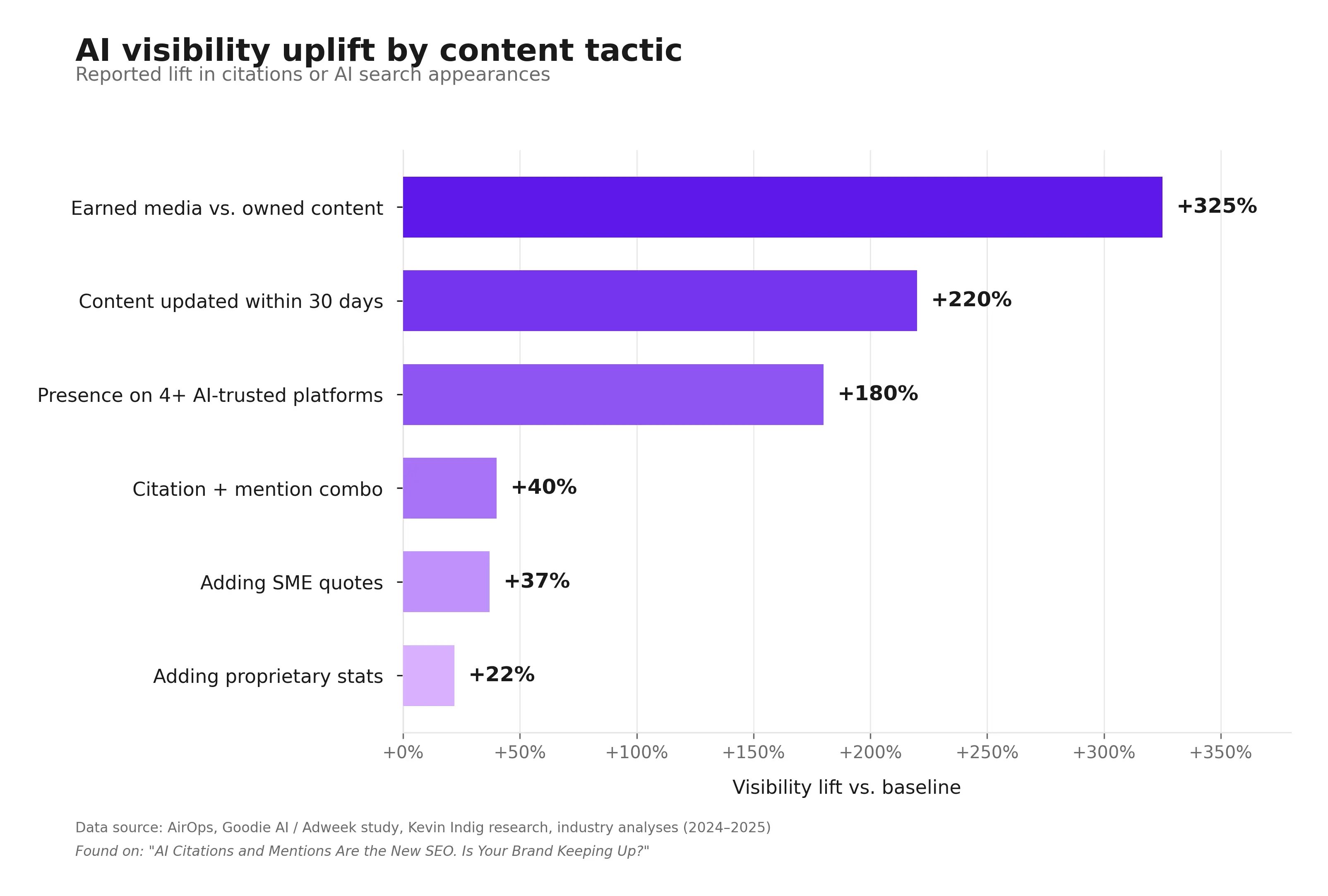
Recent data from AirOps found that brands earning both a citation and a mention are 40% more likely to show up the next time someone asks a similar question. In the same way money in a high-yield savings account earns compounding interest over time, your content earns compounding trust when you consistently show up in AI search results.
What’s the Difference Between Traditional SEO and AI Search?
Traditional SEO relies on algorithms to rank pages based on trust signals like backlinks and domain authority, and strategic content choices like keyword diversity and structured metadata.
AI search prioritizes content that LLMs deem trustworthy, often through third-party reviews, Reddit threads, and sites it already knows.
Many people and agencies view these two types of optimizations for search as mutually exclusive - meaning they have two separate strategies and thus separate service offerings. From our research and testing, we align more with Google’s view - that it’s all still SEO, just a more modern version with a couple additional data points to factor in. In short, it’s a new data layer on top of what I have been doing for close to 20 years, not a new service offering. Bill Ross, Founder, Emulent Digital Marketing
The Reason Your Brand Keeps Getting Skipped By AI Search
When AI models are trained, they ingest enormous amounts of information from across the internet. Along the way, they bump into several familiar faces. Brands that repeatedly get cited by Wikipedia, for example. Recurring Reddit mentions. Positive feedback on third-party review sites like Tripadvisor.
These familiar faces eventually become core memories to LLMs—a mechanism that AI researchers refer to as parametric knowledge. But here’s the rub: Not every memory carries the same weight, and not every AI platform gives the same credence to the same sources.
To illustrate, research from AI visibility and Generative Engine Optimization (GEO) platform Profound shows that:
- Wikipedia accounts for 47.9% of top citations on ChatGPT
- Reddit accounts for 46.7% of top citations on Perplexity
- YouTube accounts for 23.3% of top citations on Google AI Overviews
- Claude draws from user-generated content like blogs, reviews, and social posts at rates 2x to 4x higher than other popular LLMs
- Only 11% of domains get cited by both ChatGPT and Perplexity
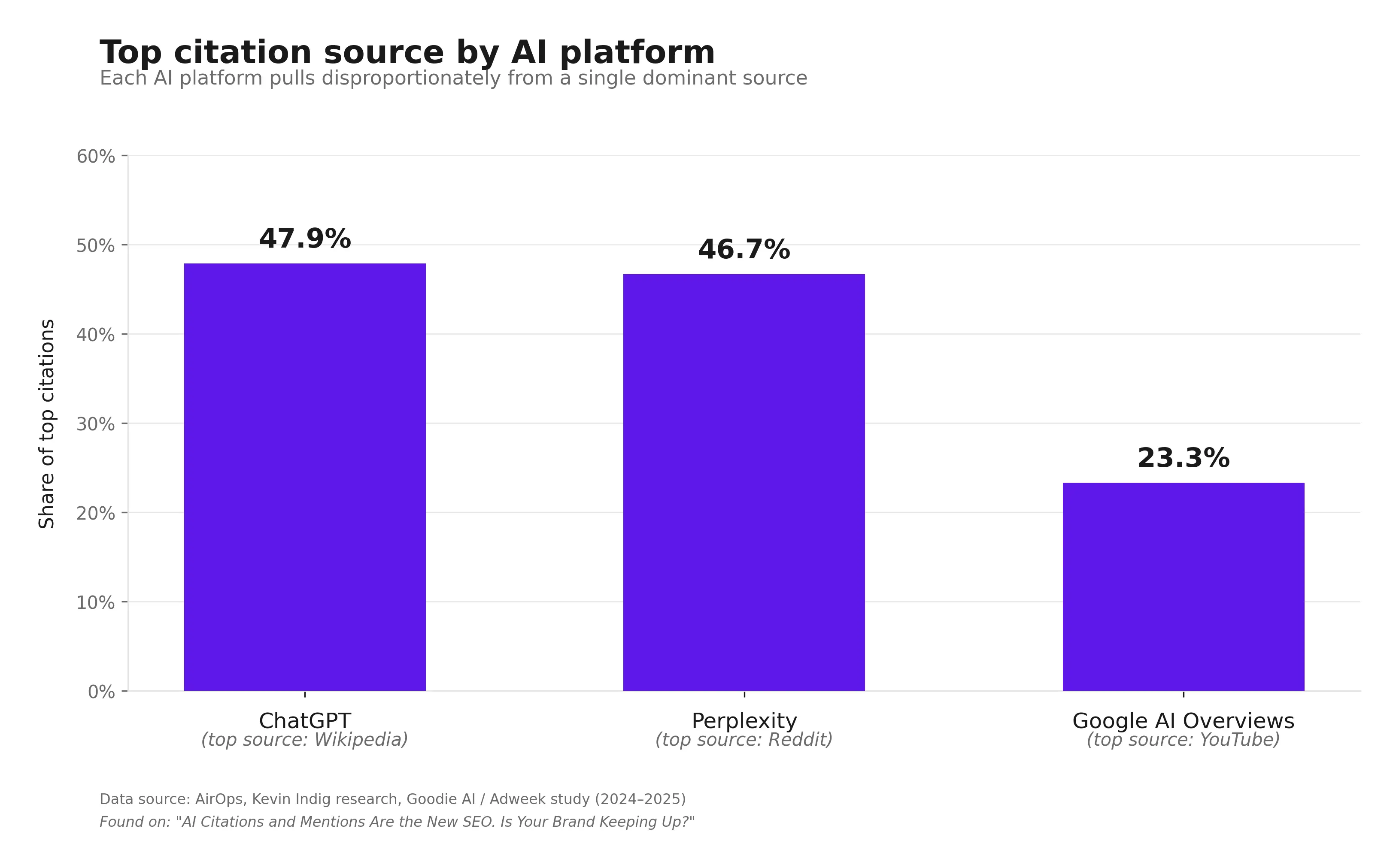
A lot can be gleaned from the data that’s already out there. But one of the most important takeaways is that the sources driving visibility on one platform are often doing nothing for another.
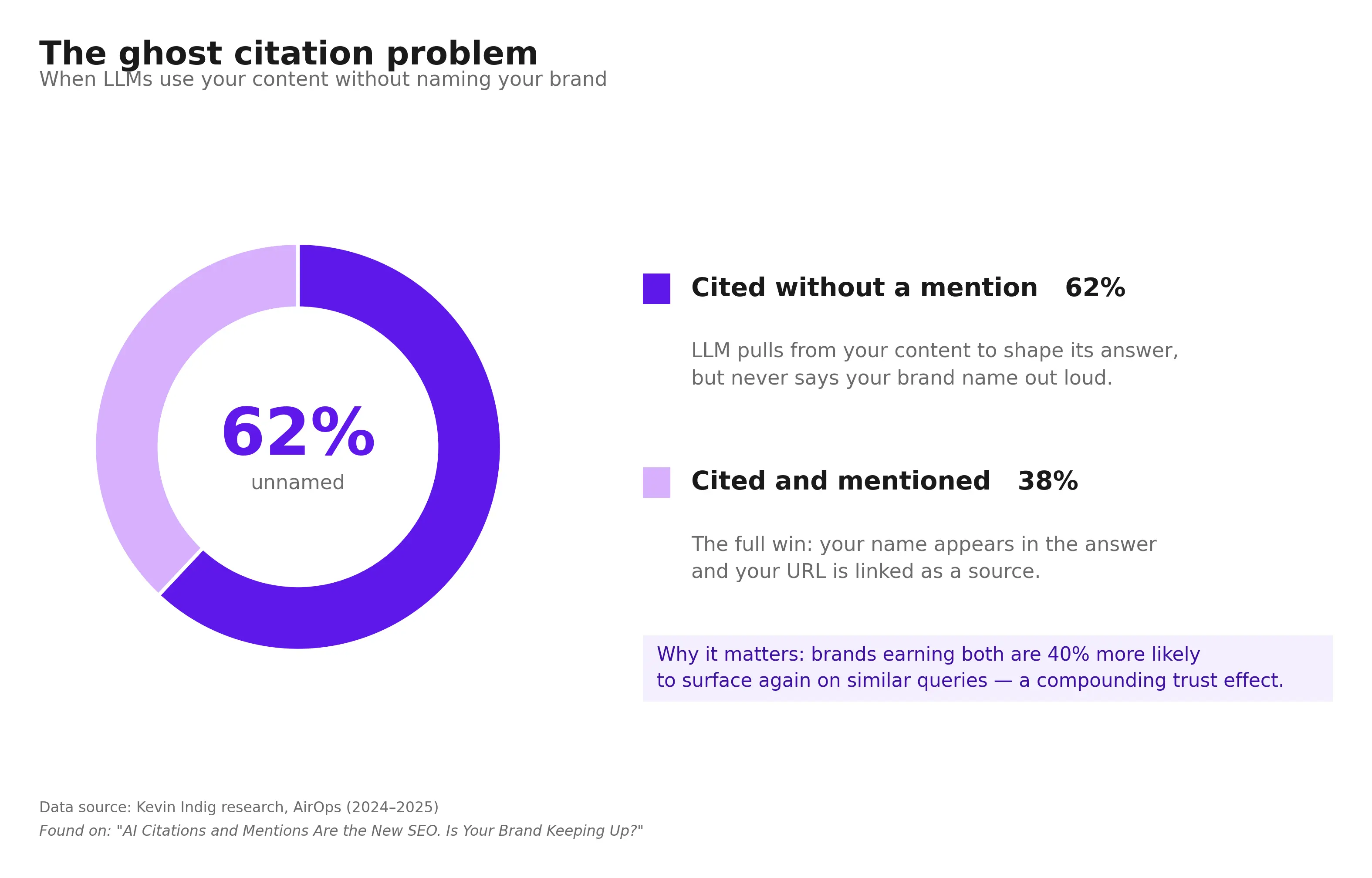
Another important nuance to factor in is the “ghost citation” problem. According to researcher Kevin Indig, 62% of LLM citations occur without the person or brand ever being mentioned in the answer. In other words, the AI is using your content, but not mentioning your name.
To show up where it matters, you need both working together.
What Conventional Analytics Miss About AI Visibility
Fewer than 20% of ChatGPT brand mentions contain a link that analytics platforms can track, Chatbeat’s AI-search research reports. If measurement depends on referral sessions, more than four-fifths of those brand exposures may leave no direct trail in GA4.
Chatbeat addresses this gap by repeatedly testing customer-style prompts across ChatGPT, Gemini, Perplexity, and other AI systems. It records whether the brand appears, where it ranks in the answer, how it is described, and which URLs support the response. This makes four distinct signals measurable:
- Mention rate: The percentage of monitored responses naming the brand.
- Owned citation rate: The percentage citing a page controlled by the brand.
- Citation-mention alignment: The percentage containing both the brand name and a supporting citation.
- Source concentration: The percentage of citations supplied by the three most-used domains.
Each signal exposes a different problem. A rising owned citation rate with weak alignment indicates that AI systems trust the content while stripping away its authorship. Strong mentions with few owned citations mean the brand is recognized, although publishers, communities, or competitors may be controlling the supporting narrative. Heavy dependence on three sources makes visibility vulnerable to an editorial update or a model changing its preferred domains.
The commercial case for measuring mentions separately is already visible. Michał Sadowski, the author of Chatbeat’s AI-search guide, analyzed 833 brands appearing prominently in AI answers and reported an 87% correlation between web mentions and AI ranking. His team also grew from zero to more than 10,000 new monthly visitors from ChatGPT within several months.
Create a Free Cheatbeat Account
Run the same prompt set every month and preserve results by model. When visibility changes, inspect which sources were added or removed and whether the brand remained in the answer. That evidence shows whether the next move should be refreshing owned content, earning placement on a frequently cited domain, or correcting inconsistent brand information.
What It Actually Takes To Get Cited and Mentioned in AI Search
How LLMs come across your content is a moving target, and that’s likely not going to change anytime soon. That said, there are a few steps you can take today to start building toward a scalable AI search strategy, including:
- Building a presence across four or more AI-trusted third-party platforms
Contribute meaningfully to Reddit discussions. Claim and complete your third-party profiles, such as Trustpilot. Publish regularly on LinkedIn, and claim your Wikidata record. Sites that successfully execute on this strategy are 8 times more likely to appear in ChatGPT responses alone.
- Adopting a reader-first writing style that quickly delivers what the headline promises
Keep sentences and paragraphs short and scannable. Include FAQ sections where it makes sense. Make headers snackable and actionable.
- Generating original data and SME quotes
LLMs love citing proprietary data, especially when other publications that it already trusts reference your research. A recent study found that adding proprietary stats to a piece of content can boost AI visibility by 22%, and using quotes can increase it by around 37%.
- Pursue earned media
Earned media generates up to 325% more AI citations than owned content. Try getting quoted as an expert in a Forbes article. Contribute a byline to Business Insider. Ask a collaborator for a review or testimonial on third-party review sites. Getting your name out on platforms AI already trusts is a strong umbrella tactic that produces measurable results over time.
- Keep your content fresh
You don’t have to constantly publish new content to stay relevant. According to a Goodie AI and Adweek study, content updated within the last 30 days earns 3.2 times more citations across platforms than older content.
Keeping your brand name consistent across all channels can also help you become more visible to AI systems. They need confirmation that your brand is trustworthy, established, and legit, and ensuring your entity name is consistent everywhere helps them do that.
The 30/60/90 Day AI-Visibility Plan
While getting cited and mentioned in AI search takes time, results typically show up much faster than they do with traditional SEO. An actionable game plan for your first 90 days might look something like this:
Days 1-30: Audit Your Content
- Identify the core tenets of your brand and use them as a foundation for every decision you make
- Search for your brand in all major LLMs, including ChatGPT, Claude, Gemini, and Perplexity, noting where you do and don’t appear
Days 31-60: Establish Your Brand’s Online Identity
- Standardize your brand across every platform you exist on
- Implement basic schema markup across your core pages
- Complete any third-party profiles that you may have abandoned in the past
Days 61-90: Make a Strategic Earned Media Play
- Pitch bylines or viral clips to outlets AI already trusts
- Contribute to Reddit threads and community forums for your category
- Refresh your highest-traffic pages or posts with new data and updated stats
After you’ve executed your 90-day plan, it’s time to start tracking your progress. One way to do this is by monitoring your AI Visibility Score—a metric that tracks your mentions and how often you’re cited by major AI models.
Monitor your citation and mention rates separately, and keep an eye on branded search volume, which is a strong indicator that AI is discovering your content.
Bottom Line
The content and brands winning AI search aren’t always the household names or the ones with the most financial backing. They’re the ones consistently showing up in the sources that LLMs already trust.
The search game has changed, and refusing to acknowledge that within your marketing strategy will quickly get you left behind. The mechanics of AI citations and SEO backlinks are fundamentally different. Optimizing your own content is never a bad idea, but third-party sites often carry more weight within AI search. And the nuances don’t stop there.
But through thoughtful research, consistency, flexibility, and a content marketing strategy that embraces where search is today and will be tomorrow, your brand can build a presence that AI systems keep coming back to.


