
A creator holds up a compact carry-on and says, “I’ve dragged this through six airports; it fits every overhead bin, and the front pocket actually holds my laptop.”
The comments are filled with buying questions. Some viewers tap the link. Others open ChatGPT, Gemini, or another shopping assistant and ask for “the suitcase with a laptop pocket that fits overhead bins.”
That second group may never see the product. The brand’s catalog calls it a “22-inch polycarbonate spinner,” leaves the laptop compartment out of the description, and lists the color the creator showed as “stone,” while shoppers keep calling it beige.
The creator did the hard part: creating preference. The product data failed to carry that preference into the next place the shopper looked.
The creator speaks human. The catalog often doesn’t
Creators sell through context. They explain that a pan is easy to clean after eggs, that a jacket works over a thick sweater, or that a desk lamp doesn’t glare during video calls. Product catalogs tend to speak in category names, dimensions, internal color labels, and whatever copy was approved when the item launched.
Imagine a skincare creator describing a moisturizer as a good choice for people who hate heavy creams. The product page says “barrier-supporting hydration” and lists the ingredients, but never mentions texture, finish, absorption time, or whether it sits well under makeup. A human who watched the video understands the recommendation; a shopping assistant trying to match “light moisturizer under makeup” has much less to work with.
Brands need a dependable route from creator insight to product information. In practice, a connected product-data and storefront system can help keep descriptions, attributes, availability, and channel listings aligned as shoppers move between social posts, AI interfaces, marketplaces, and the brand’s own site. That alignment matters most when a campaign changes how customers talk about an existing item.
Creator commerce already recognizes the value of curation. Influencer Marketing Hub’s coverage of creator-led storefronts shows how creators can turn isolated recommendations into browsable collections. AI shopping adds another layer: the collection may be understood through a conversation rather than a page, so the underlying products still need enough detail to survive outside the creator’s original post.
AI shoppers need useful specificity
A shopper rarely asks an AI assistant for “women’s footwear, category 184.” She asks for white sneakers that won’t look too sporty with a dress, come in wide sizes, and can arrive before a weekend trip. Those details are closer to the way creators talk than the way many catalogs are built.
Current shopping systems already rely on concrete product and merchant information. OpenAI’s merchant page says merchants can apply to share product data so their products can participate in shopping experiences in ChatGPT, including feed integrations that allow products to appear in results through ChatGPT merchant product data.
That doesn’t mean brands should stuff every product page with adjectives. It means giving the system fewer reasons to guess. The basics still matter: an accurate product name, usable images, price, currency, stock status, variants, shipping details, returns, brand, identifiers, and a description that distinguishes the item from similar products.
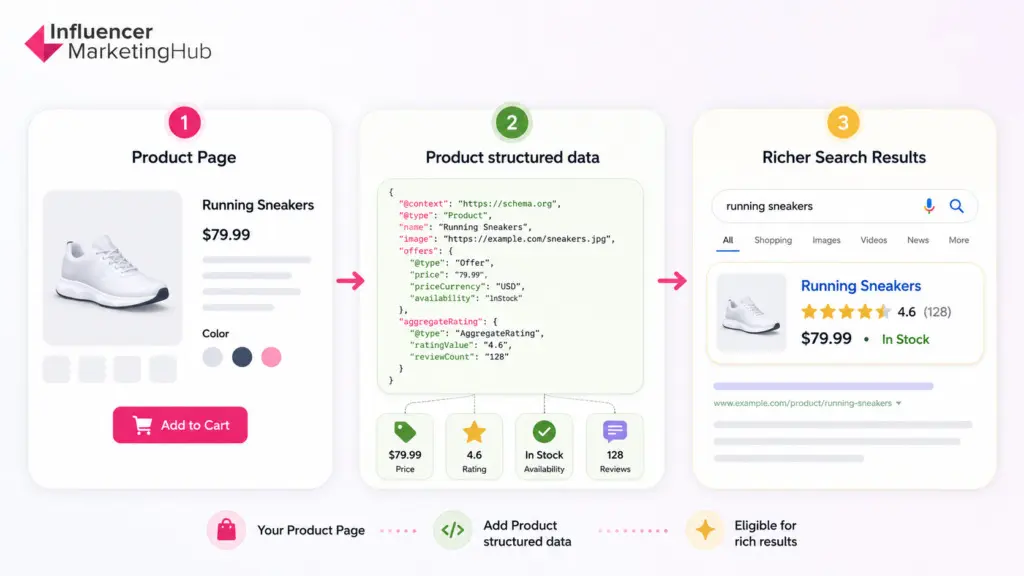
Google’s product documentation makes the same point from a search perspective. Adding Product structured data can make product information eligible for richer Google Search results, including price, availability, review ratings, shipping information, and other product details.
Google Merchant Center’s product data specification also says accurate, correctly formatted product data helps match products to relevant queries and prevent disapprovals or display issues.
Less obvious attributes can determine whether creator-driven demand carries into another shopping interface. A creator might repeatedly mention that a tote stands upright, a microphone works with an iPhone, or a dress has functional pockets. If those facts live only in a Reel, they may not carry reliably into the next interface the shopper uses.
There’s also a freshness problem. A recommendation can keep circulating long after a campaign ends. OpenAI notes that prices shown in ChatGPT shopping results may reflect third-party provider data and may not always be the lowest available price, which makes accurate merchant data and a clear product page more important, not less.
The campaign brief has to reach the catalog
Most influencer workflows have a creative handoff and a reporting handoff. Someone approves the talking points, discount code, usage rights, and posting date. Later, someone collects reach, engagement, clicks, and sales. Product-data teams may never see the language that made the campaign work.
That separation creates small, expensive misses.
Suppose a creator testing headphones tells viewers, “The ear cups don’t press against my glasses.” The comment section shows that this is the detail people care about. Paid social picks up the clip. The landing page uses the same wording. Yet the main product description, comparison chart, merchant feed, and marketplace listing remain unchanged.
A strong campaign process should capture those buying phrases while they’re fresh. The ecommerce owner doesn’t need every enthusiastic comment. They need repeated questions, unexpected use cases, common comparisons, objections, and creator wording that reveals how shoppers categorize the product.
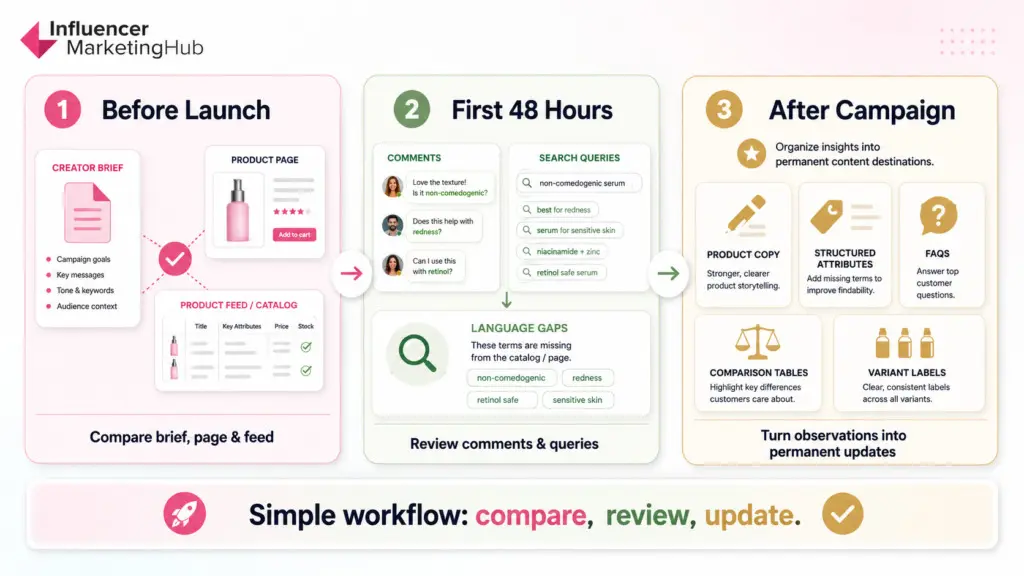
The work can be simple. Before launch, compare the creator brief with the product page and feed. During the first 48 hours, review comments and search queries for languages the catalog doesn’t contain. After the campaign, decide which observations belong in permanent product copy, structured attributes, FAQs, comparison tables, or variant labels.
Campaign teams already spend time polishing the post-click experience. Influencer Marketing Hub’s guide to high-converting drop landing pages explains how landing pages built for influencer drops need to keep attention, expectations, and conversion paths aligned. The same standard should apply beyond the campaign page: a polished landing page can convert direct clicks while the product remains difficult to retrieve through every other shopping surface.
Measure whether demand traveled
Creator campaigns are usually judged through visible paths: tracked links, codes, affiliate sales, view-through conversions, and perhaps branded search lift. AI-assisted shopping can make that path harder to reconstruct. A person can watch a TikTok on Monday, ask an assistant for alternatives on Wednesday, and buy from a product card on Friday without touching the creator’s link.
That doesn’t make measurement pointless. It changes the questions worth asking.
Did searches for the product’s name, category, or creator-used phrase increase? Are customers arriving on product pages through AI or conversational-search referrals? Do feed diagnostics show missing identifiers, rejected variants, stale prices, or availability conflicts? When the product is described to major shopping assistants using the same language customers use, does it appear accurately and consistently?
Teams should also compare the products that received creator attention with the products that were technically ready to benefit from it. Influencer Marketing Hub’s 2026 benchmark report is based on a survey of 600+ marketing professionals and frames 2026 influencer marketing around operational issues such as measurement design, quality controls, AI-enabled scaling, and social commerce. That context matters because weak sales after creator exposure may reflect the commerce setup as much as the creative.
One practical metric is the correction rate. Track how often staff must fix a product title, price, image, variant, compatibility detail, or stock status after a campaign begins. A high correction rate can indicate that the organization is drawing attention before the catalog is ready to receive it.
The same thinking applies to customer support. If support tickets after a creator post cluster around sizing, compatibility, delivery timing, or “is this the same one from the video,” the campaign has exposed missing product information. Those tickets are not just service problems. They are clues about what the catalog failed to say clearly.
Wrap-up takeaway
Creators are becoming one of the strongest sources of product language because they hear the questions buyers ask before and after the sale. AI shopping systems can extend that demand, but only when the product remains recognizable after the video, caption, or storefront disappears. The brands that benefit won’t necessarily publish the most content; they’ll connect customer language to accurate, current product information. That requires cooperation between creator marketing, ecommerce, merchandising, and whoever owns the feed. Pick one product from a recent creator campaign today and compare the words used in the post, comments, product page, and catalog fields side by side.