

Over the past few weeks, I've seen renewed conversation about measurement in the creator economy heading into 2026. Much of it centers on the idea that platform metrics no longer tell the full story.
I agree with that premise. But I want to add a layer of nuance from the agency side.
Standard platform metrics — views, completion rate, engagement rate — are not meaningless. They still tell us important things about distribution efficiency and attention capture. How far did the content travel? How many people actually stayed with it?
Those signals matter, especially at the top of the funnel.
The problem starts when teams stop there.
Where Measurement Breaks Down
What we see repeatedly is creator content being evaluated through a single scorecard, regardless of what that content was designed to do.
A top-of-funnel awareness video is judged by the same metrics as a shoppable post. A narrative endorsement is evaluated the same way as a quick product demo. When that happens, teams walk away with incomplete conclusions.
Not because the metrics are wrong — but because they're being used out of context.
This is why influencer marketing measurement needs a new framework. Not one that replaces platform metrics, but one that puts them in their proper place.
A Layered Measurement Stack
The most effective creator programs use a layered approach to measurement — one where each layer answers a different question.
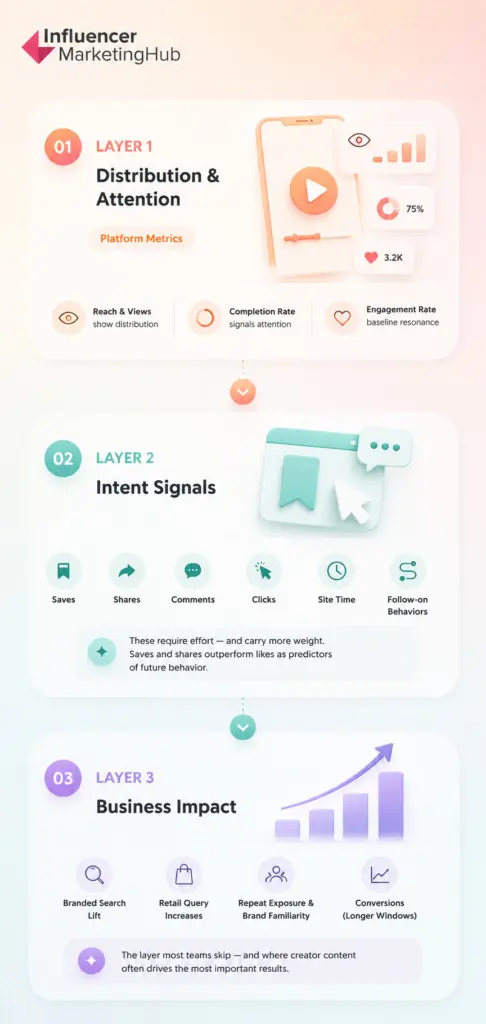
Layer 1 — Distribution & Attention (Platform Metrics):
- Reach and views show distribution
- Completion rate signals attention
- Engagement rate provides a baseline read on resonance
These tell us whether content cleared the first hurdle. Did anyone see it? Did they stay?
Layer 2 — Intent Signals:
- Saves
- Shares
- Substantive comments
- Clicks
- Site time
- Follow-on behaviors
These carry more weight because they require effort from the audience. We consistently see saves and shares outperform likes as predictors of future behavior — especially when content is educational or endorsement-driven.
Layer 3 — Business Impact:
- Branded search lift
- Retail query increases
- Repeat exposure and brand familiarity
- Conversion attributed across longer windows
This is the layer most teams skip — and it's often where creator content is quietly doing its most important work.
Not All Creator Content Plays the Same Role
This is where segmentation becomes critical — and where the old framework fails most visibly.
Some creator content is built to drive endorsement behavior. That shows up in saves, shares, tags, and thoughtful comments. These pieces often perform quietly at first but compound over time.
Other content is built for mental availability and recall. The impact shows up later — through search behavior, retail visits, repeat exposure, or brand familiarity across touchpoints.
Judging both against the same benchmark misses the point entirely.
Custom success criteria are no longer optional. But they only work when tied to the role content plays in the funnel. Awareness content should not be penalized for lacking conversion signals. Performance content should not be overvalued based on reach alone.
The framework has to match the intent.
What's Accelerating the Need for Change in 2026
As budgets grow and creator programs become more embedded in business operations, measurement has to mature alongside them.
And there's another force accelerating this shift: AI-driven discovery.
Consumers are increasingly describing problems, needs, and aspirations directly to large language models — often before they know what product they want or which brand they're considering. Recent industry research suggests more than half of U.S. consumers already use AI tools as part of their shopping research.
In these moments, AI isn't inventing opinions. It's synthesizing what already exists across trusted, high-quality content ecosystems.
This creates two important shifts for brands:
- Category perception is being shaped before intent forms. The brands, creators, and narratives surfaced in AI summaries influence how consumers frame the entire category — not just which link they click later.
- Credible voices carry more weight than ever. Authoritative editorial, expert creators, and high-trust publishers are cited more often than keyword-optimized content. Conversational, experience-based content is outperforming formulaic SEO writing.
The measurement implication is significant: creator and editorial content can now influence decisions even when the visible action happens elsewhere — through branded search lift, retailer queries, or conversions that never show up inside a platform dashboard.
Which means platform metrics didn't become irrelevant. They became insufficient on their own.
What the New Framework Looks Like
The teams getting measurement right in 2026 are not abandoning platform metrics. They are:
- Contextualizing them — understanding what each metric is actually measuring and what it isn't
- Weighting intent signals more thoughtfully — saves, shares, and follow-on behavior over passive engagement
- Aligning success criteria with content's role — awareness content measured for awareness, performance content measured for performance
- Building for AI-mediated discovery — recognizing that influence is happening before the click, not just after it
The new measurement framework isn't more complicated. It's more honest about what we're actually trying to measure — and why.
At Intuition Media Group, we help global brands build creator ecosystems that compound — designed for cultural relevance and built for measurable business impact.
If you're rethinking how you measure creator performance in 2026, we'd welcome the conversation.


