
Extended reality (XR) is one of the umbrella terms for augmented reality (AR), virtual reality (VR), and mixed reality (MR).
Brands are using XR in marketing to solve specific commercial problems: reducing product return rates, shortening sales cycles, training workforces at scale, and creating in-store experiences that drive foot traffic and brand recall.
Each one of the eight examples below is chosen because it illustrates a distinct business problem that XR solved better than any previous tool available to that marketing team.
Global spending on XR is projected to surpass $85 billion by 2030. The organizations driving that number are doing so because the commercial case is documented and repeatable.
In this guide, we'll look at how brands are using extended reality (XR) in marketing, exploring both the strategy and the outcomes.
- 1. Mixed Reality Showroom: BMW
- 2. Immersive Brand Activations at Scale: Coca-Cola
- 3. AR-Powered Product Visualization: IKEA
- 4. Virtual Try-On and Return Reduction: Gucci
- 5. AR as a Portfolio-Wide Marketing Infrastructure: L’Oréal
- 6. VR Training at Enterprise Scale: Walmart
- 7. Immersive Brand Experience and Destination Marketing: Marriott
- 8. Immersive In-Store Experience: ULTA Beauty
- What the Best XR Deployments Have in Common
1. Mixed Reality Showroom: BMW
Brands use XR to replace or extend physical showrooms, allowing buyers to configure and experience full-scale products in virtual environments.
BMW's mixed reality showroom lets customers change vehicle specifications in real time and generates behavioral data that feeds into marketing and inventory decisions.
The physical showroom has always imposed a hard ceiling on what a brand can show a buyer. Dealer lots stock a fraction of available configurations. Photography compresses a three-dimensional object into a flat image that communicates almost nothing about scale, materiality, or how a product occupies space.
BMW’s mixed reality showroom program removes that ceiling. A customer puts on a headset, and a vehicle appears before them at full scale. They walk around it, open the door, change the exterior paint, and reconfigure the interior.
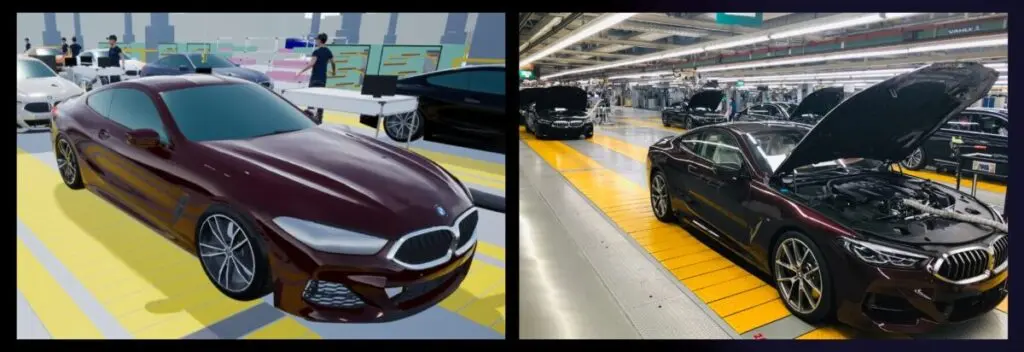
They experience the exact car they intend to purchase, not the closest approximation on the lot.
Every interaction inside the virtual environment is a data event. Which configurations hold attention the longest? Which features do buyers return to? Where they disengage. That behavioral data feeds directly into product development, pricing architecture, and inventory strategy.
2. Immersive Brand Activations at Scale: Coca-Cola
Brands use AR to turn physical products into interactive media channels, activating millions of consumers simultaneously across geographies without additional retail infrastructure. Coca-Cola's AR packaging campaign reached consumers across more than 50 countries using scannable cans that triggered animated brand experiences.
Most brand activations are local by nature. A pop-up event, a trade show booth, an experiential installation: each one reaches the people who happen to be in a specific place at a specific time. Augmented reality removes that constraint.
The Coca-Cola x Marvel collaboration used scannable packaging on Coca-Cola and Coca-Cola Zero Sugar products across more than 50 countries to unlock AR animations of over 30 Marvel characters. The physical product became an interactive experience. Consumers were not just buying a drink. They were buying an interaction.
@tyroot Coca-Cola & Marvel unite. New Marvel / Coke can AR activation, explained. Collect all 32 characters! Enjoy. 🦸♂️#ar #cocacola #marvel @Coca-Cola @Marvel Entertainment
Coca-Cola has deployed AR across multiple campaigns at this scale, including AR vending machines that gamify the purchase and drive social sharing. The strategic principle is consistent application: AR is treated as a repeatable channel, not a one-off activation.
3. AR-Powered Product Visualization: IKEA
AR improves B2B and B2C product evaluation by allowing buyers to place true-to-scale product models in their actual environment before purchase, reducing evaluation time and approval cycles.
IKEA Place demonstrated that AR visualization resolves fit and scale uncertainty in minutes rather than days.
The longest part of any considered B2B purchase is the evaluation phase. Buyers know what they need. They do not know whether the specific product in front of them fits their specific context. That uncertainty drives longer sales cycles, more stakeholder meetings and more deals that stall.
IKEA addressed this with IKEA Place, an AR application that places true-to-scale 3D furniture models into a buyer’s real environment through a smartphone camera. A sofa appears in the corner. A bookcase fills the wall. The buyer resolves the central purchase question in minutes rather than days.
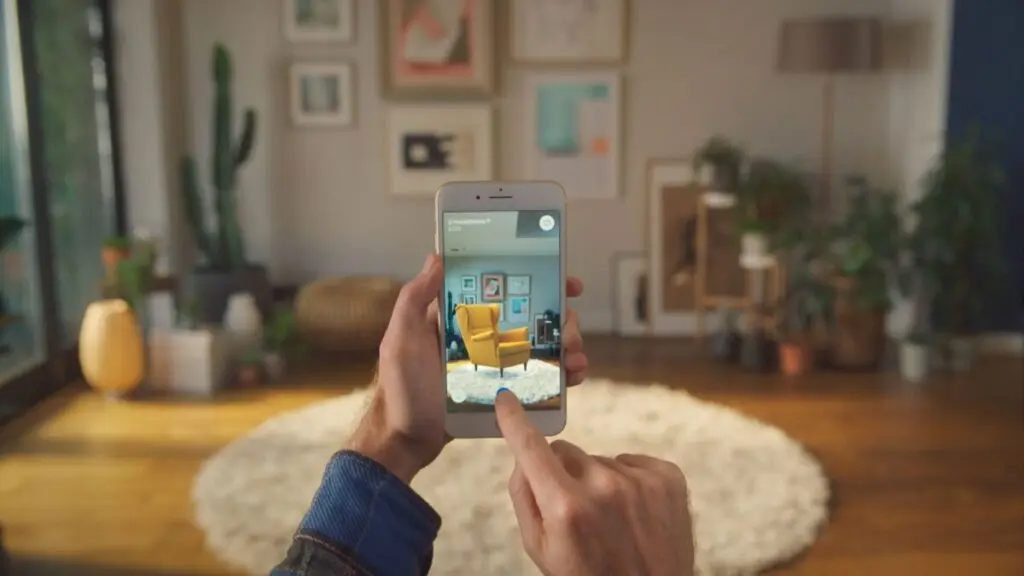
For brands selling equipment, office infrastructure or physical systems to business buyers, the commercial implication is direct. A facility manager who can see a product in their actual space before committing eliminates the primary source of evaluation delay.
AR visualization improves the customer experience and accelerates the revenue cycle. The value of reducing friction at the evaluation stage is often larger than additional top-of-funnel investment.
4. Virtual Try-On and Return Reduction: Gucci
Luxury brands use AR try-on technology to let customers visualize products in real time before purchasing, reducing return rates caused by fit uncertainty and increasing purchase confidence.
Gucci's AR sneaker try-on, deployed via its iOS app and Snapchat, delivered a positive ROAS and expanded brand engagement among younger audiences.
Product returns are one of the most underexamined cost centers in retail marketing. Return rates in online apparel and footwear regularly exceed 30%. The cause is almost always the same: the customer could not accurately assess the product before purchasing.
Gucci integrated AR try-on into its iOS app, allowing customers to see true-to-scale renderings of sneakers on their feet in real time, with accurate foot movement tracking and photorealistic material rendering. The brand then extended this through a partnership with Snapchat, launching the first global AR shoe try-on campaign on that platform.
The strategic logic was twofold: reduce returns among existing customers and build brand engagement with a younger demographic building affinity for the future. Luxury brand loyalty is built over decades. AR gave Gucci a cost-effective tool for establishing that relationship years before a customer has the income to act on it.
For any retail brand with a meaningful return rate, the ROI calculation is straightforward. Reduced return-handling costs are measurable and often substantial. Improved purchase confidence and social sharing are additional returns on top of that.
5. AR as a Portfolio-Wide Marketing Infrastructure: L’Oréal
L'Oréal acquired AR technology company ModiFace in 2018 and deployed virtual try-on across 36 brands in 65 countries, treating AR as infrastructure rather than a campaign. By 2023, the platform generated over 100 million virtual try-on sessions annually, with users converting at three times the rate of those who did not use the AR feature.
Most AR deployments are campaigns. They run for a quarter, generate press coverage, and get retired. L’Oréal made a different decision.
In 2018, the company acquired ModiFace, a Toronto-based AR and AI company that had spent seventeen years building leading technology for virtual beauty try-ons. It was the first time L’Oréal had acquired a technology business rather than a beauty brand.
On the company’s Q2 2018 earnings call, Chairman and CEO Jean-Paul Agon described it as “a major milestone in the transformation of L’Oréal into a digitally augmented beauty company.”
The strategic logic was to embed AR capability across the entire brand portfolio. Within a year, ModiFace technology was deployed across 36 brands in 65 countries, with one new AR project launched per day.
By 2023, L’Oréal’s CEO reported over 100 million virtual try-on sessions in a single year. Customers using virtual try-on converted at three times the rate of those who did not. The technology had ceased to be a marketing initiative. It had become a core commercial driver.
Brands running XR as a campaign channel generate incremental returns. Brands that treat XR as infrastructure and deploy it systematically across their entire business generate compounding returns.
6. VR Training at Enterprise Scale: Walmart
VR training at enterprise scale ensures every frontline employee receives the same high-fidelity experience, regardless of location. Walmart trained over one million employees using VR headsets, achieving a 96% reduction in training time for specific modules and consistent outperformance on post-training assessments among VR-trained staff.
Organizations that train thousands of people across dozens of locations face the same problem: how do you maintain quality and consistency when you cannot put every trainee in the same room? VR solves that problem in a way that classroom instruction never has.
Walmart’s VR training program, starting in 2017 and eventually reaching over one million employees across thousands of US store locations, placed Oculus headsets in every store and deployed immersive simulations covering customer service, operations and safety.
A Black Friday rush. A customer de-escalation. A new technology rollout. Every associate experienced the same scenario, with the same stakes.
Documented outcomes: a 96% reduction in training time for specific modules, with VR-trained employees consistently outperforming peers on post-training assessments.
A frontline team that has rehearsed difficult customer interactions in a realistic simulated environment delivers a more consistent customer experience than one encountering those situations for the first time in a live store. VR training is a direct investment in the delivery of the brand promise.
7. Immersive Brand Experience and Destination Marketing: Marriott
Hospitality brands use VR to let prospective guests experience destinations before booking, reducing purchase uncertainty and deepening brand loyalty.
Marriott's #GetTeleported campaign and VR Postcards program created fully immersive destination previews that embedded Marriott properties as the natural gateway to the experiences being shown.
The challenge for hospitality and travel brands has always been that the product is the experience, and the experience cannot be sampled before purchase. Virtual reality changes that equation entirely.
Marriott Hotels built a systematic response with the #GetTeleported campaign, deploying VR Teleporter booths across eight US hotel lobbies.
Guests put on Oculus Rift headsets and were transported to a black sand beach in Maui and the top of a skyscraper in London. Heat, wind and mist augmented the visual experience. The physical sensation of standing somewhere made the destination tangible in a way no brochure could replicate.
Marriott followed this with VR Postcards, a room-service-delivered VR experience available to hotel guests. Three travelers in the Andes, in Beijing and in Rwanda told their stories in 360-degree environments guests could inhabit from inside their room.
Each story positioned a Marriott property as the natural departure point for the journey being shown.
The ability to let a prospective customer feel your product before committing to it is one of the most effective conversion tools available. VR makes that possible at a cost and scale that physical sampling programs cannot approach.
8. Immersive In-Store Experience: ULTA Beauty
In-store XR experiences drive foot traffic and brand recall by creating sensory environments that cannot be replicated online, turning a store visit into a memory.
ULTA Beauty deployed an immersive Meta Quest experience themed around Ariana Grande's R.E.M. Beauty line, producing documented outcomes including enhanced product education, increased foot traffic and a strengthened digital innovation positioning for the brand.
Physical retail’s competitive challenge is structural. E-commerce offers convenience that a store cannot match. The response that works is not to compete on convenience. It is to offer something e-commerce cannot deliver: a physical, sensory, emotionally resonant experience that a customer cannot have anywhere else.
ULTA Beauty’s digital innovation team built exactly this. Developed on Meta Quest technology and set inside an outer-space dreamscape themed around Ariana Grande’s R.E.M. Beauty product line, the in-store experience placed customers inside a fully realized virtual environment where they could explore beauty products through spatial storytelling.
It was not a screen in a store. It was a world customers stepped into, moved through and carried with them when they left.
Documented outcomes included enhanced product education, measurable increases in foot traffic to participating locations and stronger brand engagement metrics. ULTA Beauty also secured a reputation as a digital innovation leader in beauty retail, a positioning that reinforces customer loyalty and attracts brand partnerships that accelerate future growth.
A customer who spends ten minutes inside an immersive brand experience has a fundamentally different relationship with that brand than one who walked past a shelf display. That depth of engagement translates into purchase intent, repeat visits and word-of-mouth advocacy at a rate no point-of-sale display can generate.
What the Best XR Deployments Have in Common
The most effective XR deployments share one characteristic: they were built around a specific, measurable business problem, not around the technology itself. Each brand identified where their existing marketing tools were falling short and deployed XR to close that gap.
BMW identified that photography could not communicate the reality of a premium vehicle. Walmart identified that a classroom could not replicate the pressure of a live store floor. Marriott identified that a brochure could not make a travel destination feel real enough to book. ULTA Beauty identified that a shelf display could not create the kind of brand memory that drives lasting loyalty.
XR extended what each brand’s existing marketing fundamentals could accomplish by enabling categories of experience, interaction and measurement that no previous channel could support.
Ready to explore what extended reality could do for your brand? Book a free XR strategy consultation with Treeview’s enterprise team to discuss your specific use-case and goals.