
Cracker Barrel unveiled a stripped-down logo on August 19, 2025. One week later, it abandoned it. Between August 18 and 27, conversation about the brand on X exploded from roughly 350 posts before the announcement to more than 1.58 million mentions. Over 423,000 framed the change through culture-war language, nearly 40,000 called for a boycott, and the company lost almost $100 million in market value. On volume and polarity alone, the rebrand looked like an overwhelming rejection.
Then the authenticity analysis changed the picture. PeakMetrics examined 52,000 posts from the first 24 hours and flagged 44.5% as showing bot-like behavior; among boycott posts, that figure reached 49%. Seventy percent of boycott messages used identical language. Across the broader August 19–September 5 conversation, roughly 24% of more than two million posts showed signs of automation.
Yet the dissatisfaction was not entirely manufactured. A YouGov survey of 1,002 U.S. adults found that 76% preferred the old logo, 38% viewed the redesign negatively, and only 23% viewed it positively. More importantly, 29% said the change made them less likely to visit, compared with 9% who became more likely.
That is what useful brand sentiment analysis must resolve. AI can classify public mentions as positive, negative, or neutral, but classification is only the first layer. A defensible analysis combines sentiment distribution with conversation volume, velocity, topic, source, audience, and authenticity.
A single sentiment score would have hidden the defining fact here: the backlash contained both genuine brand rejection and manufactured scale. The business question was not simply whether sentiment was negative. It was which signals represented customers, what they rejected, how quickly the narrative was spreading, and whether it would change behavior.
- What Is Brand Sentiment Analysis?
- Why Brand Sentiment Matters More in the AI Search Era
- How Brand Sentiment Analysis Works
- How to Measure Brand Sentiment
- Brand Sentiment Analysis Methods and Techniques
- Common Challenges in Brand Sentiment Analysis
- Brand Sentiment Analysis Is Becoming a Real-Time Reputation System
- Frequently Asked Questions
What Is Brand Sentiment Analysis?
Brand Sentiment Analysis Definition
Brand sentiment analysis measures how people feel about a brand based on the language, tone, and context used in online conversations. Instead of simply tracking how often a company gets mentioned, sentiment analysis focuses on the emotional direction behind those mentions.
Most sentiment analysis systems classify conversations into three broad categories:
- positive sentiment
- negative sentiment
- neutral sentiment
More advanced systems go further by identifying frustration, excitement, disappointment, trust, sarcasm, or purchase intent across large volumes of conversations.
The process pulls data from multiple sources, including social comments, forums and Reddit threads, UGC, support tickets, news coverage, blog mentions, online reviews, and more.
Modern AI and NLP models then analyze patterns inside that data to determine how public perception changes over time.
Brand sentiment analysis often gets confused with brand awareness, but the two measure very different things. Brand awareness measures visibility. Sentiment measures perception. A brand can dominate conversations online while still generating overwhelmingly negative reactions.
That distinction matters because attention alone rarely tells marketers whether campaigns, products, or messaging are actually strengthening trust. A viral product launch may generate millions of impressions while simultaneously damaging customer perception if conversations turn negative after release.
Sentiment analysis gives marketers a clearer view into those shifts. Ecommerce brands often use it to monitor product reactions after launches. Enterprise companies use it to detect reputation risks before they escalate publicly. Customer experience teams analyze sentiment trends to identify recurring frustrations inside support conversations and reviews.
Why Brand Sentiment Matters More in the AI Search Era
Search behavior is changing quickly, and brand perception is increasingly being shaped by AI-generated answers rather than traditional search results alone.
Google confirmed in 2026 that more than 2.5 billion users now interact with AI Overviews and AI-powered search experiences each month. Industry studies also show AI Overviews now appear in a significant share of Google searches, particularly for informational queries where users are looking for explanations, comparisons, recommendations, or opinions.
That shift changes how people encounter brands online.
AI-generated answers increasingly pull information from:
- reviews
- Reddit discussions
- forums
- news articles
- creator content
- public customer feedback
Several studies have found that Reddit and Quora are now among the most-cited sources inside Google AI Overviews. Public conversations that once stayed buried inside forums can now become part of mainstream search visibility.
Brand sentiment plays directly into that environment.
A company facing recurring complaints around pricing, customer support, product quality, or creator controversies may eventually see those narratives reflected in AI-generated summaries and recommendations. Positive sentiment can work the same way by reinforcing trust, authority, and customer satisfaction signals across search experiences.
Recent research also suggests users behave differently when AI summaries appear. Pew Research found that users clicked traditional search results in only 8% of visits when AI summaries were present, compared to 15% when summaries did not appear.
AI-generated answers increasingly act as the first layer of brand perception before users ever visit a website.
Marketing teams, therefore, need visibility into more than mention volume or engagement metrics alone. Emotional direction matters more:
- Are complaints increasing?
- Are customers frustrated after a product launch?
- Are creators generating positive reactions?
- Are conversations becoming more skeptical over time?
Sentiment analysis helps marketers detect those shifts earlier.
Platforms like Brandwatch increasingly position sentiment monitoring as part of a broader consumer intelligence workflow that combines social listening, trend analysis, reputation monitoring, and audience perception tracking across multiple digital channels.
AI search environments are accelerating the importance of that work because public sentiment now influences visibility, trust, and discovery at a much larger scale than before.
How to Audit Brand Sentiment in AI Answers
Social listening measures the opinions available across reviews, forums, news, and social media. It cannot show which signals an AI model selects, how it frames them, or whether it recommends the brand when someone asks a decision-stage question. That answer layer requires a separate dataset.
Chatbeat runs structured, customer-like prompts through ChatGPT, Gemini, Claude, Perplexity, and other AI systems. It retains the exact responses and measures brand position, share of voice, positive/neutral/negative sentiment, comparison context, and cited sources. Teams can open a negative result, isolate the criticism, identify the source informing it, and check whether the same framing recurs across prompts and models.
A useful prompt set should cover 4 types of intent:
- Discovery: “Which [category] tools are best for [use case]?”
- Comparison: “[Brand] vs. [competitor] for [requirement]”
- Validation: “Is [brand] reliable for [audience]?”
- Risk: “What are the main problems with [brand]?”
Keep the prompts, models, market, and testing interval fixed. Otherwise, a sentiment change may come from a changed test rather than changed brand perception.
Coverage must sit beside sentiment. Suppose 100 prompt-model runs produce 20 brand mentions, of which 16 are positive. Positive sentiment among mentions is 80%, while positive exposure across the complete test is only 16%. Reporting the first figure alone would substantially overstate the brand’s position during AI-assisted discovery.
Chatbeat’s Brand Score supplies that visibility control by combining how frequently and how highly a brand appears. Its 0–100% scale classifies 0% as no measurable visibility, 1–9% as minimal or emerging, 10–29% as decent, 30–49% as respectable, 50–69% as good, and 70–100% as excellent.
The framework has produced measurable movement. During a 4-month Viessmann project, share of voice for gas and condensing boiler prompts rose from approximately 18–19% to 29%, while median AI position moved from second to first. One GPT project recorded a Brand Score increase from 7.65% to 57%. The team used prompt gaps and cited-source data to reshape content around customer questions and publications repeatedly used by AI models.
How Brand Sentiment Analysis Works
Brand sentiment analysis starts with collecting large volumes of customer conversations from digital channels where people already discuss brands naturally. We've established that most systems pull data from social media platforms, reviews, forums, support conversations, surveys, creator content, news coverage, and community discussions.
But raw data alone is not especially useful.
The real value comes from identifying emotional patterns inside those conversations at scale.
Natural language processing (NLP) models help sentiment analysis systems understand whether a mention expresses positive, negative, or neutral sentiment. More advanced AI systems can also detect:
- frustration
- excitement
- skepticism
- purchase intent
- urgency
- recurring complaints
Context matters heavily during this process. A sentence like “Great, another delayed shipment” contains negative sentiment even though it includes a positive word. Sarcasm, slang, emojis, and cultural phrasing make sentiment classification far more difficult than simple keyword matching.
Modern AI models, therefore, rely on much more than predefined positive and negative word lists. Machine learning systems analyze sentence structure, surrounding context, historical language patterns, and emotional associations to improve classification accuracy over time.
Most sentiment analysis workflows follow four core stages:
| Stage | What Happens |
| Data collection | Platforms gather mentions from reviews, social media, forums, surveys, and other sources |
| Sentiment classification | AI models categorize conversations by emotional tone |
| Trend analysis | Teams identify patterns, spikes, and shifts in perception over time |
| Strategic response | Marketers respond to risks, complaints, campaigns, or reputation changes |
Different types of sentiment analysis are often used depending on the business goal.
Basic polarity analysis focuses on positive, neutral, and negative sentiment. Aspect-based sentiment analysis goes deeper by analyzing reactions to specific parts of a customer experience, such as shipping, pricing, customer support, or product quality.
Emotional detection models attempt to identify more nuanced emotional states like frustration, confusion, or trust.
Visual sentiment analysis is also becoming more important. Some AI systems can now analyze logos, facial expressions, objects, and visual context inside user-generated images and videos to better understand how brands appear across social platforms.
Accuracy still remains one of the biggest challenges in sentiment analysis. Human communication is messy. Sarcasm, irony, mixed opinions, multilingual conversations, and evolving internet slang regularly create classification errors. Bot activity and fake reviews can also distort sentiment signals if platforms fail to filter low-quality data properly.
Platforms like Brandwatch increasingly combine AI classification, social listening, and trend analysis to reduce those blind spots and give marketing teams a broader view of how public perception changes across channels.
How to Measure Brand Sentiment
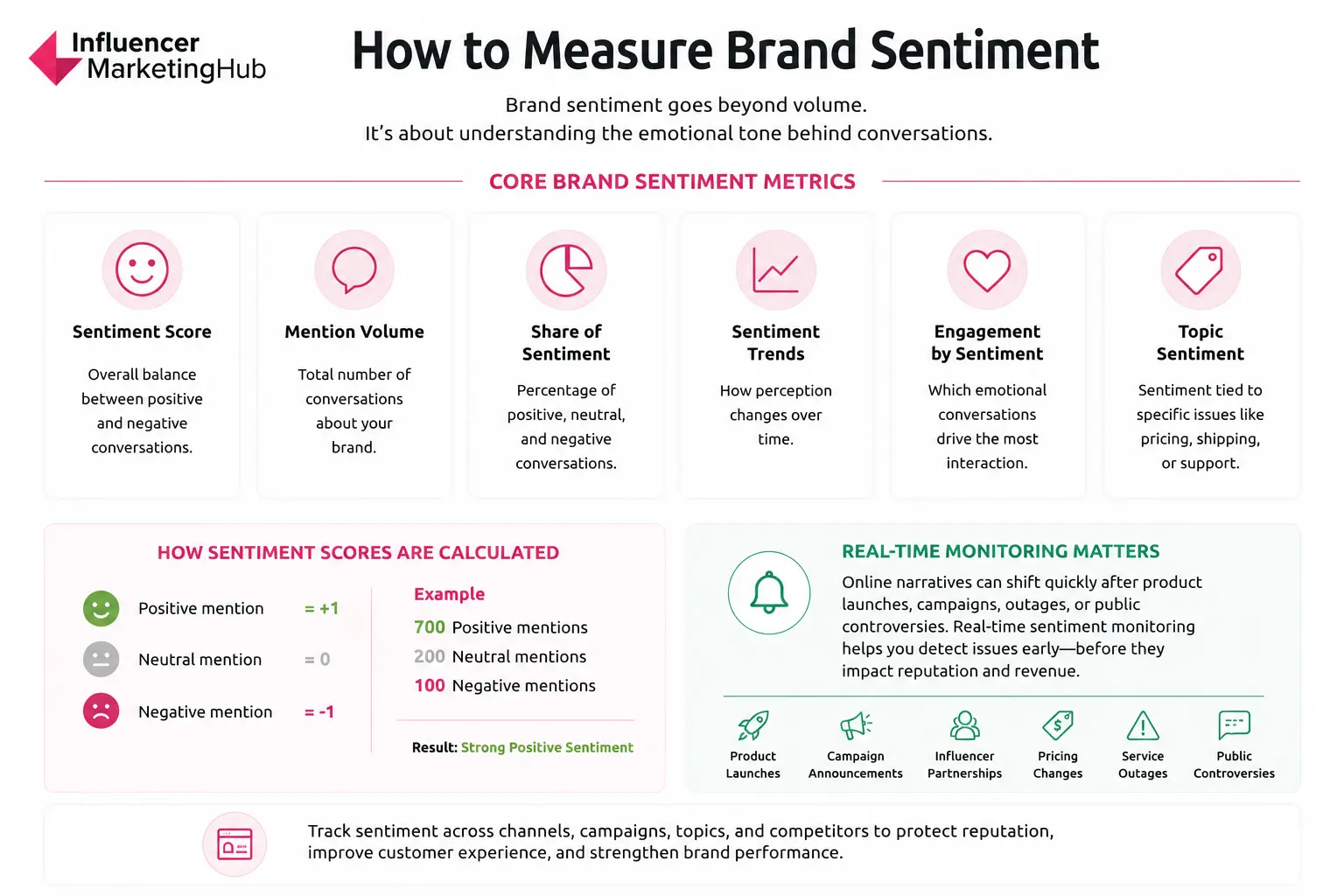
Tracking brand sentiment starts with understanding that sentiment is not a single metric. Most marketing teams monitor a combination of emotional signals, conversation trends, and engagement patterns to understand how public perception changes over time.
A sudden increase in mentions may look positive on the surface, but volume alone rarely explains whether conversations are supportive, frustrated, skeptical, or neutral. Sentiment analysis helps marketers separate attention from actual perception.
Core Brand Sentiment Metrics
Sentiment score measures the overall balance between positive and negative conversations, while mention volume tracks how often people discuss a brand online. Marketers also monitor share of sentiment to understand the percentage of positive, neutral, and negative discussions over time.
Sentiment trends reveal how perception shifts after campaigns, product launches, or customer experience issues. Many teams also track engagement by sentiment to identify which emotional conversations generate the strongest reactions.
Topic-level sentiment analysis adds another layer by showing how audiences feel about specific issues like pricing, delivery speed, customer support, or product quality.
How Sentiment Scores Are Calculated
Most platforms calculate sentiment scores by assigning values to mentions based on emotional tone.
A simplified version often looks like this:
- Positive mention = +1
- Neutral mention = 0
- Negative mention = -1
The final sentiment score is calculated by comparing the balance between positive and negative conversations across a dataset.
For example:
- 700 positive mentions
- 200 neutral mentions
- 100 negative mentions
would produce a strongly positive sentiment score overall.
Some enterprise systems use weighted scoring models that account for audience reach, engagement volume, creator influence, virality, and source authority.
A negative post from a major creator or news outlet may therefore carry far more weight than several smaller complaints.
Real-Time Monitoring Matters More Than Static Reporting
Many brands no longer treat sentiment analysis as a monthly reporting exercise. Real-time monitoring has become increasingly important because online narratives can shift quickly after:
- product launches
- campaign announcements
- influencer partnerships
- pricing changes
- service outages
- public controversies
Airlines, telecom providers, ecommerce companies, and consumer brands often monitor sentiment continuously during high-risk periods because customer frustration tends to appear publicly long before operational reports reflect the problem internally.
Research from Sprout Social found that 73% of consumers will buy from a competitor after more than one bad experience with a brand. Public complaints that go unanswered can therefore influence both reputation and customer retention. (sproutsocial.com)
Building a Brand Sentiment Dashboard
Most sentiment dashboards combine multiple data sources into a single reporting view. Marketing teams commonly track the overall sentiment score, sentiment by channel, campaign sentiment, competitor sentiment, creator sentiment, emerging negative topics, and customer experience complaints.
Executive teams increasingly use sentiment dashboards alongside traditional performance metrics because reputation problems rarely stay isolated to social media alone. Negative sentiment can eventually lead to poor conversion rates, customer disloyalty, negative media coverage, and a decrease in AI search visibility.
Strong sentiment monitoring helps brands identify those risks before they become larger business problems.
Brand Sentiment Analysis Methods and Techniques
Not all sentiment analysis systems work the same way. Some rely on simple keyword matching, while others use advanced AI models capable of understanding context, emotional tone, and behavioral patterns across millions of conversations.
The method a platform uses directly affects how accurately it can interpret customer perception.
Rule-Based Sentiment Analysis
Rule-based sentiment analysis uses predefined word libraries to classify sentiment. Positive words like “great,” “fast,” or “reliable” increase positive scores, while words like “terrible,” “slow,” or “broken” contribute to negative classifications.
Older sentiment analysis systems relied heavily on this approach because it is relatively simple and inexpensive to implement. Rule-based systems can still work reasonably well for straightforward customer feedback and basic monitoring tasks.
Problems appear when conversations become more nuanced.
Sarcasm, slang, emojis, cultural phrasing, and mixed opinions often confuse rule-based models because they interpret words literally rather than contextually. A sentence like:
“Amazing, another delayed order”
may incorrectly register as positive because of the word “amazing.”
Machine Learning Sentiment Analysis
Machine learning models improve sentiment analysis by learning from large datasets rather than relying entirely on static keyword lists.
Instead of analyzing isolated words, machine learning systems examine sentence structure, context, word relationships, historical language patterns, and emotional association.
Modern NLP systems can, therefore, detect more subtle emotional patterns across conversations.
AI-powered sentiment analysis has become especially important as brands monitor increasingly unstructured conversations across:
- TikTok comments
- Reddit discussions
- creator content
- customer reviews
- support tickets
Research from Salesforce found that 81% of customers expect faster interactions as technology advances. Growing demand for real-time responses has pushed brands toward AI-driven monitoring systems capable of analyzing large volumes of conversations continuously.
Hybrid Sentiment Analysis
Many enterprise platforms now use hybrid models that combine rule-based logic with machine learning systems.
Hybrid approaches help improve accuracy because rule-based systems still provide useful structure for brand terminology, industry-specific language, predefined risk keywords, and compliance monitoring.
Machine learning models then add contextual interpretation on top of those rules.
A platform like Brandwatch increasingly uses hybrid AI approaches to improve real-time sentiment classification across multilingual and multi-platform environments.
Aspect-Based Sentiment Analysis (ABSA)
Aspect-based sentiment analysis focuses on specific parts of a customer experience instead of evaluating overall brand perception alone.
A customer review may contain both positive and negative sentiment at the same time:
“The product quality is excellent, but shipping took too long.”
Traditional sentiment analysis may struggle to classify that feedback accurately. Aspect-based analysis separates the conversation into individual categories like:
- product quality
- delivery
- pricing
- support
- usability
This gives marketers and customer experience teams much more actionable insights.
Ecommerce brands frequently use aspect-based analysis to identify recurring operational complaints tied to returns, fulfillment delays, or product durability.
Visual Sentiment Analysis
Visual sentiment analysis expands monitoring beyond text.
Some AI systems can now analyze:
- logos inside images
- facial expressions
- product placements
- visual context
- creator-generated imagery
This has become increasingly important as platforms like TikTok, Instagram, and YouTube shift more online conversations toward video-first content.
Visual analysis helps brands understand not only what people say, but also how products, creators, and campaigns appear visually across social platforms.
Common Challenges in Brand Sentiment Analysis
Brand sentiment analysis has improved significantly with advances in AI and NLP, but accuracy is still far from perfect. Human communication is complicated, emotional, and heavily shaped by context. Even advanced models can struggle to interpret conversations the same way people do.
Understanding those limitations matters because inaccurate sentiment analysis can easily distort how brands interpret customer perception.
Sarcasm and Context Remain Difficult for AI
Sarcasm continues to be one of the biggest challenges in sentiment analysis.
A comment like:
“Amazing customer service. Love waiting three weeks for a refund.”
contains strongly negative sentiment despite including positive language. Simpler sentiment models often misclassify those conversations because they rely too heavily on individual keywords rather than context.
Internet culture makes this even harder. Memes, slang, emojis, abbreviations, and irony constantly evolve across platforms like TikTok, Reddit, and X. Language that signals excitement in one community may signal criticism in another.
Context also changes meaning quickly. A word like “crazy” could describe excitement, frustration, disbelief, or admiration, depending on how it is used.
Multilingual and Cultural Differences
Global brands face additional complexity because sentiment does not translate evenly across languages or regions.
Local slang, cultural references, humor, and regional phrasing often create classification problems for AI systems trained primarily on English-language datasets. Certain expressions may carry positive sentiment in one market while sounding offensive or sarcastic in another.
Multilingual monitoring, therefore, requires much more than direct translation. Accurate sentiment analysis often depends on understanding:
- cultural context
- regional language patterns
- platform-specific communication styles
- local customer behavior
Brands operating internationally typically need human review layers alongside AI classification systems to avoid major interpretation errors.
Fake Reviews and Bot Activity Distort Sentiment Signals
Not all online sentiment reflects genuine customer perception.
Fake reviews, coordinated spam campaigns, bot activity, and artificial engagement can distort sentiment trends significantly. Ecommerce brands are especially vulnerable because review manipulation directly affects public trust and conversion behavior.
Research from BrightLocal found that 93% of consumers say online reviews influence purchasing decisions. Manipulated review environments can therefore create misleading sentiment signals that affect both customers and brands.
Coordinated negative campaigns can create similar problems during public controversies or product launches. Large spikes in negative sentiment may not always reflect broad customer dissatisfaction if conversations are being amplified artificially.
Filtering low-quality or suspicious activity has therefore become an important part of modern sentiment analysis workflows.
Sentiment Without Context Can Be Misleading
High conversation volume does not automatically indicate positive brand health.
Some of the most visible online moments generate extremely negative sentiment despite producing strong engagement numbers. A controversial ad campaign, influencer scandal, or customer backlash event may dramatically increase reach while simultaneously damaging trust.
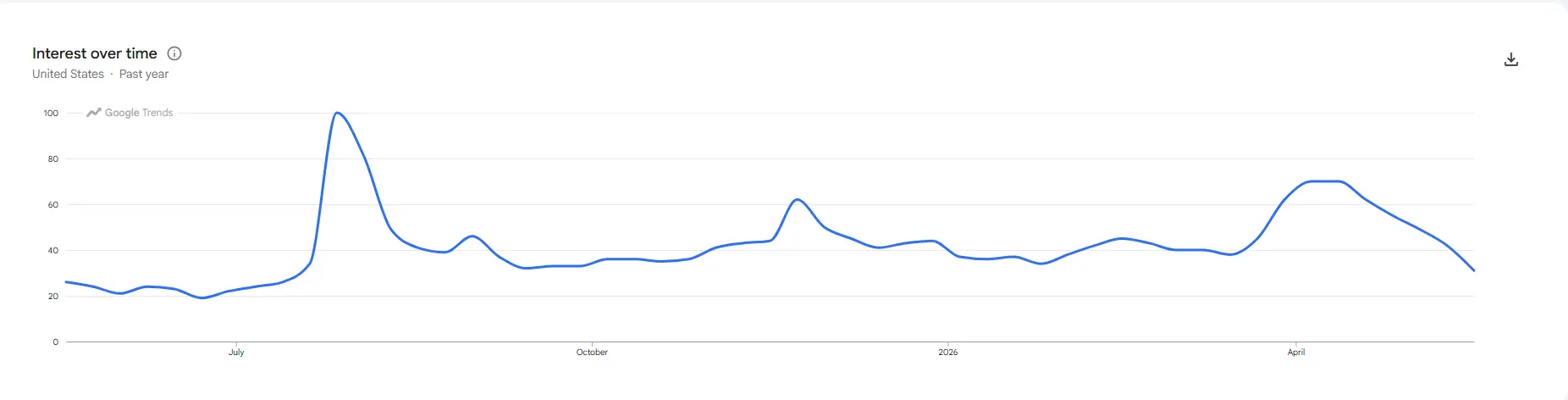
A popular example is Sydney Sweeney's controversial "She Has Great Jeans" ad for American Eagle.
While the ad drove endless discussions on socials, it's safe to say that most of the conversations were negative. The late July spike is the time the ad dropped.
Sentiment analysis becomes much more useful when combined with:
- topic analysis
- engagement patterns
- source quality
- trend monitoring
- customer experience data
A brand experiencing negative sentiment around customer service may still maintain positive sentiment around product quality. Looking only at aggregate sentiment scores can hide operational problems inside specific parts of the customer experience.
AI Classification Accuracy Still Has Limits
AI sentiment analysis systems continue improving, but they still struggle with emotional ambiguity and fragmented online conversations.
People regularly express mixed opinions in the same post:
“The product is great, but support was terrible.”
Some models may classify that as neutral even though the complaint itself is important operationally.
Conversation fragmentation also creates challenges. Customers may discuss the same issue differently across TikTok, Reddit, YouTube, reviews, and support channels. Sentiment systems need to connect those conversations together to identify broader perception trends accurately.
Sentiment analysis works best when brands treat it as a decision-support system rather than a fully autonomous source of truth.
Brand Sentiment Analysis Is Becoming a Real-Time Reputation System
Brand sentiment analysis has evolved far beyond social listening dashboards and keyword monitoring. Modern brands now use sentiment intelligence to understand how customers react to campaigns, products, creators, customer experiences, and public controversies in real time.
AI-powered search experiences have expanded that responsibility even further, turning public conversations into visible reputation signals that influence trust and discovery across the internet. Marketing teams can no longer rely only on engagement metrics or mention volume to understand brand health accurately.
Emotional context matters more. Brands that actively monitor sentiment trends, identify reputation risks early, and respond to shifting customer perception faster are better positioned to protect trust, improve customer experience, and make more informed strategic decisions in increasingly AI-driven digital environments.
Frequently Asked Questions
What is brand sentiment analysis?
Brand sentiment analysis measures how people feel about a brand by analyzing conversations across social media, reviews, forums, surveys, and other digital channels.
How does brand sentiment analysis work?
Sentiment analysis uses AI and natural language processing (NLP) to classify conversations as positive, negative, or neutral based on emotional tone and context.
Why is brand sentiment analysis important?
Brand sentiment analysis helps marketers understand customer perception, detect reputation risks earlier, monitor campaign reactions, and improve customer experience strategies.
What data sources are used in sentiment analysis?
Most sentiment analysis systems analyze data from social media platforms, online reviews, customer surveys, forums, support tickets, creator content, and news coverage.
What is a sentiment score?
A sentiment score measures the balance between positive and negative conversations about a brand over a specific period of time.
What is the difference between social listening and sentiment analysis?
Social listening tracks brand mentions and conversations, while sentiment analysis evaluates the emotional tone behind those conversations.
How accurate is AI sentiment analysis?
Modern AI sentiment analysis systems are much more accurate than older keyword-based models, but sarcasm, slang, emojis, and cultural context can still create classification challenges.
How does AI search affect brand sentiment?
AI-generated search experiences like ChatGPT, Claude, Gemini, Perplexity, and Google AI Overviews increasingly summarize public opinions from reviews, forums, and online discussions, making sentiment more visible across search experiences.