
Most affiliate managers measure their program by the number of people in it.
That number is easy to grow. Run another outreach campaign, and it goes up. Report it in a monthly update, and it looks like progress.
The problem is that it tells you almost nothing about whether the program is working. You can have 500 affiliates and a retention problem. You can have 80 affiliates and a retention problem. The number of people with links says nothing about the number of people who are actively promoting your brand.
Let's discuss a faster diagnostic you can apply today. Divide your total affiliate revenue from last month by your total number of active affiliates.
That number is your Revenue Per Affiliate, or RPA.
- If your RPA is growing quarter over quarter, it means your retention is working.
- But if it's flat or declining while your affiliate count is rising, you're recruiting to fill a hole.
Every new person you onboard is replacing someone who dropped off. While the top of the funnel might look busy, the bottom is leaking.
This article is about the bottom.
- The Recruitment Loop That Goes Nowhere
- RPA: The Number That Tells You If Your Program Is Growing or Spinnin
- Why Affiliates Stop Posting
- Give Affiliates a Ladder
- Make Their Performance Visible to Them
- Fix the Friction Before Anything Else
- Pay Automatically, Every Time, Without Being Asked
- The Check-Up Your Program Needs Every Quarter
The Recruitment Loop That Goes Nowhere
Here's what the cycle looks like in most programs.
You onboard 50 affiliates. Send the welcome email, share the links, explain the commission structure. A handful post in the first two weeks. Pull up your dashboard three months later and eight of them are still active.
The instinct when this happens is to recruit more. More outreach, more people in the pipeline. It feels like the right move because, on paper, affiliate marketing is a numbers game.
More people posting = more reach = more sales.
But if affiliates are dropping off, adding more of them will never fix the leak. What happens is that you end up running an expensive recruitment loop: bring in 50, keep 8, recruit again, keep another 8. The math never improves because the problem is downstream of recruitment. Something happens after affiliates join that makes them stop.
The brands that build affiliate into a real revenue channel are not recruiting better, or not only that. They spend as much energy on what happens after onboarding as they do on finding people in the first place.
RPA: The Number That Tells You If Your Program Is Growing or Spinnin
Before getting into fixes, it's worth understanding what active means in practice.
A program with 500 affiliates, each posting once, is generating 500 pieces of content. A program with 50 affiliates who each post ten times a year generates the same output. But those two programs perform differently.
The second one compounds. An affiliate who posts repeatedly builds a track record with their audience:
- The first post is a mention.
- The fifth post is a recommendation that their followers have context for.
- The tenth is a habit for both the affiliate and the audience, paying attention to them.
Trust builds with repetition, and affiliate marketing is fundamentally a transfer of trust between an affiliate and their community. One well-placed recommendation from someone an audience has followed for three years is worth twenty disconnected mentions from affiliates who posted once and disappeared.
Affiliate marketing also costs nothing upfront.
You pay for impressions on Meta, for clicks on Google, and for sales through affiliates. Come to think about it, a dormant affiliate is a missed opportunity. And a churned affiliate is your sunk cost: the outreach time, the product you seeded, the onboarding call, and the relationship you built to get them started.
RPA captures all of this in one number. High RPA means your existing affiliates are earning and active. A low RPA with a large affiliate list indicates noise, and most of your affiliates have effectively left without telling you.
The formula is simple:
Track it every quarter.
Why Affiliates Stop Posting
Churn rarely comes down to one thing, but the reasons show up in patterns:
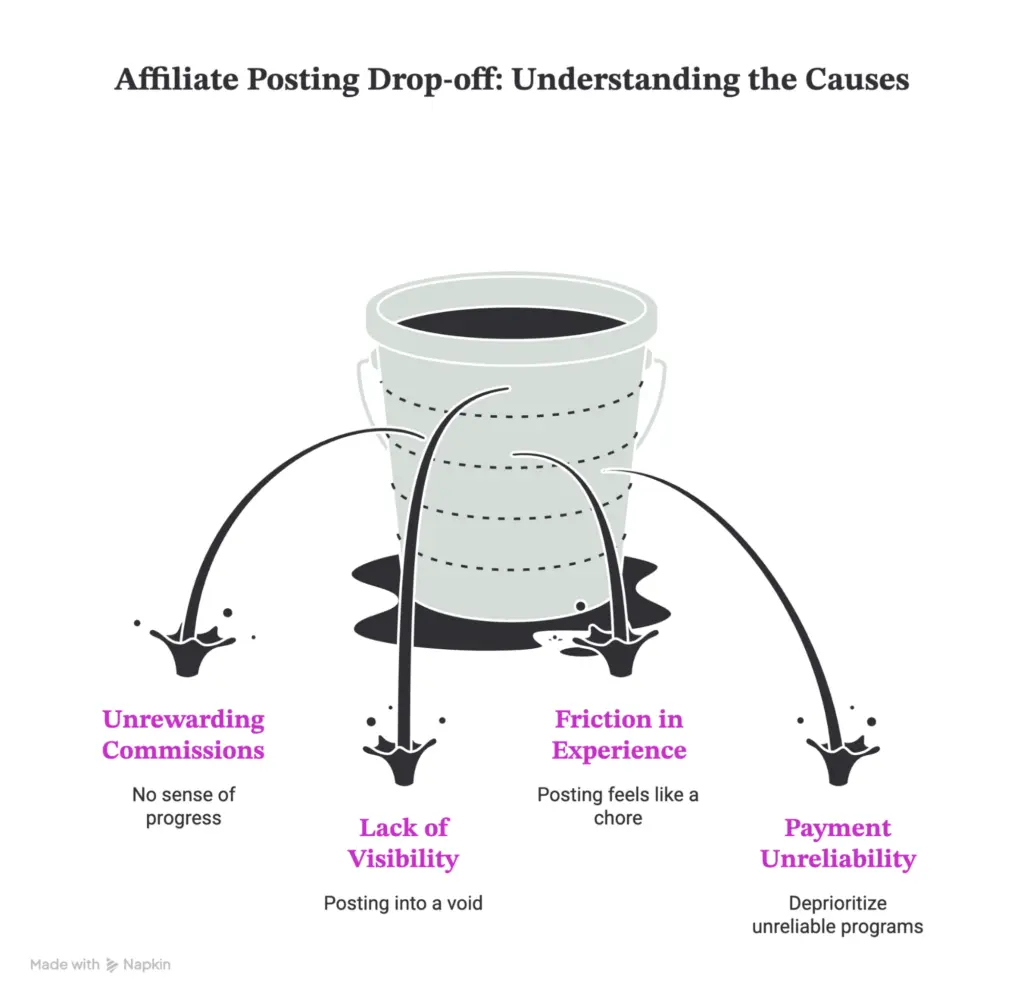
- There's nothing to work toward. A flat commission rate is enough to get someone through the door. It is not enough to keep them posting six months later. If there's no milestone to hit, no tier to unlock, no sense of progress, posting starts to feel optional. People deprioritise optional things.
- They can't see how they're doing. An affiliate who can't check their clicks, commissions, and progress toward the next milestone is posting into a void. They don't know if what they're doing is working. They don't know how close they are to anything. Over time, that absence of feedback kills momentum.
- The experience you built for them has friction. A clunky dashboard, login details they have forgotten, a link they have to email someone to get, or a commission structure that takes three reads to understand: all increase the cognitive load of posting for your brand. And when it feels like admin work, people find reasons not to.
- They don't trust they'll get paid. An affiliate who has had to chase a payment, or who knows someone else who did, deprioritizes that program. Active affiliates often run partnerships with multiple brands at once. The ones that feel professional and predictable get their attention. The ones that require follow-up to claim commissions already earned do not.
Give Affiliates a Ladder
A commission rate is a floor. It's the minimum someone needs to say yes. What keeps people posting six months in is having somewhere to go.
The first milestone is the most important to get right. It needs to be achievable for a brand-new affiliate, not only your top performers. If the first reward unlocks at 100 sales and most of your affiliates average eight, nobody bothers trying for it. The goal is for a new affiliate to hit something early, feel the reward, and want to repeat the behaviour.
A practical structure looks like this:
| Milestone | Reward |
| First $100 in sales | Free product or $50 cash bonus |
| $1,000 in cumulative revenue | Commission moves from 15% to 20% |
| $5,000 in cumulative revenue | $500 bonus + early product access tier |
Time-bound challenges work well when layered on top of this
To give you an example:
"Post three times in the next two weeks while our summer sale is running and earn a $200 bonus" gives affiliates:
- a defined target
- a reward, and
- a deadline that creates urgency.
... that drives short-term activation during the moments when you need it most.
The top commission number matters less than the distance between the rungs. Each step should feel one level away from where someone currently is.
A tool like SATHI lets you set these rules once inside your campaign settings and automate them from there. You can define the trigger (like: sales crossing a threshold, a number of orders, posts in a set period), choose the reward (like: a cash bonus, a free product, a tier upgrade), and the platform tracks and executes it without manual intervention from your team. When a milestone is hit, the affiliate is automatically notified, and the reward is triggered.

A UK-based beverage brand running a 500-affiliate program used SATHI to add milestone bonuses tied to their summer campaign. Three posts in 30 days unlocked a cash bonus. Their affiliate activity rate went from under 25% to above 60% during that window, and held above 40% for the two months that followed. Their affiliate count barely changed. What changed was how many of their existing affiliates consistently posted each month.
Make Their Performance Visible to Them
Transparency is an underused retention lever, and one of the cheapest available.
When an affiliate logs into their dashboard and can see:
- Their clicks and conversion rate
- Commissions earned this period
- Distance to the next milestone or tier
- What they need to do to unlock the next reward
...they have a reason to check back in. That visibility creates a feedback loop that self-reinforces: good performance shows up in the dashboard, the affiliate sees it, they post more.
When that information is hard to find, buried behind a forgotten login or requiring a request to your team, the program becomes a black box. They're posting into something they can't see. That is when they start to drift.
Fix the Friction Before Anything Else
Audit your affiliate experience the same way you'd audit a checkout flow. Every unnecessary step is a step they might not complete.
Three things worth checking first:
- Link access. Can an affiliate get to their link without emailing anyone? If the answer is no, fix this before anything else. A difficult link-retrieval process does not just waste 2 minutes. It signals that the program is not particularly well-run, which affects how much effort an affiliate puts in.
- Commission clarity. Can a new affiliate, in under sixty seconds, answer the question "what do I earn and when?" If the structure requires interpretation, simplify it.
- Payout timing. Is there a stated payout schedule? Does it run automatically? Affiliates who have had to chase a payment once remember it. The ones running partnerships across multiple brands will quietly route more of their attention to whoever pays them without friction.
None of these is an exciting improvement. But they are the foundation on which everything else rests.
Pay Automatically, Every Time, Without Being Asked
This is the baseline. Everything above it is optimization. Below it, nothing else matters.
Affiliates who are active across multiple brand partnerships allocate their efforts to the programs that feel professional. A payout that required a follow-up email tells an affiliate something about how seriously you take the relationship. They remember it, and they do not prioritise you the same way afterwards.
Automated payouts that run on a predictable schedule, without anyone needing to trigger them manually, remove the single most common reason affiliates start to question whether a program is worth their time.
There is also a compounding effect that's easy to overlook. Affiliates who trust that their payment is coming do not have to think about it. That attention goes toward posting, which is exactly where you want it.
The Check-Up Your Program Needs Every Quarter
Come back to RPA.
Take your total affiliate revenue for the quarter and divide by the number of affiliates who drove at least one sale during that period. Compare it to last quarter.
- RPA is rising: your retention work is compounding. Existing affiliates are posting more, earning more, and staying in the program.
- RPA is flat while affiliate count grows: you have a replacement problem. New affiliates are substituting for ones who dropped off, not adding to the program.
- RPA is falling: your program has structural issues that recruitment will not solve.
A large program with a low RPA is a list, not a growth asset. Most of the people on it have already moved on. The right response is to identify your ten or twenty highest-performing affiliates, understand what's keeping them active, and build the program around what's working for them. That might mean:
- Rethinking the first milestone so it's achievable in week one.
- Rewriting the affiliate dashboard so performance is visible at a glance.
- Automating payouts that currently require manual intervention every month.
The specifics will vary by program but the signal is the same. If your RPA is not growing, a leak is confirmed, and recruiting harder is not going to close it.


