

Knowing how to grow your Pinterest account requires a different approach than most social platforms.
That's because Pinterest operates as a visual search engine used by as many as 86 million Americans. On Pinterest, content is indexed, ranked, and distributed based on relevance.
Growth comes from creating pins that align with search intent, optimizing them for discovery, and consistently publishing content that earns saves and clicks.
Many accounts struggle because they focus on surface-level tactics instead of understanding how distribution works.
As such, learning how to get followers on Pinterest starts with visibility. When pins appear in search results and recommendations, engagement increases, and followers become a natural byproduct of that exposure.
This guide looks at the proven ways to grow your Pinterest followers and, by default, your Pinterest account.
Why Most Pinterest Accounts Don’t Grow
Many Pinterest accounts fail to grow because they rely on habits borrowed from platforms like Instagram or TikTok. Posting occasionally, focusing on aesthetics alone, or expecting immediate traction leads to limited distribution and low engagement.
A common issue is the absence of keyword optimization. Pinterest relies heavily on search signals, meaning pins without clear, relevant keywords rarely surface in results. Titles and descriptions that lack intent-driven phrasing reduce the chances of being indexed and shown to users actively searching for content.
Inconsistent publishing is another limiting factor. Pinterest prioritizes fresh content, and accounts that post sporadically generate fewer opportunities for distribution. Each new pin acts as a separate entry point into the platform’s ecosystem.
Content structure also plays a role. Pins that fail to communicate value quickly tend to be ignored. Weak headlines, unclear visuals, or generic messaging reduce click-through rates and saves, which are key signals for further distribution.
Finally, many users misunderstand how followers are gained on Pinterest.
Unlike traditional social media, follower growth is not driven by direct engagement tactics. Users follow accounts after discovering valuable content through search or recommendations. Without consistent visibility, even high-quality content struggles to convert into followers.
Understanding these limitations is essential before applying any growth strategy.
How Pinterest Growth Actually Works
As already established, Pinterest growth is driven by content distribution at the pin level.
Each pin operates as a standalone asset that can rank, surface, and scale independently. Growth happens when multiple pins consistently enter Pinterest’s distribution system and perform well.
To understand how to grow your Pinterest account, it helps to break the system into three stages:
1) Indexing: How Pinterest Understands Your Content
Every pin is analyzed before it is distributed.
Pinterest uses:
- Pin title
- Description
- Board name
- Visual elements (text overlays, objects, context)
The goal is simple: determine what the pin is about and which searches it should appear in.
If keyword alignment is weak or unclear:
- The pin may never enter search results
- Distribution is limited from the start
What this means in practice:
Pins should target one clear search intent. Broad or vague descriptions reduce visibility. Specific, intent-driven phrasing increases the chances of being indexed correctly.
2) Initial Distribution: Where Your Pin First Appears
Once indexed, Pinterest tests the pin in small placements:
- Search results
- Home feed
- Related pins
At this stage, reach is limited. Pinterest is evaluating whether users interact with the content.
Key signals include:
- Saves
- Clicks
- Close-ups
These signals determine whether the pin moves forward or stalls.
3) Expansion: How Pins Scale
Pins that perform well in testing are pushed further into distribution.
This includes:
- Wider search visibility
- More frequent home feed placements
- Increased presence in related content
Poor performance leads to the opposite outcome. Distribution slows down, regardless of how often you post.
Important distinction
Posting more content does not guarantee growth. Publishing more performing content does.
What Drives Distribution, Follower Growth, and Long-Term Results
Pinterest rewards accounts that continuously introduce new, relevant content into its system.
The platform prioritizes fresh pins because each one represents a new opportunity to match user intent and generate engagement. Reposting the same asset without variation limits reach, while creating multiple versions of the same idea increases the chances of entering different search queries and recommendation feeds.
A single piece of content can support a broader distribution strategy when approached correctly. High-performing accounts develop several variations that target different keywords, visual styles, and messaging angles.
Each variation is treated as a separate asset by Pinterest, which expands the number of opportunities to gain impressions and engagement. Over time, this approach compounds, as more pins enter circulation and continue to resurface based on performance.
Scaling this process manually becomes difficult as volume increases. Managing multiple boards, scheduling pins consistently, and testing variations across accounts requires an operational structure.
Tools like GeeLark are designed for this stage, allowing teams to manage multiple Pinterest accounts, automate publishing workflows, and maintain consistent activity without relying on manual execution. The role of these tools is not to replace strategy, but to support the level of output required for sustained growth.
Visibility is what drives follower growth on the platform. Most users discover content through search or recommendations rather than by visiting profiles.
When a pin consistently appears in relevant contexts and delivers value, users are more likely to engage with additional content and eventually follow the account. Growth, in this sense, is driven by repeated exposure rather than isolated interactions.
This is the blueprint you should be following. Instead of optimizing for follower count, the focus shifts toward maximizing distribution and engagement at the pin level. Accounts that generate consistent visibility across multiple pins create a steady flow of impressions, leading to more saves, clicks, and ultimately more followers.
But here's the catch. Sustained growth comes from reinforcing this cycle.
Keyword-aligned pins enter the system, engagement signals determine their reach, and high-performing content continues to surface over time. Each new pin contributes to this process, increasing the overall probability of success.
Accounts that treat Pinterest as a scalable content engine, rather than a posting platform, tend to achieve more consistent and predictable growth.
Pinterest SEO Strategy That Drives Growth
At the end of the day, visibility starts with optimization. Remember, Pinterest is a visual search engine, so focusing on optimization is a must.
Pinterest SEO determines whether your content is seen at all. Every pin competes for placement in search results and recommendations, and keyword alignment is what allows the platform to match your content with user intent. Without it, even well-designed pins fail to generate impressions.
Growth on Pinterest is directly tied to search visibility. Accounts that consistently target the right keywords generate more impressions, which leads to more saves, clicks, and ultimately more followers.
Here's a breakdown of how you should do Pinterest SEO.
Step 1: Find Keywords With Real Demand
Keyword research on Pinterest starts inside the platform.
The search bar reveals how users actually phrase their queries. Typing a broad term surfaces autocomplete suggestions, which represent real search behavior. These suggestions are one of the most reliable indicators of demand.

A simple workflow:
- Start with a broad topic
- Note autocomplete variations
- Click into results and review related keyword tiles
For example:
- Broad term: “Backyard DIY”
- Expanded queries:
- Backyard DIY ideas
- DIY ideas to transform your backyard
- How to build a DIY backyard oasis
Each variation reflects a different level of intent. Targeting these variations individually increases the likelihood of ranking.
Step 2: Turn Keywords Into Searchable Pin Concepts
Keywords alone are not enough. Each keyword needs to be translated into a clear content angle.
A common mistake is using a keyword without aligning the visual or message to it. Pinterest evaluates both text and image context. Misalignment reduces engagement, which limits distribution.
Instead of creating one pin per topic, develop multiple concepts:
- “Backyard DIY ideas” → list-style visual
- “How to transform your sad backyard” → educational guide
Each concept targets a different segment of search intent, even if the underlying content is similar.
Step 3: Place Keywords Where Pinterest Actually Looks
Pinterest relies on specific fields to understand and rank content. Placement directly impacts indexing.
Keywords should appear in:
- Pin title: Carries the strongest weight for search visibility. The primary keyword should appear naturally and early.
- Pin description: Provides additional context. Secondary keywords and variations should be included without keyword stuffing.
- Board name and description: Reinforces topical relevance. Pins placed in well-optimized boards are easier to categorize and rank.
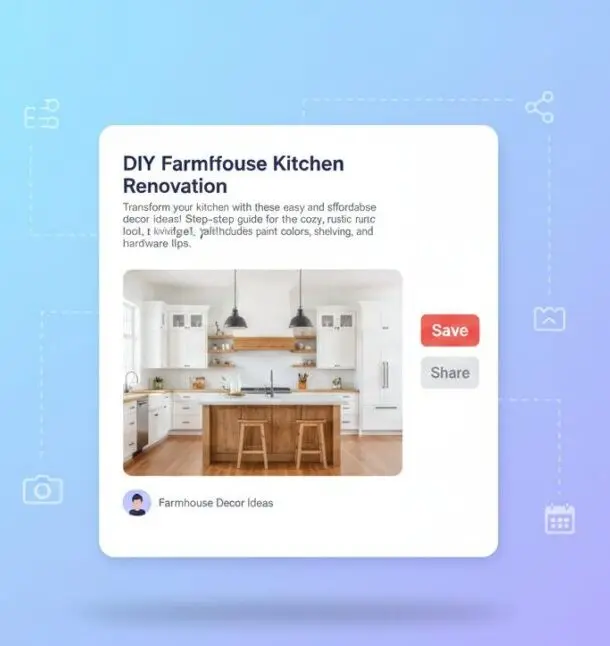
Here's an example of a Pinterest Pin that achives this to perfection:
From this, we can conclude that weak or inconsistent placement creates ambiguity. When Pinterest cannot clearly identify the topic, distribution is reduced.
Step 4: Use Long-Tail Keywords to Rank Faster
Broad keywords are highly competitive. New or growing accounts benefit from targeting more specific queries.
Long-tail keywords:
- Reflect clearer intent
- Face less competition
- Convert better into engagement
For example:
- Broad: “Backyard DIY tips”
- Long-tail: “DIY tips to transform your sad backyard”
The second version is more aligned with user intent and easier to rank for. Over time, consistently targeting these variations builds visibility across a wider set of searches.
Step 5: Build Topical Authority Over Time
Pinterest rewards consistency within a niche.
Accounts that repeatedly publish content around related keywords become easier to categorize. This increases the likelihood of ranking across multiple searches within that topic.
Instead of covering unrelated subjects, focus on:
- A defined niche
- A consistent set of keyword themes
- Repeated coverage of high-performing topics
This creates a compounding effect. As more pins rank within the same topic, overall visibility increases.
How Pinterest SEO Translates Into Followers
Pinterest SEO is the entry point to growing your account on the platform. When pins rank for relevant searches:
- Impressions increase
- Engagement signals improve
- More users discover your content
As a result, you're growing your Pinterest followers and, subsequently, growing your Pinterest account.
But you're not done yet. Ongoing optimization is the backbone of any successful SEO strategy, even on Pinterest. As search behavior shifts, so do performance across your pins. Therefore, tracking impressions, saves, and clicks for each keyword allows for refinement over time.
You can always replace or remove underperforming keywords. High-performing keywords, on the other hand, can be expanded into new pin varaitions.
How to Get Followers on Pinterest (What Actually Works)
Given everything said above, what actually moves follower count on Pinterest?
Follower growth on Pinterest is not triggered by direct actions. It is the result of how often your content is seen, how consistently it delivers value, and how clearly it signals relevance to a specific audience.
Accounts grow when users encounter multiple useful pins over time and decide the content is worth following.
Distribution Creates the Opportunity to Gain Followers
Most users do not visit profiles intentionally. They discover content passively while browsing search results and recommendations. A single impression rarely leads to a follow. Growth depends on how often your content appears in front of the same type of user.
Accounts that gain followers consistently tend to show up repeatedly within a specific topic. That repeated visibility builds familiarity. When users recognize a pattern of useful content, they are more likely to engage further and eventually follow.
Action step:
Focus on publishing multiple pins around the same topic or keyword cluster within a short timeframe to increase repeated exposure to the same audience.
Consistency Increases the Number of Conversion Moments
Follower growth is tied to how many chances you create for a user to convert.
Publishing one or two pins per week limits exposure. Even strong content struggles to build momentum when output is low. Increasing frequency expands the number of moments where a user can discover your content, engage with it, and return to it later.
Consistency also reinforces recognition. When similar content appears over time, it becomes easier for users to associate that content with a single source. That recognition plays a direct role in whether they choose to follow.
Action step:
Set a fixed publishing cadence, such as daily or near-daily pinning, and maintain it for at least 30 days to build momentum and recognition. For this, consider using dedicated Pinterest publishing and scheduling apps.
Clear Positioning Improves Follow Rate
Users follow accounts that consistently deliver a specific type of value.
When content spans multiple unrelated topics, it becomes harder for Pinterest to match it with the right audience and harder for users to understand what they will get by following.
Accounts that grow steadily tend to focus on a narrow set of themes. Each pin reinforces that positioning, making it easier for the platform to recommend the content and easier for users to decide whether the account is relevant to them.
Follower growth improves when content serves a clearly defined audience, topics remain consistent, and value is easy to identify at a glance.
Action step:
Define 2 to 3 core content themes and ensure at least 80% of your pins align with those themes.
Repetition Drives Conversion, Not Single Interactions
Pinterest does not operate on one-touch conversion. A user rarely follows after seeing one pin, even if it performs well.
Follower growth happens through repeated exposure. A user may save one pin, encounter another a few days later, and click through a third. At that point, the pattern becomes clear. The account is associated with a consistent value, which increases the likelihood of a follow.
This is why isolated high-performing pins do not always translate into sustained growth. Without repetition, there is no reinforcement.
Action step:
Create multiple pins for the same topic over time instead of relying on a single post, spacing them out across days or weeks.
Volume Increases the Likelihood of Finding What Converts
Testing, testing, and more testing!
Every pin introduces a new opportunity to reach users and test what resonates. Some pins generate saves, others generate clicks, and a smaller number lead to profile visits and follows.
Accounts that grow faster tend to produce more content within a defined structure. Increasing output makes it easier to identify which types of pins lead to deeper engagement and which ones fail to convert.
Over time, patterns emerge. Certain formats attract more saves, certain messages drive more clicks, and certain topics generate more follows. Growth accelerates when those patterns are repeated and scaled.
Action step:
Track your top-performing pins each week and create new variations based on the same format, message, or topic.
What Does Not Lead to Sustainable Follower Growth
Many tactics that work on other platforms have little impact on Pinterest.
Direct engagement strategies, such as following other accounts in hopes of a return follow, do not influence distribution. Pinterest does not prioritize reciprocal behavior in the same way as traditional social platforms.
Relying on a small number of pins also limits growth. Even strong-performing content has a ceiling. Without additional pins entering the system, reach plateaus and follower growth slows.
Short-term spikes, including occasional viral pins, can generate temporary increases in followers. However, without consistent output, that growth is difficult to sustain.
Avoid this!
Stop using follow-for-follow or manual engagement tactics and redirect that time toward creating and publishing more optimized pins.
How to Grow Your Pinterest Account With a System That Scales
Growing a Pinterest account is not about shortcuts or isolated tactics. It comes down to building a system that consistently produces searchable content, earns engagement, and reinforces a clear content direction over time.
Pinterest rewards alignment. Pins that match user intent, deliver immediate value, and are published consistently are more likely to surface in search and recommendations. As visibility increases, engagement follows, and follower growth becomes a natural outcome rather than a forced objective.
Sustained growth requires repetition and refinement. High-performing patterns should be expanded, underperforming ones replaced, and content output maintained at a steady pace. Accounts that treat Pinterest as a long-term distribution channel, rather than a posting platform, tend to see the most consistent results.
Frequently Asked Questions
How do I grow my Pinterest account fast?
Short-term growth comes from increasing content output and targeting long-tail keywords with clear intent. Faster results typically come from publishing more pin variations within a focused niche rather than relying on a small number of posts.
How do I get followers on Pinterest?
Followers come from repeated exposure to valuable content. When users consistently encounter helpful pins in search and recommendations, they are more likely to engage with multiple posts and follow the account over time.
How do I get more followers on Pinterest without paying?
Organic growth depends on keyword alignment, consistent publishing, and strong engagement signals. Pins that rank in search and generate saves and clicks continue to drive visibility without requiring paid promotion.
How often should I post on Pinterest to grow?
Consistent activity is more important than exact volume. Accounts that publish daily or near-daily tend to generate more distribution opportunities than those posting sporadically.
Why am I not getting followers on Pinterest?
Common reasons include low visibility due to weak keyword targeting, inconsistent posting, or unclear content positioning. Without consistent distribution, even high-quality pins struggle to convert into followers.
Do Pinterest followers matter for growth?
Follower count has less impact on reach compared to other platforms. Most impressions come from non-followers discovering content through search and recommendations. Followers are a result of visibility, not the driver of it.
How long does it take to grow on Pinterest?
Initial traction can take several weeks, while consistent growth often becomes visible after a few months. Pinterest content can continue generating traffic long after it is published, which supports long-term growth.
What type of content performs best on Pinterest?
Content that solves a specific problem or delivers a clear outcome tends to perform best. Pins that align closely with search intent and communicate value quickly are more likely to generate saves, clicks, and distribution.

SUGGESTED

41 Important Pinterest Statistics for Marketers in 2024
Explore 41 key Pinterest statistics for marketers in 2024 to optimize your strategy and...

The Ultimate Step-by-Step Pinterest SEO Guide
This is a guide to Pinterest SEO that will help your images and their surrounding text...

Pinterest Publishes Four-Step Framework to Optimize Pin Listings
Pinterest’s Path to Performance guide introduces a four-step framework to help...