
The problem with many influencer marketing tips is that they often focus on surface-level tactics. But brands that see consistent results treat influencer marketing as a structured, performance-driven channel.
According to our benchmark data, the industry reached $32.55 billion last year, with 85% of marketers reporting it as an effective strategy. Growth for 2026 is expected, with 72% of marketers scaling their influencer marketing budgets by more than 50%.
As such, running successful influencer marketing campaigns now requires more than selecting creators and launching posts. It demands clear strategy, repeatable execution, and measurable outcomes.
The following guide breaks down what influencer marketing looks like today and introduces practical tips brands use to drive real results, not just engagement.
Estimate Your Potential Influencer Marketing ROI
Before applying the tips below, use inBeat’s Influencer Marketing ROI Calculator to establish a performance benchmark. Enter your campaign budget, average followers per influencer, and planned number of Stories, posts, and videos to generate an instant ROI estimate.
You can adjust the inputs to compare campaign setups, then validate the estimate using conversion, revenue, and acquisition data once the campaign launches.
What Influencer Marketing Actually Means Today
Influencer marketing has evolved far beyond its original definition as a brand awareness tactic powered by social media personalities. At its core, influencer marketing refers to partnerships between brands and creators who produce content designed to influence audience behavior, whether that means driving purchases, shaping perception, or increasing engagement.
That definition still holds, but the way brands approach execution has changed significantly.
Modern influencer marketing operates within a broader performance marketing ecosystem. Campaigns are no longer judged solely on reach or impressions. Instead, brands evaluate outcomes such as conversion rates, content efficiency, customer acquisition cost, and the ability to scale winning creative.
The shift aligns influencer marketing more closely with paid media and social advertising, where testing, iteration, and optimization are essential.
The rise of platforms like TikTok, Instagram Reels, and YouTube Shorts has also redefined the role of creators.
Content format now matters as much as the creator behind it. High-performing influencer campaigns often rely on repeatable formats such as product demonstrations, storytelling hooks, or problem-solution narratives that can be tested across multiple creators.
As a result, brands are placing greater emphasis on influencer content strategy, focusing on how content is structured rather than relying solely on audience size.
Another key development is the separation between content creation and distribution. Many brands now work with creators to produce content assets without requiring them to publish on their own channels.
These assets are then deployed through paid advertising, brand-owned social accounts, or eCommerce product pages. This approach turns influencer marketing into a scalable content engine rather than a one-time promotional tactic.
Social media influencer marketing has also become more integrated with commerce. Features like in-app shopping, affiliate links, and creator storefronts allow brands to connect influencer campaigns directly to revenue.
Taken together, these changes redefine influencer marketing as a system built on three core pillars: content, distribution, and measurement. Brands that understand this structure are better positioned to move beyond isolated campaigns and build programs that consistently generate results.
Why Most Influencer Marketing Tips Fail
Most influencer marketing tips sound useful, but break down in execution. Advice often stays high-level, leaving brands without a clear path to consistent results.
- Overvaluing Reach: Follower count drives decisions, but engagement quality and audience relevance determine actual performance and conversions.
- One-Off Campaign Thinking: Isolated influencer campaigns lack continuity, making results difficult to replicate or scale over time.
- Weak Content Strategy: Creative ideas are prioritized over repeatable formats, limiting the ability to test, refine, and scale winning content.
- Poor Measurement: Metrics like likes and views are tracked without tying them to business outcomes such as revenue or customer acquisition.
- Lack of Integration: Influencer marketing operates separately from paid media, social, and eCommerce, reducing overall campaign impact.
These gaps highlight a core issue. A strong influencer marketing strategy depends on systems that connect creators, content, distribution, and measurement into a unified approach.
5 Influencer Marketing Tips That Actually Drive Results
Strong influencer marketing tips are not about isolated tactics. Results come from how brands structure campaigns, test content, and scale what works. The following approaches reflect how high-performing teams treat influencer marketing as a repeatable growth channel.
1. Treat Influencer Marketing as a Performance Channel
Many brands still approach influencer marketing as a visibility play. That approach limits its impact.
High-performing teams treat influencer marketing the same way they treat paid media. Every campaign is tied to outcomes such as conversions, revenue, or customer acquisition.
Our data consistently shows that brands generate strong returns, with average ROI often exceeding $5.78 for every $1 spent. That level of efficiency only becomes possible when campaigns are built around measurable goals.
Execution starts with defining clear KPIs before any creator is selected. Metrics such as cost per acquisition, click-through rate, or revenue per post provide a much clearer picture than likes or impressions. Tracking mechanisms like unique links, discount codes, and platform attribution tools make it possible to connect content directly to results.
Performance-driven influencer campaigns work best when there is a clear path from content to conversion. Results tend to fall short when success is defined by engagement alone, without any connection to business outcomes.
2. Prioritize Repeatable Content Formats Over One-Off Campaigns
Content drives performance more than creator selection alone. One strong post rarely translates into consistent results.
Brands that scale influencer marketing focus on identifying formats that can be repeated and improved over time. Some highly successful formats include:
- Product demonstrations
- Problem-solution narratives
- Short-form storytelling
These formats allow teams to test variations, refine messaging, and apply winning structures across multiple creators. Here's an example of one of these formats in action.
@ariellelorre nighttime skincare but ok WHO has tried P-tiox? Im kind of obsessed? We need to discuss 😯
Our data shows that 70% of shoppers act on creator recommendations for product discovery, especially on short-form platforms. That advantage increases when brands move from isolated ideas to structured content systems.
Execution requires shifting focus away from chasing virality. Instead of relying on a single post to succeed, high-performing campaigns test multiple variations across creators, then scale what works. Campaigns struggle when every activation starts from scratch with no connection to previous learnings.
3. Use Micro-Influencers for Testing Before Scaling
Testing is one of the most overlooked advantages of influencer marketing.
Micro-influencers offer a cost-efficient way to validate content, messaging, and audience response before committing larger budgets. Smaller creators typically deliver higher engagement rates and allow brands to run multiple variations without significant financial risk.
A structured testing approach involves launching campaigns across several micro-influencers, each using different hooks, formats, or messaging angles. Performance is evaluated at the content level rather than the creator level. Once a pattern emerges, brands can scale winning creatives through larger influencers or paid distribution.
This approach reduces guesswork and shortens the time needed to identify what resonates. Results tend to be inconsistent when brands skip testing and invest heavily in a single creator or concept without prior validation.
4. Separate Content Creation From Distribution
Influencer marketing is no longer limited to what creators post on their own channels.
Many brands now treat creators primarily as content producers. Instead of relying solely on organic reach, they use influencer-generated content across paid ads, brand social channels, and eCommerce experiences.
This shift turns influencer marketing into a scalable content engine.
Execution begins with securing usage rights. High-performing teams ensure that content can be repurposed across multiple channels. Paid amplification plays a critical role, allowing brands to extend reach and target specific audiences using proven creative.
This model works particularly well in performance-driven campaigns, where content quality matters more than audience size. Results are often limited when campaigns depend entirely on influencer posting without any amplification or reuse strategy.
5. Build an Always-On Influencer Program
Consistency separates high-performing influencer marketing strategies from short-term experiments.
One-off campaigns rarely produce reliable results because they lack continuity and learning cycles. Always-on programs, on the other hand, allow brands to continuously test, optimize, and scale.
Our 2026 Influencer Marketing Benchmark Report found that a 6.5% of marketers are shifting budgets toward long-term creator partnerships rather than single activations.
An always-on approach involves maintaining a steady pipeline of creators, content, and campaigns. Relationships with high-performing influencers are extended over time, allowing for better alignment, stronger content, and improved performance.
Sustained success comes from iteration. Campaigns improve as more data is collected, formats are refined, and distribution strategies are optimized. Performance tends to plateau when influencer marketing is treated as a one-time initiative instead of an ongoing system.
Tools and Platforms That Help Execute Influencer Marketing at Scale
Execution at scale requires more than strategy. Influencer marketing becomes significantly more efficient when supported by the right mix of platforms, especially as campaigns expand across creators, formats, and channels.
The tools below align with different stages of the system outlined earlier, from managed execution to discovery, collaboration, and measurement.
Managed Influencer Marketing Platforms
Some brands prefer not to build everything in-house. Managed platforms combine strategy, creator sourcing, and campaign execution into a single model designed to deliver outcomes.
Solutions like Linqia focus on performance-driven campaigns, where creator selection, content production, and distribution are handled within a structured framework. This approach is particularly useful for brands that prioritize measurable results and consistent content output without managing every operational detail internally.

- Source: Linqia.com
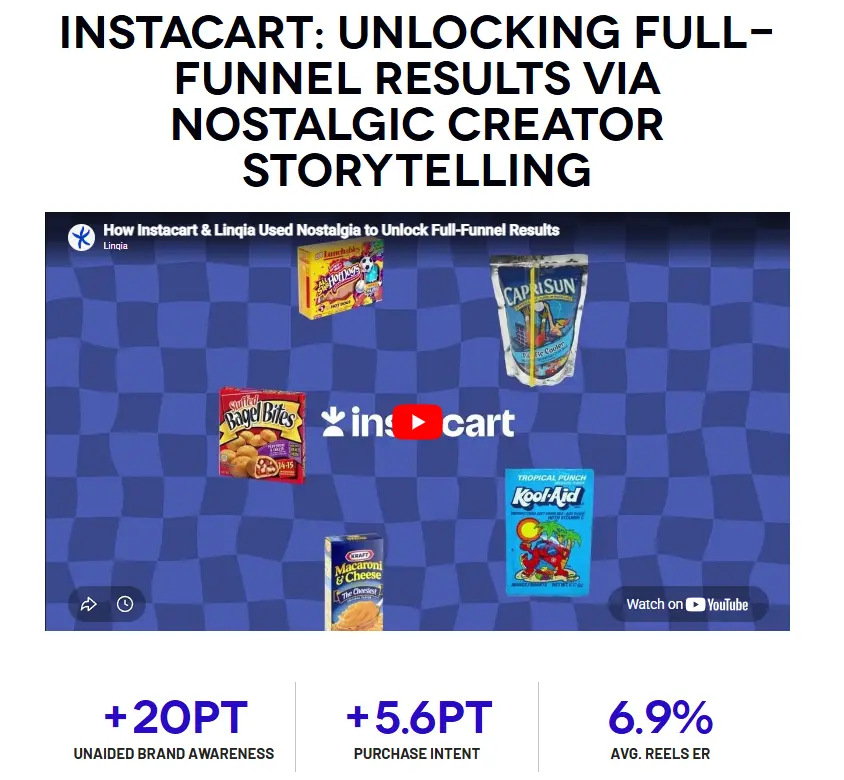
Managed models work best when campaigns require scale, speed, and reliable execution. Greater control is sacrificed compared to self-serve tools, but efficiency and performance often improve due to centralized coordination and data-driven optimization.
Influencer Discovery Platforms
Discovery platforms help brands identify and evaluate creators at scale. Manual research quickly becomes inefficient once campaigns expand beyond a handful of influencers.
Platforms such as Modash and Influencity provide access to large creator databases, along with filters for audience demographics, engagement rates, and niche relevance. These tools allow teams to move faster while maintaining a higher level of precision in creator selection.
Discovery tools are most effective during the testing phase, where multiple creators need to be sourced quickly across different audience segments and content styles.
Campaign Management Platforms
As influencer marketing programs grow, coordination becomes more complex. Campaign management platforms streamline outreach, briefing, approvals, and creator communication.
Tools like Upfluence and Creator.co support in-house execution by centralizing campaign workflows. Teams can manage multiple creators simultaneously, maintain consistent briefs, and track deliverables without relying on fragmented processes.
These platforms work best for brands that want to retain control over strategy while improving operational efficiency across campaigns.
Content and Collaboration Tools
Content production introduces another layer of complexity, especially when multiple stakeholders are involved. Clear workflows are essential to maintain quality and consistency.
Platforms like Planable help teams manage content approvals, feedback, and scheduling in a structured environment. This ensures that influencer-generated content aligns with brand guidelines before it goes live or enters paid distribution.
Collaboration tools become increasingly important as content volume grows, particularly in always-on influencer programs.
Measurement and Analytics Platforms
Measurement determines whether influencer marketing delivers real value. Without proper tracking, even well-executed campaigns lack actionable insights.
Platforms such as Sprout Social and Brandwatch provide reporting, performance tracking, and audience insights across campaigns. These tools help brands understand which creators, formats, and channels contribute to results.
Analytics platforms play a critical role in the optimization and scaling stages. Data collected here informs future campaigns, improves targeting, and ensures that budgets are allocated to high-performing content.
Common Influencer Marketing Mistakes That Limit Results
Even with the right strategy in place, execution gaps can quickly reduce the impact of influencer marketing campaigns. Many of the same issues appear repeatedly across brands, often limiting performance, scalability, and long-term growth.
- Choosing influencers based on follower count: Large audiences create visibility, but engagement quality and audience relevance drive actual results.
- Running one-off campaigns: Isolated activations prevent learning, making it difficult to replicate or improve performance over time.
- Lack of clear KPIs: Campaigns without defined success metrics struggle to connect activity with business outcomes.
- Ignoring content performance: Focusing on creators instead of formats limits the ability to identify and scale what works.
- No paid amplification strategy: Relying only on organic reach restricts distribution and reduces overall campaign impact.
- Weak or unclear briefs: Poor direction leads to inconsistent content that fails to align with campaign goals.
- Lack of tracking and attribution: Without proper measurement, optimization becomes guesswork rather than a data-driven process.
- Treating influencer marketing as a standalone channel: Lack of integration with paid media, social, and eCommerce reduces efficiency and results.
Avoiding these mistakes is essential for building a scalable influencer marketing strategy. Consistent performance comes from structured execution, continuous testing, and clear alignment between content, creators, and measurable outcomes.
Influencer Marketing Tips That Drive Real Results
In 2026, influencer marketing has evolved from a visibility tactic into a performance channel. Brands that rely on isolated tips often struggle to see consistent outcomes. Strong results come from structured strategy, repeatable content formats, and continuous testing across campaigns.
High-performing teams treat influencer marketing as a system where creators, content, distribution, and measurement work together. Campaigns improve over time as insights are applied and scaled.
Influencer marketing now plays a central role in driving measurable growth, making it a reliable channel for brands that approach it with discipline and clear execution frameworks.
Frequently Asked Questions
What is influencer marketing?
Influencer marketing is a strategy where brands collaborate with creators to produce content that influences audience behavior, including engagement, consideration, and purchases.
What are the most effective influencer marketing tips?
The most effective tips focus on performance, repeatable content formats, structured testing, and long-term creator partnerships rather than one-off campaigns.
How do you create an influencer marketing strategy?
A strong strategy includes clear goals, defined KPIs, structured testing, content optimization, and scaling through paid distribution and high-performing creators.
What makes influencer marketing campaigns successful?
Successful campaigns rely on relevant creators, high-quality content, clear messaging, and performance tracking tied to business outcomes.
Why is influencer marketing effective?
Influencer marketing works because creator content feels authentic and relatable, which increases trust and drives stronger engagement compared to traditional ads.
What is an influencer content strategy?
An influencer content strategy focuses on creating repeatable formats and messaging that can be tested, optimized, and scaled across multiple creators and platforms.
How do brands measure influencer marketing performance?
Brands measure performance using metrics such as conversions, revenue, engagement rates, click-through rates, and return on investment.
What are common influencer marketing mistakes?
Common mistakes include focusing on follower count, running one-off campaigns, lacking clear KPIs, ignoring content performance, and failing to track results.