
Photos and videos are one of the most underused ranking levers in local SEO. For this article we interviewed Bill Ross, Founder of Emulent Digital Marketing, to dig into how visual content influences Google Maps rankings, what Google’s algorithm actually reads in an image, and the publishing cadence that separates profiles that rank from profiles that stall.
Q: What first made you realize that photos and videos directly impact Google Maps rankings, not just engagement?
We were onboarding many service-based clients, and because they didn’t have a physical address, they were having trouble getting ranked for the geographic area they served.
We also had clients that were based in the suburbs outside a main city but wanted to rank within the city limits. They needed to prove to Google that they served a specific area; and photos and video helped do that.
Q: For business owners who think Google Maps rankings are mostly about reviews and citations, how big a role does visual content play?
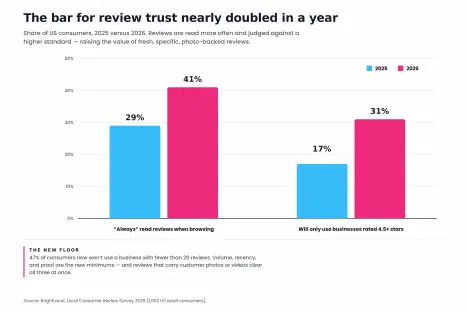
Reviews are still a big part of why a business ranks - if they are done properly. BrightLocal’s 2026 Local Consumer Review Survey found that the share of consumers who will only use businesses rated 4.5 stars or higher nearly doubled in a single year.
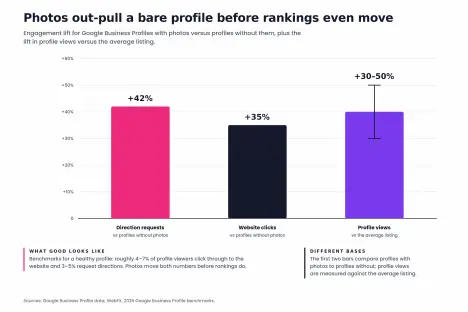
However, when we look at the impact of images, businesses with photos on their Business Profile receive 42% more requests for driving directions and 35% more click-throughs to their website than businesses without photos.
Q: What types of photos should every local business be uploading to their Google Business Profile?
We have found that on-the-job and behind-the-scene videos, and customer stories cover the different user needs, and thus do well with both engagement, building trust, and increasing leads.
Q: How often should businesses add new photos, and does freshness matter to the algorithm?
Yes, freshness and publishing frequency matters.
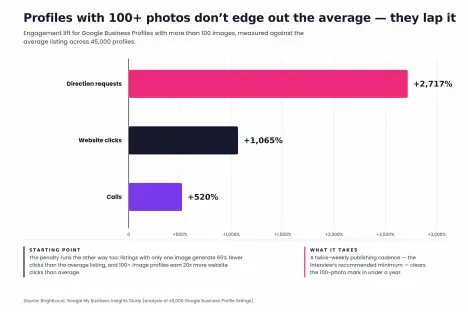
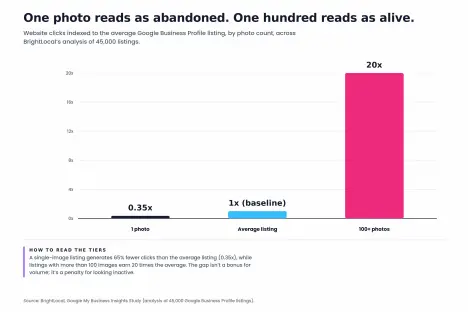
Volume compounds over time, too. BrightLocal’s Google My Business Insights Study found that businesses with more than 100 images on their profile get 520% more calls, 2,717% more direction requests, and 1,065% more website clicks than the average business.
As the chart below shows, the gap between a high-volume profile and the average listing isn’t incremental; it’s an order of magnitude. A twice-weekly cadence puts you past the 100-photo mark in under a year.
Q: Owner-uploaded photos vs. customer-uploaded photos?
Each type of photo adds value in its own way.
- Customer-uploaded photos show potential customers a unique real-world perspective of your products or services. These images carry a ton of social proof, and help build trust with future clients.
- Owner-uploaded images are helpful because they often provide a holistic understanding What are the technical specs that get overlooked?
File names, location, and date: these are the most often overlooked data for uploaded photos and videos. Google can see every data point for the image, which it then adds to the other business data points it uses to evaluate and rank the business.
Q: What’s your take on stock photos vs. authentic brand photography for local SEO?
I don’t think you should use stock photos at all within your Google Business Profile. There’s no benefit.
The only scenario I can imagine where you would use stock images is if a business is just starting out and they don’t have any photos, but need something as a placeholder. However, even in that case you can create photos and videos pretty easily – at minimum you’ll need something for GBP verification.
Q: Video is still underused on Google Business Profiles - why is that, and what’s the missed opportunity?
Many companies neglect video on their Google Business Profiles simply because they assume that there’s a larger barrier to entry. This just is not the case. Businesses can train techs to use their phone to take videos of what they’re doing, documenting anything that goes on at the job site, good or bad.
Q: How long should these videos be, and what specs does Google prefer?
Most of the time, these videos need to be under 30 seconds to keep users engaged. I wouldn’t do a long-form video unless you’re going to post it to YouTube and use it as an informational intent video to educate viewers.
As far as the technical specs, Google wants videos under 75 MB in file size with at least 720p resolution.
Q: Walk us through how you’d optimize a single photo or video from capture to upload for maximum local SEO impact.
The process is really simple.
- Start by taking the photo or video with a high-quality camera like an iPhone.
- Shoot it both in vertical and horizontal formats.
- Don’t be vague when naming your image or video. Include the name of the job, location, and date.
- For example, avoid names such as “garage-door-photo.jpg” Instead, name it “fixed-broken-spring-on-garage-door-in-raleigh-4-22-2026.jpg”
- Upload it to your Google Business Profile
- Add it your website on the location page that corresponds with where the image or video was taken Also, the text surrounding the image can give Google clues to what the image is about - so make sure it’s in a spot that is contextually relevant for the photo.
Q: What role do photos and videos embedded in Google Reviews play?
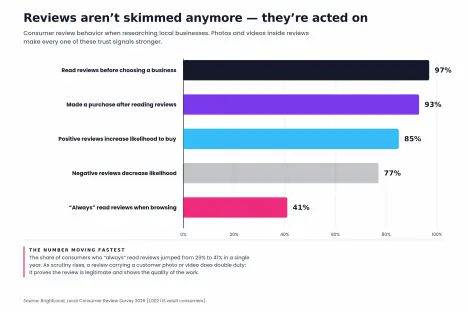
Google reviews remain one of the highest-leverage trust signals in local search. If you customers embed a photo or video in a review is adds more value to the review, including:
- Reinforcing the trustworthiness of the review and your business
- Providing more value to the user – which in turn Google rewards
- Showing potential customers the quality of the job you did.
The chart below shows how thoroughly reviews now shape buying behavior, which is exactly why a photo or video inside a review carries so much weight.
Q: What metrics should businesses track to know their visual content is actually working?
Start with metrics such as; calls, clicks, directions requests, bookings, and the keywords used by the user to find your profile – these all are provided within the analytics or your business profile.
Also, use a tracking tool like SEMrush to monitor your ranking distribution by area or city to provide additional data that proves your visual content strategy is working.
Q: How long does it usually take to see ranking shifts after a consistent visual content push?
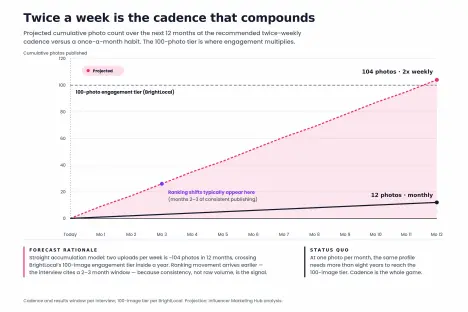
Typically, we see results in 1 to 3 months depending on the legacy metrics of the business’s profile.
The projection below shows why cadence matters more than any single upload: a twice-weekly habit crosses BrightLocal’s 100-photo engagement tier mentioned above inside a year, while a once-a-month habit barely registers, and the first ranking shifts arrive well before the volume tier does.
Q: What are the biggest mistakes you see businesses make with their Business Profile imagery?
Inconsistent publishing is the number one killer of Google rankings, but it's not the only thing holding businesses back. The use of stock photos, along with incomplete or missing file names, offers a benefit that's next to nothing.
We’ve also recently seen many businesses post irrelevant photos that actually damage their rankings. For example, including stock photography of the town where the business is located.
Q: How do you recover a profile that’s been neglected for a long time?
We start by building out a photo strategy; first auditing your images, finding gaps, and optimizing what we can. Then, based on the gap, we build a photo acquisition strategy and implementation plan.
Q: When does it make sense to hire a professional photographer or videographer vs. DIY?
I would suggest investing in a professional photographer for anything that’s brand-related. This includes:
- Team Photos and Headshots
- External and Internal Office Photos
- Product Photography (if you offer products)
- Drone Photography and Videography
Q: How is AI changing brand photography and videography?
You can do some great things with AI, like color grading or resizing images to be consistent across your website. However, when it comes to generating images from scratch, I would stay away from it for now.
The interesting part is as more businesses take the shortcut of using AI to create images and flood the web with them, it will make authentic photos and video matter more, not less.