Influencer marketing in Saudi Arabia has developed into a distinct, high-context channel that cannot be approached with the same assumptions used in Western or even broader MENA markets.
With social media penetration exceeding 90% and a population that spends significantly more time on mobile-first platforms than the global average, the Kingdom offers both scale and intensity of engagement.
At the same time, it introduces layers of complexity that directly impact campaign performance, including language, regulation, platform behavior, and cultural expectations.
What differentiates Saudi Arabia is how influencer marketing functions within the market. Platforms do not play equal roles, audiences respond differently to content formats, and regulatory frameworks actively shape who can participate in commercial activity.
Marketers must plan around specific execution decisions that might be secondary elsewhere, such as language choice, creator selection, or disclosure compliance. These decisions ultimately become primary drivers of outcomes.
This guide focuses on how influencer marketing actually operates in Saudi Arabia. It is structured to help brands and agencies understand the underlying dynamics of the market, not just the surface-level trends, so they can plan campaigns with a clearer view of what works and why.
- Why Saudi Arabia Has Become a Priority Market for Influencer Marketing
- What Makes Influencer Marketing in Saudi Arabia Different
- Types of Influencers in Saudi Arabia and How Brands Use Them
- What Influencer Marketing Costs Look Like in Saudi Arabia
- Common Mistakes Brands Make in Saudi Arabia
- Influencer Marketing in Saudi Arabia Requires a Market-Specific Approach
- Frequently Asked Questions
Why Saudi Arabia Has Become a Priority Market for Influencer Marketing
Saudi Arabia stands out within the GCC due to its scale, digital maturity, and the increasing role of social platforms in consumer decision-making. For marketers, the opportunity is defined by a combination of reach, engagement, and evolving commercial infrastructure.
Key Market Signals:
- 94% social media penetration with ~35 million active users
- 40% of GCC influencer marketing spend is concentrated in Saudi Arabia
- TikTok reach exceeds 100% of the population, indicating multi-account usage and high platform saturation
- Snapchat reaches 75% of adults, with particularly strong adoption among younger audiences
- Arabic-first content drives 35–50% higher engagement compared to translated English content
- Social commerce is scaling, with platforms integrating direct purchasing and affiliate-driven models
- Regulation is tightening, with licensing requirements formalizing the creator ecosystem
These factors position Saudi Arabia as a high-engagement, commercially active market. At the same time, they introduce constraints that require localized strategy, particularly around language, platform selection, and compliance.
What Makes Influencer Marketing in Saudi Arabia Different
Influencer marketing in Saudi Arabia operates within a set of structural conditions that differ from those in other markets. These differences affect how campaigns are planned, executed, and measured. For brands entering the market, performance is closely tied to how well these factors are understood and incorporated into strategy.
Culture Shapes Content Performance
Content in Saudi Arabia is evaluated through a cultural lens that goes beyond aesthetics or messaging clarity. Social norms, religious context, and family-oriented values influence how audiences interpret brand collaborations.
Campaigns that align with these expectations tend to integrate more naturally into creator content, while those that do not may face reduced engagement or negative sentiment.
This has practical implications for briefing and creative direction. Influencers are cultural intermediaries. Their role includes adapting brand messaging in a way that feels appropriate and relevant to their audience.
Arabic-First Content Is a Performance Lever
Language plays a central role in engagement. Arabic content, particularly when localized to regional dialects, consistently outperforms translated English versions. In GCC markets, Arabic-first campaigns have been shown to generate 35–50% higher engagement rates.
This is not limited to captions or subtitles. It extends to tone, phrasing, and cultural references embedded within the content. Campaigns that treat Arabic as a core creative input rather than a translation layer are better positioned to match audience expectations and improve interaction rates.
Platform Roles Are Not Interchangeable
Platform dynamics in Saudi Arabia differ from markets where one or two channels dominate. Usage is distributed across several platforms, each with a distinct role in the influencer ecosystem.
Short-form video platforms are central. TikTok and Snapchat are used for discovery and high-frequency engagement, while YouTube plays a role in longer-form content and product evaluation.
This distribution requires platform-specific planning, as content formats and user behavior vary significantly across channels.
Recent campaign execution reflects this shift. In one tourism-focused campaign, Visit Saudi used TikTok’s branded search functionality alongside creator-led content to target users actively searching for travel-related information.
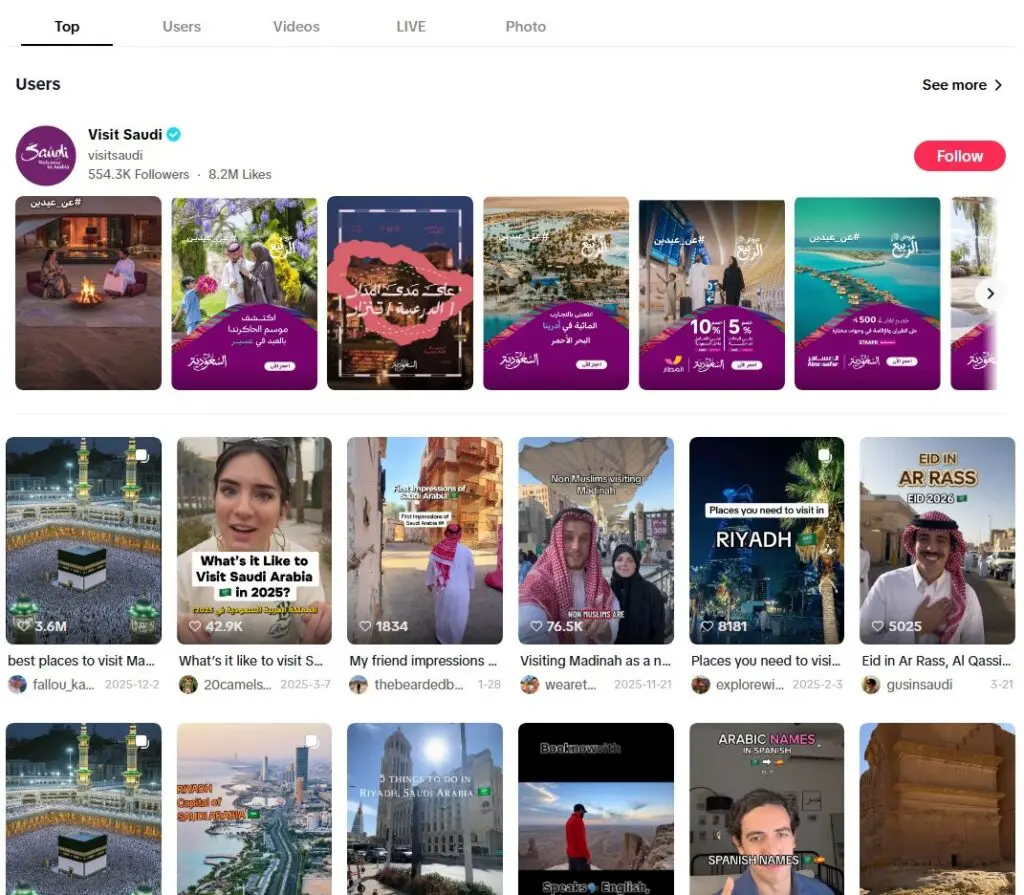
The campaign contributed to a 1.2x increase in organic search activity, illustrating how influencer-style content can extend beyond awareness into active consideration and intent capture.
Trust and Community Outweigh Reach
Audience relationships in Saudi Arabia tend to be built around trust and consistency rather than scale alone. While large creators provide reach, smaller influencers often deliver stronger engagement within specific communities.
This is reflected in how brands approach localized campaigns. In sectors such as food, retail, and lifestyle, partnerships with micro-influencers are commonly used to drive measurable outcomes like store visits or regional demand.
@20camels_emily What’s it like to visit Saudi Arabia in 2025? 🇸🇦 #fyp #saudi #saudiarabia🇸🇦 #saudia #saudi_tiktok #saudiarabia_tiktok #ksa #riyadh #riyadhksa #رياض #الرياض_الان #الرياض❤️ #اكسبلور #السعودية #visitsaudi
These creators typically have more concentrated audiences, which can result in higher interaction rates and more direct influence on consumer behavior.
As a result, influencer selection in Saudi Arabia often prioritizes audience alignment and credibility over follower count, particularly for campaigns targeting specific cities or demographic groups.
Regulation Shapes the Creator Ecosystem
Influencer marketing in Saudi Arabia is regulated by the General Authority for Media Regulation (GAMR), the government body responsible for overseeing media and advertising activity in the Kingdom.
Through its Mawthooq licensing system, GAMR has formalized influencer marketing as a regulated commercial activity rather than an informal extension of social media.
Under this framework, any individual earning revenue from promotional content must obtain a Mawthooq licence. The licence is issued for a fixed period and requires influencers to comply with disclosure rules, ensure promoted products meet local regulations, and publish content through registered accounts.
Non-Saudi creators are not permitted to operate independently and must work through locally licensed agencies.
This regulatory structure has had a direct impact on the creator ecosystem. Since its introduction, the number of active influencers has declined as participation now requires formal registration and compliance. While this reduces the overall pool of available creators, it also introduces greater accountability and standardization.
For brands, this changes how brand deals are evaluated. Beyond audience fit and content style, creators must be verified as licensed and compliant before collaboration. As a result, compliance is no longer a post-campaign consideration.
It is part of the initial planning process, influencing both creator selection and campaign structure.
Types of Influencers in Saudi Arabia and How Brands Use Them
Influencer categories in Saudi Arabia follow the standard tier structure based on audience size. However, how these tiers are used in practice differs from other markets. Selection is influenced not only by reach but also by cultural fit, audience concentration, and campaign objectives.
Nano Influencers (1K–10K Followers)
Nano influencers are typically used in situations where audience concentration and credibility are more important than scale. Their smaller followings often translate into closer relationships with their audiences, which can influence how recommendations are received.
In Saudi Arabia, this makes them relevant for campaigns that require localized impact or audience trust, particularly when targeting specific communities or testing messaging in a controlled way.
@mariiapeach
Their role is limited when broader visibility is required, but they can be effective when precision and authenticity are prioritized.
Micro Influencers (10K–100K Followers)
Micro influencers provide a balance between reach and engagement. Their audiences are larger than those of nano creators but still relatively focused, which allows brands to expand exposure without losing relevance.
In practice, they are frequently used for campaigns that require sustained engagement across multiple creators rather than a single point of visibility. Their content tends to feel less commercial, which aligns with audience expectations in the Saudi market, where relatability and consistency influence performance.
Macro Influencers (100K–1M Followers)
Macro influencers provide broader reach while maintaining some degree of audience segmentation. They are often positioned as category-specific creators, making them suitable for campaigns that require both scale and contextual relevance.
In Saudi Arabia, macro influencers are typically used for product launches, regional campaigns, and brand awareness initiatives.
@foris_kitchen Top 3 Best Restaurants after my Riyadh Trip #foodtok #foodspot #eating #restaurant
While they extend reach beyond niche communities, engagement rates may be lower than smaller tiers, requiring more deliberate selection and content alignment.
Mega Influencers (1M+ Followers)
Mega influencers, including celebrities and widely recognized public figures, offer the highest level of reach. Their audiences are large and diverse, making them suitable for campaigns focused on visibility and brand positioning.
These partnerships are commonly used for national campaigns or major brand moments. However, they are less targeted and involve higher costs, which limits their use to campaigns where scale is the primary objective.
@ferasjtl حابين اضيف لكم برجر كنق حاشي؟ لايفوتكم الطعم الرهيب (AD)@Burgerkingksa
How Brands Combine Influencer Tiers
In practice, influencer marketing strategies in Saudi Arabia often involve a combination of tiers rather than reliance on a single group. A typical structure includes larger creators to establish reach, supported by smaller influencers to drive engagement and localized impact.
Execution at this level of coordination is often managed through specialized agencies.
Let an Influencer Agency Take Charge of Your Campaigns
Executing influencer campaigns across multiple tiers in Saudi Arabia requires coordination across creator selection, content development, compliance checks, and performance tracking.
For many brands, this level of operational complexity makes agency support a practical consideration, particularly when campaigns involve multiple creators, platforms, and approval layers.
InHype is one example of an agency operating in this space, supporting brands with end-to-end influencer campaign execution. Their work typically includes identifying creators based on audience relevance, managing outreach and collaboration, and overseeing content production to ensure alignment with campaign objectives.
This approach is combined with performance tracking, allowing brands to evaluate campaigns based on engagement and other measurable outcomes.
This type of support is particularly relevant in Saudi Arabia, where campaign performance depends on aligning multiple variables including platform behavior, cultural context, and regulatory requirements.
What Influencer Marketing Costs Look Like in Saudi Arabia
Influencer pricing in Saudi Arabia varies widely depending on audience size, engagement, platform, and campaign scope. However, available benchmarks provide a useful baseline for how costs are typically structured.
Per-post pricing ranges (Saudi market):
- Nano influencers (1K–10K): ~SAR 750 to SAR 3,000 per post
- Micro influencers (10K–100K): ~SAR 3,000 to SAR 15,000 per post
- Macro influencers (100K–1M): ~SAR 15,000 to SAR 75,000 per post
- Mega influencers (1M+): ~SAR 75,000 to SAR 300,000+ per post
Additional sources confirm similar ranges, with nano influencers starting around SAR 1,000 and top-tier creators exceeding SAR 50,000+ per collaboration, depending on scope.
Note: Ranges are estimates based on Starngage reports.
Campaign-Level Costs
Looking beyond individual posts:
- Small to mid-sized campaigns often start around SAR 5,000 to SAR 20,000
- Larger campaigns involving multiple creators can exceed SAR 100,000+
- Enterprise-level programs (multi-channel, ongoing) can scale significantly beyond this
Common Mistakes Brands Make in Saudi Arabia
Influencer marketing in Saudi Arabia requires a level of localization and operational discipline that differs from other markets. When campaigns underperform, the cause is often not the channel itself, but how it has been applied.
The following are recurring issues that affect campaign outcomes.
#1 Treating Saudi Arabia Like a Standard Market
Campaigns developed for other regions are sometimes reused with minimal adaptation. This approach does not account for differences in audience behavior, platform usage, or cultural context.
As a result, content may reach the intended audience but fail to generate meaningful interaction. In Saudi Arabia, market-specific planning directly influences how content is received.
#2 Relying on Translation Instead of Localization
Using Arabic as a direct translation of English content can limit engagement. Language in influencer marketing is tied to tone, context, and cultural references, not just wording.
Content that is technically correct but not locally adapted may appear disconnected from the audience. Campaigns that incorporate dialect, phrasing, and culturally relevant messaging tend to perform more consistently.
#3 Selecting Influencers Based on Follower Count Alone
Follower count is often used as a primary filter in creator selection, but it does not provide a complete view of potential performance. In Saudi Arabia, audience alignment and engagement quality are more reliable indicators.
Creators with smaller but more focused audiences can generate stronger interaction, particularly when campaigns target specific demographics or regions.
#4 Ignoring Regulatory Requirements
Influencer marketing in Saudi Arabia operates under a defined regulatory framework overseen by the General Authority for Media Regulation. Creators engaging in paid promotions are required to hold a Mawthooq licence and follow disclosure guidelines.
When these requirements are not considered during planning, campaigns can face delays or compliance issues. Responsibility does not sit solely with creators. Brands are expected to ensure that partnerships meet regulatory standards before content is published. Incorporating compliance checks early in the process reduces this risk.
#5 Using the Same Content Across All Platforms
Each platform in Saudi Arabia serves a different role within the influencer ecosystem. Reusing identical content across channels without adjusting for format or audience behavior can reduce effectiveness.
Short-form video, long-form reviews, and ephemeral content each require different approaches. Campaigns that treat platforms as interchangeable often see uneven performance.
#6 Over-Scripting Influencer Content
Influencer content is effective in part because it reflects the creator’s voice and style. When content is overly controlled or scripted by the brand, it can lose this quality. In the Saudi market, where trust and relatability influence engagement, this can affect how audiences respond.
Providing clear direction while allowing creators flexibility tends to produce more natural and effective content.
These issues are not always immediately visible during campaign planning, but they have a measurable impact on outcomes. Addressing them requires aligning strategy with how influencer marketing operates in Saudi Arabia, rather than applying assumptions from other markets.
Influencer Marketing in Saudi Arabia Requires a Market-Specific Approach
Influencer marketing in Saudi Arabia operates within a framework shaped by culture, language, platform behavior, and regulation. Each of these factors influences how campaigns are planned and how audiences respond. As a result, strategies that work in other regions do not always translate directly to this market.
For brands, this means approaching influencer marketing as a localized discipline rather than a standardized channel. Creator selection must account for audience alignment and compliance, content must reflect cultural and linguistic context, and platform strategy must adapt to how users engage across different environments.
Execution also requires coordination, particularly when campaigns involve multiple creators or tiers.
The opportunity in Saudi Arabia is supported by high digital engagement and an increasingly structured creator ecosystem. At the same time, outcomes depend on how well campaigns align with the realities of the market.
Frequently Asked Questions
What is influencer marketing in Saudi Arabia?
Influencer marketing in Saudi Arabia involves brands collaborating with social media creators to promote products or services, with campaigns shaped by local culture, language, and regulatory requirements.
Why is Saudi Arabia important for influencer marketing?
Saudi Arabia combines high social media penetration, strong engagement rates, and growing digital ad spend, making it a key market within the GCC for influencer-led campaigns.
Which platforms are most used for influencer marketing in Saudi Arabia?
TikTok, Snapchat, YouTube, and Instagram are the primary platforms, each serving different roles across discovery, engagement, and content consumption.
Do influencers in Saudi Arabia need a license?
Yes. Influencers must comply with regulations set by the General Authority for Media Regulation, including obtaining a Mawthooq licence for paid promotional activity.
How much does influencer marketing cost in Saudi Arabia?
Costs vary by influencer tier, platform, and campaign scope. Nano influencers may charge a few hundred SAR per post, while top-tier creators can charge significantly more.
Are micro influencers effective in Saudi Arabia?
Micro influencers are commonly used due to their focused audiences and higher engagement rates, making them suitable for campaigns that prioritize interaction over reach.
What language should influencer campaigns use in Saudi Arabia?
Arabic is the primary language for most campaigns. Localized Arabic content typically performs better than translated English, particularly when adapted to regional tone and context.
What are the biggest challenges in influencer marketing in Saudi Arabia?
Common challenges include ensuring cultural relevance, selecting the right creators, complying with regulations, and adapting content to different platforms.


