

Influencer marketing has crossed a line from experimental budget to serious allocation. Our 2026 Influencer Marketing Benchmark Report, built on responses from more than 600 marketers, brands, agencies, and creator economy professionals, shows that budget intent is not incremental. More than 72% of respondents expect influencer marketing budgets to grow by more than 50% in 2026.
That scale brings scrutiny. As influencer programs absorb larger shares of spend, they start getting evaluated like other major channels. Finance wants defensible budget logic. Procurement wants repeatable vendor and risk controls. Leadership wants measurement discipline that stands up in planning cycles and post-mortems.
At the same time, the biggest risk signal in our dataset is not creative execution. It is audience integrity.
More than 56% of respondents identified fake or bot followers as their most common influencer risk concern for 2026. When budget expansion and authenticity risk rise together, governance stops being an abstract concept. It becomes the condition for scaling without waste.
Deep analysis is the practical bridge between influencer marketing’s growth and the accountability standards now surrounding it.
- Influencer Marketing Has a Governance Problem, Not a Creativity Problem
- What Shallow Influencer Vetting Gets Wrong
- What Deep Analysis Actually Means in Influencer Marketing Governance
- The Governance Outcomes Deep Analysis Enables
- A Practical Influencer Marketing Campaign Auditing Framework That Scales
- Where Platforms Fit and What to Look for in Tooling
- Deep Analysis as the New Standard for Scalable Influencer Governance
Influencer Marketing Has a Governance Problem, Not a Creativity Problem
Most influencer marketing teams know how to ship content. The operational friction shows up elsewhere.
Influencer marketing is increasingly treated as an operating system, not a one-off campaign tactic. That shift shows up in how teams think about platform roles, creative iteration cycles, rights, and measurement readiness.
In our benchmark, measurement adoption is present, but there are signs that instrumentation is not keeping pace with aggressive scaling intent. That is where governance breaks. When spend increases faster than controls, variability increases with it.
The consequence is predictable. Programs get judged on inconsistent evidence. Results become harder to compare across creators, regions, and time periods. The internal narrative becomes fragile, even when the creative is strong.
Deep analysis addresses this by making the evaluation repeatable and defensible. It turns creator selection and performance interpretation into a process with standards, not a set of opinions.
What Shallow Influencer Vetting Gets Wrong
Shallow vetting tends to overweight what is easy to see.
Follower count and engagement rate are convenient because they are available everywhere and easy to communicate. They are also easy to misread. A creator can look healthy on surface metrics while carrying structural risk that only appears after spend is committed. That risk can take several forms.
- One is audience authenticity, where follower or engagement activity does not represent real, targetable humans.
- Another is engagement integrity, where the visible engagement is driven by low-signal activity that does not correlate with attention or purchase intent.
- A third is reach efficiency, where a set of creators looks large in aggregate but has heavy audience overlap, leading to redundancy rather than incremental reach.
All three create the same governance problem. The team cannot clearly explain what the budget bought, why those creators were selected, and what should be scaled next cycle.
Deep analysis exists to prevent those failures before they appear in quarterly reviews.
What Deep Analysis Actually Means in Influencer Marketing Governance
Deep analysis in influencer marketing is not about adding complexity for its own sake. It is about building a defensible decision layer.
A useful definition is this:
In practice, it typically includes a small set of governance-relevant dimensions.
- Audience authenticity and quality validation:
This focuses on whether the audience behaves like a real audience and whether the engagement profile is credible. It reduces exposure to inflated reach and engineered activity.
- Demographic and interest alignment:
This checks whether the audience fits the campaign’s target segments. It prevents teams from paying for scale that is irrelevant to the buyer.
- Reach efficiency and overlap logic:
It looks at how much unique exposure each creator adds relative to the roster. It helps teams defend the value of adding or removing creators from a program.
- Competitive context:
This compares creator choices and content patterns against what competitors are doing, so decisions are grounded in market reality rather than internal preference.
Platforms that support deep analysis typically turn these layers into a repeatable workflow.
For example, Trendin’s Deep Analysis solution is designed to help teams move beyond surface metrics by providing tooling for audience authenticity checks, audience segmentation, audience overlap analysis, and competitor-focused creator research, so brands can standardize creator evaluation instead of relying on ad hoc judgment.
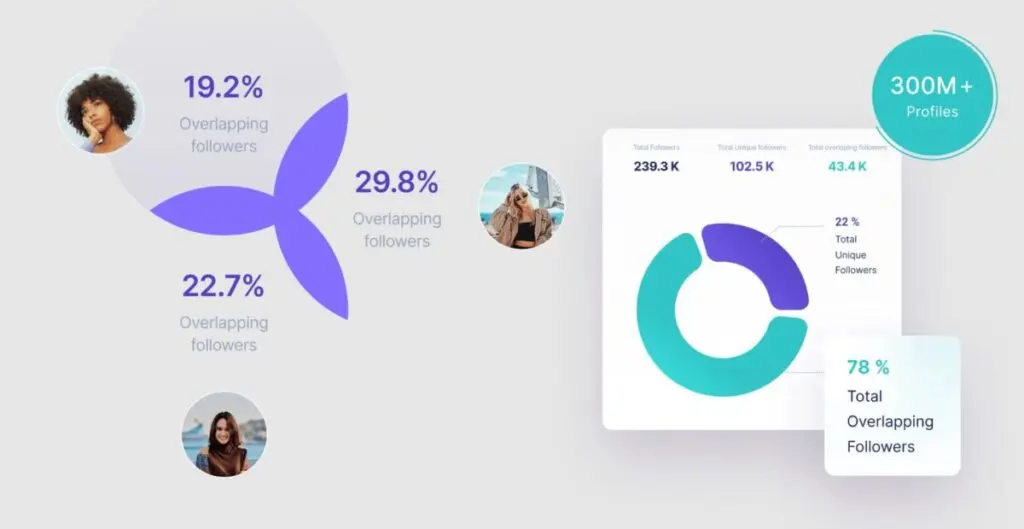
The governance point is not the tool itself. It is the ability to embed these checks into a consistent evaluation process that can be documented, reviewed, and applied across campaigns, teams, and markets without depending on individual intuition.
The Governance Outcomes Deep Analysis Enables
When deep analysis becomes part of the operating system, its impact shows up in outcomes that leadership immediately understands. Governance is mainly about reducing avoidable volatility as spend scales.
Reduced Budget Leakage
The most immediate outcome is fewer partnerships that look promising during discovery but underdeliver once content goes live. Audience quality issues, inflated engagement, or heavy overlap across creators can quietly erode performance before anyone realizes the problem.
As influencer budgets expand, even small inefficiencies compound. A governance-driven deep analysis layer helps teams filter out structural risk before contracts are signed. That reduces wasted spend and improves the probability that the incremental budget actually produces incremental reach or business impact.
Stronger Creator Selection Rationale
Deep analysis replaces subjective preference with structured justification. Instead of choosing creators based on aesthetic fit or historical familiarity alone, teams can reference audience alignment, authenticity indicators, and role within the broader roster.
This creates a documented rationale for selection decisions. When leadership asks why a creator was approved, the answer is tied to defined criteria rather than intuition. It also improves continuity. If team members change or agencies rotate, the evaluation logic remains intact.
Defensible Reporting Narratives
Influencer performance is often debated because attribution models and evaluation windows differ across stakeholders.
Deep analysis strengthens reporting by anchoring it in validated inputs. When audience quality, segmentation logic, and overlap considerations are built into the initial selection process, performance discussions start from a more stable baseline. Results become easier to interpret, compare across campaigns, and defend in budget reviews.
The narrative shifts from explaining anomalies to explaining strategy.
Repeatability Across Markets and Agencies
A governance model only matters if it scales. Deep analysis supports scale by turning evaluation into a consistent framework that can be applied across regions, brands, and partner teams. This is particularly important in organizations where influencer marketing is run in-house but supported by agencies for sourcing or execution.
When vetting standards and reporting definitions are centralized, expansion does not create fragmentation. The program grows without losing coherence.
This is the difference between an influencer initiative that expands with confidence and one that becomes politically fragile under scrutiny.
A Practical Influencer Marketing Campaign Auditing Framework That Scales
Governance needs to be light enough to run continuously, not heavy enough to slow execution. A workable auditing framework has three phases.
Pre-Campaign Controls
This is where deep analysis prevents preventable mistakes. The goal is to achieve minimum viable governance.
- Set baseline criteria for audience quality and authenticity
- Validate audience alignment to the campaign target
- Check roster-level overlap so reach is not duplicated
- Document why each creator is in the mix and what role they play
This documentation becomes a governance asset. It improves internal review and it improves learning loops.
In-Campaign Monitoring
Governance does not stop once posts go live. Influencer programs should monitor for anomalies that signal quality issues or performance drift.
- Watch for sudden spikes that do not match prior patterns
- Track whether engagement quality matches expectations
- Confirm that creative and messaging are being executed as agreed
This stage is about catching problems early enough to adjust, not about retroactive blame.
Post-Campaign Validation
The goal here is clarity and repeatability.
- Evaluate performance against the defined objective
- Separate leading indicators from final outcomes where timelines differ
- Record learnings that can be reused in the next cycle
- Update vetting thresholds based on what actually correlated with performance
Doing this ensures influencer marketing becomes an operating system. The program improves because the standards improve.
Where Platforms Fit and What to Look for in Tooling
A governance framework should not depend on manual workflows. Tooling should reduce overhead while improving evidence quality.
For governance-minded teams, the most useful capabilities typically include:
- Audience authenticity and quality indicators that can be applied consistently
- Demographic and segmentation depth that matches your targeting needs
- Overlap analysis that supports incremental reach planning
- Clear reporting outputs that can be shared with leadership and procurement
Trendin’s Deep Analysis tool is specifically designed around those governance layers, especially segmentation, overlap visibility, and competitive context, which are often the hardest to handle in spreadsheets.
Deep Analysis as the New Standard for Scalable Influencer Governance
Influencer marketing is scaling fast, and our benchmark data reflects that. At the same time, the most common risk concern in 2026 is still audience authenticity. That combination forces a shift in operating standards.
Deep analysis is the governance layer that makes influencer growth sustainable. It protects budget integrity, strengthens internal accountability, and creates repeatable decision rules that hold up as programs scale across creators, regions, and teams.
The brands that win in 2026 will be the ones that build a system that can justify spend, validate quality, and defend performance under scrutiny.

SUGGESTED

Influencer Marketing Benchmark Report 2026
Influencer marketing in 2026 is evolving fast. Learn how companies can leverage AI...
What is Influencer Marketing? - The Ultimate Guide for 2026
Learn how influencer marketing drives brand awareness engagement and sales with our...
How an Influencer Reporting Platform Improves Campaign Accountability
How an influencer reporting platform improves campaign accountability centralizes...