
Influencer marketing is scaling aggressively. In our 2026 Influencer Marketing Benchmark Report, more than 72% of surveyed marketers expect their influencer budgets to increase by at least 50% this year.
Expansion at that level signals confidence, but it also introduces operational pressure.
What makes the situation more complex is that reporting infrastructure is not expanding at the same pace. The same aggressive budget-growth group accounts for a smaller share of overall measurement tool adoption than their growth intent would suggest. Even more telling, only 10.5% of respondents report using a dedicated reporting application within their influencer marketing workflow.
In practical terms, spend is accelerating faster than structured reporting systems.
That imbalance creates a governance risk.
As influencer marketing absorbs larger allocations and tighter payback expectations, campaign accountability becomes non-negotiable. Without a centralized reporting infrastructure, even strong campaign performance can become difficult to defend internally.
This is where an influencer reporting platform shifts from operational convenience to strategic necessity.
The Accountability Problem in Influencer Marketing
Influencer campaigns generate layered complexity. A single program may involve multiple creators, multiple platforms, organic distribution, paid amplification, affiliate links, promo codes, and a mix of awareness and conversion objectives.
Yet in many organizations, performance tracking remains fragmented.
- Engagement metrics sit inside native social dashboards.
- Affiliate revenue lives in a separate tracking system.
- Paid media results are managed elsewhere.
- Creator deliverables and payments are tracked independently.
This fragmentation creates structural accountability gaps.
First, KPI definitions drift. Awareness metrics and performance metrics blur together without clear hierarchy. Second, reporting cycles slow down. Data must be manually reconciled before analysis can even begin. Third, executive defensibility weakens.
When finance or leadership asks what the program delivered relative to spend, the answer often requires interpretation rather than evidence.
Accountability is not about tracking more numbers. It is about structuring performance data in a way that withstands scrutiny.
Why Traditional Reporting Breaks at Scale
Manual reporting can function when influencer activity is limited. It breaks as soon as scale is introduced.
As creator volume increases, so does reporting complexity:
- Paid and organic metrics must be reconciled
- Attribution windows differ by objective
- Regional campaigns introduce currency and platform variation
- Cross-channel comparisons become necessary
Spreadsheets cannot normalize performance across these layers in real time.
More importantly, they cannot answer the strategic questions leadership cares about:
- Which creators drove incremental impact versus vanity engagement?
- How did paid amplification influence performance outcomes?
- Where is efficiency improving or declining mid-flight?
- How does influencer ROI compare to other paid channels?
Without a centralized reporting infrastructure, influencer marketing remains operationally fragile — difficult to benchmark, difficult to scale, and difficult to defend.
An influencer reporting platform exists to solve this structural weakness.
What a Modern Influencer Reporting Platform Must Solve
Influencer spend isn’t treated as an “experimental line item” anymore. Creator advertising is now sized as a major U.S. channel, with IAB projecting $37B in 2025 (+26% YoY) and nearly half of buyers calling creators a “must buy.”
That growth changed what leadership expects from reporting. The “pretty dashboard” era is over. The next reporting stack has to do three jobs at once:
- Prove business impact (not just engagement)
- Prevent governance drift (disclosure, paid usage, approvals, audit trails)
- Make optimization possible while the campaign is still live
And the market is openly telling you where the current systems break: brands are calling for advanced attribution and consistent reporting as top improvement areas—because without those, you can’t link creator activity to outcomes in a fragmented ecosystem.
Unified Performance Visibility
Campaign accountability starts with one rule: if performance is scattered across three systems, nobody trusts the conclusion.
A reporting platform built for governance has to ingest—and reconcile—four data layers that typically live in different places:
- Creator content performance (views, watch time, saves, shares, comments—not just likes)
- Paid amplification performance (whitelisting/Spark Ads metrics, CPM, CTR, view-through)
- Commerce and conversion signals (affiliate revenue, TikTok Shop/Shopify lift, assisted conversions)
- Creator-level cost inputs (fees, usage rights, paid boosting budgets, product seeding cost)
For example, platforms like Stellar reduce fragmentation by centralizing campaign data across creators and distribution channels into unified dashboards. Rather than exporting engagement metrics from one platform, affiliate revenue from another, and paid performance from a third, teams can evaluate performance within one structured reporting system.
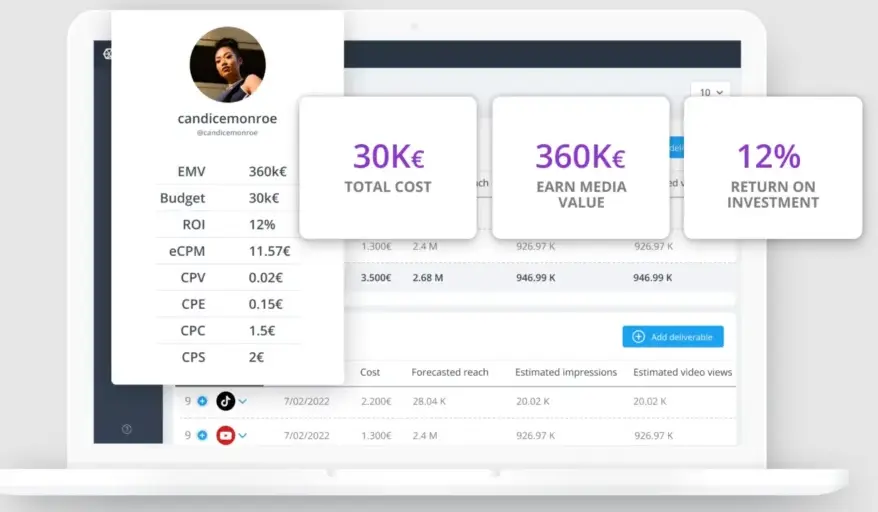
This eliminates reconciliation bottlenecks and increases reporting consistency.
Platforms are actively restructuring where creator + paid data lives:
- TikTok launched TikTok One specifically to consolidate workflows that used to be separate logins—and explicitly positions Creator Marketplace reporting as unified across organic + paid creator content, with APIs for partners to pull data into preferred workstreams.
- Meta has been pushing Creator Marketplace toward performance-informed selection, adding ad performance indicator badges and “predicted to drive high-performing ads” signals. That’s the platform telling you: creator selection and reporting are now inseparable.
A real unified environment also removes reconciliation bottlenecks—because when teams have to manually stitch exports together, governance becomes “best effort” instead of a repeatable process.
KPI Standardization
Influencer reporting breaks most often at the definition stage. Not because data is missing, but because the success criteria move.
A campaign launches with awareness objectives. Mid-flight, optimization shifts toward engagement. In the QBR, leadership asks for revenue contribution. By the time the board reviews performance, the question becomes incremental lift.
Without a predefined KPI architecture, reporting becomes elastic.
The platforms themselves are signaling that this flexibility is no longer acceptable.
Meta has introduced performance signals inside Creator Marketplace that surface historical ad performance data during creator selection. That means creator discovery is now being informed by conversion potential, not just follower count. Selection and measurement are merging.
TikTok’s Spark Ads model integrates creator content directly into Ads Manager, where it competes in the same auction system as traditional paid media. Once creator content enters the auction, it inherits auction-level accountability. CPM, CTR, and CPA, these metrics are no longer optional overlays. They are embedded.
This structural shift means KPI alignment must happen before the campaign launches.
A governance-grade influencer reporting platform should:
- Lock campaign-level primary KPIs before activation
- Separate leading indicators from financial outcomes
- Apply consistent benchmarking logic across creators
- Prevent post-hoc redefinition of success
When KPI definitions remain stable, performance interpretation becomes stable.
When they shift, trust erodes. Standardization is not about clarity but about credibility.
Real-Time Transparency
Influencer marketing now operates inside paid infrastructure.
Whitelisted creator posts on Meta run through the same delivery system as standard ads. Spark Ads on TikTok are optimized through the same performance dashboards as direct-response campaigns.
In both cases, capital is being deployed dynamically.
Yet many influencer programs still rely on weekly exports and post-campaign summaries.
That creates a structural mismatch.
If creator content is receiving paid amplification and entering algorithmic bidding systems, delayed visibility becomes financially inefficient.
Optimization must happen while the campaign is live, not after spend is exhausted.
Real-time transparency enables:
- Budget reallocation toward high-performing creator assets
- Rapid pause of underperforming partnerships
- Creative iteration during peak performance windows
- Spend efficiency monitoring across paid and organic layers
When reporting lags behind delivery, governance becomes reactive.
A reporting platform built for accountability must surface performance signals as they occur, not as historical artifacts.
Because once creator content becomes paid media, reporting speed becomes a financial control.
Cross-Channel Context
Influencer marketing no longer lives outside commerce systems. TikTok Shop integrates creator content directly into in-app purchase flows. Instagram product tagging connects creator posts to storefronts. Amazon’s Creator Connections embeds influencer partnerships directly into retail conversion environments.
When influencer programs operate inside commerce systems, leadership expects cross-channel comparison.
- How does creator-driven revenue compare to retail media spend?
- What is the blended CAC when influencer and paid social run concurrently?
- Is creator-driven traffic incremental or overlapping with search and retargeting?
Without cross-channel normalization, influencer results appear isolated.
An influencer reporting platform must allow influencer performance to be evaluated in relation to:
- Paid social efficiency
- Affiliate revenue
- Commerce lift
- Assisted conversions
...not as standalone engagement dashboards.
Cross-channel context transforms influencer reporting from creative recap to financial contribution analysis.
That shift determines whether influencer marketing competes for incremental budget or loses it.
Executive-Ready Outputs
As influencer budgets grow, reporting moves upward.
- Procurement evaluates usage rights exposure.
- Legal reviews disclosure compliance.
- Finance evaluates capital efficiency.
- Leadership evaluates forecast reliability.
Governance risk increases with scale.
Meta’s branded content policies require proper partnership labeling. TikTok enforces disclosure requirements through its branded content tools. Platform-level monetization systems now track commercial partnerships more aggressively than in earlier creator eras.
If reporting infrastructure does not preserve:
- Paid partnership documentation
- Creator contract alignment with usage
- Amplification transparency
- Audit-ready performance summaries
...then governance becomes personality-dependent instead of system-driven.
Executive-ready outputs are not about aesthetics. They are about repeatable reporting cadence, exportable performance documentation, consistent benchmark logic, and traceable decision history.
When reporting must be rebuilt manually for every board review, risk compounds.
When reporting is structured and systematized, governance becomes embedded.
And embedded governance is what allows influencer marketing to withstand financial scrutiny at scale.
How an Influencer Reporting Platform Strengthens Governance
As influencer spend scales, governance becomes the mechanism that protects capital, prevents internal dispute over results, and keeps execution consistent across markets and partners.
Budget Control
Budget leakage rarely looks dramatic. It shows up as small inefficiencies that compound, creator fees decoupled from outcomes, paid amplification that keeps running after creative fatigue, and promo code or affiliate performance that is reviewed too late to adjust.
An influencer reporting platform strengthens governance by reconciling cost inputs with performance outputs at the creator and campaign level. That includes creator fees, usage rights, seeding costs, and boosting budgets, tied directly to measurable outcomes.
Stellar is built around this kind of reconciliation, positioning its campaign reporting to track promo codes and measure ROI and costs per campaign and per influencer automatically.
The governance benefit is practical. When finance asks where the money went, the program can answer with a consistent cost-to-impact view instead of a narrative assembled from multiple exports.
Internal Credibility
Influencer marketing becomes politically fragile when each stakeholder grades performance differently. Brand teams focus on reach and sentiment. Growth teams focus on conversions. Finance asks what was incremental. Agencies report in one format, internal teams in another.
Governance improves when reporting is structured enough that the organization stops debating definitions and starts debating decisions. A platform that produces consistent campaign reporting and exportable outputs reduces the need for ad hoc interpretation.
Stellar explicitly positions exportable reports as part of how teams share and defend results, which maps directly to leadership-facing accountability.
Scalability Without Reporting Breakdown
Most influencer programs do not fail because a single campaign underperforms. They fail because scaling introduces measurement drift. Regions adopt different KPIs. Creator tiers get evaluated inconsistently. Partners deliver performance summaries that cannot be compared.
A governance-ready influencer reporting system prevents that drift by enforcing a common reporting structure across markets, campaigns, and partners. It allows a program to grow without rewriting the scorecard every quarter. That comparability is what makes performance optimization possible at scale and what keeps leadership trust intact as spend increases.
Institutional Learning
When reporting systems are centralized, historical performance becomes a strategic asset. Teams can:
- Compare creator tiers over time
- Identify repeatable performance patterns
- Refine selection criteria
- Improve forecasting accuracy
Without centralized reporting, institutional memory is anecdotal. With it, influencer marketing becomes data-continuous.
From Reporting to Strategic Decision Infrastructure
An influencer reporting platform should not be viewed as a reporting tool. Instead, it should be viewed from a decision infrastructure lens.
When performance data is structured and centralized:
- Creator selection becomes evidence-based
- Budget allocation becomes more precise
- Optimization cycles shorten
- Leadership conversations become data-driven
Over time, this builds trust.
Influencer marketing stops being evaluated as a creative experiment and starts being managed as a performance channel with governance standards comparable to paid media.
The brands that scale successfully will not be those that simply increase creator volume. They will be those who align budget growth with reporting maturity.
An influencer reporting platform makes that alignment possible.

