

Summary
Booking models today requires clear role definitions, market-based pay rates, and online hiring systems that match real-time availability. When these elements are in place, teams reduce no-shows, fill roles faster, and maintain predictable budgets across trade shows, runway events, and content production.
Model booking has shifted significantly in recent years as trade shows, fashion events, and content teams move faster and operate with leaner crews. With millions of freelance models active across the U.S. and tighter production timelines than ever, hiring is no longer about browsing portfolios alone. Successful teams now focus on speed, availability, and role fit—treating model booking as an operational process rather than a purely creative one.
Model Booking in 2025: Key Data Points
- ~3 million freelance models active in the U.S. by the end of 2025
- 98% of roles successfully scouted within the first few hours when availability and requirements align
- Posting a job takes under 5 minutes on modern booking platforms
- Pay rates increasingly suggested using real market data, helping first-time project managers budget accurately
Why Booking Models Has Changed in the Last Few Years
The number of freelance models has grown, timelines are shorter, and hiring now depends on speed and data rather than long agency lead times.
By the end of 2025, the U.S. market included an estimated 3 million freelance models across events, fashion, and content—making filtering, availability, and verification more important than raw volume. This shift changed how brands and agencies book talent. Instead of planning months ahead through long email chains, many projects now move from idea to execution in days—or even hours.
Trade shows add pressure with fixed dates and busy floors. Runway events rely on tight rehearsals and exact sizing. Content teams often need creators who can shoot quickly and adapt on set. In all three cases, delays in booking can derail the entire project.
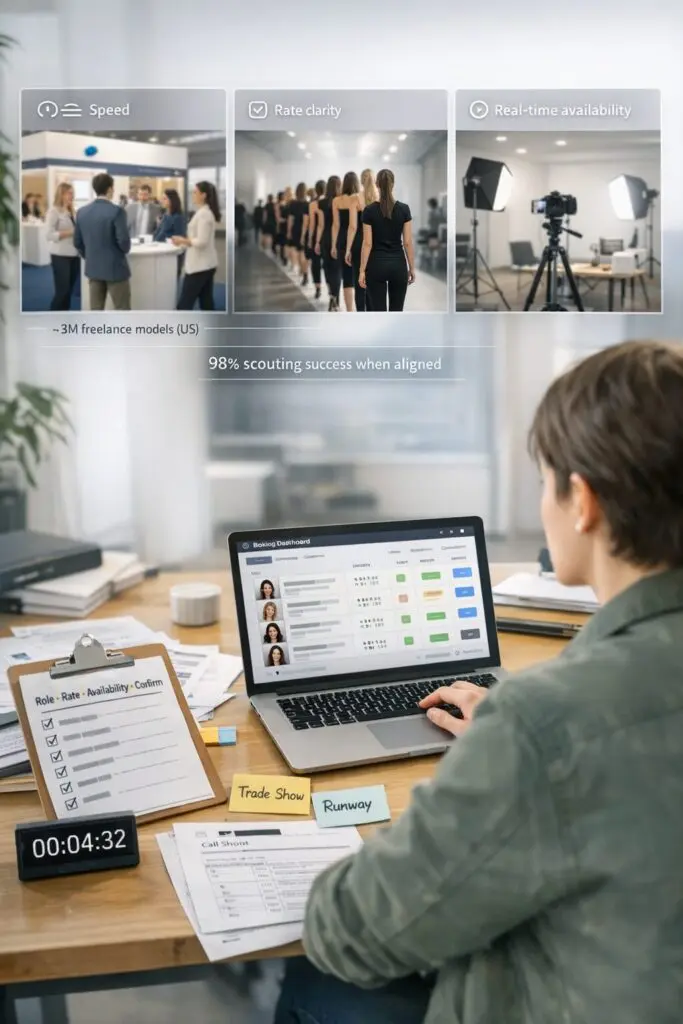
Modern booking execution phase focus on three things:
- Speed from job post to confirmation
- Accurate pay expectations upfront
- Reliable attendance on the day of work
The Three Most Common Booking Scenarios
Most model bookings fall into trade shows, runway events, or content production, each with different requirements and risks.
1) Trade Shows and Live Events
Trade shows need models who can engage people for long hours, follow brand scripts, and stay professional in busy spaces. Reliability matters more than portfolio polish alone.
Common roles include:
- Booth staff and brand ambassadors
- Product demo support
- Lead capture and guest flow
Late cancellations are costly here because replacements are hard to find once the event starts.
2) Runway and Fashion Events
Runway booking is highly structured. Measurements, walk timing, and fittings matter. Models must be available for rehearsals and show days, often with little flexibility.
Key needs include:
- Exact sizing and look
- Prior runway experience
- Availability for fittings and call times
3) Content and Campaign Shoots
Content work moves fast and varies widely. Some shoots last a few hours; others run full days. Many projects now blend stills, short videos, and social clips.
Teams usually look for:
- Comfort on camera
- Ability to follow creative direction
- Fast turnaround and adaptability
Step 1: Define the Role Before Looking at Talent
Clear role definitions reduce mismatches and speed up booking decisions.
Before searching for models, project managers should lock in:
- Job type (event, runway, content)
- Location and dates
- Hours and call times
- Wardrobe or size needs
- Usage rights for content
Vague job posts attract mismatched candidates and slow down decisions. Clear details allow systems to surface talent that truly fits.
Step 2: Set Rates Using Real Market Data
Market-based rate suggestions help teams avoid underpaying or overspending.
One challenge for newer project managers is knowing how much to budget.
Platforms like Zodel reflect this shift by suggesting pay rates based on live market data, allowing newer project managers to budget confidently without relying on outdated rate cards.
Rates vary by city, job type, and duration. Guessing often leads to low response rates or last-minute changes.
Modern tools now suggest pay ranges based on:
- Location demand
- Role type
- Duration and experience level
This helps rookie managers plan budgets with confidence instead of relying on outdated rate cards.
Step 3: Post the Job and Match Availability
Faster posting and real-time availability lead to quicker fills. Traditional hiring involved forms, emails, and long wait times. Today, posting a job can take under five minutes when productions are streamlined.
Tools designed for modern hiring reflect this shift by removing friction at the earliest stages of booking. Posting a job typically takes less than five minutes, and roles are matched only with models who are available at that time. In practice, teams report a 98% success rate in scouting suitable talent within the first few hours of posting when availability and requirements are aligned.
Rate-setting has also become more accessible. Instead of relying on experience or guesswork, newer project managers can view suggested pay ranges based on market data, helping them understand realistic budgets for their campaign before outreach begins. This combination of fast posting, data-informed rates, and real-time availability reduces delays and makes model booking easier to manage, even for teams hiring for the first time.
Why speed matters
When availability, role details, and rates are aligned, teams report a 98% success rate in scouting suitable talent within the first few hours of posting a job.
Where Modern Hiring Tools Fit Into the Booking Process
Zodel is especially useful for teams that don’t book models every day—startup brands, growing agencies, and rookie project managers—because it removes guesswork around pricing, availability, and confirmation.
The Zodel modeling platform acts as the implementation layer that turns a defined process into confirmed bookings.
When teams define the role, rate, and timing upfront, they can rely on systems that match only available, verified models to those exact requirements. In practice, this allows a trade show team to post a role quickly, see suggested rates, and review a short list of pre-matched talent instead of scrolling endlessly.
Zodel modeling platform surfaces only models who are available and fit the role, reducing noise and saving time. Many teams use it as the operational layer once planning is complete.
Key features commonly used mid-project include:
- Job posting in under five minutes
- Suggested pay rates based on market data
- Real-time matching that fills most roles within 24 hours
- Secure fund holding until completion
- Payments released to models within 24 hours after the job
Traditional agencies often take 10–40%, while newer systems apply fees as low as 5%, helping teams maintain tighter budgets.
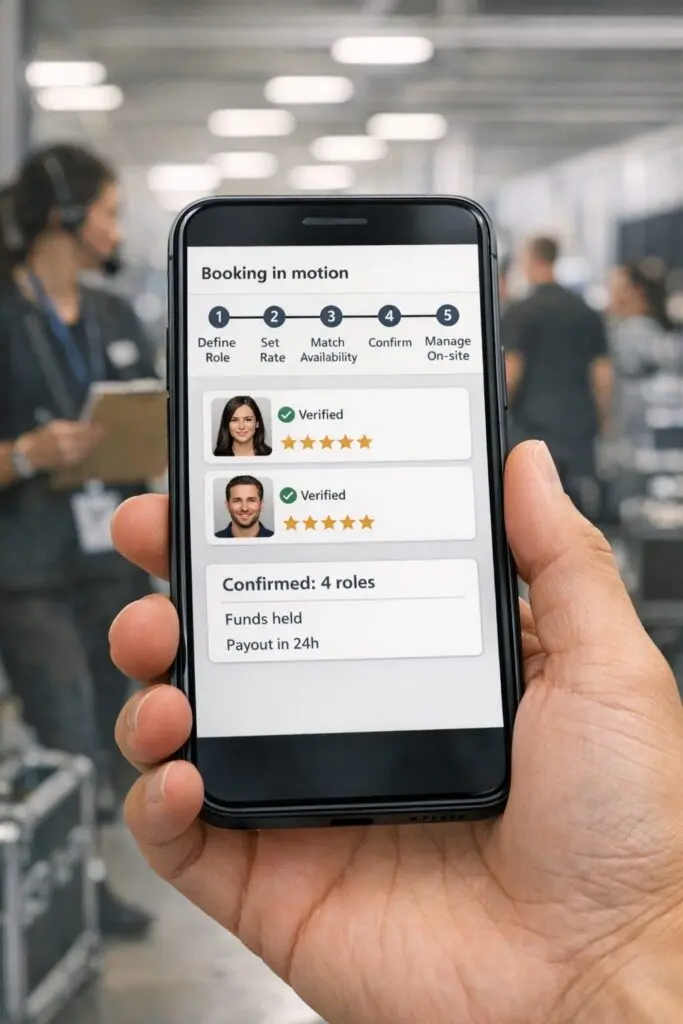
Step 4: Review, Chat, and Confirm
Built-in communication reduces misalignment before the job day.
Once suitable matches appear, teams move into confirmation mode. This stage is where small details are finalized and misunderstandings are prevented. Reviewing profiles side by side makes it easier to compare experience, availability, and prior performance without switching between tools.
Integrated messaging allows teams to clarify specifics such as wardrobe requirements, arrival times, meeting points, and expected deliverables in one place. Having these conversations early helps prevent last-minute surprises and ensures everyone arrives prepared.
Verification and rating systems add another layer of accountability. When both clients and models have visible histories, expectations are clearer, and professional standards are easier to maintain—especially for live events and runway shows where timing and precision matter.
Step 5: Manage the Job On the Go
Mobile access keeps projects on track during busy days.
Event and production days rarely unfold exactly as planned, and most coordination happens away from a desk. Mobile access allows teams to stay responsive as schedules shift or questions arise.
Being able to review profiles, message talent, approve hours, and manage payments from a phone reduces delays and keeps decisions moving in real time. This is particularly valuable during trade shows, fittings, or multi-location shoots where quick adjustments are often required.
Full access via iOS and Android supports:
- On-site coordination as schedules evolve
- Fast approvals without waiting for post-event follow-ups
- Real-time issue resolution when conditions change
On the ground, during a runway rehearsal, the show runs longer than expected. The production manager updates call times, confirms extended hours, and communicates changes directly from a phone. Models receive updates immediately, and approvals are handled the same day, keeping the show on schedule without post-event confusion.
Modern Booking vs. Traditional Agencies
Modern-first booking prioritizes speed and transparency, while agencies focus on representation and long-term contracts.
| Area | Traditional Agencies | Modern Online Booking |
| Time to book | Days or weeks | Hours to 24 hours |
| Rate clarity | Negotiated manually | Market-based suggestions |
| Availability | Often unclear | Real-time |
| Fees | 10–40% | As low as 5% |
| Flexibility | Contracts required | Project-based |
This does not replace agencies for all use cases, but it fits well for fast-moving campaigns and events.
Common Mistakes to Avoid
Most booking problems trace back to preventable breakdowns in planning and coordination rather than a lack of talent. When expectations are unclear or timelines are rushed, even experienced teams can run into avoidable issues.
Common pitfalls include:
- Publishing job details that are too broad, which attracts mismatched candidates and slows selection
- Setting compensation without accounting for local demand, timing, or role complexity
- Locking in talent without confirming exact call times, locations, or duration
- Treating runway bookings like standard shoots and overlooking fittings or rehearsals
- Filling schedules too tightly without contingency options for last-minute changes
Teams that document roles clearly, confirm logistics early, and plan for small buffers tend to avoid most of these failures and maintain smoother execution across events and productions.
Why Speed and Trust Matter More Than Ever
With millions of freelancers in the market, filtering and verification are more valuable than raw volume.
Having access to many profiles means little if availability and reliability are unknown. Systems that verify identities, show only active talent, and hold funds securely reduce risk for both sides.
Zodel supports this by:
- Verifying both clients and models
- Holding project funds until completion
- Paying models within 24 hours after the job
- Providing 24/7 support for issue resolution
These safeguards matter most in live environments where mistakes are public and costly.
How Location and Timing Change Model Availability and Cost
Model availability is not evenly distributed across cities, seasons, or even days of the week. Understanding how location and timing affect supply helps teams plan smarter and avoid last-minute compromises.
Major markets like Las Vegas, Los Angeles, New York, Miami, and Chicago experience sharp demand spikes tied to events, fashion weeks, trade shows, and campaign cycles. During large conventions or seasonal fashion events, availability tightens quickly, and rates often rise as demand outpaces supply. Booking early in these periods reduces risk and keeps budgets stable.
Timing within the week also matters. Weekends and evenings are in higher demand for events and content shoots, while weekday daytime roles often have more flexibility. Short-notice bookings can still succeed, but only when systems surface talent that is genuinely available at that moment.
Teams that factor location and timing into planning tend to:
- Secure better rate alignment
- Avoid overbooking or under-staffing
- Reduce last-minute cancellations
This context is especially important for newer project managers who may underestimate how quickly availability shifts in high-demand markets.
What Reliable Attendance Looks Like in Practice
Reliability in model booking is not just about showing up—it is about consistency, preparedness, and alignment with expectations. Many booking failures stem from unclear definitions of what “reliable” actually means.
For trade shows, reliable attendance includes arriving early, staying for the full shift, following brand guidelines, and maintaining professionalism throughout long days. For runway events, it means attending fittings, rehearsals, and call times without exception. For content shoots, it includes being prepared, adaptable, and responsive to direction.
Modern hiring systems reduce attendance risk by:
- Showing only talent who has confirmed availability
- Surfacing models with proven completion histories
- Enabling clear communication before the job day
When attendance expectations are defined early and reinforced through confirmation steps, teams reduce friction and avoid costly replacements.
How Payment Structure Affects Booking Outcomes
Payment structure plays a larger role in booking success than many teams realize. Delays, unclear terms, or uncertain payout timing often discourage qualified talent from committing, especially for time-sensitive roles.
Clear, upfront payment terms improve response rates and attendance. When funds are secured before the project and released promptly after completion, both sides operate with confidence. Models are more likely to accept and honor commitments when payment timelines are predictable.
For project managers, secure fund handling also simplifies accounting and reduces disputes. Instead of managing multiple invoices or follow-ups, payment workflows are handled alongside booking and confirmation.
Teams that align payment structure with modern expectations tend to:
- Attract more qualified responses
- Reduce drop-offs before the event or shoot
- Build repeat working relationships
This becomes especially important in live environments where trust and timing directly affect execution.
For teams managing fast-moving trade shows, runway events, or content shoots, platforms like Zodel provide a way to turn planning into confirmed bookings without agency overhead or long lead times.
Final Thoughts
Booking models successfully today depends on clear planning, data-backed rates, and tools that move as fast as modern projects require.
Trade shows, runway events, and content shoots all demand different skills, but they share one need: reliable talent on tight timelines. Teams that use structured workflows and real-time matching reduce stress, protect budgets, and execute with confidence.
As the freelance model workforce continues to grow, the advantage will belong to teams that can move quickly without sacrificing trust or quality.

SUGGESTED

How GIMME Beauty Built Its Creator Strategy Around Product Proof
In categories where products can appear interchangeable, creator marketing can make small...

How Soltech Used Plant Creators to Turn Grow Lights Into Home...
Most grow lights begin with the needs of the plant. Soltech also considered the room...

Going Multilingual: What AI Dubbing Actually Does For Creators...
There is a specific kind of frustration that hits creators somewhere around the point...