
Influencer Marketing Hub sets itself apart from conventional review platforms through the involvement of AI Marketing experts such as Werner Geyser, Djanan Kasumovic, Camille Kennedy, Dave Eagle, and other notable industry figures. This expert team brings a profound understanding of the AI Marketing landscape, assessing tools and platforms with an insider’s perspective on capabilities, experience, and industry acumen. Unlike user-generated review platforms, Influencer Marketing Hub’s evaluations are rooted in extensive firsthand experience and direct interactions with the tools and platforms in question. This ensures that the reviews are not only trustworthy but also deeply informed. High-caliber brands like Hamster Garage, AiDisco, and Linqia undergo rigorous monthly evaluations, highlighting the platform’s commitment to identifying and showcasing top-tier solutions in AI Marketing and beyond.
Influencer Marketing Hub has consistently been recognized by leading media outlets for our authoritative data, findings, and insights within the AI Marketing landscape. Our platform is frequently cited as a trusted source of information, demonstrating the value and impact of our work in shaping industry standards and practices.





Influencer Marketing Hub employs an expert-driven methodology to evaluate AI Marketing agencies, ensuring that our recommendations are both reliable and comprehensive. This approach is designed to help businesses and individuals find the best agencies to meet their specific AI Marketing needs. Here’s how we assess the various agencies like Hamster Garage, AiDisco, and Linqia:
Search visibility is no longer defined solely by blue links and keyword rankings. In 2026, brand exposure increasingly depends on whether AI systems choose to surface your company inside synthesized answers.
Platforms such as ChatGPT, Gemini, Perplexity, and other generative engines now summarize, interpret, and recommend sources directly within conversational responses. If your brand is not included in those outputs, traditional search rankings may offer limited protection.
This shift has introduced a new priority for marketing leaders: AI visibility.
Unlike conventional SEO, visibility in AI environments depends on entity clarity, structured data integrity, authoritative citations, and content architecture that large language models can reliably interpret and retrieve. Being crawlable is no longer enough. Brands must be structured, contextualized, and reinforced across trusted digital sources.
As a result, a new category of agencies has emerged around Answer Engine Optimization. The firms in this evaluation position themselves as specialists in building the technical and content infrastructure required to increase brand inclusion within AI-generated answers.
- What AI Visibility Actually Means
- Why AEO Requires Specialized Agencies
- Top AEO Agencies for 2026
- 1. Hamster Garage
- 2. AiDisco
- 3. Linqia
- 4. AEO Agency
- 5. BetterAnswer
- 6. Embarque
- 7. Discovered Labs
- Evaluation Methodology
- Best AEO Agency by Use Case
- Building Durable AI Visibility Infrastructure in 2026
- Frequently Asked Questions
What AI Visibility Actually Means
AI visibility refers to a brand’s inclusion within answers and summaries generated by large language models and AI-powered search interfaces.
This differs from traditional search visibility, where ranking among blue links drives traffic. In AI search environments, such as ChatGPT, Gemini, Perplexity, and others, the goal for brands is to be retrieved and cited inside synthesized responses rather than merely ranking high in SEO results.
This distinction matters because AI search is increasingly influencing how users find information. For example, more than one-third of consumers say they begin their searches with AI tools instead of traditional search engines, reflecting a shift in discovery behavior.
At the same time, AI-generated summaries have grown rapidly as part of broader search experiences. McKinsey research indicates that roughly 50% of search sessions now include AI-generated overviews, a figure expected to rise further.
While traditional search engines still dominate overall query volume, AI visibility is no longer peripheral. Brands that fail to appear in these responses risk being overlooked even when they perform well in SEO.
AI visibility is built on structural and semantic signals, including:
- Structured data and schema markup to clarify entity relationships
- Entity authority reinforcement across trusted sources
- Content formatted for conversational query interpretation
- Knowledge graph alignment, where AI systems can confidently map relationships
This shift means that being crawlable and ranked in search engines is not enough. Winning inclusion in AI responses requires tailoring content and technical signals for machine understanding and retrieval, moving optimization focus from keyword rankings to structural and entity clarity.
Why AEO Requires Specialized Agencies
The emergence of AI-generated answers has introduced optimization requirements that extend beyond conventional search engine strategies. Traditional SEO focuses on indexing, ranking signals, backlink authority, and keyword relevance.
While these remain foundational, they do not guarantee inclusion within AI-generated responses.
Large language models retrieve and synthesize information differently from search engines. They rely on entity clarity, contextual reinforcement across trusted sources, structured formatting, and semantic consistency. A webpage ranking in position one does not ensure that an AI system will cite it.
This shift introduces several technical demands:
- Structured data implementation beyond basic schema
- Entity mapping and reinforcement across digital ecosystems
- Knowledge graph alignment
- Conversational query modeling
- Content formatting optimized for answer extraction
- Monitoring of AI-generated outputs for brand inclusion
Many traditional SEO agencies are optimized for ranking improvement, not for retrieval inclusion within generative systems. AEO requires a blend of technical SEO, structured data engineering, digital PR, entity authority building, and ongoing monitoring of AI answer environments.
Additionally, measurement complexity increases. AI platforms do not provide standardized analytics dashboards for citation inclusion. Agencies operating in this space must rely on structured testing, query sampling, brand mention monitoring, and indirect visibility signals.
For organizations investing in AI visibility, the challenge is no longer keyword targeting alone. It is infrastructure alignment. This is where specialized AEO agencies position themselves, focusing on technical precision, entity reinforcement, and structured content architecture designed for AI interpretation.
Top AEO Agencies for 2026
1. Hamster Garage
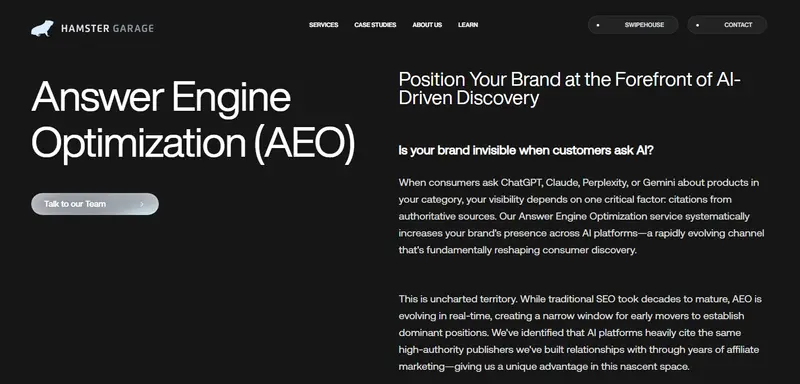
Best For: Brands seeking citation inclusion within AI-generated answers
Core Strength: AI citation amplification through strategic content placement
Technical Depth: Advanced citation strategy with structured content reinforcement
Schema & Structured Data Expertise: Referenced as part of broader AI visibility positioning
Entity Optimization Capability: Focus on reinforcing brand presence across trusted sources
AI Citation Strategy: Emphasis on increasing brand mentions within AI platforms such as ChatGPT, Gemini, Claude, and Perplexity
Industries Served: Consumer brands, eCommerce, digital-first companies
Pricing: Upon request
Notable Clients: Xero, Uber, Canva
Read More
Hamster Garage
Hamster Garage is an award-winning affiliate and creator marketing agency built by former Airbnb growth leaders and trusted by category-defining brands including Uber, Airbnb, Tesla, Canva, Slack, Xero, MasterClass, Faire, and Bill.

10 - 50

Chicago, New York, San Francisco, and Lahore
Best for:
Growth-driven mid-market and enterprise brands
Hamster Garage
Hamster Garage is an award-winning affiliate and creator marketing agency built by former Airbnb growth leaders and trusted by category-defining brands including Uber, Airbnb, Tesla, Canva, Slack, Xero, MasterClass, Faire, and Bill.
2. AiDisco
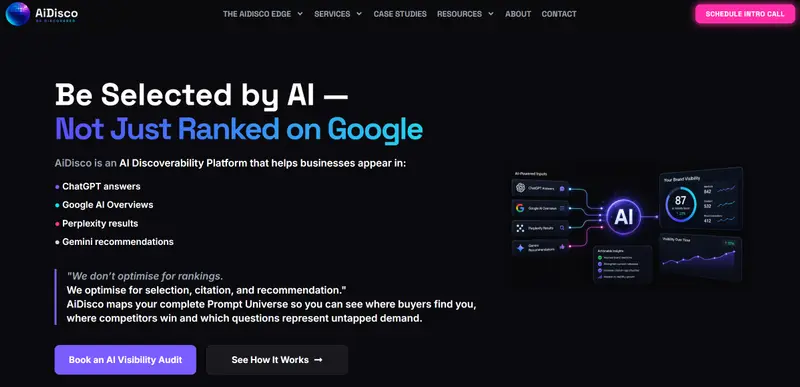
Best For: B2B, SaaS, professional services, outsourcing, and eCommerce brands targeting buyer-stage AI visibility
Core Strength: Prompt Universe mapping paired with AI Narrative Intelligence, Share of Answer, Share of Buyer Answer, and White Space analysis
Technical Depth: Repeated prompt testing across ChatGPT, Gemini, Claude, Perplexity, and Google AI Overviews
Schema & Structured Data Expertise: JSON-LD implementation, structured-answer formatting, content extraction, and schema architecture
Entity Optimization Capability: Entity relationship mapping, cross-platform consistency, internal linking, and third-party authority reinforcement
AI Citation Strategy: Prompt-aligned content, source-worthy pages, structured answers, authority development, and external validation
Industries Served: SaaS, B2B, professional services, outsourcing, eCommerce, and enterprise organizations
Pricing: AI Visibility Audits from $2,500; implementation generally ranges from $5,000 to $25,000+; ongoing optimization uses custom pricing
Read More3. Linqia
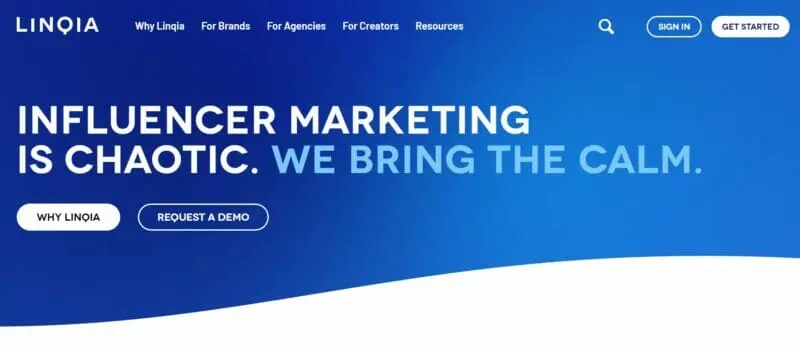
Best For: Fortune 500 Brands incorporating creator content into their AI visibility strategy
Core Strength: Turning AI search insights into targeted creator campaigns
Technical Depth: AI search analysis through AirOps, combined with Linqia’s creator selection and campaign execution.
Schema & Structured Data Expertise: Implementation services are not publicly documented in the AEO materials reviewed
Entity Optimization Capability: Dedicated entity mapping and knowledge graph services are not publicly documented
AI Citation Strategy: Identify relevant questions and content gaps, then commission creator videos intended to improve brand visibility in AI-generated answers.
Industries Served: CPG, retail, food and beverage, beauty, technology, and other sectors across its broader agency practice.
Pricing: $50,000+.
Read More
Linqia
Linqia is the leading independent influencer marketing agency in the U.S., specializing in data-driven campaigns for major brands, combining influencer marketing, paid media, and content production. They are well known for their "guaranteed resul...
50+
San Francisco, Chicago, New York, Colombia
Best for:
Fortune 500 Brands
Linqia
Linqia is the leading independent influencer marketing agency in the U.S., specializing in data-driven campaigns for major brands, combining influencer marketing, paid media, and content production. They are well known for their "guaranteed resul...
4. AEO Agency
Best For: Brands seeking focused AEO expertise to improve AI search visibility
Core Strength: Dedicated Answer Engine Optimization strategy centered on AI inclusion
Technical Depth: Specialized positioning around conversational AI retrieval environments
Schema & Structured Data Expertise: Positioned as part of structured optimization efforts
Entity Optimization Capability: Emphasis on strengthening authority signals for AI interpretation
AI Citation Strategy: Focused on improving brand inclusion within ChatGPT, Gemini, and similar AI platforms
Industries Served: B2B, service-based businesses, digital brands
Pricing: Undisclosed
Notable Clients: OpenAI, Airbnb, Hubspot
Read More5. BetterAnswer
Best For: Brands seeking measurable AI visibility growth through structured audits and tracking
Core Strength: Audit-led AEO strategy with prompt-level monitoring
Technical Depth: Advanced implementation across AI search and traditional SEO
Schema & Structured Data Expertise: Includes schema markup implementation as part of optimization
Entity Optimization Capability: Structured content refinement aligned to AI retrieval patterns
AI Citation Strategy: Focused on increasing prompt-level brand inclusion across ChatGPT, Perplexity, and similar platforms
Industries Served: Retail, beauty, SaaS, digital brands
Pricing: From $5,000 per project
Notable Clients: Undisclosed
Read More6. Embarque
Best For: SaaS and content-driven brands seeking AI visibility through strong SEO infrastructure
Core Strength: Content-led SEO with authority and backlink reinforcement
Technical Depth: Advanced SEO execution with structured content architecture
Schema & Structured Data Expertise: Incorporated within broader SEO strategy
Entity Optimization Capability: Reinforced through content clusters and backlink authority
AI Citation Strategy: Positioned as an extension of SEO authority building
Industries Served: SaaS, software, startups, digital platforms
Pricing: Typically from $1,000 per project
Notable Clients: Flick, VEED, Buy Me A Coffee
Embarque is widely recognized for its SaaS-focused SEO and content marketing expertise. Client feedback consistently highlights traffic growth, improved keyword rankings, and strong backlink profile development.
Read More7. Discovered Labs
Best For: B2B organizations seeking structured AI visibility and entity authority reinforcement
Core Strength: B2B-focused Answer Engine Optimization with authority engineering
Technical Depth: Advanced entity positioning aligned with AI retrieval systems
Schema & Structured Data Expertise: Integrated within broader technical SEO frameworks
Entity Optimization Capability: Strong emphasis on brand positioning across trusted industry sources
AI Citation Strategy: Focused on improving inclusion within generative AI recommendations for B2B queries
Industries Served: B2B, SaaS, technology, professional services
Pricing: Typically from $5,000 per project
Notable Clients: Instantly, Incident.io, Passion.io
Read MoreEvaluation Methodology
The agencies in this review were evaluated using a structured framework focused specifically on AI visibility capabilities rather than traditional SEO performance alone.
Assessment criteria included:
- Explicit positioning around Answer Engine Optimization
- Depth of structured data and schema implementation
- Entity optimization and authority reinforcement strategy
- AI citation and retrieval inclusion methodology
- Monitoring capability for AI-generated responses
- Integration between SEO infrastructure and AEO execution
- Publicly documented case studies, client feedback, or measurable outcomes
Where third-party validation or performance documentation was limited, this was noted in the analysis. The goal of this evaluation is not to rank agencies hierarchically, but to clarify how each positions itself within the emerging AI visibility landscape.
Because Answer Engine Optimization is still evolving, documentation depth and monitoring standards vary across providers. Readers are encouraged to assess technical alignment, reporting transparency, and infrastructure fit relative to their organization’s AI visibility objectives.
Best AEO Agency by Use Case
AI visibility requirements vary by company size, industry complexity, and technical maturity. The agencies reviewed align differently depending on organizational objectives.
- Best for enterprise AI visibility infrastructure → BetterAnswerAI
Documented prompt tracking, AI traffic growth metrics, and structured audit frameworks position it well for organizations seeking measurable AI inclusion and ongoing monitoring.
- Best for SaaS and content-driven brands → Embarque
Strong SEO foundations, content architecture expertise, and backlink authority development make it suitable for content-heavy companies building AI eligibility through search authority.
- Best for focused AEO specialization → AEO Agency
Positioned exclusively around Answer Engine Optimization, appealing to brands seeking a dedicated AI visibility partner rather than a broader SEO provider.
- Best for citation amplification strategy → Hamster Garage
Emphasis on strengthening brand inclusion across trusted digital environments aligns with organizations prioritizing AI citation presence across multiple generative platforms.
- Best for B2B authority reinforcement → Discovered Labs
Structured B2B positioning and entity authority focus may resonate with companies operating in specialized or technical industries.
|
Agency |
Best For | Technical Depth | Schema Expertise | Entity Strategy Depth | AI Citation Focus | Minimum Engagement |
Ideal Company Size |
| Hamster Garage | Citation amplification | Advanced | Moderate | Advanced | High | Scope-based | Undisclosed |
| AEO Agency | Dedicated AEO specialization | Advanced | Moderate | Advanced | High | Strategy-based | Undisclosed |
| BetterAnswerAI | Measurable AI traffic growth | Enterprise-Grade | Advanced | Advanced | High | Audit + implementation | $5,000 per project |
| Embarque | SaaS content authority | Advanced | Moderate | Advanced | Moderate | Growth-stage budgets | $1,000 per project |
| Discovered Labs | B2B entity positioning | Advanced | Moderate | Advanced | Moderate | Mid-market B2B | $5,000 per project |
Building Durable AI Visibility Infrastructure in 2026
AI visibility is rapidly becoming a structural layer of digital strategy rather than an experimental channel. As generative systems increasingly synthesize answers instead of listing links, brands must ensure they are eligible for retrieval, citation, and contextual inclusion.
Traditional SEO remains foundational, but entity clarity, structured data precision, and authority reinforcement now play a central role in whether a brand appears inside AI-generated responses.
Answer Engine Optimization introduces new measurement challenges and infrastructure requirements. Monitoring prompt-level inclusion, reinforcing knowledge graph signals, and aligning content architecture with conversational queries require deliberate technical execution.
Organizations investing in AI visibility should evaluate agencies based on technical depth, reporting transparency, and integration with broader search infrastructure. In a retrieval-driven environment, durable visibility depends on structure, consistency, and authority alignment rather than rankings alone.
Frequently Asked Questions
How can predictive AI tools improve SEO over time?
Predictive tools help anticipate shifts in user intent and search patterns, enabling marketers to plan content that aligns with future queries. When evaluating optimization partners, brands often consider AI tools for predictive SEO to enhance visibility across both traditional search and generative AI environments.
What role does AI play in blogging for search visibility?
AI can help structure long-form content, optimize headings, and anticipate semantic relevance for emerging queries. Many strategies extend beyond SEO into conversational models, such as applying insights from AI SEO blogging to improve how content may be interpreted by large language models.
Is generative AI useful for writing SEO-optimized content?
Yes, AI systems can assist with content drafting, topic clustering, and relevance scoring. When combined with human editing and entity clarity, AI SEO content writing can support structured information that improves both search engine rankings and relevance signals for AI visibility.
How do AI tools help with keyword research?
AI keyword tools analyze intent clusters and emerging conversational phrases, which can reveal opportunities traditional tools might miss. Teams often pair these insights with AI SEO keywords research to build content that aligns with retrieval patterns in both search engines and generative AI outputs.
Can ChatGPT be used for link-building outreach?
Yes. ChatGPT can generate tailored outreach messages and help identify high-authority domains for backlink opportunities. Combining this with structured link development strategies, such as using ChatGPT for link building, can reinforce authority signals important for both search and AI visibility.
How does AI influence search discovery beyond ranking?
AI influences discovery by summarizing content, presenting synthesized results, and suggesting answers directly within conversational interfaces. Understanding AI search discovery dynamics is essential for agencies helping brands gain visibility inside generative responses rather than relying solely on traditional ranking.
Why is geo-targeted optimization important for visibility?
Geo-targeted strategies ensure content relevance for localized queries, which can affect how brands are surfaced to users in specific regions. Agencies often incorporate geo strategies and tactics to improve contextual authority and alignment with user intent at a local level.
What are some advanced tactics for optimizing local and regional search presence?
Advanced tactics include structured location data, local entity reinforcement, and region-specific content that aligns with user expectations. Geo optimization strategies help brands appear both in traditional local search and in region-aware generative AI responses.


