
Social commerce continues to attract creators with the promise of new revenue opportunities. Global social commerce sales are projected to approach $1 trillion in 2026, while platforms continue expanding shopping features and creator monetization programs.
Growth, however, does not eliminate risk.
Creators who have spent years building audiences have lived through enough platform cycles to recognize a recurring pattern. Algorithms change. Monetization programs evolve. Consumer behavior shifts. Platforms rise quickly and sometimes disappear just as fast.
Early-stage creators often focus on growth potential. Experienced creators tend to focus on sustainability.
Questions around revenue stability, operational reliability, and long-term business viability have become increasingly important as creators expand beyond content and into commerce. Many are no longer searching for the next trend. They're looking for systems they can build on for years.
Long-term success in social commerce depends on more than product selection or commission rates. Infrastructure matters. Reliable payments matter. Fulfillment matters. Compliance matters.
Those operational foundations often determine whether a commerce business can withstand the inevitable changes that shape the creator economy.
MyyShop was built around that reality, combining creator monetization opportunities with the infrastructure and operational support needed for long-term growth.
- The Creator Economy Has Entered Its Long-Termism Era
- Why Veteran Creators Are Growing Wary of Social Commerce Volatility
- What Revenue Security Actually Looks Like for Creators
- The Infrastructure Advantage: Why MyyShop Is Built for the Long Term
- How MyyShop's Full-Loop Ecosystem Creates Sustainable Revenue Growth
- Building for the Next Decade, Not the Next Trend
The Creator Economy Has Entered Its Long-Termism Era
A noticeable shift is taking place among established creators.
Growth remains important, but revenue durability has become a higher priority.
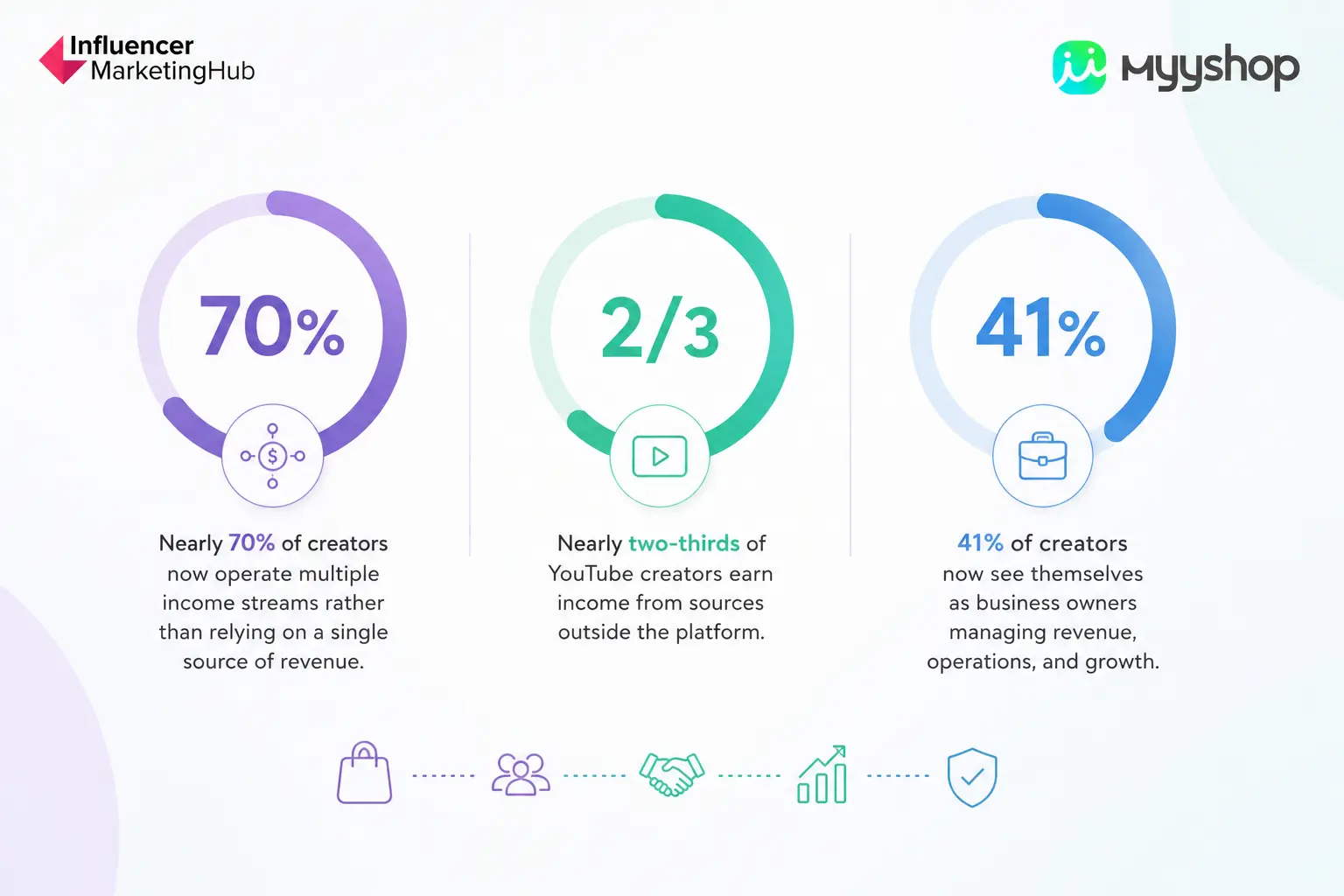
Industry research found that nearly 70% of creators now operate multiple income streams rather than relying on a single source of revenue. Diversification has become a practical response to platform dependency, fluctuating brand budgets, and changing audience behavior.
Many creators have also expanded beyond platform-native monetization. A report from TIME found that nearly two-thirds of YouTube creators generate income from sources outside the platform itself, including merchandise, memberships, brand partnerships, affiliate programs, and commerce initiatives.
The trend reflects a broader evolution in how creators view their businesses.
Content creation increasingly resembles entrepreneurship. Epidemic Sound's Future of the Creator Economy Report found that many creators now view themselves as business owners responsible for managing revenue, operations, partnerships, and long-term growth. The sentiment, according to the report, is shared by 41% of respondents.
Commerce naturally becomes part of that equation.
Social commerce creates opportunities to build revenue streams that extend beyond advertising payouts and sponsorship deals. At the same time, commerce introduces new operational responsibilities that many creators never had to manage before.
Product sourcing, order fulfillment, customer experience, payments, shipping, and compliance all influence the outcome.
Experienced creators understand that every new revenue stream introduces a new layer of operational risk.
Certainty becomes valuable in that environment.
Reliable infrastructure often creates more long-term value than short-term monetization opportunities. Sustainable growth comes from systems that continue working when platform trends change, algorithms evolve, and new commerce tools enter the market.
Veteran creators have seen enough cycles to know the difference.
Why Veteran Creators Are Growing Wary of Social Commerce Volatility
Social commerce continues to grow, but growth alone does not guarantee stability.
More than 50% of global shoppers have already made purchases through social media platforms. Consumer adoption is accelerating, and social commerce is becoming a larger part of the broader ecommerce landscape.
Opportunity is not the concern. Unpredictability is.
Creators who have spent years building audiences understand how quickly the digital landscape can change. Entire platforms have disappeared. Algorithm updates have reshaped reach overnight. Monetization programs have launched, evolved, and sometimes ended with little warning.
Commerce introduces another layer of complexity.
Revenue no longer depends solely on audience engagement or content performance. Product availability, fulfillment speed, customer satisfaction, payment processing, and cross-border logistics can all influence outcomes.
Many creators enter social commerce expecting a straightforward extension of their content business. Reality often looks different. Every order creates operational responsibilities that exist outside a creator's area of expertise.
Managing those responsibilities becomes increasingly challenging as businesses scale.
Cross-border commerce presents an even greater challenge. International customers expect competitive shipping times, transparent tracking, reliable delivery, and secure payment experiences regardless of location. Meeting those expectations requires infrastructure that many individual creators cannot realistically build on their own.
Consumer expectations continue to rise as well. Research from PwC found that 73% of consumers consider customer experience an important factor in their purchasing decisions. Product discovery happens through creator content, but fulfillment and delivery ultimately influence whether customers return.
Established creators recognize the implications.
A weak operational foundation can undermine an otherwise successful commerce strategy. Audience trust takes years to build and only a few poor customer experiences to damage.
Many veteran creators have reached a point where they evaluate commerce opportunities differently. Commission percentages, trending products, and short-term earning potential remain important considerations, but they are rarely the deciding factor.
Questions around reliability often carry more weight:
- Can customers receive products consistently?
- Can payments be processed securely?
- Can the business support international growth?
- Can the revenue stream remain dependable over time?
Answers to those questions often determine whether a commerce initiative becomes a sustainable business or a short-lived experiment.
What Revenue Security Actually Looks Like for Creators
Revenue security rarely gets the same attention as growth.
Most conversations around creator monetization focus on earning potential. Headlines often highlight top-performing creators, record-breaking sales events, and rapidly growing social commerce trends.
Experienced creators tend to evaluate opportunities through a different lens.
Revenue security is not about maximizing income in a single month. It is about building systems that can generate income consistently over time.
A sustainable commerce business depends on several factors working together:
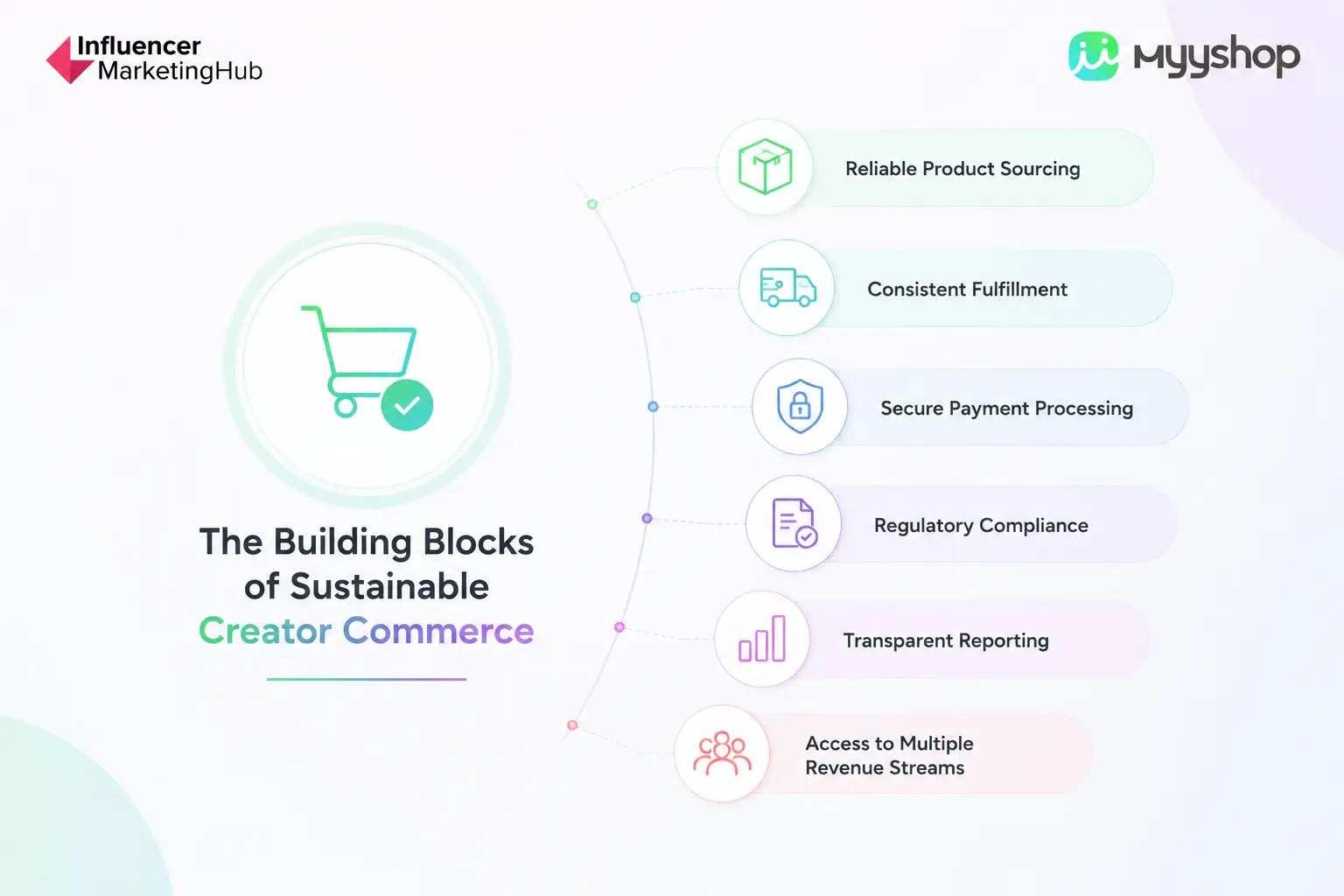
- Reliable product sourcing
- Consistent fulfillment
- Secure payment processing
- Regulatory compliance
- Transparent reporting
- Access to multiple revenue streams
Weakness in any one of those areas can create friction that affects both customer experience and creator earnings.
Diversification plays an important role as well. Research from Linktree found that creators with multiple income streams are increasingly better positioned to navigate platform changes, economic shifts, and fluctuations in brand spending. Relying on a single source of income creates concentration risk. Multiple revenue channels create resilience.
Many veteran creators have already adopted this mindset.
Brand partnerships remain valuable, but sponsorship revenue often depends on campaign cycles and marketing budgets. Affiliate programs create additional opportunities, but performance can fluctuate based on product demand and platform visibility.
Long-term stability often comes from combining several complementary revenue streams into a single ecosystem. Commerce can become a powerful component of that ecosystem when supported by the right infrastructure.
Operational reliability matters because every commerce transaction affects more than revenue. Product quality influences customer trust. Shipping performance affects repeat purchases. Payment systems influence cash flow. Compliance requirements determine whether creators can confidently expand into new markets.
Commerce success becomes much easier to sustain when creators can focus on audience growth and content creation while proven systems handle the operational complexity behind the scenes.
Infrastructure may not be the most visible part of social commerce, but it often becomes the difference between temporary monetization and long-term business growth.
Creators who prioritize revenue security understand that distinction. The strongest businesses are rarely built on a single viral moment. They are built on reliable systems that continue producing results long after the initial excitement fades.
The Infrastructure Advantage: Why MyyShop Is Built for the Long Term
Many creator commerce platforms focus on front-end features. Product discovery tools, storefronts, affiliate links, and commission structures often dominate the conversation.
Infrastructure receives far less attention.
Experienced creators know infrastructure is often what determines whether a commerce business can scale successfully.
Reliable fulfillment, secure payments, supplier quality, compliance requirements, and cross-border operations all happen behind the scenes. Customers may never see those systems directly, but they experience the results every time they place an order.
MyyShop approaches creator commerce from that perspective.
Rather than building a commerce platform from scratch, MyyShop is backed by DHgate Group, a company with more than 20 years of experience in global cross-border ecommerce. Over two decades, DHgate has built the operational foundation required to connect suppliers, merchants, logistics providers, and customers across international markets.
The heritage matters.
Cross-border commerce becomes significantly more complex as businesses expand internationally. Shipping requirements vary by region. Regulatory standards differ across markets. Payment systems must operate securely across multiple currencies and geographies.
Managing those complexities independently requires significant resources.
MyyShop gives creators access to infrastructure that has already been developed, tested, and refined through years of global commerce operations.
Logistics is one example.
Research from DHL shows that delivery speed, tracking visibility, and shipping reliability remain among the most important factors influencing ecommerce purchasing decisions. Product discovery may happen through creator content, but fulfillment ultimately shapes customer satisfaction.
Payment security is equally important.
Delayed payments, fragmented systems, and unclear reporting create unnecessary friction for creators trying to build predictable revenue streams. Established payment infrastructure helps reduce uncertainty and creates greater confidence in long-term planning.
Compliance represents another often-overlooked challenge.
Commerce businesses operating across Western markets must navigate evolving regulations, consumer protection requirements, tax obligations, and marketplace standards. Compliance failures can create operational disruptions that affect both creators and customers.
MyyShop's foundation allows creators to operate within a system designed to support those requirements rather than manage them independently.
The result is a different type of value proposition.
Most creator commerce platforms emphasize earning potential. MyyShop emphasizes earning potential supported by operational stability. Veteran creators understand why that distinction matters.
Revenue growth becomes far more meaningful when it is built on infrastructure designed to support the business for years rather than months.
How MyyShop's Full-Loop Ecosystem Creates Sustainable Revenue Growth
Sustainable creator businesses rarely depend on a single source of income. Multiple revenue streams help reduce exposure to changing algorithms, fluctuating brand budgets, and evolving consumer behavior.
Sponsored campaigns, affiliate programs, and commerce each have their own strengths, but each also has limitations. Sponsorship revenue depends on advertiser demand. Affiliate earnings rely on purchases and commission structures. Building a resilient creator business means combining complementary revenue streams rather than relying on one monetization model.
MyyShop's full-loop ecosystem is designed around that principle.
Instead of offering a single way to earn, the platform combines Brand Deals and MyyFinds, giving creators access to two monetization models that support different stages of the customer journey.
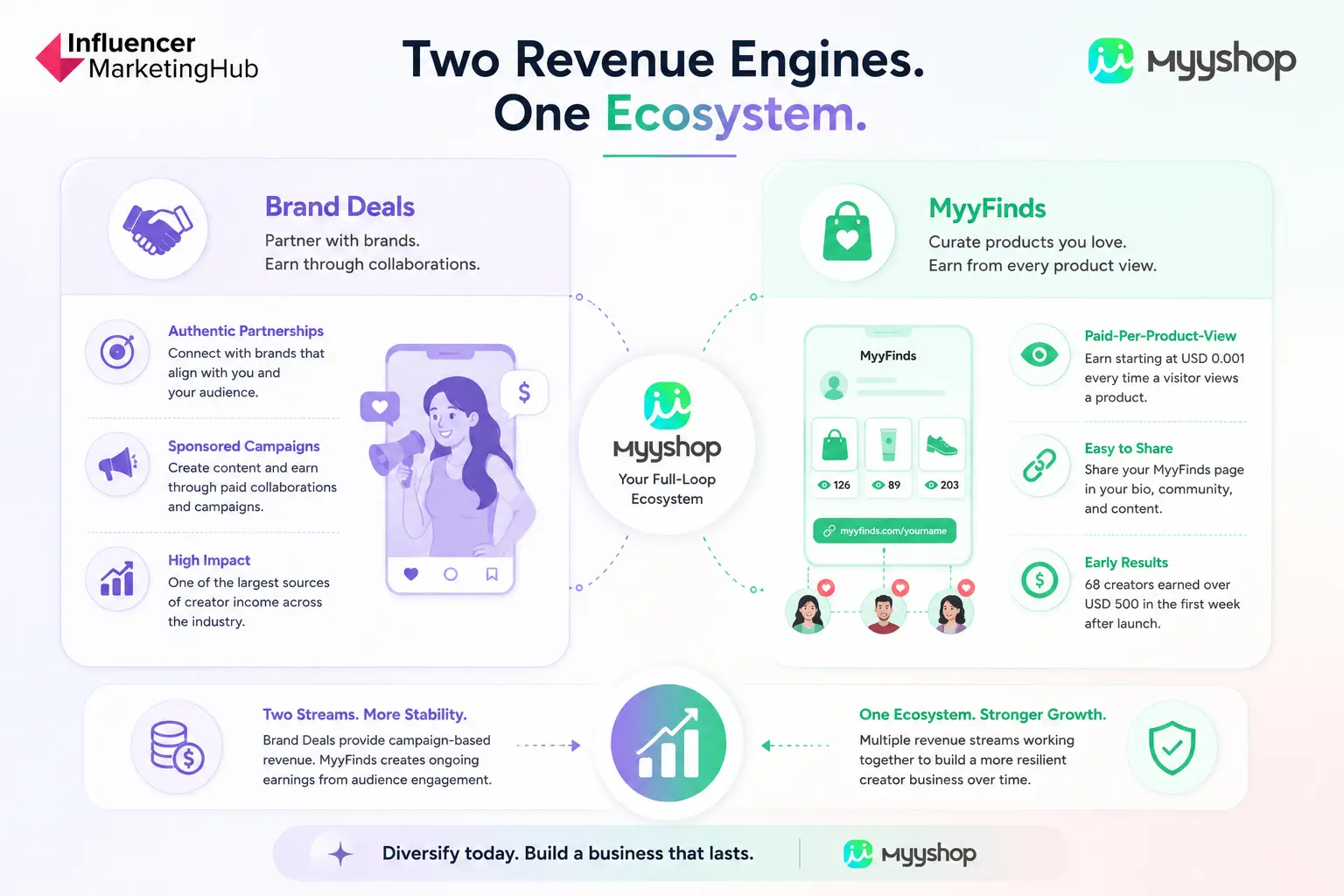
Brand Deals connect creators with businesses looking for authentic partnerships. Sponsored campaigns remain one of the largest sources of creator income, allowing creators to monetize their audiences through paid collaborations with brands that align with their content and communities.
MyyFinds extends those opportunities beyond individual campaigns. Creators can build a personalized product discovery page featuring products they genuinely recommend and share it across their social channels.
Rather than relying solely on purchases to generate income, MyyFinds introduces a paid-per-product-view model. Brands bid on product views, creating opportunities for creators to earn whenever visitors discover products through their MyyFinds page.
Since launch, the average brand bid has been USD 0.0025 per product view, while creators are guaranteed a minimum payout of USD 0.001 per valid view.
The model rewards product discovery itself, allowing creators to monetize audience engagement throughout the shopping journey rather than only at the point of purchase.
For example, if three products on a creator's MyyFinds page receive a combined 1,000 valid product views in a day, earnings would total USD 2.50 at the current average bid—or USD 1.00 at the guaranteed minimum rate.
Early adoption has already produced encouraging results. During its first week after launch, 68 creators generated more than USD 500 in combined product-view earnings, demonstrating how audience engagement can become an additional revenue stream alongside sponsored campaigns.
Building for the Next Decade, Not the Next Trend
Social commerce continues to create new opportunities for creators, but opportunity alone is rarely enough to build a lasting business. Veteran creators understand that sustainable growth depends on more than audience size, platform reach, or short-term earning potential.
Reliable infrastructure, diversified revenue streams, secure payments, and operational stability often play a much larger role in long-term success.
Market conditions will continue to evolve. New platforms will emerge. Consumer behavior will shift. Monetization models will change.
Creators who build on dependable foundations are often best positioned to navigate those changes. MyyShop's combination of commerce infrastructure, brand partnerships, and DHgate Group's two decades of cross-border ecommerce expertise offers a model built around longevity, helping creators focus less on uncertainty and more on building businesses designed to endure.