Spotify is best known as a music streaming platform, but recently, it has also become a significant advertising channel for brands looking to reach consumers through audio, video, display, and podcast inventory.
Unlike traditional radio advertising, Spotify gives advertisers access to audience targeting, campaign reporting, and self-serve media buying tools. Marketers can reach listeners based on factors such as demographics, interests, listening behavior, device usage, and location, making Spotify a very different proposition from broadcast audio.
Spotify reported 678 million monthly active users and 268 million premium subscribers worldwide in 2025, giving advertisers access to one of the largest digital audio audiences available today.
Understanding how Spotify advertising works, what campaigns cost, which formats are available, and where the platform fits within a broader media strategy can help marketers decide whether it deserves a place in their advertising mix.
This guide covers Spotify advertising costs, ad formats, audience targeting, campaign setup, performance measurement, and how Spotify compares with channels such as podcast advertising, YouTube, TikTok, and traditional radio.
What Is Spotify Advertising?
Spotify Advertising Definition
Spotify Advertising is Spotify's advertising platform that allows brands to reach users across music, podcasts, video content, and display placements within the Spotify app.
Campaigns can be purchased through Spotify Ads Manager, the company's self-serve advertising platform, or through managed-service solutions for larger advertisers. Similar to platforms like Meta and TikTok, advertisers can define audiences, set budgets, upload creative assets, and measure campaign performance through reporting dashboards.
Most Spotify advertising inventory is delivered to users on the platform's ad-supported tier. Premium subscribers generally enjoy an ad-free listening experience for music, although advertisers can still reach podcast audiences through certain podcast advertising products.
Several ad formats are available depending on campaign objectives. Audio ads remain Spotify's most recognizable format, but advertisers can also run video ads, display ads, podcast ads, sponsored sessions, and homepage placements.
Access to first-party listening data allows campaigns to be tailored to specific audience segments and listening contexts.
For marketers, Spotify sits somewhere between traditional radio and digital advertising. Brands gain the reach and attention associated with audio while benefiting from audience targeting, campaign measurement, and self-serve media buying tools that are common across modern advertising platforms.
How Advertising on Spotify Works
Spotify advertising operates through an auction-based system similar to many digital advertising platforms. Advertisers define an audience, set a budget, upload creative assets, and compete for available impressions across Spotify's advertising inventory.
Most advertising inventory is served to users on Spotify's free, ad-supported tier. Audio ads typically appear between songs, while video, display, and sponsored placements can appear throughout the listening experience. Podcast advertising inventory may also be available, depending on the campaign type and market.
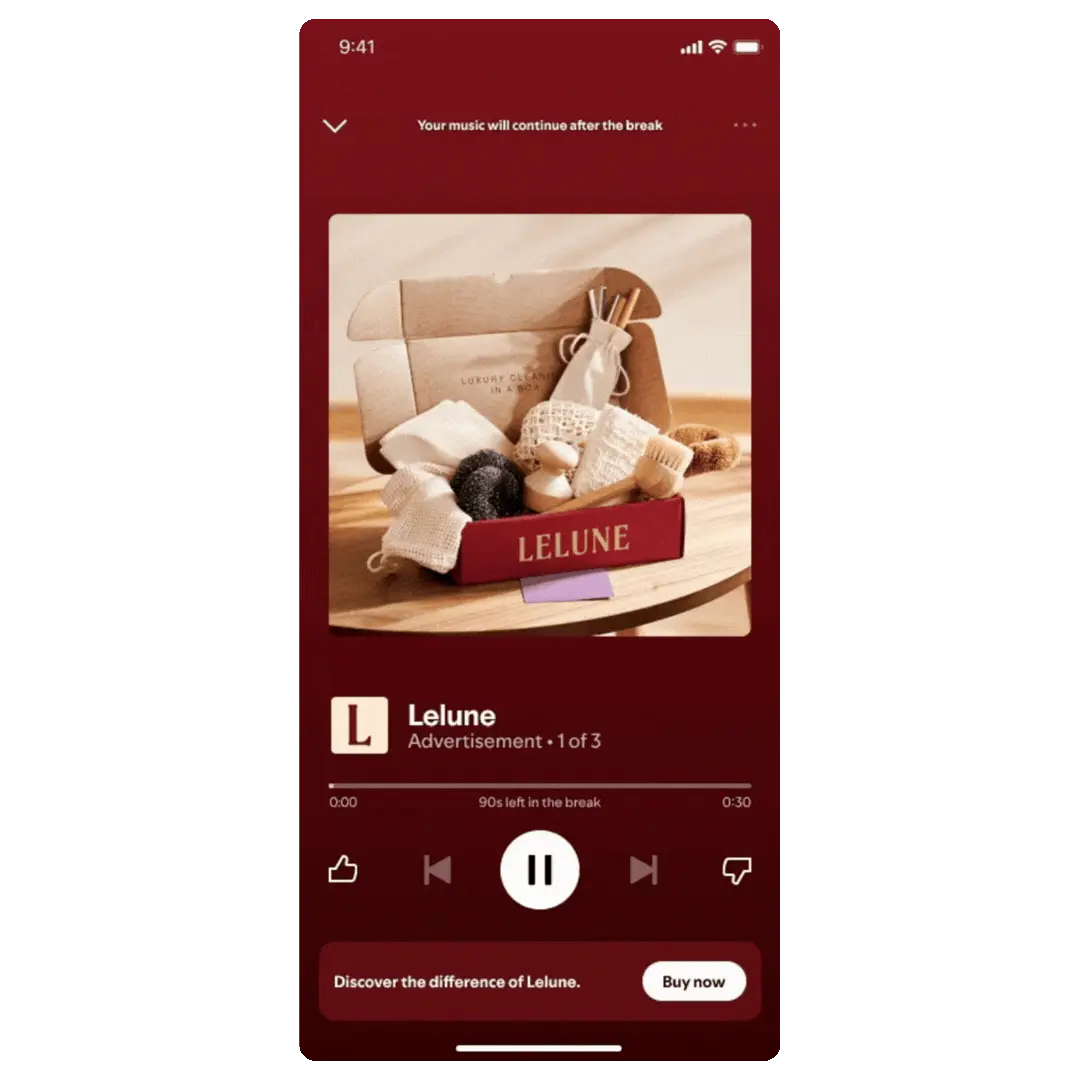
Campaign delivery starts with audience targeting. Advertisers can build audiences using factors such as age, gender, location, interests, listening behavior, and device type. Spotify then identifies eligible users that match those criteria and delivers ads when inventory becomes available.
Unlike traditional radio advertising, Spotify does not buy audiences based solely on station selection or broadcast schedules. Campaigns are delivered to individual listeners based on audience criteria and bidding parameters.
The platform also gives advertisers control over campaign budgets and scheduling. Daily budgets and lifetime budgets can be used depending on campaign goals. Campaigns can run continuously or during specific promotional periods such as product launches, seasonal campaigns, or event promotions.
Measurement is another key difference between Spotify and traditional audio advertising. Advertisers can track metrics such as impressions, reach, frequency, clicks, video views, and completion rates through Spotify's reporting tools. Access to campaign-level reporting makes it easier to evaluate performance and optimize future campaigns.
The overall process is relatively straightforward:
|
Step |
What Happens |
| Campaign Setup | Advertiser selects an objective and audience |
| Budget Allocation | Daily or lifetime budget is established |
| Ad Delivery | Spotify serves ads to eligible listeners |
| Performance Tracking | Campaign metrics are collected and reported |
| Optimization | Creative, targeting, and budgets can be adjusted |
For marketers evaluating Spotify as a media channel, the biggest takeaway is that campaigns function much more like digital advertising than traditional radio. Audience targeting, budget controls, reporting, and optimization tools are all built into the buying process.
How Much Does it Cost to Advertise on Spotify?
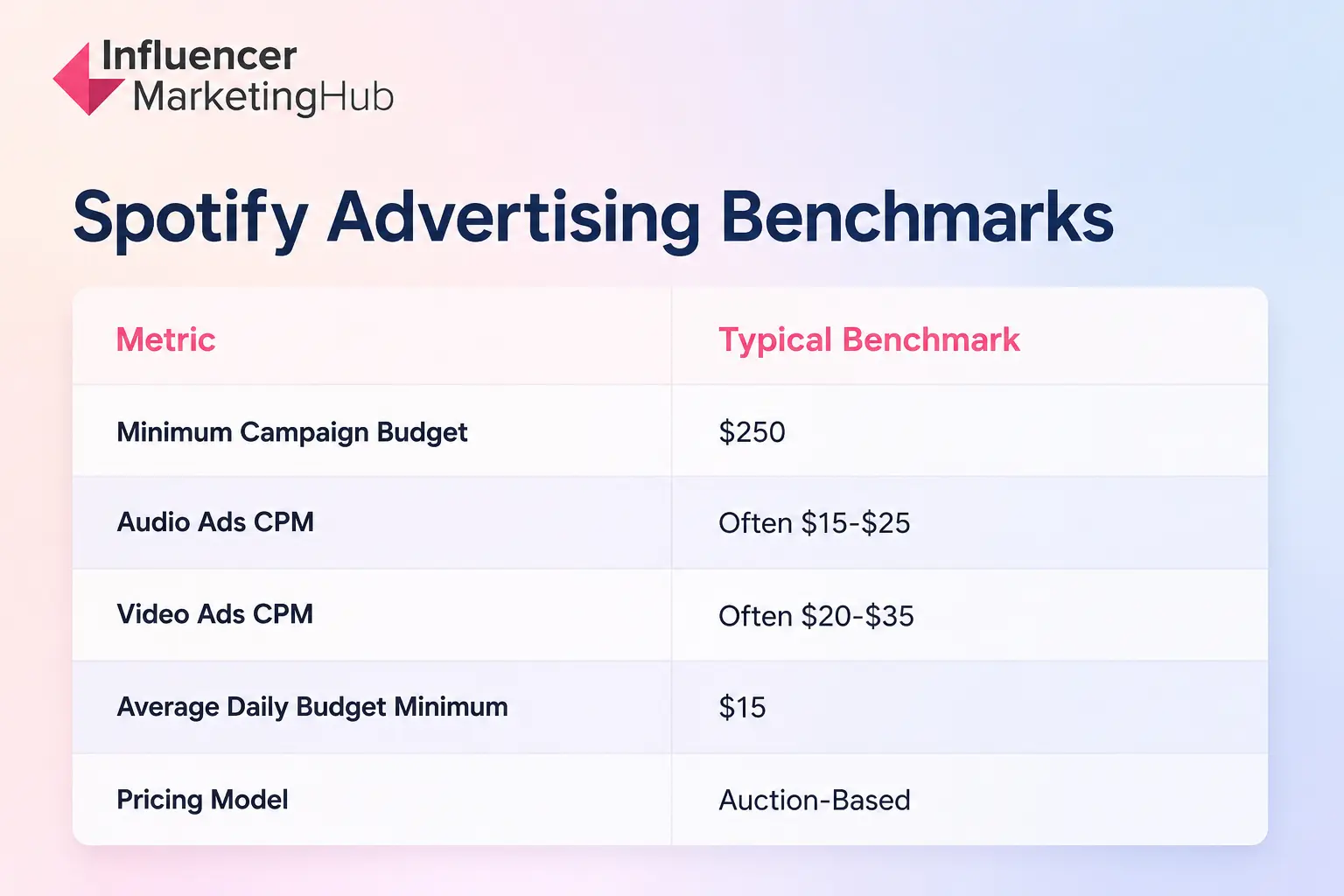
Spotify advertising is accessible to much smaller advertisers than many marketers assume. Campaigns launched through Spotify Ads Manager require a minimum budget of $250 in your local currency, making the platform viable for testing without committing to a large media spend.
Unlike traditional media buys that often come with fixed rates, Spotify uses an auction-based system. Advertisers compete for available inventory, and costs fluctuate based on audience demand, targeting settings, geography, ad format, and seasonality.
Most Spotify audio campaigns are purchased on a CPM basis, or cost per thousand impressions. Industry benchmarks place Spotify audio CPMs commonly in the $15 to $25 range, although highly competitive audiences and premium inventory can push costs higher. Some industry sources report CPMs reaching $40 in competitive markets.
Video inventory typically commands higher rates than audio inventory because it offers a visual component in addition to audio exposure. Several industry benchmarks place Spotify video CPMs between $20 and $35.
Audience targeting has a significant impact on cost.
Broad awareness campaigns generally produce lower CPMs than campaigns targeting highly specific demographics, interests, or listening behaviors. Geographic targeting also matters. Reaching users in major advertising markets such as the United States, the United Kingdom, and Canada is often more expensive than targeting smaller markets.
Budget planning should focus on more than simply meeting Spotify's minimum spend requirement.
A $250 campaign can provide an initial test of creative assets and audience targeting, but larger budgets are usually needed to generate enough reach and frequency to evaluate performance with confidence. Several industry practitioners recommend budgeting at least $1,000 when the goal is to gather meaningful optimization data rather than simply launch a test campaign.
For marketers comparing channels, Spotify's pricing generally falls between traditional radio and premium video platforms. Costs are often higher than some social media inventory but come with audience targeting, measurement capabilities, and access to listeners during moments where attention is focused on audio content rather than competing visual distractions.
Spotify Ad Formats Explained
Spotify offers more than just audio advertising. Brands can choose from several ad formats depending on campaign goals, creative assets, and the type of audience experience they want to create.
Choosing the right format matters. An awareness campaign may benefit from broad audio reach, while a product launch could justify investing in video inventory. Understanding how each format works makes it easier to align creative decisions with business objectives.
Spotify Audio Ads
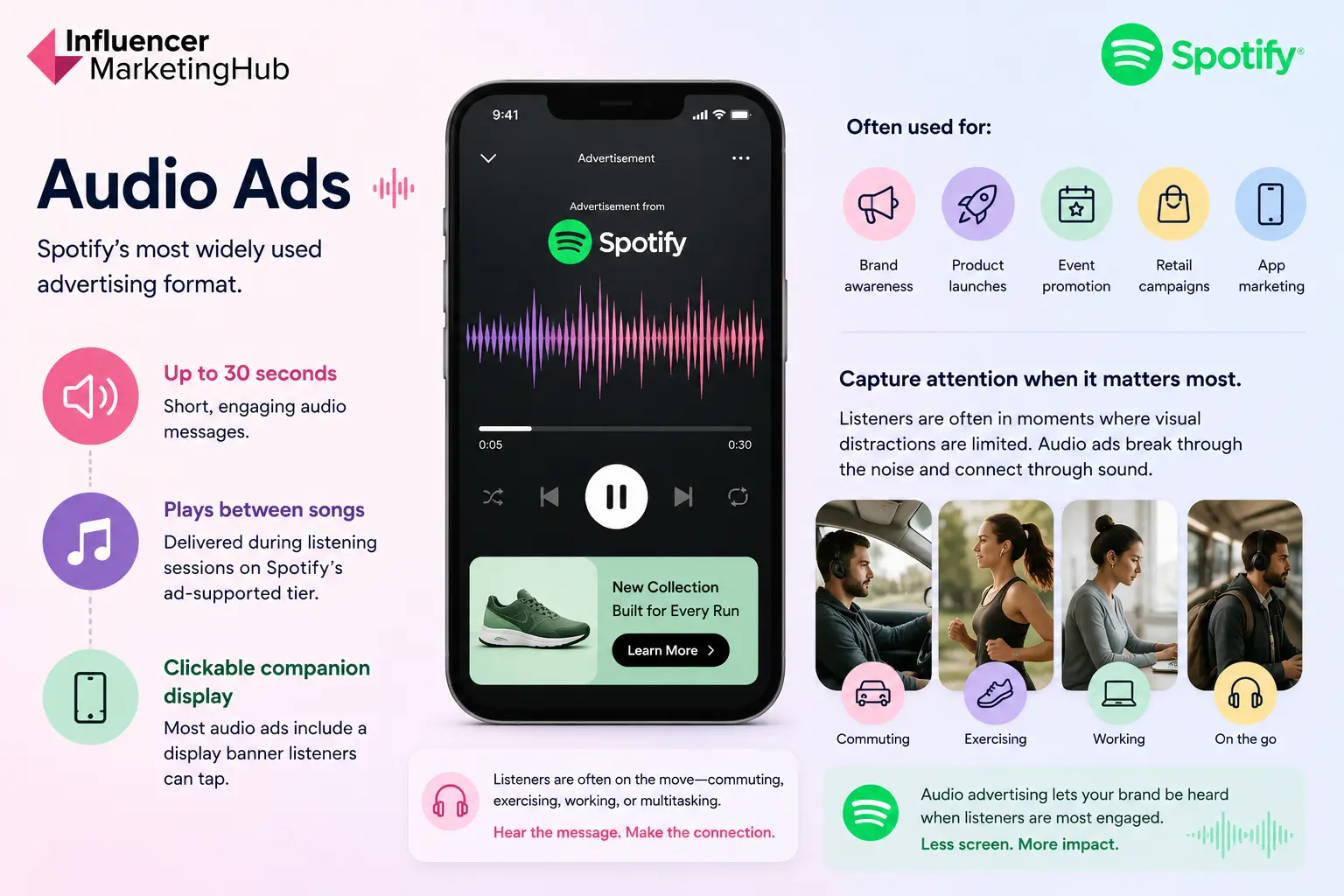
Audio Ads are Spotify's most widely used advertising format.
These ads are typically up to 30 seconds long and play between songs during listening sessions on Spotify's ad-supported tier. Most audio ads are accompanied by a clickable companion display unit, giving listeners a visual element alongside the audio message.
Audio Ads are often used for:
- Brand awareness
- Product launches
- Event promotion
- Retail campaigns
- App marketing
Audio advertising offers a unique advantage compared to many digital channels. Listeners are often consuming content while commuting, exercising, working, or performing other activities where visual distractions are limited. That creates an opportunity to capture attention through sound rather than competing for screen space.
Spotify Video Ads
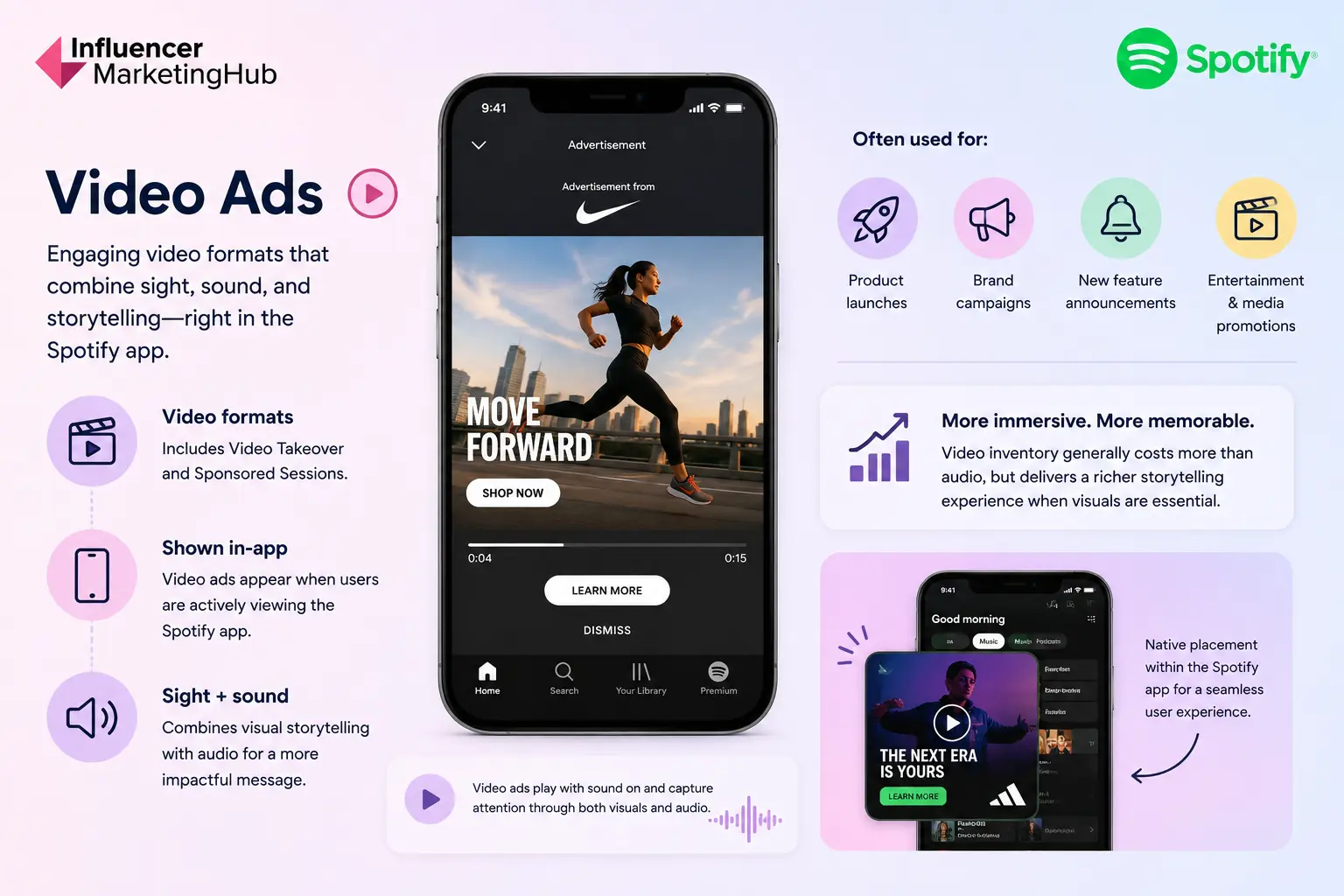
Spotify offers video inventory through formats such as Video Takeover and Sponsored Sessions.
Video ads appear when users are actively viewing the Spotify app. Unlike audio ads, video campaigns combine visual storytelling with sound, making them useful when creative assets play an important role in communicating the message.
Brands often use video ads for:
- Product launches
- Brand campaigns
- New feature announcements
- Entertainment and media promotions
Video inventory generally costs more than audio inventory, but it can provide a richer storytelling experience when visuals are essential to the campaign.
Spotify Display Ads
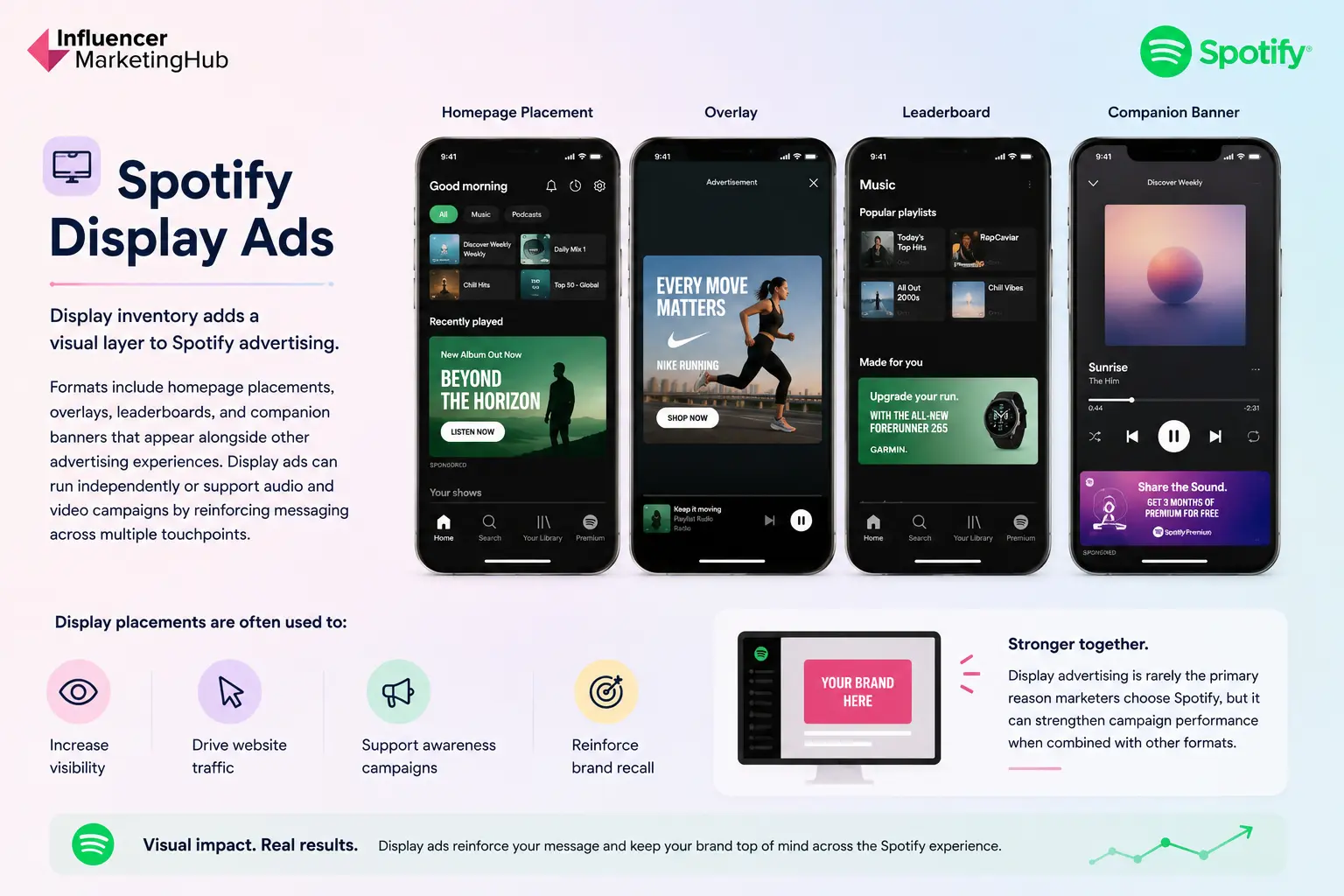
Display inventory adds a visual layer to Spotify advertising.
Formats include homepage placements, overlays, leaderboards, and companion banners that appear alongside other advertising experiences. Display ads can run independently or support audio and video campaigns by reinforcing messaging across multiple touchpoints.
Display placements are often used to:
- Increase visibility
- Drive website traffic
- Support awareness campaigns
- Reinforce brand recall
Display advertising is rarely the primary reason marketers choose Spotify, but it can strengthen campaign performance when combined with other formats.
Spotify Sponsored Sessions
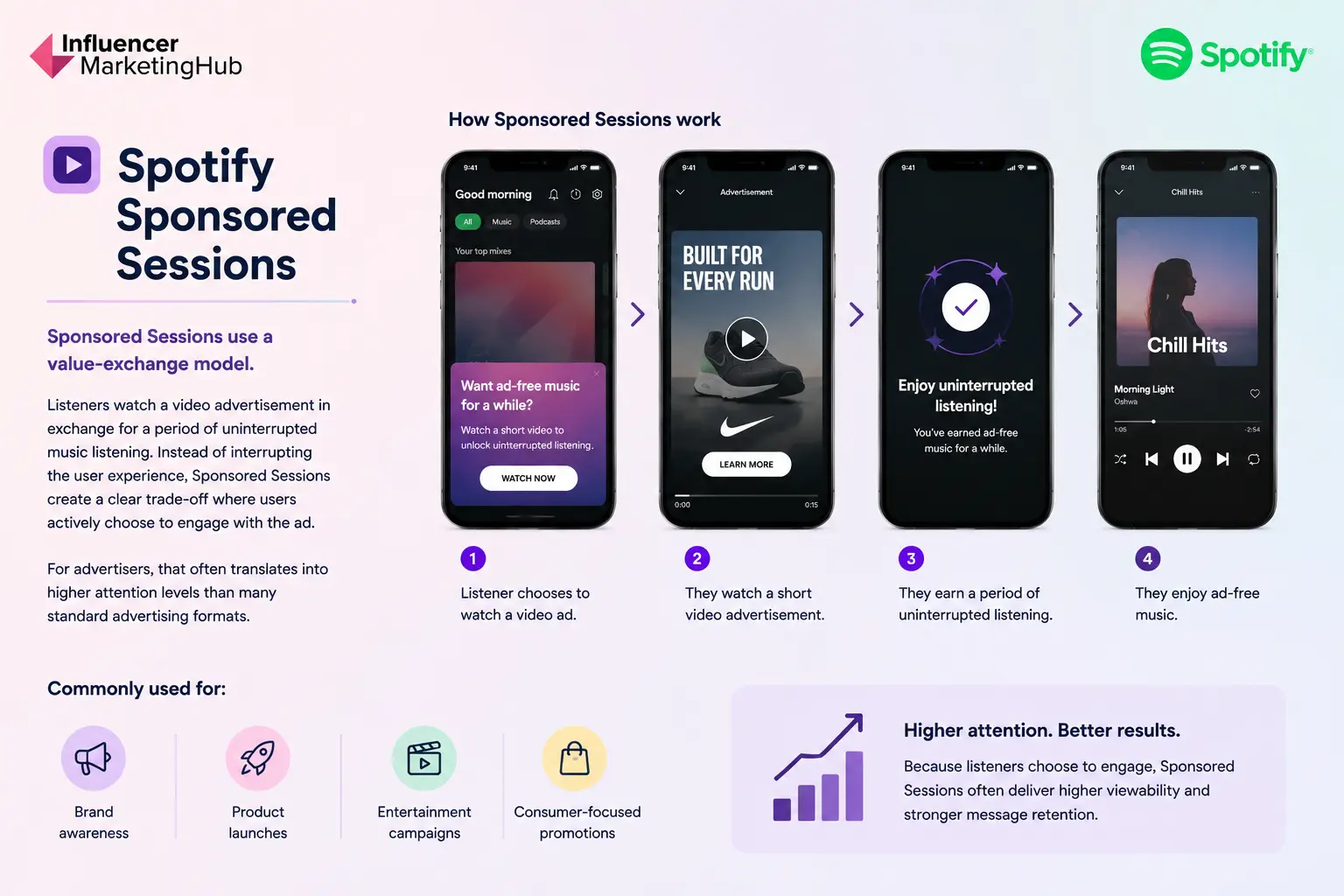
Sponsored Sessions use a value-exchange model.
Listeners watch a video advertisement in exchange for a period of uninterrupted music listening. Instead of interrupting the user experience, Sponsored Sessions create a clear trade-off where users actively choose to engage with the ad.
For advertisers, that often translates into higher attention levels than many standard advertising formats.
Sponsored Sessions are commonly used for:
- Brand awareness
- Product launches
- Entertainment campaigns
- Consumer-focused promotions
Spotify Podcast Ads
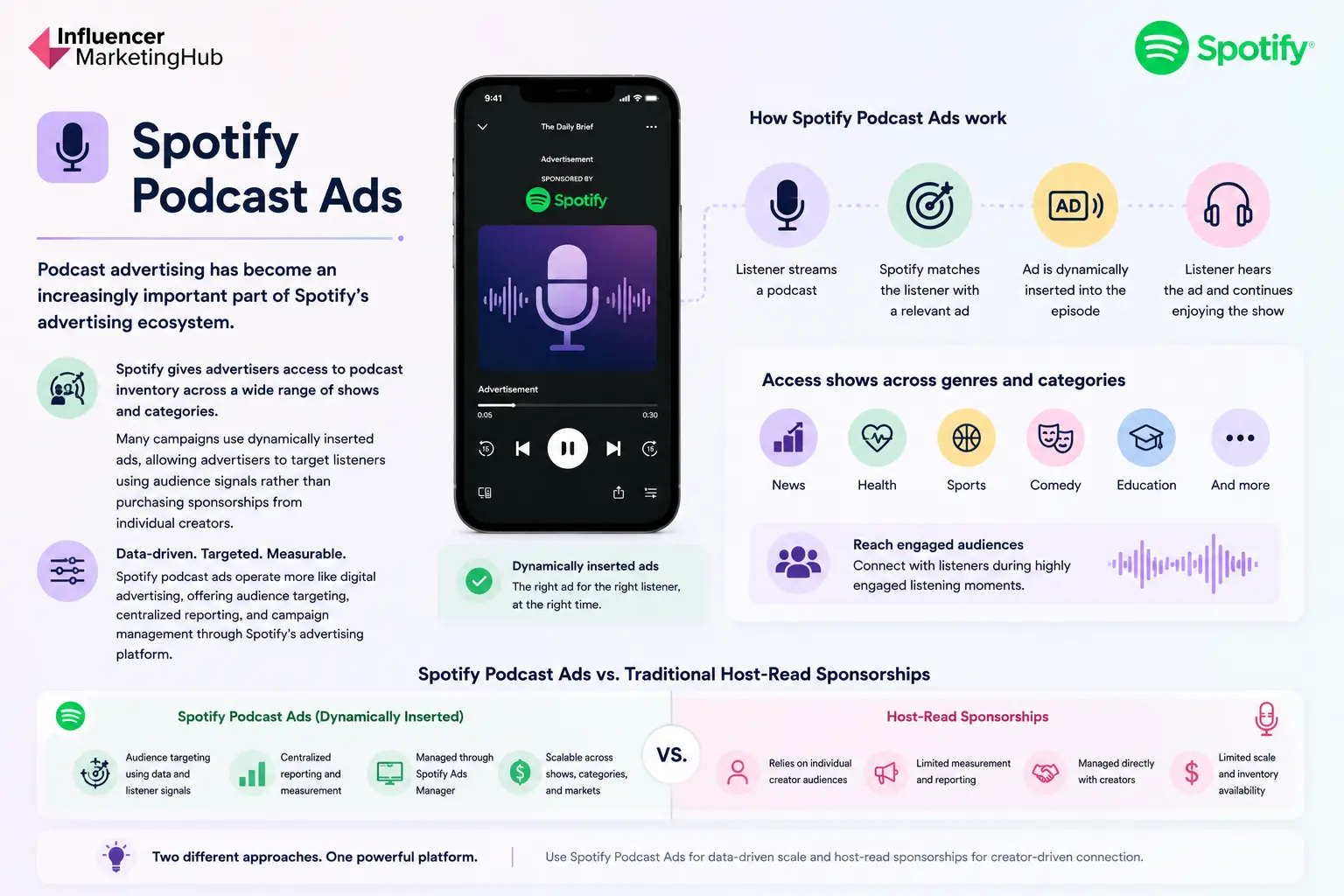
Podcast advertising has become an increasingly important part of Spotify's advertising ecosystem.
Spotify gives advertisers access to podcast inventory across a wide range of shows and categories. Many campaigns use dynamically inserted ads, allowing advertisers to target listeners using audience signals rather than purchasing sponsorships from individual creators.
This approach differs from traditional host-read podcast advertising.
Host-read sponsorships rely on creators delivering branded messages directly to their audiences. Spotify podcast ads operate more like digital advertising, offering audience targeting, centralized reporting, and campaign management through Spotify's advertising platform.
Looking Beyond Spotify's Podcast Inventory?
Spotify Podcast Ads and traditional podcast sponsorships solve different marketing challenges.
Learn how host-read endorsements, CPM pricing, and creator partnerships work in our complete guide to Podcast Sponsorships and discover which approach aligns best with your campaign goals.
Spotify Audience Targeting Options
Audience targeting is one of Spotify's biggest advantages as an advertising platform.
Traditional radio advertising often relies on broad assumptions about who might be listening to a particular station or program. Spotify takes a different approach.
Advertisers can build audiences using demographic data, interests, listening habits, contextual signals, and device information, allowing campaigns to reach listeners with much greater precision.
For many marketers, audience targeting has a bigger impact on campaign performance than the ad format itself. Reaching the right audience at the right moment often matters more than whether the campaign uses audio, video, or display inventory.
Demographic Targeting
Spotify allows advertisers to target audiences using standard demographic criteria such as:
- Age
- Gender
- Location
- Language
Demographic targeting is often used as a starting point rather than the primary targeting method. Most marketers combine demographic filters with additional audience signals to create more relevant campaigns.
Interest Targeting
Spotify can also group listeners based on interests and affinities.
Depending on the market and campaign setup, advertisers may be able to reach audiences interested in areas such as:
- Fitness
- Travel
- Gaming
- Technology
- Entertainment
- Food and drink
Interest targeting helps advertisers move beyond basic demographic categories and focus on audiences that are more likely to engage with a specific message.
Listening Behavior Targeting
Listening behavior is where Spotify becomes particularly interesting.
The platform collects first-party listening data that can help advertisers understand what content users consume across music and podcasts. Advertisers can use these signals to build audiences around listening preferences rather than relying solely on age or gender.
Examples include:
- Music genres
- Playlist preferences
- Podcast categories
- Listening frequency
- Content consumption patterns
A fitness brand, for example, may find workout playlist listeners more relevant than simply targeting a broad age group.
Contextual Targeting
Spotify's contextual signals allow advertisers to align campaigns with specific listening moments.
Listeners often use Spotify during activities such as:
- Exercising
- Commuting
- Working
- Studying
- Relaxing
These moments can provide valuable context for advertisers. Someone listening during a morning commute may be in a very different mindset than someone listening to a sleep playlist late at night.
Contextual targeting gives marketers another way to improve relevance without relying entirely on audience demographics.
Device Targeting
Campaigns can also be delivered based on the device being used.
Spotify inventory is available across:
- Mobile devices
- Desktop computers
- Tablets
- Connected devices
Device targeting can be useful when campaigns are tied to specific user experiences or conversion paths.
Geographic Targeting
Geographic targeting allows advertisers to focus campaigns on specific locations.
Options may include:
- Countries
- Regions
- Cities
- Local markets
Geographic targeting is particularly useful for retail promotions, events, regional launches, and location-based campaigns where audience proximity matters.
Spotify's targeting capabilities are one of the main reasons advertisers compare the platform to digital channels rather than traditional radio. Audience data, listening behavior, and contextual signals give marketers more control over who sees their campaigns and when those campaigns are delivered.
The next step is turning that audience strategy into a live campaign. Fortunately, Spotify Ads Manager follows a process that will feel familiar to anyone who has used platforms such as Meta Ads Manager, Google Ads, or TikTok Ads.
How to Create a Spotify Advertising Campaign
Launching a Spotify advertising campaign is relatively straightforward, especially for marketers who have experience with platforms such as Google Ads, Meta Ads Manager, or TikTok Ads Manager.
The campaign creation process follows a familiar structure. Advertisers define a goal, choose an audience, set a budget, upload creative assets, and monitor performance after launch. Understanding these decisions before creating a campaign can help avoid wasted spend and improve results.
Step 1: Choose a Campaign Objective
Every Spotify campaign starts with an objective.
Campaign objectives help determine how budgets are allocated, how success is measured, and which ad formats are most appropriate for the campaign.
Common objectives include:
- Brand awareness
- Reach
- Website traffic
- App installs
- Product launches
- Audience engagement
A brand launching a new product may prioritize awareness and reach, while an app developer may focus on driving installs. Defining the objective first creates a clear framework for every decision that follows.
Define Your Audience
Spotify's audience targeting options allow advertisers to narrow campaigns using demographics, interests, listening behavior, contextual signals, and geography.
Audience selection should reflect the campaign objective.
A local retailer promoting an in-store event may prioritize geographic targeting, while a fitness brand could focus on listeners who frequently engage with workout playlists and health-related content.
The goal is not to reach the largest possible audience. The goal is to reach the most relevant audience.
Set Your Budget and Schedule
Once the audience is defined, advertisers can establish campaign budgets and flight dates.
Spotify supports both daily budgets and lifetime budgets, giving marketers flexibility depending on campaign requirements.
Short-term campaigns are often used for:
- Product launches
- Seasonal promotions
- Event marketing
Longer campaigns are commonly used for:
- Brand awareness
- Ongoing audience building
- Continuous market presence
Testing is often a smart starting point. Smaller budgets can help validate creative and audience assumptions before larger investments are made.
Upload Creative Assets
Creative requirements depend on the format being used.
Audio campaigns require audio files and often include companion display units. Video campaigns require video assets, while display campaigns rely on visual creative such as banners and graphics.
Regardless of format, successful Spotify creative usually follows a few common principles:
- Introduce the brand early
- Keep messaging simple
- Focus on one primary call-to-action
- Match the message to the audience and listening context
Listeners may be exercising, commuting, working, or relaxing. Creative that aligns with those moments often feels more relevant and less disruptive.
Launch and Monitor Performance
After creative assets are approved, campaigns can begin delivering impressions to eligible listeners.
Performance monitoring should start immediately after launch.
Several key metrics are worth paying attention to:
- Reach
- Frequency
- Impressions
- Click-through rate
- Completion rate
- Website traffic
- Conversions
Early performance data can help identify opportunities to improve targeting, adjust budgets, or test new creative variations.
Spotify campaigns should not be treated as a one-time setup. Ongoing optimization is often where the biggest performance gains occur. Small adjustments to audience targeting or creative messaging can sometimes produce more meaningful results than increasing budget alone.
The campaign creation process itself is relatively simple. Measuring success, however, is where many advertisers encounter challenges. Understanding which metrics matter and how Spotify fits into a broader attribution strategy is often just as important as launching the campaign in the first place.
Is Spotify Advertising Right for Your Marketing Strategy?
Spotify advertising gives brands access to one of the world's largest digital audio audiences through a combination of audio, video, display, and podcast inventory. Audience targeting, campaign measurement, and self-serve media buying tools make the platform much more flexible than traditional radio advertising.
The right fit ultimately depends on campaign goals. Spotify often works well for brand awareness, product launches, event promotion, and reaching consumers during moments when they are actively listening rather than scrolling.
Advertisers looking for immediate purchase intent may find search advertising more effective, while those focused on awareness and audience reach may benefit from adding Spotify to their media mix.
Like any advertising channel, success depends on audience selection, creative quality, budget planning, and ongoing optimization. Testing campaigns, measuring performance, and comparing results against other channels remain the best way to determine long-term value.
Frequently Asked Questions
What is Spotify advertising?
Spotify advertising is the platform's advertising solution that allows brands to reach listeners through audio ads, video ads, display ads, sponsored sessions, and podcast advertising inventory.
How much does Spotify advertising cost?
Spotify Ads Manager campaigns require a minimum budget of $250. Most audio advertising campaigns are purchased through an auction-based CPM model, with industry benchmarks often ranging between $15 and $25 CPM.
Does Spotify have a minimum advertising budget?
Yes. Spotify Ads Manager currently requires a minimum campaign budget of $250 or the local currency equivalent.
What ad formats are available on Spotify?
Spotify offers Audio Ads, Video Ads, Display Ads, Sponsored Sessions, and Podcast Ads. Each format supports different campaign goals and creative requirements.
How does Spotify Ads Manager work?
Spotify Ads Manager is the platform's self-serve advertising tool. Advertisers can create campaigns, define audiences, set budgets, upload creative assets, and monitor performance through a centralized dashboard.
Can small businesses advertise on Spotify?
Yes. The $250 minimum campaign budget makes Spotify accessible to many small businesses, particularly those focused on local awareness, events, retail promotions, and audience growth.
Is Spotify advertising worth it?
Spotify advertising can be effective for awareness-focused campaigns, product launches, and audience reach initiatives. Results depend on factors such as targeting, creative quality, budget, and campaign objectives.
How does Spotify advertising compare to podcast advertising?
Spotify podcast ads operate similarly to digital advertising, using audience targeting and centralized reporting. Traditional podcast sponsorships typically rely on host-read endorsements delivered directly by podcast creators to their audiences.