
Marketing teams have never had more campaign data available to them. Dashboards track impressions, clicks, conversions, and return on ad spend in near real time. Yet these metrics rarely answer a deeper question that marketing leaders care about:
- Did the campaign actually change how people perceive the brand?
That question carries real business weight. Research shows that 81% of consumers say they must trust a brand before considering a purchase, highlighting how strongly perception influences buying decisions.
Brand perception shapes how audiences interpret every interaction with a company. It affects trust, purchase consideration, willingness to recommend, and long-term loyalty. A campaign may generate strong engagement while leaving perception unchanged, or even damaging it if the messaging is misunderstood.
For this reason, many marketing teams combine traditional campaign metrics with brand perception measurement and structured campaign impact analysis. Rather than focusing only on immediate performance, they evaluate whether messaging actually shifted how audiences think and feel about the brand.
Understanding that shift requires a clear framework.
- What Brand Perception Measurement Actually Captures
- Why Campaign Impact Analysis Requires a Baseline
- Measuring Brand Perception Before a Campaign
- Tracking Perception During a Campaign
- Measuring Brand Perception After a Campaign
- Interpreting Brand Lift and Campaign Impact
- Turning Perception Insights Into Future Strategy
What Brand Perception Measurement Actually Captures
Brand perception refers to the collective impressions, attitudes, and associations people hold about a brand. These impressions form through advertising, customer experience, media coverage, and social conversations.
Unlike awareness metrics that simply indicate whether audiences recognize a brand name, perception metrics evaluate how the brand is understood and evaluated.
Common Indicators Used in Brand Perception Measurement
- Brand awareness: Whether consumers recognize or recall the brand.
- Favorability and trust: The degree to which audiences view the brand positively.
- Perceived quality or expertise: How credible or capable the brand appears within its category.
- Purchase consideration: Whether consumers would consider the brand when buying.
- Advocacy and recommendation likelihood: Often measured through Net Promoter Score or similar indicators.
These signals together form a picture of brand health. When marketers run campaigns aimed at repositioning, launching products, or expanding audience reach, the goal is often to influence these perceptions rather than drive immediate sales alone.
Understanding whether those perceptions actually changed requires a structured measurement process.
Why Campaign Impact Analysis Requires a Baseline
One of the most common mistakes in campaign evaluation is attempting to measure perception change without first establishing a baseline.
Brand perception is not static. It is influenced by ongoing factors such as competitor activity, customer experiences, and broader industry conversations. Without a reference point from before the campaign, it becomes difficult to determine whether observed shifts are meaningful.
A pre-campaign baseline typically includes:
- Existing brand awareness levels
- Current sentiment toward the brand
- Common brand associations
- Audience familiarity with key messaging themes
- Share of voice within the industry
This baseline becomes the benchmark against which post-campaign data is compared.
For example, if positive sentiment around a brand increases from 45% to 60% during a campaign period, the difference provides evidence that the campaign may have contributed to a perception shift. Without the baseline, the same figure would lack context.
Baseline measurement also helps identify which perception attributes require improvement, allowing marketers to design campaigns that target specific gaps such as trust, product knowledge, or category leadership.
Measuring Brand Perception Before a Campaign
The pre-campaign phase focuses on building a clear understanding of the brand’s starting position.
Most organizations combine three primary research approaches.
Survey-Based Brand Studies
Structured surveys remain one of the most direct ways to measure brand perception. Respondents can be asked questions related to:
- Brand familiarity
- Brand favorability
- Perceived value or quality
- Likelihood to recommend
- Purchase consideration
These surveys can target a general consumer audience or a specific segment that the campaign intends to reach.
Survey data establishes a measurable baseline across multiple perception attributes. It also helps determine which messages resonate most strongly with audiences.
Behavioral Signals
While perception itself is attitudinal, certain behavioral metrics can provide supporting context.
Examples include:
- Branded search volume
- Direct website traffic
- Repeat visits to product pages
- Engagement with brand content
These indicators reflect how actively audiences are seeking or interacting with the brand prior to the campaign.
Social Listening and Conversation Analysis
Social media platforms and online communities contain vast amounts of unprompted consumer feedback. Monitoring these conversations helps marketers understand how the brand is discussed in public contexts.
This includes identifying:
- Overall sentiment trends
- Common praise or criticism themes
- Emerging product or service concerns
- Influencer discussions affecting brand reputation
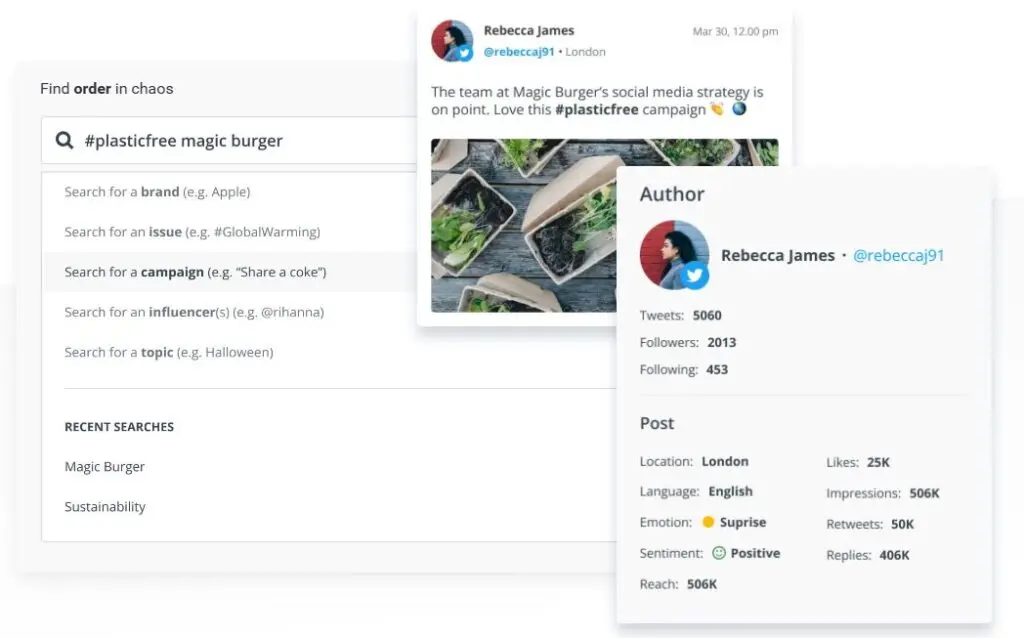
Social listening platforms can aggregate conversations across social networks, forums, and news coverage to provide a broader view of brand perception in the market.
Tools such as Brandwatch are often used to track these conversation trends and sentiment patterns before campaigns begin, allowing marketing teams to identify the dominant narratives surrounding their brand.

- Source: Brandwatch Social Listening
Tracking Perception During a Campaign
Once the campaign launches, measurement shifts from baseline analysis to real-time monitoring.
This phase helps marketers understand how audiences are reacting to campaign messaging and whether perception signals are starting to move.
Monitoring Social Conversation Trends
Campaigns often trigger spikes in brand mentions across social platforms. Monitoring these conversations reveals whether the campaign message is being understood and shared as intended.
Key signals to track include:
- Increases in brand mentions
- Sentiment shifts within conversations
- Campaign hashtag usage
- Influencer commentary about the campaign
Real-time monitoring allows marketing teams to detect potential issues early. If audiences misinterpret a campaign message or respond negatively, adjustments can be made while the campaign is still running.
Identifying Message Associations
Another useful signal is whether audiences begin associating the brand with the themes or attributes promoted in the campaign.
For instance, if a campaign positions a brand as sustainable or innovative, conversation analysis can reveal whether those concepts appear more frequently in discussions about the brand.
This provides early evidence that the campaign narrative is influencing perception.
Observing Engagement and Content Interaction
Campaign performance metrics also contribute contextual insights during this stage. Engagement with campaign content, video completion rates, and shares can indicate how compelling the message is to audiences.
While engagement metrics alone do not confirm perception change, they often correlate with increased exposure and message recall.
Together, these signals help marketing teams monitor whether perception trends are beginning to move in the desired direction.
Measuring Brand Perception After a Campaign
The post-campaign phase is where campaign impact analysis becomes most visible.
At this stage, marketers compare new perception data with the original baseline to identify measurable shifts.
Post-Campaign Surveys and Brand Lift Studies
A common approach is to conduct follow-up surveys using the same questions that were asked before the campaign.
This allows marketers to evaluate changes in:
- Awareness
- Favorability
- Purchase intent
- Brand associations
- Recommendation likelihood
Some studies also compare responses between individuals who recall seeing the campaign and those who do not. This comparison helps isolate the campaign’s direct influence.
The resulting difference is often referred to as brand lift.
Sentiment and Conversation Changes
Social listening analysis also provides evidence of perception change by examining conversation trends during and after the campaign period.
Key indicators include:
- Overall sentiment improvements
- Increased share of voice compared to competitors
- Shifts in conversation themes related to the brand
If a campaign successfully reframes how audiences talk about a brand, those changes should be visible in social conversation patterns.
For example, The Body Shop uses social listening to continuously monitor global brand perception and campaign performance. The company tracks earned mentions, sentiment trends, and emerging topics to understand how audiences respond to product launches and marketing initiatives.
Using Brandwatch’s consumer intelligence tools, the brand analyzes millions of online conversations related to its products and campaigns.
According to Jennifer Rice, Director of Customer Strategy and Analytics at The Body Shop, monitoring these discussions provides immediate feedback on how consumers interpret campaigns and what product features resonate most strongly with audiences.
The insights team also tracks conversation volume, sentiment, and trending themes in dedicated dashboards during campaign launches.
Platforms such as Brandwatch allow marketers to analyze these conversation trends over time, helping teams understand how campaign messaging influences public discussion, brand sentiment, and broader perception shifts in the market.
Comparing Brand Associations
Campaigns often attempt to connect brands with specific attributes, such as innovation, sustainability, or reliability.
Post-campaign analysis can evaluate whether those attributes appear more frequently in audience discussions, survey responses, or online content related to the brand.
If new associations emerge, they provide evidence that the campaign influenced how audiences interpret the brand’s identity.
Interpreting Brand Lift and Campaign Impact
After collecting post-campaign data, the final step is translating these insights into meaningful conclusions.
Principles That Help Marketers Interpret Perception Shifts Effectively
- Look for Patterns Across Multiple Signals
Perception change rarely appears in a single metric. More reliable insights emerge when multiple indicators point in the same direction.
For example:
-
- Survey favorability increases
- Positive sentiment grows on social media
- Branded search volume rises
Together, these signals suggest that the campaign influenced how audiences view the brand.
- Distinguish Short-Term Engagement From Perception Change
High engagement with campaign content does not necessarily translate into lasting perception shifts.
Campaign impact analysis should focus on whether audiences retain new associations or attitudes toward the brand after exposure.
- Consider External Factors
Perception shifts may also be influenced by product launches, media coverage, or industry events occurring during the campaign period.
When evaluating results, marketers should consider the broader market context to avoid attributing every change solely to the campaign.
Turning Perception Insights Into Future Strategy
Measuring brand perception before and after a campaign provides more than a performance scorecard. It creates a feedback loop that informs future marketing decisions.
Campaign analysis can reveal:
- Which messages resonate most strongly with audiences
- Which perception gaps remain unresolved
- How audiences interpret the brand relative to competitors
- Which channels generate the most meaningful brand conversations
These insights help marketing teams refine their positioning, improve creative strategies, and prioritize campaigns that strengthen long-term brand equity.
By combining surveys, behavioral data, and conversation analysis, marketers can move beyond surface-level performance metrics and understand how their campaigns influence the way audiences truly perceive their brand.
Ultimately, the goal of campaign impact analysis is not just to measure success. It is to build a clearer picture of how brand perception evolves over time and how marketing efforts contribute to shaping that narrative.


