Spotify campaigns are often associated with music promotion, but the term covers much more than that.
Search for Spotify campaigns and you'll quickly run into Marquee, Showcase, Campaign Kit, and Spotify Ads. Some of these tools are built for artists looking to promote music. Others are designed for brands trying to reach Spotify's audience through audio, video, display, and podcast advertising.
Understanding the difference matters because each campaign type serves a different purpose.
Spotify reaches hundreds of millions of listeners worldwide. According to Spotify, the platform had 678 million monthly active users and 268 million Premium subscribers in the first quarter of 2025. For marketers, that creates opportunities across music, podcasting, audio advertising, and brand awareness campaigns.
Most guides focus on how Spotify's campaign tools work. Much less attention goes into when they make sense, what they cost, how they're measured, and how they compare to other promotion options.
We'll cover all of that in this guide. You'll learn how Spotify campaigns are structured, how Marquee and Showcase compare, where Spotify Ads fits into the picture, and what marketers can learn from the platform's broader campaign ecosystem.
Spotify for Creators - Start Now
- Spotify Campaigns Come in Two Very Different Forms
- Spotify Campaign Kit: Spotify's Artist Promotion Platform
- Spotify Marquee Campaigns
- Spotify Showcase Campaigns
- Spotify Ads Manager Campaigns
- Showcase vs Marquee: Which Spotify Campaign Should You Choose?
- How Audience Targeting Works in Spotify Campaigns
- How Much Do Spotify Campaigns Cost?
- Which Spotify Campaign Makes the Most Sense?
- Frequently Asked Questions
Spotify Campaigns Come in Two Very Different Forms
Spotify campaigns generally fall into two categories: artist promotion campaigns and advertising campaigns.
Artist promotion campaigns are part of Spotify's Campaign Kit. These tools help artists and music marketers increase visibility for releases, reach listeners, and encourage engagement on the platform. Marquee, Showcase, and Display Campaigns all fall into this category.
Advertising campaigns are managed through Spotify Ads Manager. Brands use these campaigns to reach Spotify listeners with audio, video, display, and podcast ads. Objectives typically focus on awareness, reach, engagement, website traffic, or conversions rather than streams and saves.
Although the audiences are different, both campaign types are built around the same advantage: Spotify's understanding of listener behavior.
Spotify knows what users listen to, when they listen, how often they engage with content, and what genres, creators, podcasts, and artists capture their attention. That data powers both artist promotion campaigns and advertiser campaigns.
For marketers, the distinction is important because the success metrics are completely different.
An artist campaign might be judged by streams, listeners, saves, and follows.
An advertising campaign might be measured through impressions, completion rates, clicks, reach, conversions, or brand lift.
The table below provides a high-level view of the main Spotify campaign types.
| Campaign Type | Primary User | Main Objective | Typical Success Metrics |
| Marquee | Artists and labels | Promote new releases | Streams, listeners, saves |
| Showcase | Artists and labels | Drive discovery and re-engagement | Streams, listeners, engagement |
| Display Campaigns | Artists and labels | Increase visibility on Spotify | Reach, engagement |
| Spotify Ads | Brands and advertisers | Reach Spotify audiences | Impressions, clicks, conversions |
Understanding those differences makes the rest of Spotify's campaign ecosystem much easier to navigate. The next step is looking at each campaign type and where it fits within a broader marketing strategy.
Spotify Campaign Kit: Spotify's Artist Promotion Platform
Most searches for "Spotify campaigns" eventually lead to Campaign Kit.
Campaign Kit is Spotify's suite of promotional tools for artists, labels, and music marketers. Instead of relying entirely on playlists, social media, or external advertising, Campaign Kit gives artists a way to promote music directly within Spotify's ecosystem.
Today, Campaign Kit revolves around two primary campaign formats: Marquee and Showcase.
Marquee is designed to help new releases gain visibility during launch periods. Showcase focuses on discovery and audience re-engagement, making it useful for both new releases and catalog music.
Although these tools are built for artists, they offer useful lessons for marketers as well. Both rely heavily on audience behavior, listening history, and recommendation signals rather than broad demographic targeting.
Understanding how Marquee and Showcase work helps explain why Spotify has become one of the most sophisticated recommendation-driven marketing platforms in digital media.
Spotify for Creators - Start Now
Spotify Marquee Campaigns
Marquee is Spotify's flagship campaign format for new music releases.
The campaign appears as a full-screen recommendation when eligible listeners open the Spotify mobile app. Unlike traditional display advertising, Marquee is designed to feel like a recommendation rather than an interruption.
Spotify built Marquee around a simple idea: helping artists place new releases in front of listeners who are most likely to engage. The platform uses listening behavior and audience relationships to determine who sees the campaign, creating a more targeted experience than broad awareness advertising.
For marketers, Marquee is interesting because it combines paid promotion with Spotify's recommendation ecosystem.
Rather than targeting broad demographic groups, Marquee focuses on listener relationships. Campaigns can reach audience segments such as active listeners, previously engaged listeners, or listeners who have shown interest in similar music.
Best Use Cases for Marquee
Marquee is most effective when there is a clear launch moment behind the campaign.
Examples include:
- New album releases
- EP launches
- Major singles
- High-priority artist campaigns
A release with existing audience momentum typically benefits more than a release starting from zero awareness.
Benefits of Marquee
Marquee's biggest strength is placement.
Instead of waiting for listeners to discover a release through playlists or recommendations, Spotify places the campaign directly in front of relevant audiences.
Spotify has reported that listeners who see a Marquee campaign are more likely to stream, save, and explore an artist's music than listeners who are not exposed to the promotion.
The format also benefits from audience quality. Marquee is designed to reach listeners who already have some level of affinity with the artist or whose listening habits suggest a higher likelihood of engagement.
Limitations of Marquee
Marquee is designed around new releases.
Catalog promotion and long-term audience development are generally better suited to other campaign formats.
Performance also depends heavily on audience size and existing listener activity. A campaign can increase visibility, but it cannot create audience demand where little interest exists.
That reality makes Marquee most valuable when it supports a broader release strategy rather than serving as the entire promotion plan.
Spotify for Creators - Start Now
Spotify Showcase Campaigns
Showcase is Spotify's campaign format for extending discovery beyond a release launch.
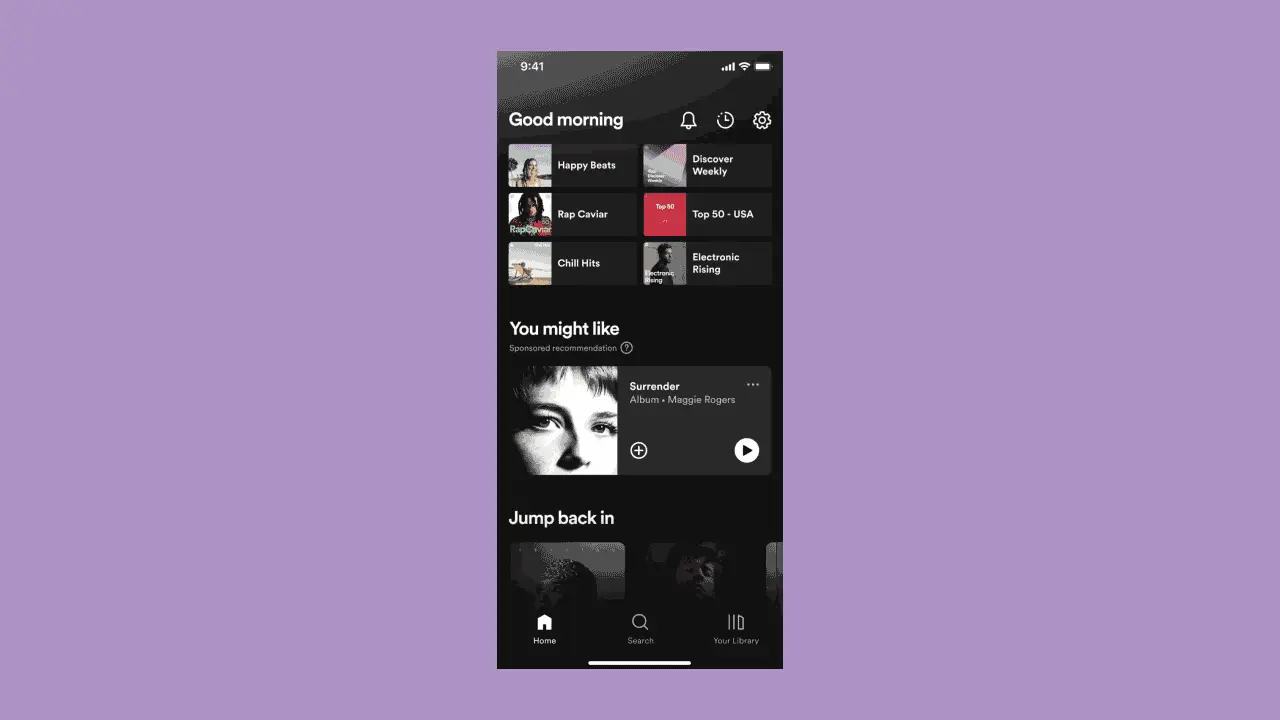
Campaigns appear on Spotify's Home feed and can promote both new releases and catalog music. That flexibility makes Showcase useful for artists who want to maintain momentum after launch week or bring attention back to existing content.
From a marketing perspective, Showcase reflects a broader trend across digital platforms. Content no longer has a short shelf life. Strong campaigns increasingly focus on helping audiences rediscover content rather than constantly replacing it with something new.
Best Use Cases for Showcase
Showcase works well when the objective extends beyond a single release.
Common use cases include:
- Promoting catalog music
- Re-engaging past listeners
- Supporting ongoing artist growth
- Extending the lifespan of a release
- Maintaining visibility between major launches
Many artists use Showcase after a Marquee campaign ends. Marquee can create an initial spike in attention, while Showcase helps maintain momentum over a longer period.
Benefits of Showcase
Flexibility is what separates Showcase from Marquee.
Campaigns are not tied to a specific release window, which creates more opportunities to test audiences, support catalog content, and re-engage listeners over time.
Showcase also supports longer-term growth objectives. Marketers can use it to sustain visibility between launches, revive interest in older releases, or support broader audience development strategies rather than focusing on a single promotional moment.
Limitations of Showcase
Showcase generally delivers a less disruptive experience than Marquee.
Home feed placements can be effective, but they don't command attention in the same way as a full-screen recommendation.
Campaign goals also need to be realistic. Showcase can help increase discovery and engagement, but it works best when supported by strong music, audience demand, and broader marketing activity.
For most artists, Showcase should be viewed as a tool for sustaining momentum rather than creating it from scratch.
Spotify for Creators - Start Now
Spotify Ads Manager Campaigns
Spotify Ads Manager is Spotify's self-serve advertising platform for brands.
While Campaign Kit helps artists promote music releases, Spotify Ads Manager helps advertisers reach Spotify listeners through audio, video, display, and podcast ads.
The platform gives marketers access to Spotify's audience across music and podcast content, along with targeting options based on demographics, interests, listening behavior, and contextual signals.
For anyone researching Spotify campaigns, the important distinction is simple. Campaign Kit is built for music promotion. Spotify Ads Manager is built for advertising.
Most brands exploring Spotify as a marketing channel will spend their time inside Ads Manager rather than Campaign Kit.
Spotify Ads Manager offers much more than campaign creation. Our complete guide covers ad formats, targeting options, costs, campaign setup, measurement, and best practices for advertisers looking to get more from the platform.
Showcase vs Marquee: Which Spotify Campaign Should You Choose?
Although both are the primary Campaign Kit tools, Marquee and Showcase are designed for different stages of a promotion strategy.
Marquee focuses on generating attention around new releases. Showcase focuses on discovery, audience re-engagement, and extending the lifespan of existing content.
| Factor | Marquee | Showcase |
| Primary Purpose | Promote new releases | Promote new and catalog releases |
| Placement | Full-screen recommendation | Spotify Home feed |
| Best Timing | Release launches | Ongoing promotion |
| Audience Strategy | Release-focused | Discovery and re-engagement |
| Catalog Promotion | Limited | Strong |
| Best For | Creating launch momentum | Sustaining visibility over time |
Looking at the table, a clear pattern emerges.
Marquee is built for concentration, while Showcase is built for consistency.
A new album, EP, or single release often benefits from a short burst of visibility during launch week. Marquee helps create that visibility by placing the release directly in front of listeners who are likely to engage with it.
Showcase takes a broader approach. Instead of focusing on a specific launch window, it helps artists continue reaching listeners after the initial release cycle. That makes it useful for catalog promotion, audience reactivation, and ongoing discovery.
Choose Marquee If
Marquee generally makes the most sense when:
- Launching a new release
- Driving awareness during release week
- Supporting a larger marketing campaign
- Reaching listeners who are most likely to engage with new music
The format works best when there is already momentum behind a release. Social campaigns, creator partnerships, PR activity, and playlist placements can all strengthen Marquee's effectiveness by creating additional demand around the same launch period.
Choose Showcase If
Showcase is often the stronger choice when:
- Promoting catalog music
- Re-engaging previous listeners
- Extending the lifespan of a release
- Maintaining visibility between launches
Many artists and music marketers use Showcase after a Marquee campaign ends. The combination allows them to capture launch attention first and then continue driving discovery over a longer period.
For marketers, the comparison highlights an important lesson that applies well beyond Spotify.
Not every campaign should be optimized for immediate impact. Some campaigns perform best when they create a short-term spike in attention. Others generate more value through sustained visibility over time.
Marquee and Showcase simply represent two different approaches to solving that problem.
How Audience Targeting Works in Spotify Campaigns
Spotify's campaign tools are built around audience behavior.
That may sound obvious, but it is one of the biggest differences between Spotify campaigns and many traditional advertising channels.
Instead of relying primarily on demographics, Spotify can use listening activity, engagement patterns, genre preferences, artist affinity, podcast consumption, and other behavioral signals to determine who sees a campaign.
For artists using Campaign Kit, audience selection often revolves around listener relationships.
Spotify groups audiences based on how people have interacted with an artist's music. Some listeners may stream regularly. Others may have listened in the past but haven't returned recently. Another segment may have shown interest in similar artists without engaging directly.
Those audience signals help determine who receives a Marquee or Showcase campaign.
The approach is valuable because not every listener sits at the same stage of engagement. Someone who streams an artist every week requires a different message than someone who has not listened in six months.
Audience Targeting in Campaign Kit
Spotify's artist campaigns generally focus on three broad audience categories:
| Audience Type | Description |
| Active Listeners | People who regularly engage with an artist's music |
| Previously Engaged Listeners | People who have listened before but may have become inactive |
| Potential New Listeners | People whose listening behavior suggests they may be interested |
That structure mirrors audience segmentation frameworks used across digital marketing.
Instead of treating every listener the same, campaigns can be aligned with the relationship each audience already has with the content.
Audience Targeting in Spotify Ads
Spotify Ads Manager expands targeting beyond artist promotion.
Advertisers can target audiences using factors such as:
- Demographics
- Interests
- Listening behaviors
- Device usage
- Contextual signals
- Podcast preferences
A fitness brand, for example, may target listeners who frequently consume workout playlists. A B2B software company may focus on audiences who regularly engage with business and technology podcasts.
The targeting options are not unique to Spotify. What makes them interesting is the context in which they operate.
Listening behavior often reveals intent, interests, and habits in ways that traditional demographic data cannot.
What Marketers Can Learn From Spotify's Approach
Spotify's campaign ecosystem reinforces a broader marketing principle.
Audience behavior is often a stronger predictor of engagement than demographic information alone.
The most effective campaigns typically focus on what people do rather than simply who they are.
That idea applies well beyond Spotify.
Whether you're running campaigns on social media, search, retail media networks, or audio platforms, audience segmentation based on behavior tends to create more relevant experiences and more efficient media spending than broad audience targeting.
How Much Do Spotify Campaigns Cost?
Spotify campaign costs vary depending on the campaign type, audience, target market, and budget.
The good news is that Spotify does not require enterprise-level spending to get started. Both Marquee and Showcase campaigns can be launched through Spotify for Artists with a minimum budget of $100 per sub-campaign, although some Spotify-managed campaigns may require higher minimums.
Unlike many advertising platforms that charge for impressions, Marquee and Showcase use a cost-per-click (CPC) model. Advertisers only pay when a listener clicks on the campaign, including actions such as saves. Spotify also provides estimated reach and click forecasts before a campaign launches.
Campaign Kit Pricing
Spotify does not publish fixed CPC rates because costs vary by audience, competition, and market.
Instead, marketers choose a budget, and Spotify forecasts how many listeners the campaign is likely to reach. Campaigns generally run until the budget is exhausted or the campaign window ends. Marquee campaigns can run for up to 10 days, while Showcase campaigns can run for up to 14 days.
| Campaign | Pricing Model | Minimum Budget |
| Marquee | Cost per click (CPC) | $100 |
| Showcase | Cost per click (CPC) | $100 |
| Spotify Ads Manager | Auction-based advertising | Varies by campaign |
Spotify also allows budgets up to $10,000 per campaign, giving larger teams room to scale promotional efforts when audience demand supports additional spend.
Spotify Ads Pricing
Spotify Ads Manager works differently.
Advertising campaigns use an auction-based model similar to many digital advertising platforms. Costs depend on factors such as audience targeting, competition, campaign objectives, inventory availability, and geographic markets.
That means there is no single "Spotify advertising cost." Two campaigns with identical budgets can produce very different results depending on who they target and where they run.
Budgeting for Spotify Campaigns
The most important budgeting decision is not how much to spend. It's whether the campaign objective justifies the investment.
A Marquee campaign supporting a major release may warrant a larger budget than a Showcase campaign promoting older catalog content. Similarly, a brand launching a new product may have different budget expectations than one testing Spotify advertising for the first time.
Spotify's forecasting tools help estimate potential reach before launch, making it easier to align campaign spend with expected outcomes. That approach is often more useful than focusing exclusively on CPCs or budget minimums.
For most marketers, the goal should be simple: start with a campaign objective, review Spotify's forecast, and scale spending only when the expected reach and audience quality support the investment.
Which Spotify Campaign Makes the Most Sense?
The best Spotify campaign depends on the goal.
Marquee is built for launch moments and works best when a new release needs immediate visibility. Showcase is better suited to discovery, audience re-engagement, and extending the lifespan of existing content.
Spotify Ads Manager serves a different purpose entirely, helping brands reach Spotify listeners through audio, video, display, and podcast advertising.
The bigger takeaway is how Spotify approaches audience engagement. Campaigns are built around listener behavior, audience relationships, and contextual relevance rather than broad reach alone.
Whether you're promoting music or running advertising campaigns, the same principle applies: matching the right campaign type to the right objective usually matters more than the size of the budget. Understanding those differences is what allows marketers to make better use of Spotify's campaign ecosystem.
Frequently Asked Questions
What are Spotify campaigns?
Spotify campaigns are promotional tools available through Spotify's ecosystem. They include artist-focused Campaign Kit tools such as Marquee and Showcase, as well as advertising campaigns managed through Spotify Ads Manager.
What is Spotify Campaign Kit?
Campaign Kit is Spotify's promotion platform for artists and music marketers. It includes campaign tools such as Marquee and Showcase that help increase visibility and listener engagement on Spotify.
What is the difference between Marquee and Showcase?
Marquee is designed to promote new releases through full-screen recommendations. Showcase promotes both new and catalog music through placements on Spotify's Home feed and is often used for discovery and audience re-engagement.
How much do Spotify campaigns cost?
Campaign costs vary by format, audience, and market. Marquee and Showcase campaigns typically require a minimum budget of $100 per sub-campaign, while Spotify Ads Manager uses an auction-based advertising model.
Are Spotify campaigns worth it?
Spotify campaigns can be effective when they support a clear objective and target the right audience. Results depend on factors such as audience size, campaign type, creative assets, and overall marketing strategy.
Can brands use Spotify campaigns?
Yes. Brands can run campaigns through Spotify Ads Manager using audio, video, display, and podcast advertising formats.
How does Spotify target audiences?
Spotify uses a combination of demographic information, listening behavior, content preferences, audience relationships, and contextual signals to determine which users see a campaign.
What metrics should marketers track for Spotify campaigns?
The most important metrics depend on the campaign type. Artist campaigns often focus on streams, listeners, saves, and follows, while advertising campaigns typically measure impressions, reach, clicks, engagement, and conversions.