
There’s much about WhatsApp’s story that makes it one of the most interesting of our time. Back in 2009, founders Brian Acton and Jan Koum, both former Yahoo! employees realized the potential of the iPhone app store. But there was a good chance that they hadn’t imagined the level of success they would achieve.
What's equally surprising is that Acton and Koum were rejected by Facebook when applying for roles in the social media giant's dev team. Fast forward to 2014, and Facebook acquired WhatsApp for a cool US$1.5 billion. And like all valuable apps, WhatsApp's evolution has been influenced by a range of factors.
While WhatsApp was initially designed for private use, the need to expand its reach to support businesses quickly became apparent. Today your business can become easily contactable via WhatsApp plugins on their websites and run push marketing campaigns. And the WhatsApp’s created seamless integration options, making it just as simple to create a business WhatsApp presence as an individual would.
What's more, you can automate your communication with clients. And that's the beauty of using chatbots.
The Birth of Chatbots
One of the first chatbots developed was called ELIZA. Created by Joseph Weizenbaum at MIT in 1994, ELIZA functioned much in the way that current chatbots do. ELIZA could recognize keywords or phrases and then produce pre-programmed responses.
Since 1994, much has evolved. AI programs have been incorporated with the goal of passing the Turing Test, and this, along with other applications of the tech, has led to an entire industry of solutions tailored to help organizations optimize sales and marketing activities for bottom-line profits.
And when it comes to combining chatbots with WhatsApp, you get a match made in heaven. WhatsApp's reach allows you access to a global audience, one that's already familiar with the chat app's features and functionality, and chatbots help you scale engagement.
WhatsApp Chatbot Tools
If you’re on the lookout for WhatsApp chatbot tools, this blog post is for you. In it will share eight WhatsApp chatbot tools you can use to design your chatbots and engage your buyers.
1. Agentbot
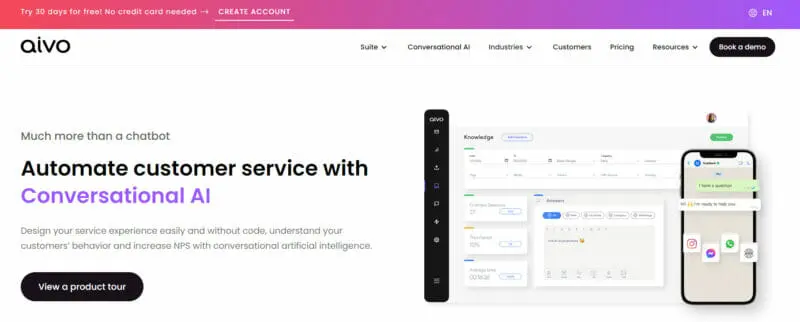
Founded in 2012, Aivo set out to streamline communication for their customers. One of their solutions is Agentbot. Like all bots, Agentbot offers brands the opportunity to build conversation flows, but does so with the help of AI.
What’s unique about Agentbot is it’s beautifully designed interface. It’s clean and offers an easy-to-use design decision tree to help you quickly build the most effective conversation flow.
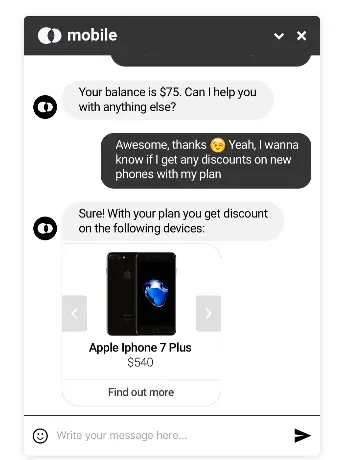
Agentbot also helps you elevate conversation flows based on customer interactions. You can train your bot (using AI) to offer better responses to customer queries and even include nifty touches like GIFs.
2. MessengerPeople
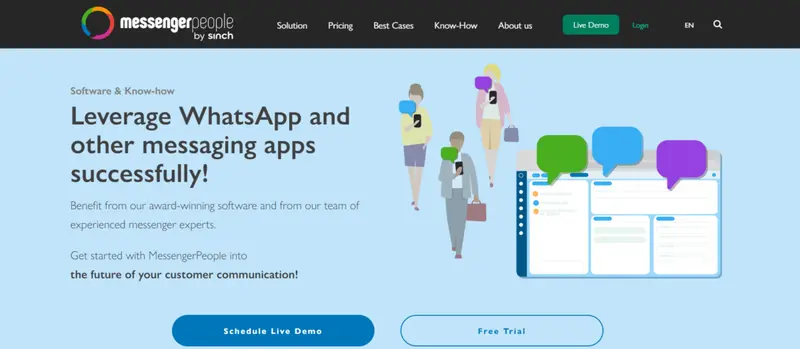
MessengerPeople has been designed for medium and large businesses. It’s positioned as a relatively easy-to-use WhatsApp chatbot tool, and it really is.
You’re able to easily build conversation flows to make customer communication more intuitive and professional. MessengerPeople also offers the ability to gather user characteristics, a feature not often marketed in this space.
User characteristics are saved as chatbot conversations take place, making it possible to drive more meaningful engagements with customers about their needs and how your brand can help.
Read More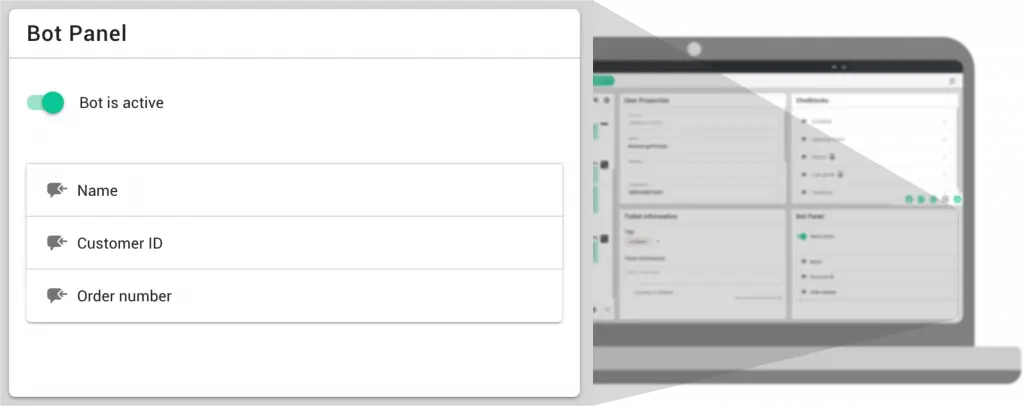
3. Botsociety
What if you’d like to prototype your WhatsApp chatbot before committing to it? There’s a tool for that. Botsociety has created a prototyping solution for brands want to get a preview of their WhatsApp chatbot’s look and feel like, before pulling the trigger.
Designing your chatbot is relatively easy and done using a clean drag-and-drop interface. Botsociety also offers brands and team members the ability to collaborate and share updates.
You can also test bots in real-time by granting access to hundreds of certified testers from various locations and demographics. As you’d imagine, the ability to test the effectiveness of your bot with real users speeds up enhancements, helping you design more effective conversation flows.

4. Raphiwha
Raphiwa offers a WhatsApp API designed for mass communication at an enterprise level. The tool allows you to pair a number with your WhatsApp business account, create a webhook and send and receive chats.
It also comes with a chat manager interface for fielding queries and an auto-reply chatbot. While not as sophisticated as other chatbot tools, you’re still able to create replies to common queries your customers have.
Price:
Pricing is based on a daily reception fee of $1.49. This “opens” your channel of communication with customers and allows unlimited replied for 24 hours. If sending messages, you’re charged $0.05 per sent message. If sending and receiving, reception and sending fees apply.
5. Gupshup
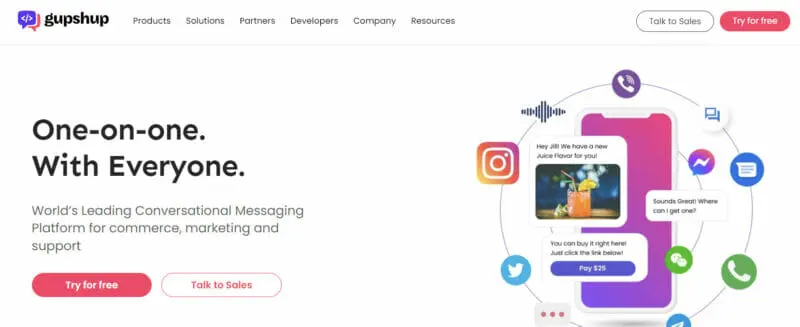
Headquartered in Silicon Valley, Gupshup offers a globally recognized and used messaging platform. To date, they processed over 225 billion messages and off integrations with Twitter, Slack, WeChat, Viber, Facebook messenger and WhatsApp.
As a messaging platform provider, they are more popular for their bot scripting tool. With it, developers are able to create chatbots capable of performing simple and complex interactions.
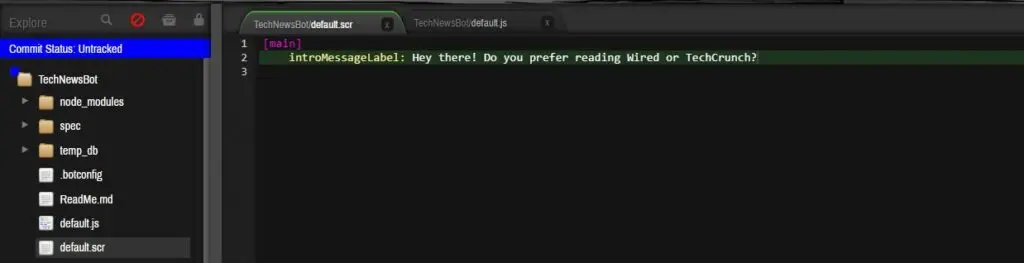
They also offer an out-of-the-box solution which includes automated response creation, the ability to customize your chat assistant, and switch to live chat mode if need be.
Price:
Start sending messages from $0.001 per message.
6. Yalo
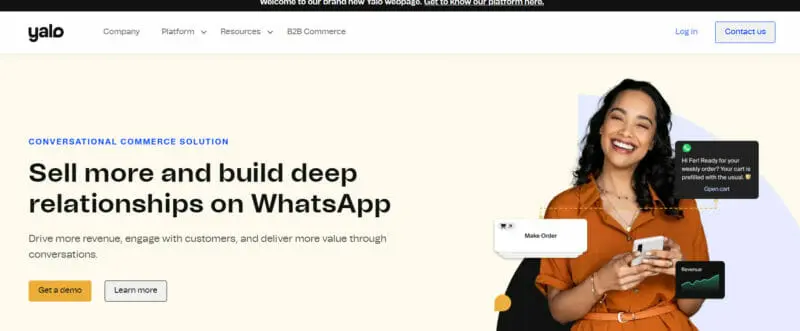
Yalochat is a WhatsApp chatbot development company with a twist. They help businesses engage and develop customer relationships with the use of AI-powered CRM. This means more intimate customer interactions can be made at scale.
Yalochat has a strong AI focus. Through deep learning, chatbots experiences are enhanced, along with continuous training from developers. And their results prove their tool highly successful. According to its website, Yalochat serves over 700,000 users weekly.
Read More7. LivePerson
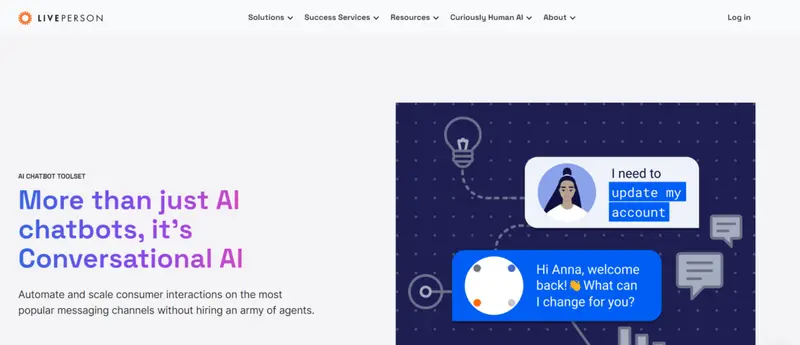
LivePerson gives brands a glimpse of exactly how intricate and valuable chatbot tech can be. For example, LivePerson offers intent analysis. Through LiveIntent, your brand can leverage AI to identify customer intent and quickly tweak messaging. And did we mention that you can do all of this in real-time?
LivePerson also comes with a powerful dashboard that allows any department to gauge how well they are performing. Anyone from sales to technical and customer support is able to track the level of engagement with their chatbot, see how many sales it was responsible for and measure other equally important stats like average order value, total conversion time, and tell how satisfied customers after a chatbot interaction.
Price:
Read More8. ChatCompose
ChatCompose provides a collection of what we’ve come to see as the top four functions powerful chabot tools are built with. You get AI and natural language processing that help predict what your audience is looking for, and where their searches may be slightly off, what they meant to say. It also comes with autocorrect, a smart addition that supports its natural language feature, making it easier to determine user intent and/or purpose. But AI and NLP aside, these tools are no help without smart integrations, and ChatCompose offers many. It works with most popular messaging, support and social media platforms, so you’ll be able to put yours to work with WhatsApp with ease.
Read More9. Landbot.io
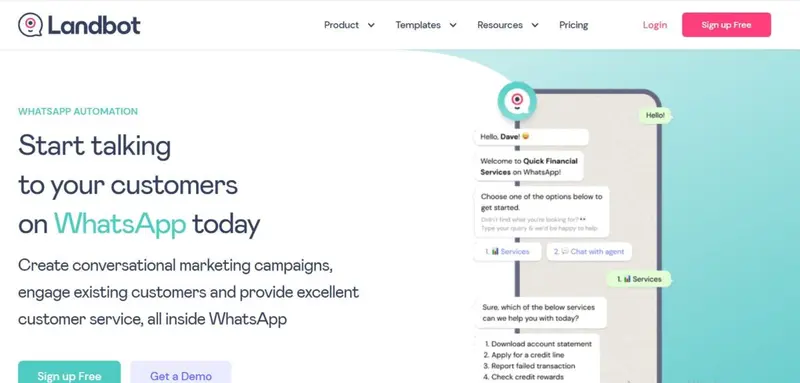
Landbot.io presents a beautifully designed interface and drag-and-drop WhatsApp chatbot building functionality. It’s also the choice of large brands such as Uber, LG, T Systems, Ernst and Young, and L’Oreal. One aspect of their tool that caught our eye is the use of rich media. Brands are able to work with videos, images, GIFs and more, easily adding them to scripts to elevate customer experiences.
Like other bots, Landbot.io includes the option to build integrations to help collect data in real-time. Other integrations include Mailchimp, Zapier, Slack, Google Analytics, Sendgrid and Salesforce.
Read More10. Engati
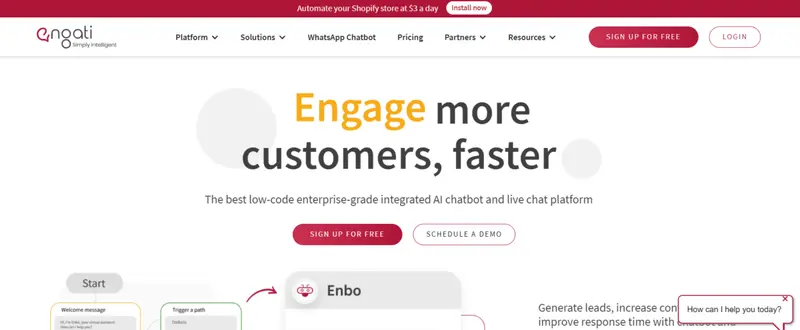
Engati’s is one of the more lauded chatbot tools available today. Customers praise the brand for streamlining everything from customer support engagements to how easy it is to use the tool to build conversation logic. Altogether, Engati’s chatbot comes with 14 features. These include NLP, a conversation flow builder, integration capabilities for JSON Rest APIs along with many OOB standard integrations, and it also supports multiple languages.
Read More11. Botsza

Botsza is a chatbot platform focused on the hospitality, airline, eCommerce, banking, finance and insurance and customer care industries. And their tool is powerful enough to carry out some of the most important tasks one can think of. Botsza is capable of providing general information on hotel and accommodation bookings, handling enquiries about flight bookings, managing eCommerce orders, returns, refunds, stock searches and also suggesting products.
Read More12. SnatchBot
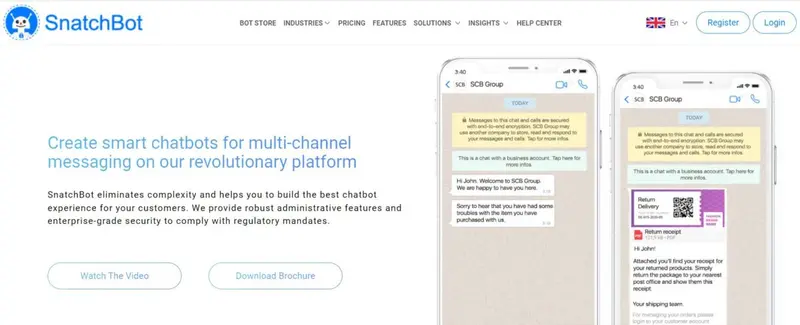
SnatchBot has positioned itself as the perfect chatbot solution for businesses of any size. What makes it a solid contender is that it’s capable of being used as a front and backend tool. This means it can be applied in a host of different ways, something that few bots can do.
Read More13. Flow.ai
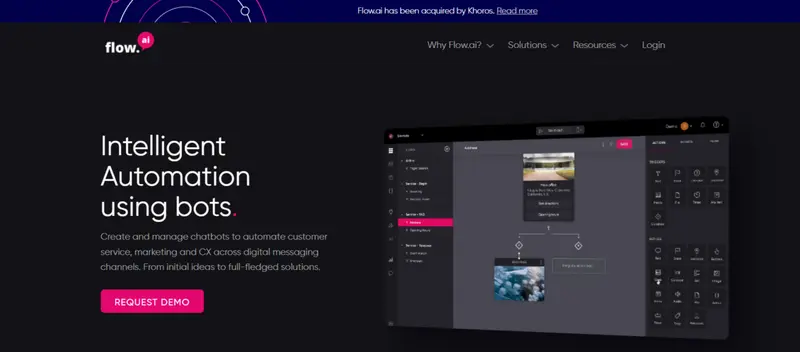
Flow.ai is a sleek and easy-to-use chatbot tool. It’s designed as the perfect solution for marketers that need to ideate and deliver automated messaging. It works with WhatsApp, Facebook Messenger, and can perform payments. Other integrations include Amazon Alexa, Google Assistant, Khoros, Telegram, Twillo, Apple Business Chat, and more.
As for features, Flow.ai makes marketing and sales simpler. It’s able to nurture leads, book appointments and sell products. It can also deflect calls to messages by using IVR prompts to deal with more customers. Like other tools on our list, human takeover is possible. Flow.ai also allows you to include rich media in conversation flow, something that adds extra value, especially when it comes to selling products and services.
Read More14. Botscrew
If we’ve learned anything about the WhatsApp chatbot tools landscape, it’s that it’s relatively broad. There is a solution for almost every kind of business out there. Take Botscrew, as an enterprise solution, it includes some interesting marketing capabilities. Need to tailor chatbot messages as part of your remarketing strategy? You can, in just a few clicks.
Botscrew’s conversation flow can be managed by category or product, depending on how your business is structured. Unlike Agentbot, designing your conversation flow is text-based, but equally intuitive and easy to use.
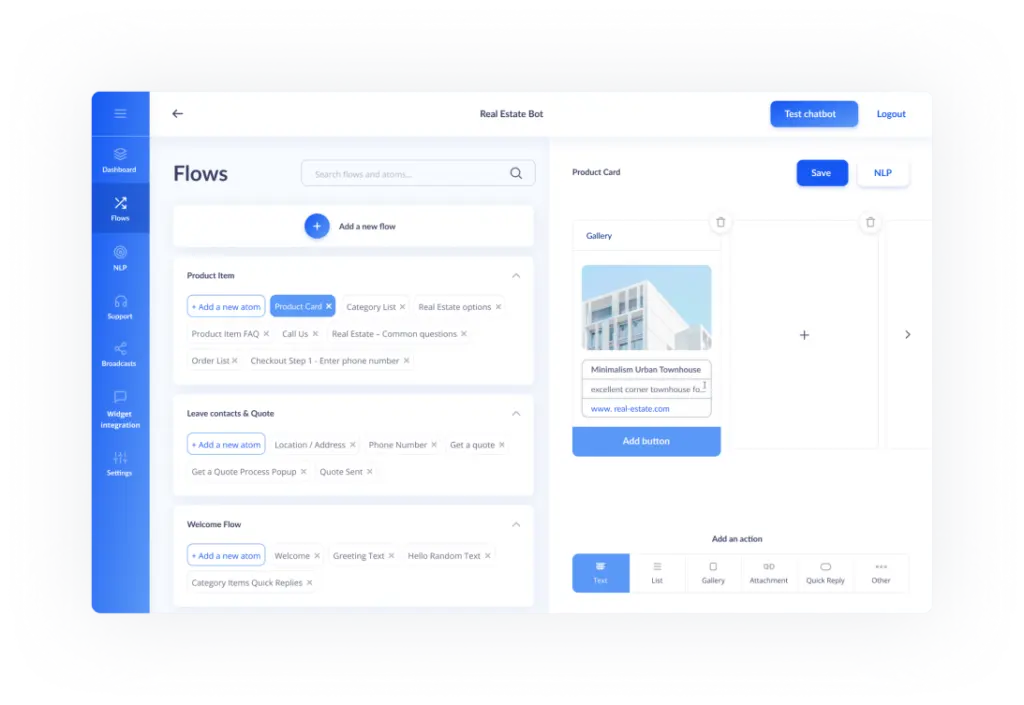
Botscrew also packs AI, making it possible to train your chatbot to offer more accurate and helpful responses.
Read More15. Tars
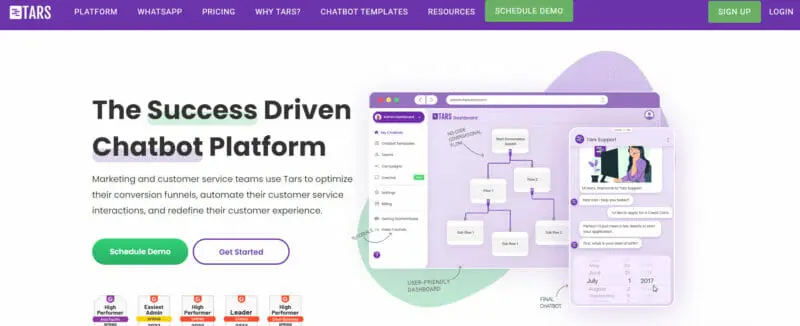
Trusted by hundreds of global brands including names like American Express, Vodafone, and Bosch, Tars is a conversational AI platform that can help businesses to deliver a more engaging customer experience. To date, they’ve created nearly 20,000 chatbots that were used for over 25 million conversations.
Read More16. Sendbee
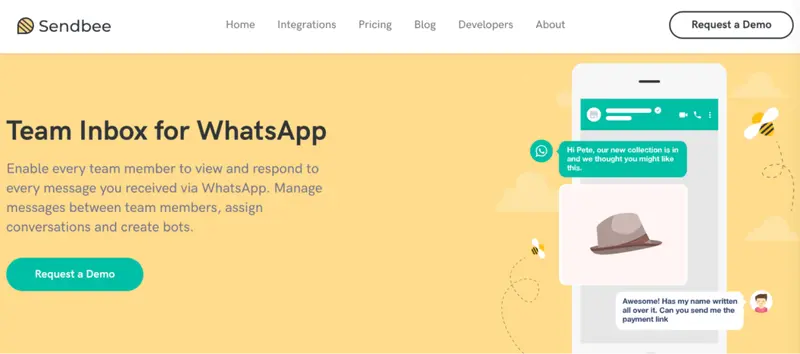
Sendbee helps hundreds of businesses to power their WhatsApp conversations. After you’ve created your WhatsApp Business API profile, you can invite your team members to Sendbee so that they can start to manage conversations as a unit. Thanks to its inbox, it becomes a whole lot easier to manage and reply to WhatsApp conversations via one place.
If you want to automate your conversations, it also offers an intuitive chatbot builder for WhatsApp. You can, for example, send an automated “Away” message to customers when your business is closed or create other templates that will help you to reduce your response time significantly.
Price
Pricing available upon request
17. SendPulse
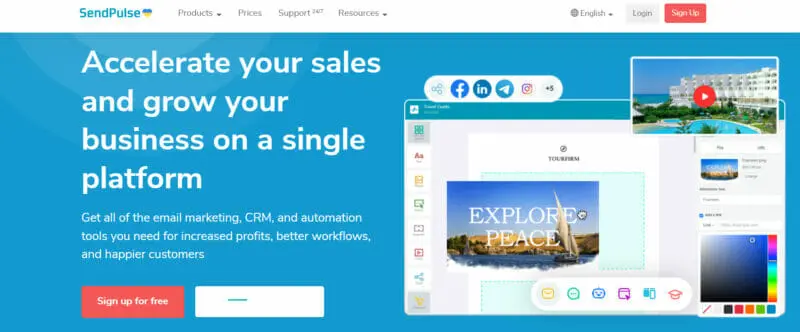
SendPulse is a multi-channel marketing platform that helps you to streamline your customer communications channels. Included in its list of features is automated chatbot flows.
With the help of its drag-and-drop editor, it’s easy to create a chatbot. You can create triggers and set up auto-replies to create an effective sales funnel for your subscribers.
Read More
18. Freshworks
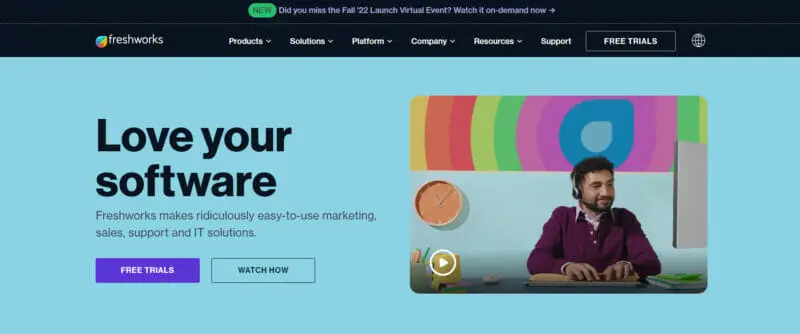
Freshworks is trusted by more than 50,000 businesses from all across the world. Included in its wide range of products are chatbots. In addition to WhatsApp, you can also use its chatbots for web, Facebook Messenger, and Apple Business Chat.
You can build a chatbot for answering customer questions, executing actions using triggers, automatically updating customer data, or one that can do all of these tasks. With its no-code builder, it’s easy to create a flow that will guide your audience through a logical troubleshooting process. Plus, thanks to its customization options, you can keep the look of your brand identity by changing elements like the color, shape, or size.
Read MoreWrapping this up
WhatsApp chatbot tools are plenty, but not all are created equal. Some offer basic integrations and functionality, while others include more detailed features designed to offer more business intelligence.
When picking your WhatsApp chatbot tool, make a clear assessment of what your business needs right now. Does customer intent matter? Do you want to be able to develop relationships after the initial chat? Would it make business sense to build something complex with long conversation flows?
While there’s definitely more to consider, we’re certain that WhatsApp chatbot tools will continue to evolve. And for brands looking to scale and do so effectively, without compromising their image and customer service levels, the more sophisticated the solution, the better.
Frequently Asked Questions
What are the best WhatsApp Chatbot tools to use?
Businesses can become easily contactable via WhatsApp plugins on their websites and run push marketing campaigns. Importantly, you can automate your communication with clients using chatbots. When you combine chatbots with WhatsApp, you get a match made in heaven. We have examined 18 of the best WhatsApp Chatbot tools in this article:
- Agentbot
- Botscrew
- MessengerPeople
- Botsociety
- Raphiwha
- Gupshup
- Yalo
- LivePerson
- ChatCompose
- Landbot.io
- Engati
- Botsza
- SnatchBot
- Flow.ai
- Tars
- Sendbee
- SendPulse
- Freshworks
How do I use chatbot on WhatsApp?
All the WhatsApp chatbots that we have covered in this article work in a slightly different way. For example, AgentBot, using Aivo’s platform, allows you to load your knowledge base and design the entire experience without technical skills. You can upload questions manually, import them from Excel and Zendesk Guide, or add content packs by industry or events. You can transfer sessions smoothly from WhatsApp to live chat solutions such as Live or Genesys to address more sensitive inquiries appropriately.
What is the WhatsApp Chatbot?
There is no official WhatsApp chatbot, but you can add a chatbot to the WhatsApp platform, either by using one of the tools covered in this post or by programming a chatbox yourself as a developer. A WhatsApp chatbot is a computer program that simulates and processes human conversation), allowing humans to interact with your business via WhatsApp. Chatbots are driven by AI, automated rules, natural-language processing (NLP), and machine learning (ML).
Does WhatsApp use AI?
All the chatbots we have covered in this article use artificial intelligence (AI) to some degree or other. It is the AI that makes a chatbox function – it is how it “thinks” to answer the questions people ask. WhatsApp technically uses AI for more than that, however. Every action while using the app creates an event that can be part of a bigger self-learning that triggers further learnings. WhatsApp stresses that they don’t use your chat conversations, however, due to privacy concerns.
How expensive is a chatbot?
Chatbots vary in price. Many of the WhatsApp chatbots listed in this article avoid publicizing their pricing details, merely asking you to schedule a demo to begin your sales engagement. Some do give a better guide to price, however. These include:
- MessengerPeople - starts are €499
- Botsociety – free or a professional package with more features for $79
- Raphiwha - a daily reception fee of $ $1.49 + $0.05 per sent message
- Gupshup - from $0.001 per message
- ChatCompose – free, Professional: $12/mo or Enterprise: $69.00/mo
How does WhatsApp make money?
The founders of WhatsApp resisted attention from investors because they wanted to build an ad-free product. The founders disliked ads and were not keen on ad-based monetization. The app initially relied on the freemium model to make money. However, in 2014 they relented and sold WhatsApp to Facebook. In 2016, Facebook made WhatsApp free for everybody. The founders left in 2017, due to dissatisfaction with Facebook introducing ads. It now makes money through the WhatsApp for Business API as well as Click to WhatsApp ads.


