
UGC has become the backbone of modern ad testing, but the way teams produce and evaluate that content is changing fast. As AI-powered tools enter the creative stack, marketers are facing new questions.
- Should you still rely on creator marketplaces to test ads, or can AI-generated UGC deliver faster and more reliable signals?
- And which software actually helps you learn what works before the budget is scaled?
Teams that treat UGC testing as a system, not a one-off creative task, are iterating faster and wasting less spend. Instead of chasing more creators, they are investing in software that improves testing velocity, creative control, and insight quality.
This article breaks down the best UGC video software for ad campaign testing, comparing AI UGC tools, creator-driven platforms, and hybrid solutions.
The goal is simple: help you choose the right tools for your testing stage, team structure, and performance goals, without overcomplicating your stack.
Best UGC Video Software for Ad Campaign Testing
1. Twirl
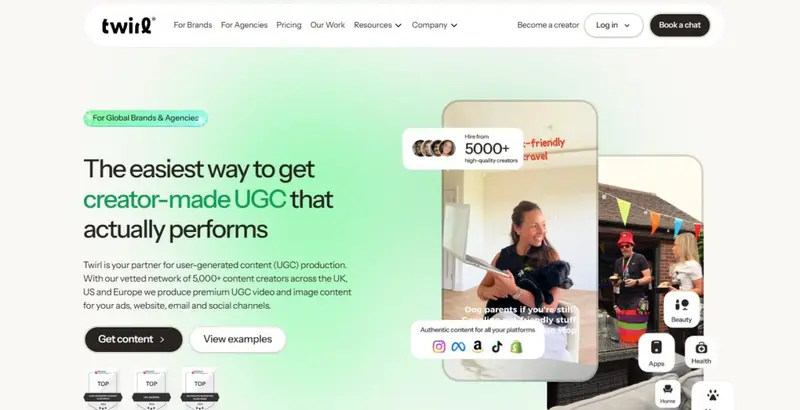
Best For: Brands and agencies that want real creator-made UGC for ad testing without managing sourcing, contracts, or production logistics.
Pricing: Pay per video starting from £240 per UGC asset with full usage rights included.
Testing Focus: Creator produced UGC designed for structured testing of hooks, formats, CTAs, and creative angles across paid social channels.
Twirl sits between a traditional UGC platform and a full-service agency. Instead of software-driven generation, it provides access to a large, vetted creator network and wraps it in a managed production workflow built for performance marketing.
Read More
Key Features: Influencer Marketplace, Influencer Content Amplification, Influencer whitelisting, Freelancer/Creator Marketplace, Content Review, Content Library, Campaign Management, Campaign Reporting, Market & Competitor Analysis, Client Relationship Management, Content Management, Team/Collaboration Tools, Campaign management and reporting, Automated reporting, Faceted Search / Filtering, Full Campaign Design,
Channels: Facebook, Instagram, Tiktok
2. Billo
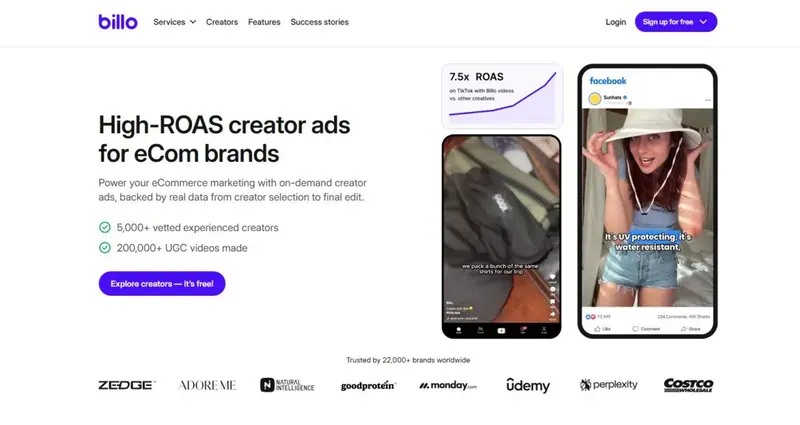
Best For: Small and Medium Brands that want to test and scale real creator-made UGC using data-driven briefs and repeatable workflows.
Pricing: Usage-based pricing tied to video production, with costs varying by creator volume and campaign needs. Agency-specific offers are available for scaled testing programs.
Testing Focus: Human creator UGC optimized for ROAS and CAC testing, with structured briefs informed by historical ad performance data.
Billo is built around the idea that UGC testing should be informed by what has already worked at scale. Instead of starting from creative intuition alone, teams generate briefs using Billo’s performance intelligence, then match with vetted creators suited to the product category and goal.
Read More
Key Features: Influencer Search & Discovery, Campaign Management, Influencer Marketplace, Influencer Content Amplification, Global Influencer Payment, Insights/Analytics, Influencer Discovery, Content Amplification, Data/Analytics, Influencer whitelisting, Freelancer/Creator Marketplace, Search/Discovery, Team Collaboration Tools, Content Review, Content Library, Campaign Management, Campaign Reporting, E-commerce Tools, Product/Gifting Tools, Forms and Compliance, Payment Processing, Faceted Search / Filtering, Forms & Compliance,
Channels: Tiktok, Instagram, Facebook, Youtube
3. Arcads

Best For: Performance marketers and growth teams that want to test UGC style ads at extreme speed using AI actors instead of real creators.
Pricing: Available upon request after account creation, with plans typically aligned to usage volume and feature access.
Testing Focus: Synthetic UGC style ads for rapid testing of hooks, emotions, scripts, visuals, and localization across paid social platforms.
Arcads is built for ad testing velocity. It offers a large library of AI actors that can deliver scripted messages with controlled emotions, lip sync, and visual consistency. For testing purposes, this allows teams to isolate creative variables such as hook wording, delivery tone, language, and visual pacing without introducing creator-related variability.
Read More4. VidAU.AI
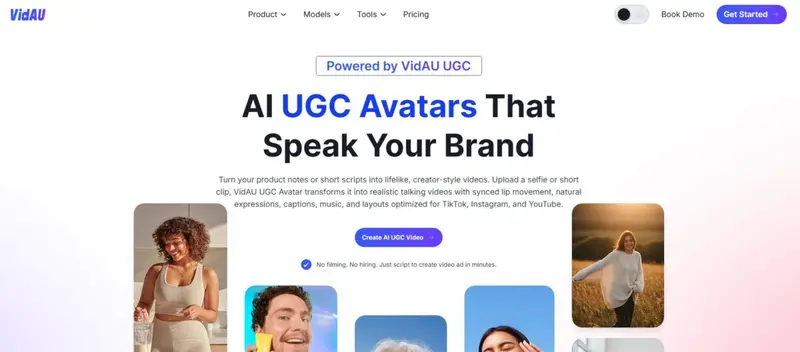
Best For: Early-stage UGC ad testing where speed, creative volume, and message validation matter more than real creator identity.
Pricing: Free plan included; Paid plans start at $29 per month
Testing Focus: Script driven UGC style video variants using AI avatars to test hooks, CTAs, pacing, voices, and languages.
VidAU is designed for teams that want to test UGC ads without relying on creators, filming logistics, or long production cycles. Instead of sourcing influencers, marketers generate talking head-style videos from short scripts or product notes using AI avatars built to resemble creator delivery.
Read More5. Omneky
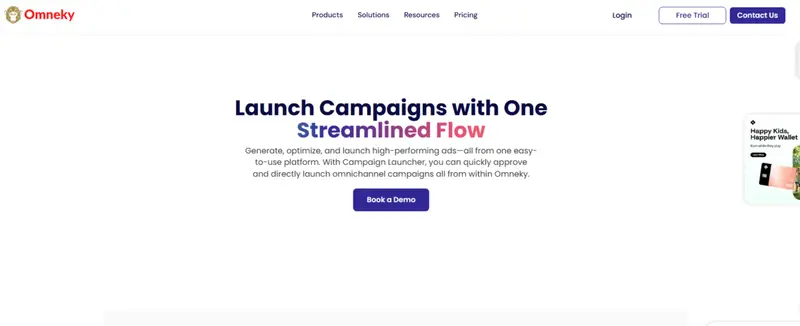
Best For: Brands and agencies that want to generate, test, and launch UGC inspired ads at scale while keeping creative tightly aligned to brand and performance data.
Pricing: Plans start at $99 per month for Creative Generation Pro, with higher tiers adding creative insights, predictive scoring, and omnichannel analytics. Enterprise pricing is custom.
Testing Focus: Data-driven generation and optimization of UGC style ads, with built in creative scoring and direct campaign launch across major ad platforms.
Omneky positions itself as an end-to-end ad creation and launch platform rather than a pure UGC production tool. Instead of sourcing creators, it generates UGC inspired ads using AI trained on brand guidelines, historical performance data, and campaign objectives.
Read MoreWhich UGC Ad Testing Tool Fits Your Team Best
Not all UGC ad testing software is built for the same job. Some tools prioritize speed and control, others focus on real creator trust, while a few are designed to orchestrate testing, insights, and launch at scale.
The comparison below is meant to help you quickly identify which tool matches your testing goals, team structure, and tolerance for synthetic versus human content, so you can choose intentionally rather than by hype.
|
Tool |
UGC Source Type | Best Use in Ad Testing | Creative Iteration Speed | Creative Control | Realism and Trust Signal | Testing or Analytics Support | Launch Support | Typical Buyer |
Where It Falls Short |
| Twirl | Real creators | Testing authentic UGC angles | Days | Medium | High | Limited, plan dependent | Manual export | Brands, agencies | Slower than AI tools |
| Billo | Real creators | Performance-driven creative testing | Days | Medium | High | Built-in insights | Manual export | Performance brands, agencies | Less control over delivery style |
| Arcads | AI actors | High volume creative experimentation | Instant | Very high | Low | None | Manual export | Growth teams, app marketers | Not suitable for social proof |
| VidAU | AI avatars | Hook, script, and language validation | Instant | High | Low | None | Manual export | Performance marketers, agencies | Synthetic output limits trust |
| Omneky | AI brand creative | Structured experimentation and scale | Same day | High | Medium | Built-in analytics | Direct in-platform launch | Enterprise teams | No real creator identity |
Creator Marketplaces vs AI UGC Software for Ad Campaign Testing
When teams start testing UGC ads at scale, the first real fork in the road is whether to rely on creator marketplaces or AI UGC software. Both can power effective testing programs, but they excel at very different jobs and stages of the experimentation cycle.
Creator Marketplaces
Creator marketplaces connect brands with real people who film content. Their biggest advantage is trust. Human creators bring natural delivery, subtle imperfections, and social proof that synthetic content cannot fully replicate.
This makes creator marketplaces ideal for testing testimonial ads, product demos, and lifestyle creatives where credibility is part of the hypothesis. They also perform better when brands want to validate whether a concept resonates emotionally, not just whether a hook stops the scroll.
The tradeoff is speed and control. Creator availability, revisions, and turnaround times introduce variability that can slow rapid experimentation.
AI UGC Tools
AI UGC software excels where creator marketplaces struggle. These tools prioritize iteration velocity and consistency. Marketers can generate dozens of variants from a single script, control tone and pacing precisely, and localize ads across markets almost instantly.
This makes AI UGC software especially effective for early-stage testing, message validation, and high-volume experimentation where the goal is to identify winning angles before committing budget.
The downside is realism. Even the most advanced avatars and AI actors still lack the trust signal of a real person, which can limit performance in social proof-driven ads.
|
Dimension |
Creator Marketplaces |
AI UGC Software |
| UGC Source | Real human creators | Synthetic avatars or AI actors |
| Best For | Trust, testimonials, demos | Speed, volume, message testing |
| Iteration Speed | Slower, days to weeks | Instant or same day |
| Creative Control | Medium | High |
| Realism and Trust | High | Low to medium |
| Cost Predictability | Variable | Predictable |
| Ideal Testing Stage | Scaling proven concepts | Early and mid-stage experimentation |
Key Takeaway
In practice, high-performing teams rarely choose one or the other. They use AI UGC software to find what works, then deploy creator marketplaces to scale what wins with human credibility. Understanding where each approach fits prevents wasted spend and mismatched expectations.
How to Choose the Right UGC Testing Stack Without Wasting Budget
UGC ad testing is no longer about finding a single tool that does everything. It is about building a workflow that matches how your team actually learns, iterates, and scales creative. AI UGC software and creator marketplaces each play distinct roles, and the strongest results come from using them intentionally rather than interchangeably.
AI-driven tools excel at speed, control, and volume. They help teams validate hooks, messages, formats, and localization quickly, before meaningful spend is committed. Creator led platforms shine once direction is clear and performance depends on trust, realism, and human delivery.
Tools that sit closer to orchestration and analytics help bridge the gap between creative production and launch.
The teams that win with UGC testing are not chasing hype. They sequence tools based on learning goals, use AI to find what works, and creators to scale what wins.
That mindset turns UGC from a creative expense into a repeatable growth system.
Frequently Asked Questions
Why are brands prioritizing UGC for ad testing instead of traditional creatives?
UGC mirrors how people already consume content on social platforms, which is why many teams see stronger engagement and faster learning cycles when testing ads built around the benefits of UGC marketing rather than polished brand-first creative.
When should brands use agencies instead of software for UGC testing?
Agencies make more sense when brands need human storytelling, compliance oversight, or creator credibility at scale, which is why some teams turn to specialized UGC video agencies once early testing has identified clear creative direction.
What makes UGC videos better suited for paid ad experimentation?
UGC videos tend to surface performance signals faster because they feel native to feeds, making it easier to compare hooks, formats, and CTAs across different UGC video ads without creative fatigue skewing results.
How should UGC testing influence influencer and creator budgets?
Testing with UGC software or marketplaces helps brands allocate spend more intelligently by validating concepts first, which supports smarter influencer budget allocation decisions before scaling creator partnerships.
Can AI-generated UGC actually work for ecommerce ad testing?
Yes, especially in early experimentation phases where speed matters more than trust, and many ecommerce teams now use AI-driven workflows inspired by AI UGC ads in ecommerce to validate messaging before involving creators.
Why has UGC become central to modern performance marketing?
As audiences grow resistant to traditional ads, brands have shifted toward creator-style formats, a trend reflected in the rise of UGC across paid social, organic content, and ecommerce campaigns.
Are seasonal campaigns more sensitive to UGC testing quality?
Seasonal campaigns amplify both wins and mistakes, which is why teams often stress-test concepts earlier when planning UGC ad creatives for holidays to avoid scaling underperforming formats during peak spend periods.
How does UGC testing fit into a broader campaign lifecycle?
UGC testing works best when treated as one stage in a structured process, feeding insights into briefing, launch, and optimization phases outlined in a UGC campaign framework rather than as an isolated creative task.


