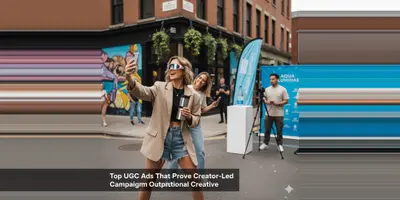
UGC video ads have become one of the most effective tools in modern performance marketing.
But what exactly makes them outperform polished studio campaigns? And how are brands using everyday creators to win attention on TikTok, Instagram Reels, and YouTube Shorts at a time when traditional ads are increasingly ignored?
Data shows just how significant this shift has become: 56% of brands now actively prioritize UGC in their marketing mix, and nearly 19% say it has become their single most important objective.
As short-form platforms shape consumer behavior, one trend is unmistakable — people trust content that feels real. This has pushed brands toward creator-driven videos that blend seamlessly into the feed, rely on social proof, and communicate value within seconds.
This guide breaks down how UGC video ads work, why they convert, and how to create them, complete with strategies, best practices, and real campaign examples to learn from.
- What Are UGC Video Ads?
- Why UGC Video Ads Work So Well for Brands
- How to Create UGC Video Ads Step by Step
- The Most Effective Types of UGC Video Ads
- Winning UGC Video Ad Examples To Mimic
- 1. Twirl
- 2. Clicks Talent
- 3. House of Marketers
- Turning UGC Video Ads Into a Repeatable Growth System
- Frequently Asked Questions
What Are UGC Video Ads?
UGC video ads are paid social ads built from content created by real customers or everyday creators rather than actors or studio crews. They are intentionally shot in a casual, mobile-first style, reflecting the way people naturally post on TikTok, Instagram Reels, and YouTube Shorts.
This approach aligns with platform guidance: TikTok’s Creative Center notes that ads perform better when they “blend into the For You feed,” and Meta’s Reels Best Practices emphasize using native, lo-fi formats to match user expectations.
UGC ads differ from studio ads in both production and viewer perception. Studio ads rely on professional lighting, scripts, and sets. They convey polish, but on short-form platforms, they often feel overly branded.
Since creators now drive the majority of culture-shaping content in feeds, ads that resemble everyday creator posts tend to earn higher attention and lower friction.
They also differ from influencer ads. Influencer ads live on a creator’s channel and reach their followers. UGC ads, however, run through the brand’s ad account once usage rights are secured. TikTok’s Spark Ads documentation clarifies this separation: creator posts can be authorized for brands to run as paid ads, allowing marketers to control targeting, optimization, and spend.
The reason UGC video ads convert well comes down to authenticity and social proof.
Our research shows consumers trust recommendations from people similar to them more than brand messaging. This trust makes first-person demonstrations, unfiltered testimonials, and everyday product usage especially effective in direct-response campaigns.
In essence, UGC video ads work because they feel real, look native to short-form platforms, and deliver credible product proof while still giving brands full control through paid media.
Why UGC Video Ads Work So Well for Brands
UGC video ads have become one of the most reliable formats for performance marketing because they align with how people browse short-form platforms and how they make purchasing decisions.
Their effectiveness can be understood through three core drivers: authenticity, attention, and cost efficiency.
Authenticity Builds Trust
One of the biggest reasons UGC video ads convert is the credibility of real customers or everyday creators. This proven trust advantage explains why first-person demos, everyday usage clips, and genuine testimonials consistently outperform scripts or polished voiceovers.
Testimonial and demonstration videos often generate higher engagement for direct-response eCommerce campaigns.
@heyimtran This is a UGC example of a top performing video! #ugcexample #kitchenware #ugccreator #ugctips
Native Format Alignment Improves Attention
Short-form feeds reward content that blends into the surrounding environment. TikTok advises advertisers to design ads that “blend into the For You feed” to avoid feeling interruptive. This native look helps UGC ads achieve longer watch times and stronger click-through rates, which is crucial in platforms where the first few seconds determine whether a user continues watching.
Cost Efficiency and Creative Iteration
Another reason brands rely on UGC ads is the ability to generate and test multiple variations at low cost. Studio production requires scripting, lighting, gear, and a full crew, while UGC content can be produced quickly and affordably.
However, the need for frequent creative refreshes cannot be understated. UGC enables that by allowing marketers to test hooks, CTAs, and angles without large production budgets. This rapid testing cycle often leads to better ROAS because winning concepts emerge faster.
Together, these factors make UGC video ads uniquely effective: they feel real, they capture attention, and they scale creatively without breaking budgets.
How to Create UGC Video Ads Step by Step
Creating effective UGC video ads is less about cinematic polish and more about clarity, relevance, and platform-native storytelling. Brands that follow a structured process consistently produce higher-performing creatives across TikTok, Meta, and Shorts.
Step 1: Define the Core Angle
Before involving a creator or filming anything, you need a clear performance angle. This includes the problem your product solves, the primary benefit you want shown on camera, and the offer or CTA you’ll lead with. Identifying the “core message” early is highly important, since strong ads communicate purpose within the first few seconds.
Step 2: Write a Simple, Creator-Friendly Script
UGC ads perform best when the script feels conversational rather than written. A common framework is Hook, Problem, Solution, Product Proof, CTA. It's recommended to structure short-form ads with a clear opening hook, because early clarity significantly increases watch time.
Scripts should allow creators room to speak naturally, but still anchor the narrative.
Step 3: Select the Right Creator or Customer
The creator doesn’t need a large following. What matters is on-camera comfort and audience match. We emphasize choosing creators who naturally produce content similar to the format you want to run as ads.
Brands should look for clear speech, expressive delivery, and familiarity with the platform’s editing style.
Step 4: Capture Social-Native Footage
Production should feel native to short-form apps: handheld clips, quick cuts, everyday settings, natural lighting, and on-screen text. We consistently see how lo-fi examples outperform overly produced sets because they feel honest and unfiltered.
For example, take a look at the ad below. It's simple, almost too simple. A few seconds long, but because it captures the essence of what it means to produce content for short-form platforms like TikTok, it overperformed most professional sets. After all, how else would you get 1.6 million likes on your videos?
@omo.oroje #Ad maybe I’m born with it …❤️ what do you think? @MaybellineUK #maybeitsmaybelline #maybelline
Step 5: Edit Variations for TikTok, Reels, and Shorts
Each platform favors slightly different pacing. TikTok supports quicker hook variations, Reels often benefit from prominent captions, and Shorts prefers straightforward messaging. Editing multiple cuts makes it easier for algorithms to match the right variant to the right audience.
Step 6: A/B Test Multiple Angles
Performance advertising relies on variation. Meta’s creative guidance stresses ongoing creative rotation as essential for keeping costs stable and preventing fatigue. Testing different hooks, CTAs, and demonstration styles helps identify what resonates fastest.
The Most Effective Types of UGC Video Ads
UGC video ads succeed when they match how people naturally consume content on TikTok, Instagram Reels, and YouTube Shorts. Certain formats consistently perform better because they communicate value quickly, feel native to the platform, and deliver clear product proof without needing heavy production.
Unboxing and First-Reaction Videos
Unboxing content works because it shows a genuine moment of product discovery. TikTok’s Creative Center highlights unboxings as one of the platform’s top-performing formats for conveying authenticity and sparking curiosity. These videos give viewers a clear look at packaging, presentation, and first impressions — all of which help reduce uncertainty for new buyers.
@elfyeah this just in ‼️ the big e.l.f.ing mystery unboxathon is happening from November 3-7 🎁 pick from 6 digital bundles packed with 5+ full-size products 🤩 starting at only $24 (all at OMG values) 😱 unlock your first digital blind box at elfcosmetics.com #elfcosmetics #eyeslipsface #blindbox #digitalblindbox #unboxing
Product Demonstrations and “How It Works” Clips
Short, direct demos are among the strongest ad formats across Meta and TikTok because they show the product solving a problem in real time. Demonstrating the product within the first few seconds is essential to increasing retention and conversion rates.
This style works especially well for beauty, home, fitness, and consumer tech categories where visual proof matters.
@rhode scented lip tint try on 🎀 @Skyler Pierce
Transformation and Before-and-After Stories
When the product delivers visible results — skincare, cleaning, hair tools, organization — transformation videos communicate impact faster than any script. They also align with platform trends, as TikTok reports strong performance for content that shows “progress, routines, or visible improvements” in its Trend Intelligence resources.
@kadymcdermott AD | code: KADYTT for 40% off @Baddest Bod ❤️✨
Testimonial and Review-Driven UGC
Direct-to-camera testimonials remain a high-performing style because viewers instantly understand the value through someone else’s experience. This format mirrors the natural review content people expect to see on TikTok and Reels. When combined with cutaway B-roll of the product in use, testimonials become even more persuasive and easier to repurpose across placements.
@bill.tamlyn1 @ARMRA ential part of my daily routine. It helps support my digestion, mental clarity, skin and hair. Talk about a full body glow up! ARMRA’s my secret weapon and, honestly, it could be yours too! #paidtestimonial #ad
Winning UGC Video Ad Examples To Mimic
The following UGC video ad case studies highlight the formats, creator styles, and executional tactics that consistently outperform across TikTok, Meta, and Instagram. These UGC video ad examples show exactly how authentic creator storytelling, hands-on demos, and native social pacing can drive awareness, trust, and conversion at scale.
1. Twirl
Papier x Twirl: Scaling UGC Video Ads Across the UK and US With Faster Turnaround and Lower CPAs
Papier, the British stationery brand known for its personalized planners, notebooks, and photo books, needed a more efficient system for producing UGC video ads at scale.
Their manual creator workflow meant long delays, strict two-month briefing lead times, and limited variation in creative assets. With only eight videos per month and slow turnaround, Papier struggled to shift spend from Meta to TikTok or test new product categories beyond stationery.
To unlock growth in both their UK and US markets, Papier partnered with Twirl to modernize their UGC production pipeline.
Read More
Key Features: Influencer Marketplace, Influencer Content Amplification, Influencer whitelisting, Freelancer/Creator Marketplace, Content Review, Content Library, Campaign Management, Campaign Reporting, Market & Competitor Analysis, Client Relationship Management, Content Management, Team/Collaboration Tools, Campaign management and reporting, Automated reporting, Faceted Search / Filtering, Full Campaign Design,
Channels: Facebook, Instagram, Tiktok
2. Clicks Talent
Lille Prins x Clicks Talent: UGC Unboxing Videos That Drove Massive Awareness for a Multifunctional Baby Product
Lille Prins, a baby brand known for lightweight, easy-to-assemble multifunctional products, partnered with Clicks Talent to spotlight its 4-in-1 Pack and Play system.
Designed as a playpen, bassinet, diaper-changing station, and nap area in one, the product is built for parents who need portability and flexibility. To introduce this hero item to a wider audience, Clicks Talent activated a one-week TikTok campaign centered entirely on creator unboxing videos — a UGC format that resonates strongly with parents seeking authentic product demonstrations.
Read More
Clicks Talent
Clicks Talent is one of the most established and globally scaled influencer marketing agencies in the industry, with operations spanning 25 countries and representing over 5,000 influencers worldwide.

10 - 50

USA, Netherlands, Brazil, Russia, UK, Israel
Best for:
Enterprises, Large and Small brands
Clicks Talent
Clicks Talent is one of the most established and globally scaled influencer marketing agencies in the industry, with operations spanning 25 countries and representing over 5,000 influencers worldwide.
3. House of Marketers
Pulsenmore x House of Marketers: UGC Video Ads That Built Trust and Awareness Across Eight Global Markets
Pulsenmore, a medtech innovator offering an at-home prenatal ultrasound device, needed to rapidly establish trust and category understanding as it entered eight English-speaking markets.
Because most consumers had never encountered at-home ultrasound technology, early challenges included low awareness, skepticism around safety, and unusually fast ad fatigue — even on UGC-friendly platforms like TikTok. To overcome these barriers and build a single, unified community of millennial mothers, Pulsenmore partnered with House of Marketers to launch a multi-market paid social and UGC video campaign.
Read More
House of Marketers
House of Marketers is the #1 TikTok-focused agency for Influencer Marketing, Paid Media, Content Creation, and Growing Business Profiles on TikTok. We specialize in helping Mobile Apps and Brands quickly scale and improve their ROI on the most valuab...
10 - 50
United Kingdom, United States, Germany, Spain, Brazil, Italy, France, Poland, Indonesia, Singapore
Best for:
Large brands and Creators
House of Marketers
House of Marketers is the #1 TikTok-focused agency for Influencer Marketing, Paid Media, Content Creation, and Growing Business Profiles on TikTok. We specialize in helping Mobile Apps and Brands quickly scale and improve their ROI on the most valuab...
Turning UGC Video Ads Into a Repeatable Growth System
UGC video ads are no longer a nice-to-have format. They are a core skill set for any brand running paid social on TikTok, Meta, or Shorts. When you understand what they are, why they work, and how to brief and test them step by step, you move from one-off creative bets to a repeatable system for performance.
This guide walked through the fundamentals: how UGC ads differ from influencer and studio creatives, how to script and capture native footage, and which formats consistently perform best.
The case studies simply prove the point in the real world, showing how brands use these principles at scale. Start with a clear angle, pick the right creators, keep production lo-fi, and keep testing variations. Do that consistently, and UGC video ads become one of the most reliable levers in your entire marketing mix.
Frequently Asked Questions
How do brands decide whether UGC video ads fit their marketing mix?
Brands typically evaluate whether UGC aligns with their audience’s browsing behavior, which is why many study the broader rise of UGC to understand how authenticity and social proof influence short-form ad performance.
What types of creators are best for UGC video ads?
Marketers often prioritize creators who already produce content in a natural, lo-fi style, and they rely on insights from user-generated content platforms to identify creators with strong on-camera comfort and consistent delivery.
How can brands measure the viral potential of a UGC ad?
Teams often look at engagement ratios, shares, and watch-through curves, but a key indicator of spread is the UGC viral coefficient, which helps determine whether a piece of content is generating organic momentum.
How do UGC ads fit into a full-funnel content strategy?
Many brands follow a structured approach spanning ideation to optimization, similar to a UGC campaign framework that organizes testing, message sequencing, and post-launch iteration.
What role do agencies play in scaling UGC video ads?
Specialized agencies are often used when brands need rapid creative volume or platform expertise, which is why some partner with TikTok ads agencies for testing, allowlisting, and paid social execution.
Can UGC video ads support live shopping or real-time commerce?
Yes. On TikTok, UGC formats often power conversion-driven moments, especially when paired with UGC live shopping trends that blend creator demos with commerce pathways.
How can B2B companies use UGC video ads effectively?
B2B brands often rely on expert explainers, customer stories, and product walkthroughs, echoing principles seen when companies leverage UGC for B2B to build trust and shorten evaluation cycles.
Are organic community posts useful for informing UGC ad concepts?
Absolutely. Many teams analyze patterns in organic feedback and customer stories, using fundamentals of user generated content to identify themes that naturally translate into high-performing ad angles.