
With U.S. digital video ad spending projected to surpass $80 billion in 2026, there's a clear shift of advertising budgets from traditional ad platforms toward streaming TV, short-form social video, creator content, and mobile-first media environments.
Video advertising now extends far beyond YouTube prerolls and traditional commercials. Brands run campaigns across TikTok, Instagram Reels, Connected TV (CTV), retail media networks, livestreaming platforms, and increasingly, Spotify’s growing video podcast ecosystem, where audio, creator sponsorships, and video inventory are starting to merge into a unified advertising channel.
Creative expectations are changing just as quickly. Vertical short-form video, creator-led ads, user-generated content (UGC), and AI-assisted production workflows often outperform highly polished studio creative in feed-based environments designed around speed, discovery, and engagement.
In fact, 79% of users say UGC strongly influences their purchasing decisions, highlighting how native-feeling creative increasingly shapes ad performance on social platforms.
Modern video advertising, therefore, operates less like a standalone ad format and more like the infrastructure layer connecting awareness, targeting, commerce, creator partnerships, and conversion across digital media ecosystems.
Calculate and Compare Video Advertising CPM
Use inBeat’s CPM Calculator to estimate campaign cost, impressions, or cost per thousand impressions. Fill in any two fields, and the calculator will automatically generate the third value.
Switch to advanced mode to compare multiple video campaigns across platforms and formats. This provides an early cost benchmark before you evaluate the advertising options covered below.
What Is Video Advertising?
Video Advertising Definition
Video advertising refers to paid promotional content distributed through video formats across digital platforms, streaming services, social media feeds, connected TVs, mobile apps, podcasts, and retail media networks.
Modern video advertising is run through:
- Short-form social video ads
- Creator-led sponsored content
- Streaming TV inventory
- Programmatic video placements
- Shoppable ecommerce video
- Podcast video sponsorships
- Native in-feed video ads
Platform behavior also differs significantly across ecosystems. TikTok and Instagram prioritize fast-paced vertical creative designed for algorithmic discovery. YouTube combines search intent with long-form viewing behavior. Connected TV platforms focus on household reach inside streaming environments.
Spotify increasingly blends podcast sponsorships, video podcasts, and streaming inventory into creator-driven advertising campaigns.
Video advertising is often confused with video marketing, but the two serve different purposes.
Video marketing usually refers to owned or organic content distributed through channels like websites, newsletters, YouTube channels, or social accounts. Video advertising specifically involves paid distribution through ad platforms, sponsorships, auction systems, or programmatic buying infrastructure.
That distinction matters because paid video campaigns rely on targeting systems, media budgets, attribution models, bidding strategies, and platform optimization signals that do not exist inside organic distribution alone.
Why Video Advertising Is Central to Modern Marketing
Video advertising expanded rapidly as consumer attention shifted toward mobile-first content, streaming platforms, and creator-led media environments. Advertisers followed that behavioral change with larger investments in short-form video, streaming inventory, and social commerce campaigns designed for feed-based discovery rather than static display engagement alone.
Short-form video platforms accelerated much of that transition. Shorts now generates more than 70 billion daily views globally, while TikTok users spend 53.8 minutes per day inside the app on average in several major markets.
Creative strategy evolved alongside platform behavior. According to Meta, 9:16 vertical video ads with audio achieved 12% higher conversions per dollar spent compared to campaigns not optimized for Reels placements.
TikTok has also stated that ads introducing products or messaging within the first 3 seconds produce stronger conversion performance than slower-paced creative.
Those trends help explain why creator-led ads, user-generated content (UGC), and fast-paced vertical video increasingly outperform traditional studio-style commercials inside social feeds designed around speed, discovery, and engagement.
Streaming growth created another major shift in video advertising infrastructure. Nielsen reported that streaming accounted for 44.8% of total TV usage in the U.S. during 2025, surpassing both cable and broadcast television.
Advertisers increasingly distribute budgets across Connected TV (CTV), ad-supported streaming services, YouTube TV, Amazon Prime Video, Netflix’s ad-supported tier, and Spotify’s growing video podcast ecosystem to reach audiences migrating away from traditional television viewing.
Spotify reflects how video advertising is starting to merge with creator media and session-based entertainment environments.
Video podcasts, creator-read sponsorships, dynamically inserted ads, and streaming inventory now allow brands to run campaigns that blend audio, video, and influencer-style advertising inside longer listening sessions rather than short scrolling interactions alone.
Modern video advertising now operates across several distinct viewing environments:
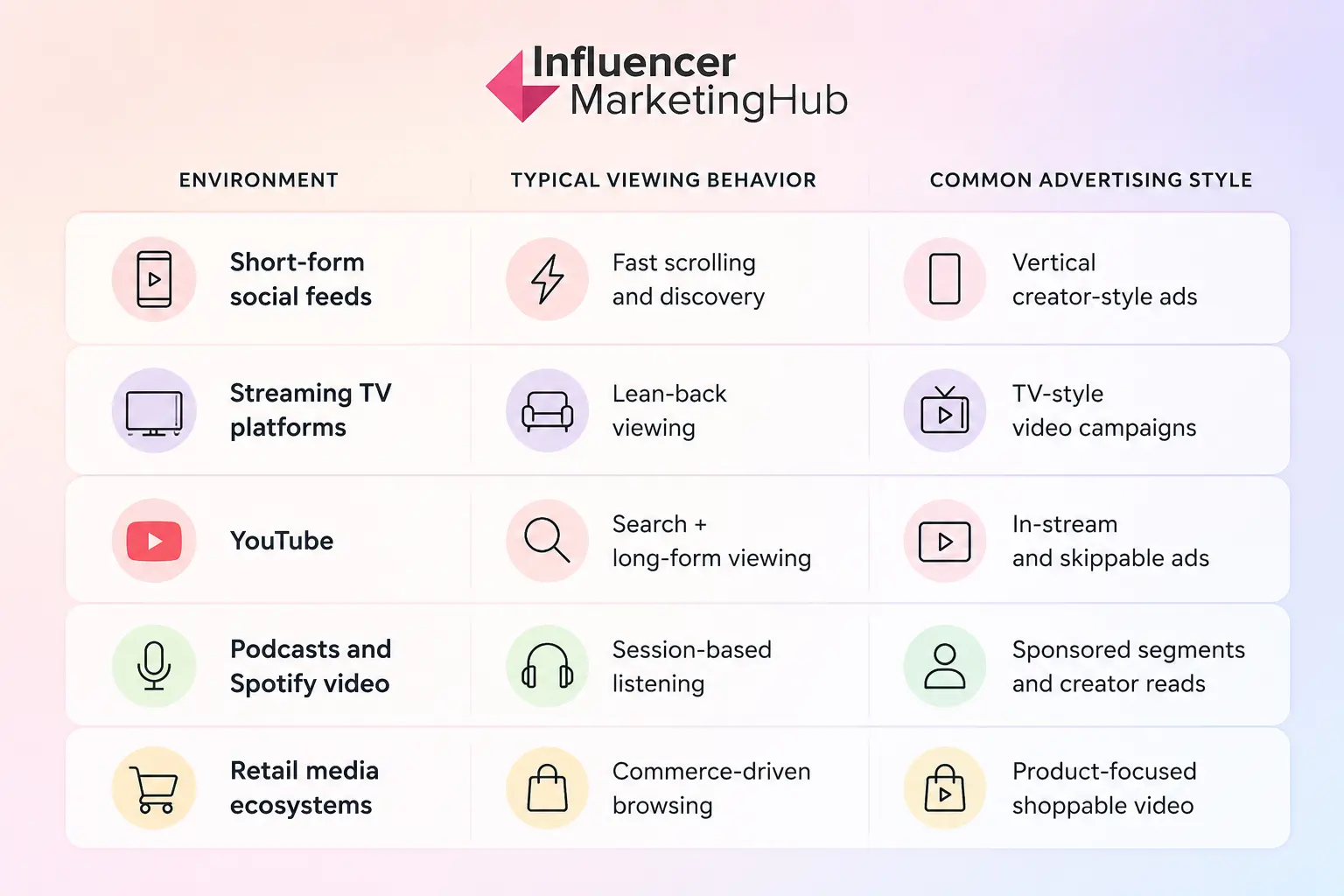
Performance expectations also changed significantly. Advertisers increasingly evaluate video campaigns through conversion metrics, ecommerce attribution, app installs, lead generation, and incremental sales impact rather than reach alone.
Video advertising, therefore, functions less like a standalone branding channel and more like a full-funnel media system connected to targeting, commerce, creator partnerships, and platform-level optimization infrastructure.
Types of Video Advertising
Modern video advertisers now distribute campaigns across different environments where each rewards different creative styles and campaign structures.
Format selection matters because viewing behavior changes significantly between platforms. A skippable YouTube ad behaves differently from a TikTok creator ad, a Spotify video podcast sponsorship, or a Connected TV (CTV) campaign running through streaming inventory.
Campaign goals, targeting systems, attribution models, and creative expectations also vary between environments.
In-Stream Video Ads
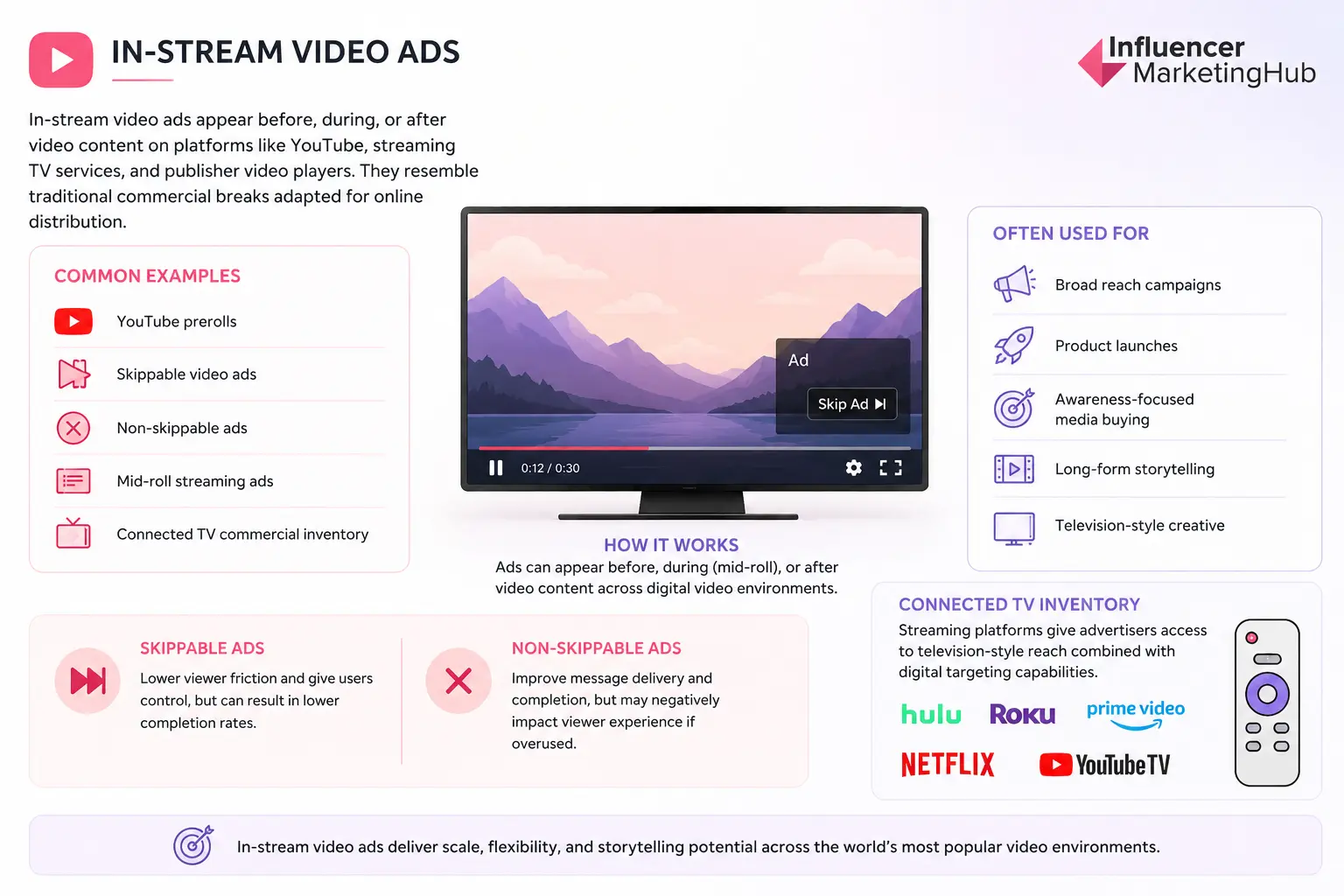
In-stream video ads appear before, during, or after video content on platforms like YouTube, streaming TV services, and publisher video players. These are some of the most recognizable forms of digital video advertising because they resemble traditional commercial breaks adapted for online distribution.
Common examples include:
- YouTube prerolls
- Skippable video ads
- Non-skippable ads
- Mid-roll streaming ads
- Connected TV commercial inventory
YouTube remains one of the largest in-stream ecosystems globally. Google reported that YouTube connected TV viewing surpassed 1 billion hours watched daily, reflecting how streaming-style viewing behavior increasingly overlaps with digital advertising infrastructure.
Skippable ads usually lower viewer friction but can reduce completion rates. Non-skippable ads improve message delivery but may negatively affect viewer experience if overused.
Connected TV inventory expanded the format further.
Streaming platforms like Hulu, Roku, Amazon Prime Video, Netflix’s ad-supported tier, and YouTube TV now give advertisers access to television-style reach combined with digital targeting capabilities that traditional broadcast environments historically lacked.
Outstream and Native Video Ads
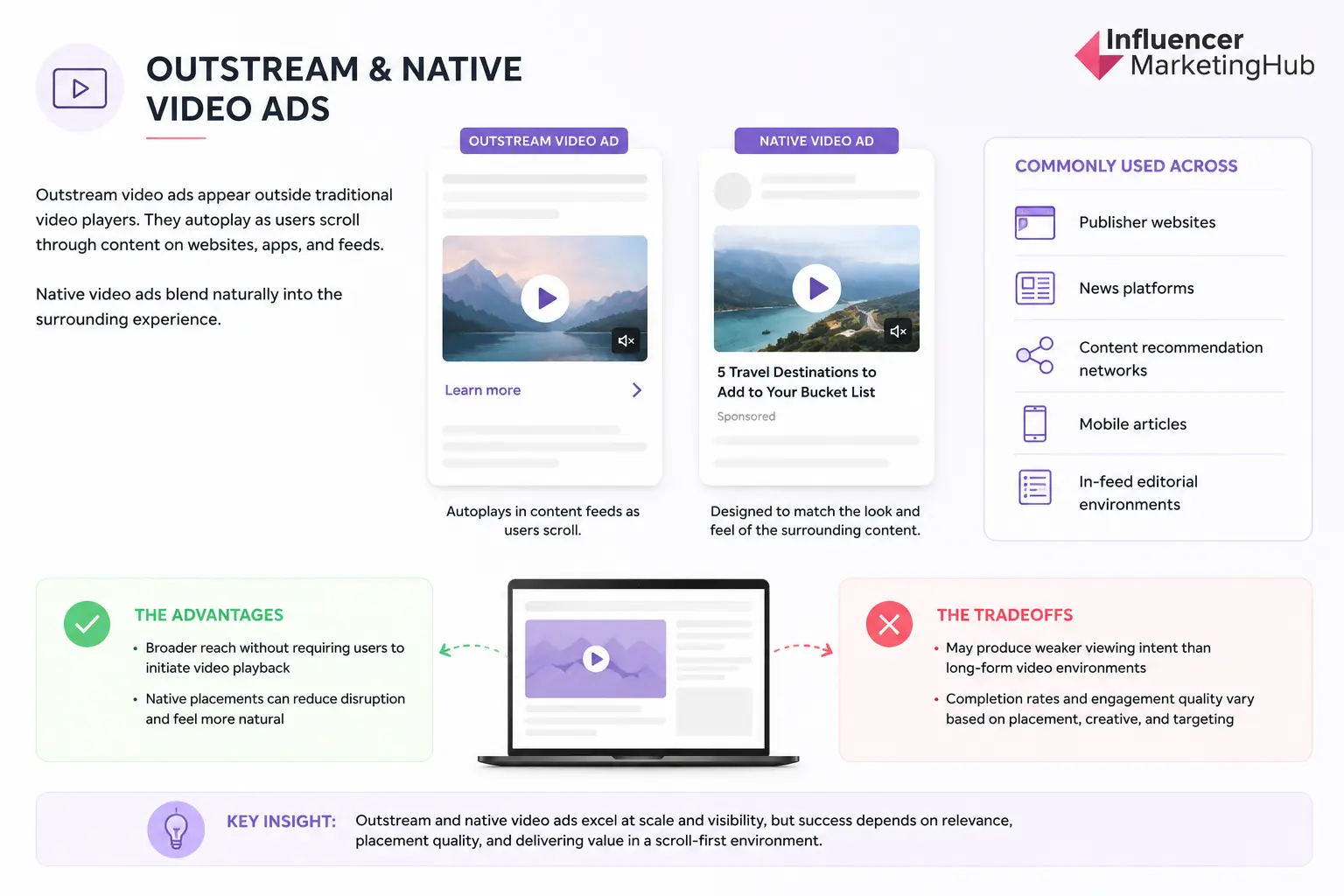
Outstream video ads appear outside traditional video players. Publisher websites, article feeds, editorial environments, and mobile apps frequently use outstream placements that autoplay as users scroll through content.
Native video ads work similarly but are designed to blend more naturally into surrounding platform experiences.
Outstream campaigns often generate broader reach because they do not require users to actively watch video content beforehand. Native environments can also reduce disruption compared to traditional prerolls.
Performance tradeoffs exist, however.
Outstream placements may produce weaker viewing intent than long-form video environments where users deliberately choose to watch content. Completion rates and engagement quality, therefore, vary heavily depending on placement quality, creative pacing, and audience targeting.
Short-Form Social Video Ads
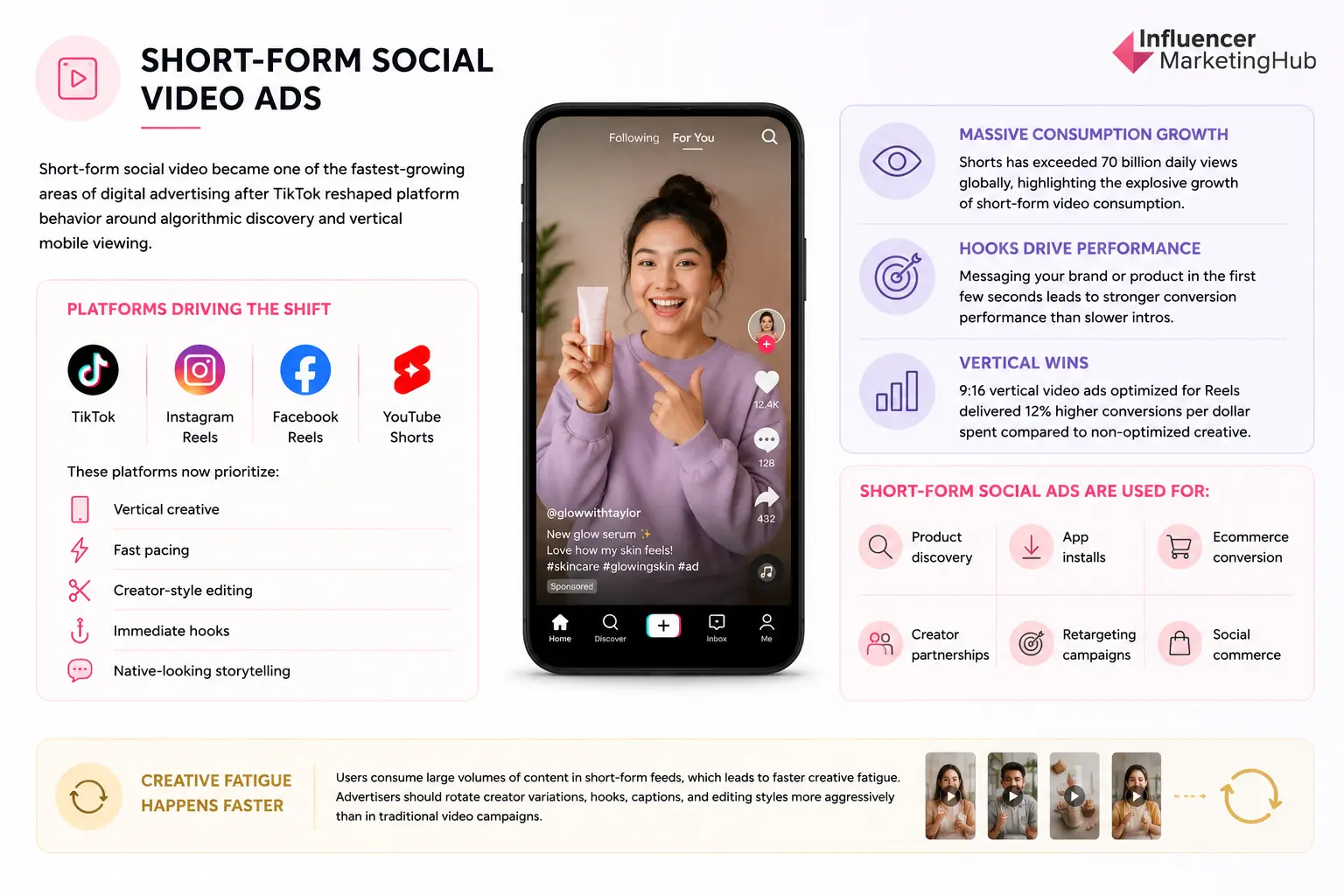
Short-form social video became one of the fastest-growing areas of digital advertising after TikTok reshaped platform behavior around algorithmic discovery and vertical mobile viewing.
TikTok, Instagram Reels, Facebook Reels, and YouTube Shorts now prioritize vertical creative, fast pacing, creator-style editing, and immediate hooks.
Creative structure matters heavily in these environments. TikTok has stated that ads communicating branding or product messaging within the first few seconds produce stronger conversion performance than slower introductions.
However, creative fatigue appears faster inside short-form feeds because users consume large volumes of content continuously. Advertisers often rotate creator variations, hooks, captions, and editing styles more aggressively than they would in traditional video campaigns.
Connected TV (CTV) and Streaming Video Advertising
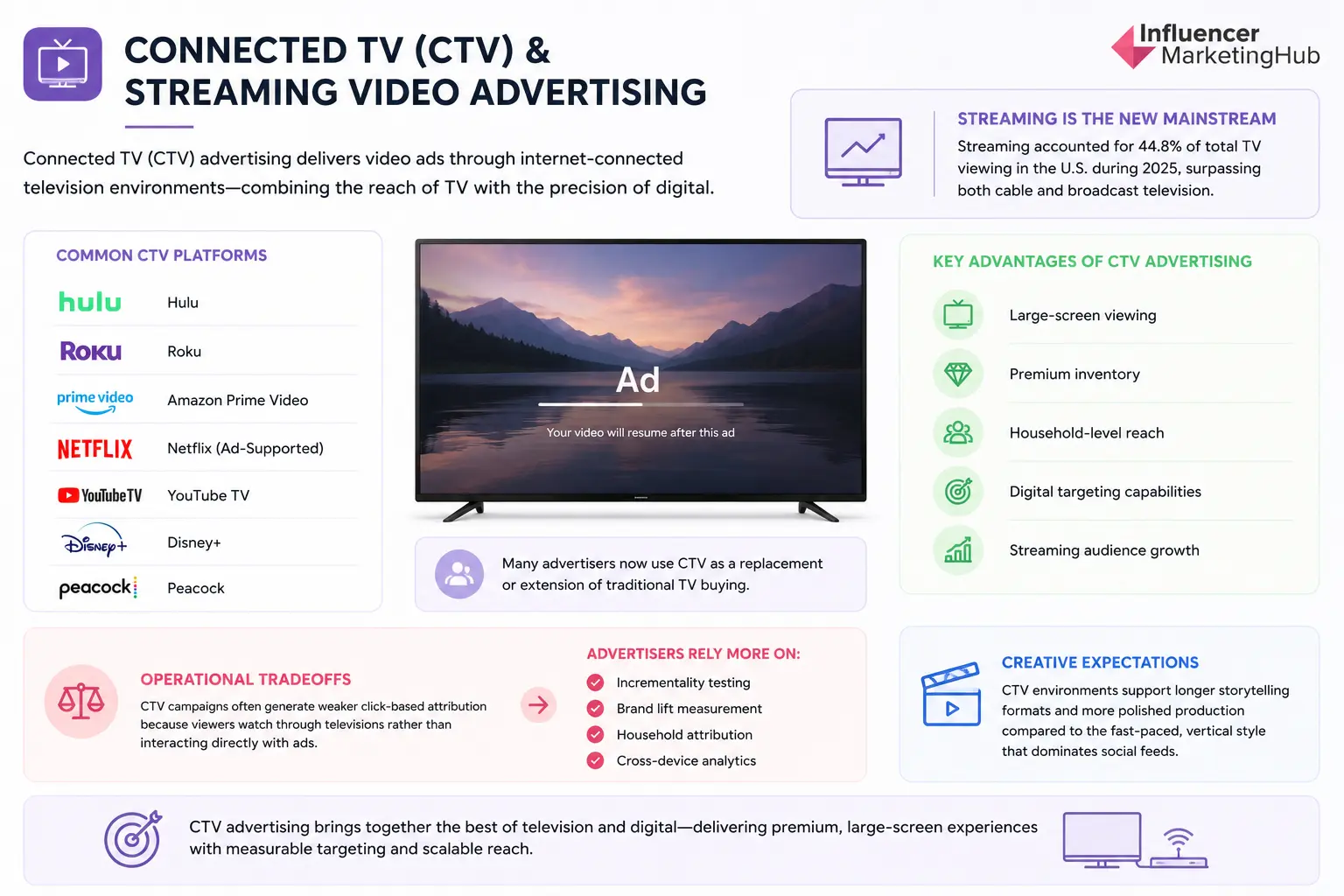
Connected TV advertising refers to video ads distributed through internet-connected television environments rather than traditional cable or broadcast infrastructure.
CTV advertising combines several advantages:
- Large-screen viewing
- Premium inventory
- Household-level reach
- Digital targeting
- Streaming audience growth
Many advertisers now use CTV as a replacement or extension of traditional television buying.
Operational tradeoffs still exist. CTV campaigns often generate weaker click-based attribution because viewers watch through televisions rather than directly interacting with ads on mobile devices or desktop browsers. Advertisers therefore rely more heavily on incrementality testing, brand lift measurement, household attribution, and cross-device analytics.
Creative expectations also differ from social feeds. CTV environments generally support longer storytelling formats and more polished production compared to fast-moving vertical social video.
Podcast and Spotify Video Advertising
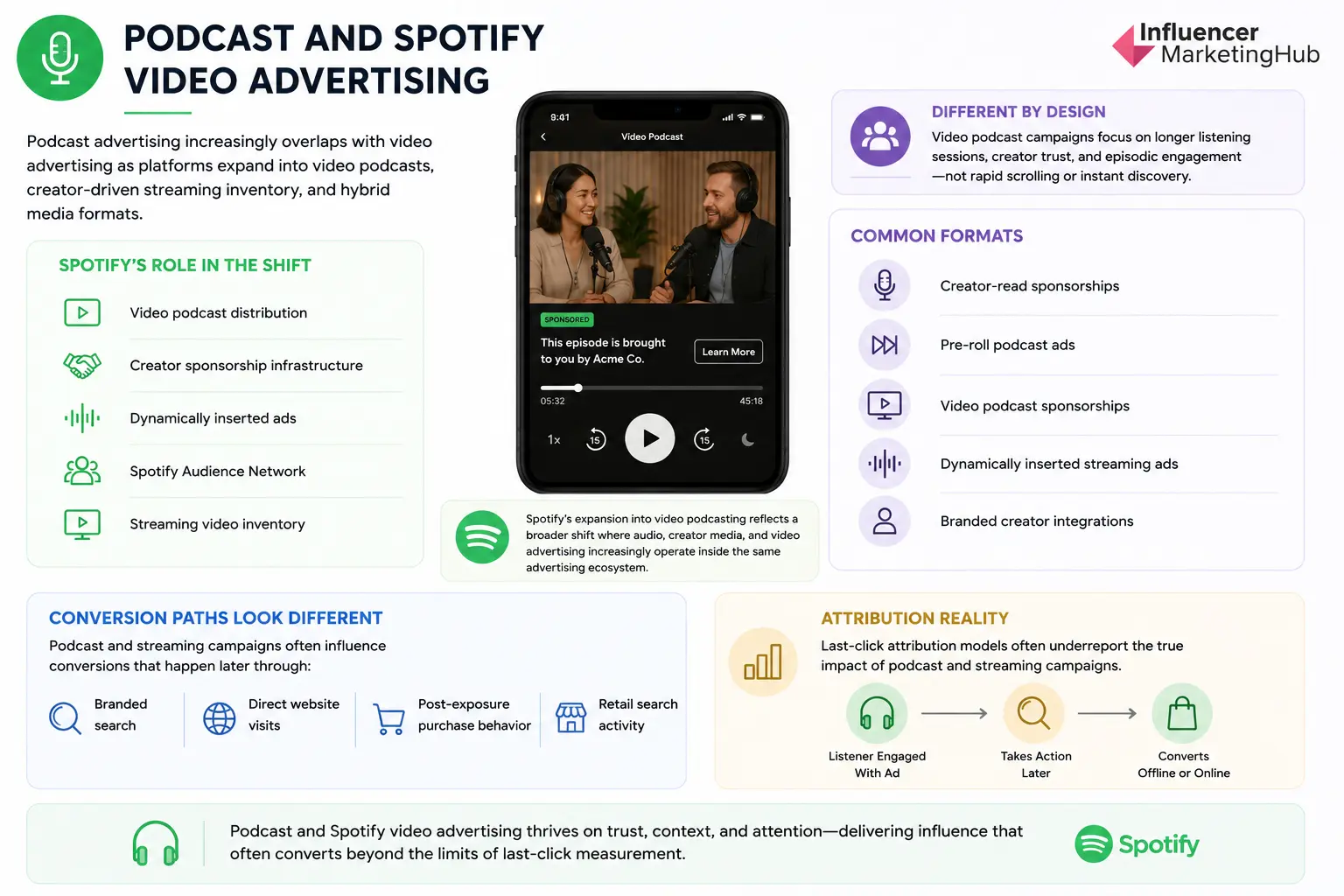
Podcast advertising increasingly overlaps with video advertising as platforms expand into video podcasts, creator-driven streaming inventory, and hybrid media formats.
Spotify is a major player in the space, primarily through the Spotify Audience Network. Podcast video advertising also provides advertisers with streaming video inventory, dynamic ad insertions, creator sponsorship infrastructure, and video podcast distribution.
Video podcast campaigns differ significantly from short-form social advertising. Audience behavior tends to revolve around longer listening sessions, creator trust, and episodic engagement rather than rapid scrolling and instant discovery. In fact, over 70% of podcast viewers/listeners finish a full episode.
Spotify’s expansion into video podcasting reflects a broader shift where audio, creator media, and video advertising increasingly operate inside the same advertising ecosystem.
Podcast and streaming campaigns also behave differently from feed-based attribution systems. Viewers and listeners frequently convert later through branded search, direct website visits, post-exposure purchase behavior, and retail search activity.
Last-click attribution models often underreport that influence.
Shoppable and Retail Media Video Ads
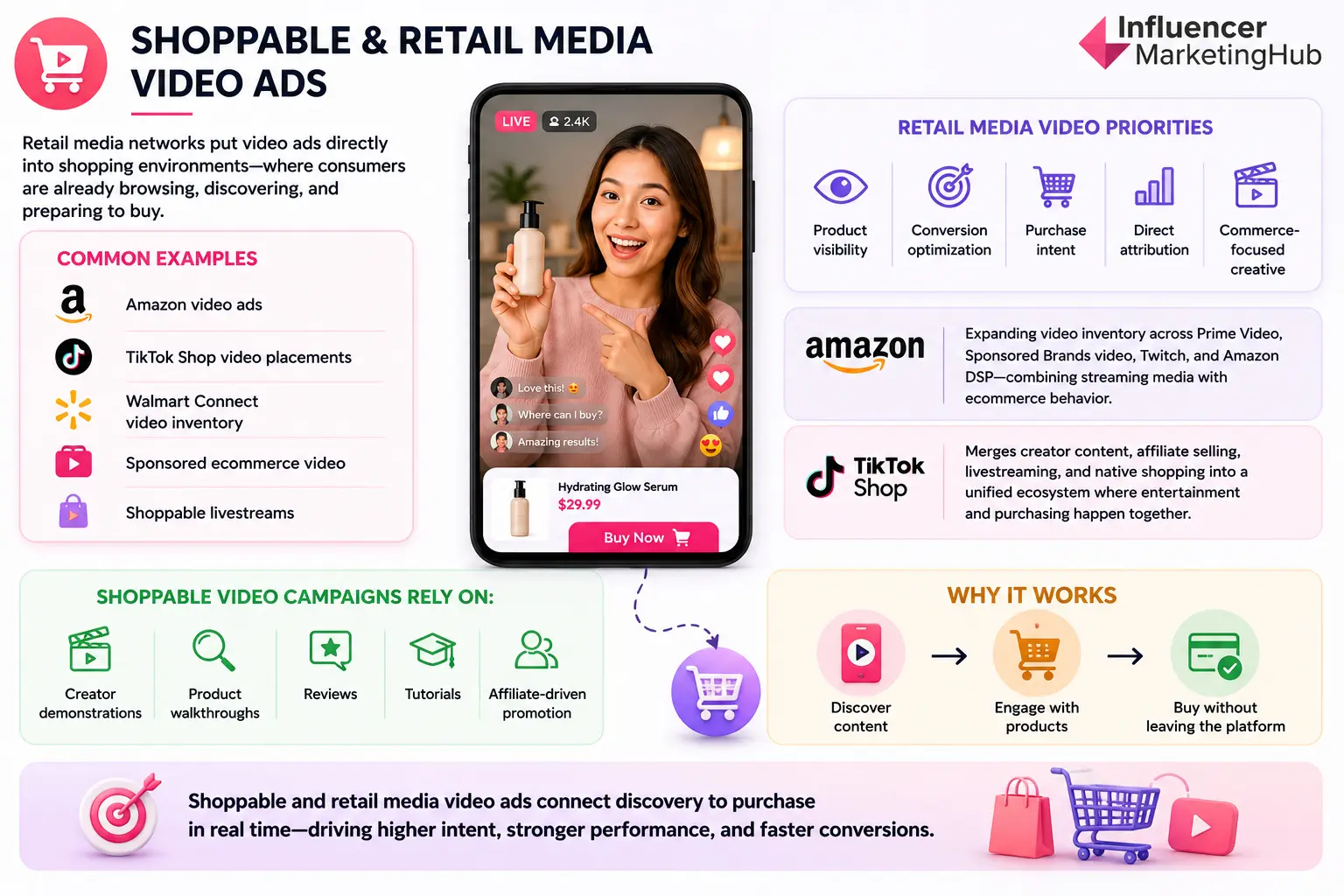
Retail media networks increasingly integrate video advertising directly into commerce environments where consumers are already browsing products or preparing purchases.
Common examples include Amazon video ads, TikTok Shop video placements, Walmart Connect video inventory, shoppable livestreams, and more.
Amazon, a particularly big player, continues expanding video inventory across Prime Video, Sponsored Brands video placements, Twitch, and Amazon DSP environments that combine streaming media with ecommerce behavior.
TikTok Shop pushed the format further by merging creator content, affiliate selling, livestreaming, and native shopping behavior into a unified commerce ecosystem where entertainment and purchasing often happen simultaneously.
Shoppable video campaigns usually rely on:
- Creator demonstrations
- Product walkthroughs
- Reviews
- Tutorials
- Affiliate-driven promotion
Those formats often perform well because viewers can move directly from content discovery to checkout inside the same platform environment.
How Video Advertising Campaigns Work
Most video advertising campaigns follow the same basic structure:
- Define the campaign goal
- Identify the audience
- Produce creative
- Distribute ads
- Optimize performance
- Measure results
The complexity comes from how differently those steps behave across platforms. Creative production, targeting logic, attribution, and optimization cycles all change depending on the platform and campaign objective.
Campaign Goals Usually Determine the Entire Strategy
Most video campaigns are built around 3 broad objectives:
|
Campaign Goal |
Typical Focus |
Common KPIs |
| Awareness | Reach and visibility | Impressions, reach, video completion |
| Consideration | Engagement and education | Watch time, CTR, site visits |
| Conversion | Sales or actions | CPA, ROAS, conversions |
Awareness campaigns usually prioritize reach and visibility across YouTube, streaming TV, or large-scale social distribution.
Conversion-focused campaigns typically rely more heavily on:
- Retargeting
- Creator ads
- Short-form video
- Ecommerce integrations
- Direct-response creative
Many brands now run multiple video campaign types simultaneously rather than relying on one funnel stage alone.
Audience Targeting Shapes Distribution
Targeting systems vary heavily between advertising platforms, but most video campaigns combine several audience layers together.
Common targeting inputs include audience demographics, purchase behavior, search intent, lookalike audiences, remarketing activity, and contextual signals, among others.
Retail media platforms often prioritize shopping behavior and purchase intent. YouTube combines search and viewing behavior. Social platforms rely more heavily on engagement patterns and algorithmic discovery systems.
Many advertisers also layer first-party data into campaigns. Advertisers use email lists, website traffic, purchase history, CRM audiences, and customer segments for better results.
That shift became more important as privacy restrictions reduced the effectiveness of older third-party tracking systems.
Creative Production Became Much Faster
Video advertising production cycles have shortened dramatically over the last few years, especially in short-form social environments.
Many brands no longer produce a handful of campaigns each quarter. Instead, they continuously test creative variations.
TikTok-style advertising accelerated this behavior because creative fatigue appears much faster in short-form feeds than in traditional video environments.
UGC pipelines, creator licensing, AI-assisted editing, and creator partnerships all expanded partly because brands needed faster ways to produce large volumes of ad creative.
Production teams increasingly operate alongside paid media teams rather than separately from them.
Retargeting Plays a Major Role in Video Advertising
Many video campaigns are designed to introduce products first and convert users later through sequential advertising.
A typical sequence might look like:
- Short-form discovery ad
- Product explainer video
- Testimonial or review content
- Retargeting conversion ad
Platforms like YouTube, Meta, TikTok, and retail media networks all support retargeting systems that reconnect with users based on signals like cart activity, app behavior, video engagement, site visits, product views, and more.
That structure allows advertisers to move users through longer buying journeys rather than expecting immediate conversions from a single impression.
Optimization Usually Happens Faster on Social Platforms
Campaign optimization speed varies significantly between environments.
Short-form social campaigns often require faster testing or aggressive creative refreshes to ensure optimal creatives. On the other hand, streaming TV and YouTube campaigns usually evolve more slowly because campaigns run at a larger scale, creative lifespan tends to last longer, or product costs are higher.
As such, optimization decisions usually focus on:
- Completion rates
- Watch time
- CTR
- CPA
- ROAS
- Audience retention
- Conversion efficiency
Performance marketers increasingly treat video campaigns as ongoing systems rather than fixed advertising launches.
Attribution Became One of the Hardest Parts of Video Advertising
Modern video campaigns often influence conversions indirectly rather than generating immediate clicks.
A user might watch a podcast ad or see a retargeting YouTube video. That fragmented behavior makes attribution much more difficult than older click-based advertising models.
Many advertisers, therefore, rely on blended measurement approaches that combine:
- Platform reporting
- Incrementality testing
- Branded search lift
- Post-view attribution
- Ecommerce attribution
- Cross-device analysis
Video advertising increasingly influences multiple stages of the customer journey at once, which means campaign measurement rarely fits neatly into last-click reporting models anymore.
How Much Does Video Advertising Cost?
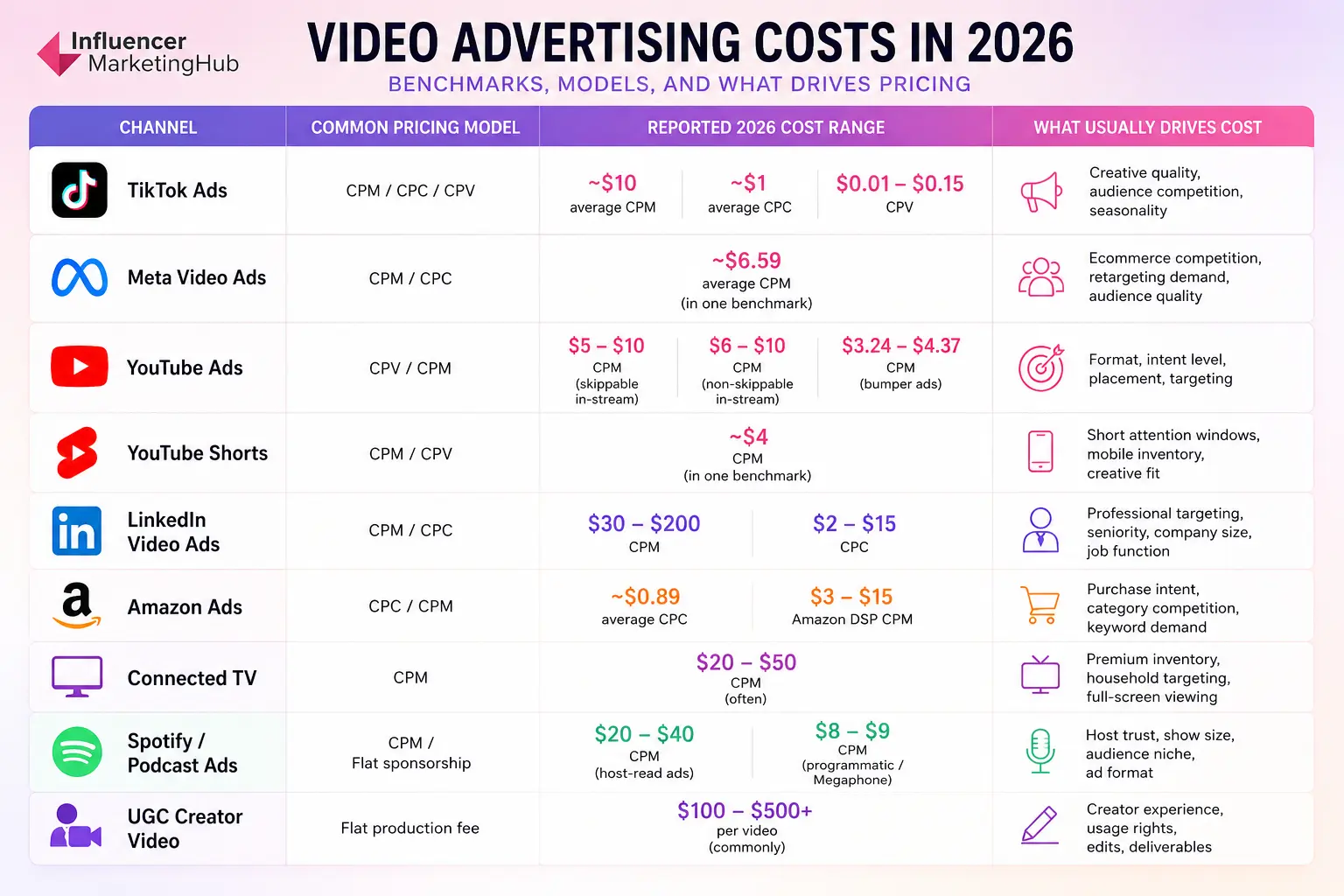
Video advertising costs can range from roughly $4 CPMs on YouTube Shorts to $20 to $50 CPMs on premium Connected TV inventory, while LinkedIn video campaigns can climb as high as $200 CPMs when advertisers target highly specific professional audiences.
TikTok campaigns currently average around $10 CPMs and roughly $1 CPC, whereas podcast sponsorships often sell around $20 to $40 CPMs because advertisers are paying for creator trust and long-form audience attention rather than pure reach alone.
These costs vary significantly and depend on anything from platform competition to targeting depth and inventory type.
Production costs also became a major part of the equation. Many brands now spend heavily on creators, editing, usage rights, and creative testing because short-form video environments require constant refreshes to sustain performance.
Social Video Advertising Costs
TikTok, Instagram Reels, Facebook video ads, Snapchat Spotlight, Pinterest video ads, and YouTube Shorts generally offer the lowest entry point for video advertising.
TikTok CPMs now average around $10 with CPCs averaging roughly $1, depending on targeting and campaign objective.
Meta video ads usually sit above TikTok on CPM, especially when advertisers are targeting ecommerce audiences, retargeting pools, or competitive U.S. markets. WebFX reports Facebook CPM around $7.47 and Instagram CPM between $6.25 and $7.68, while other benchmarks place Facebook closer to $11.76 and broader Meta CPMs around $10 to $15.
YouTube Shorts currently remains relatively inexpensive compared to many traditional video placements, with some benchmarks placing Shorts CPMs around $4.
The tradeoff is creative volume.
Short-form feeds move extremely quickly, which forces brands to produce far more creative content than they would for traditional YouTube or streaming TV campaigns. Many advertisers now operate creator pipelines and ongoing UGC production systems simply to maintain performance consistency in short-form environments.
YouTube and Long-Form Video Advertising Costs
YouTube pricing often depends less on reach and more on audience intent.
Advertisers targeting viewers researching software, financial products, enterprise services, or high-ticket consumer products usually pay more than brands running broad awareness campaigns because conversion potential is substantially higher.
- Skippable YouTube in-stream ads are around $5 to $10 CPM
- Non-skippable ads are around $6 to $10 CPM
- Bumper ads are between $3.24 and $4.37 CPM.
CPV pricing usually ranges between $0.01 and $0.30 per completed view.
YouTube also became increasingly television-oriented. Tinuiti reported that 67% of U.S. YouTube ad campaigns in late 2025 appeared on television screens, which pushed some inventory pricing closer to premium streaming environments.
LinkedIn Video Advertising Costs
LinkedIn sits in a completely different pricing category from most social video platforms because advertisers are paying for professional audience targeting rather than cheap scale.
LinkedIn video CPMs commonly range between $30 and $200 CPM, while CPCs often land between $2 and $15 per click.
These numbers generally depend on the job title targeting, company size, seniority level, and industry competition.
Those numbers are dramatically higher than TikTok or Meta, but many B2B advertisers still justify the cost because LinkedIn audiences frequently represent decision makers, enterprise buyers, and executive-level pros.
The platform is therefore optimized much more around lead quality than mass reach.
Amazon and Retail Media Video Advertising Costs
Retail media video campaigns behave differently from traditional social advertising because advertisers are often targeting users already close to making purchases.
Amazon benchmarks place average CPCs around $0.89, although competitive product categories frequently rise much higher. Amazon DSP campaigns generally range between $3 and $15 CPM.
Sponsored Brands video, Twitch inventory, Prime Video ads, and retail DSP campaigns all operate inside commerce-focused environments where conversion intent is much stronger than general awareness platforms.
That usually increases competition and bidding pressure.
Connected TV and Streaming Advertising Costs
Connected TV campaigns are now some of the most expensive forms of digital video advertising.
Streaming inventory across the most popular CTV and streaming apps commonly sits at around $20 and $50 CPM, with premium live sports and entertainment inventory climbing higher.
With these ad forms, advertisers are paying for full-screen viewing, lower ad saturation, and premium content environments.
CTV campaigns also tend to carry higher production expectations. Brands frequently invest more heavily in cinematic visuals, polished storytelling, and multiple ad-length variations than they would for creator-led social campaigns.
Spotify and Podcast Advertising Costs
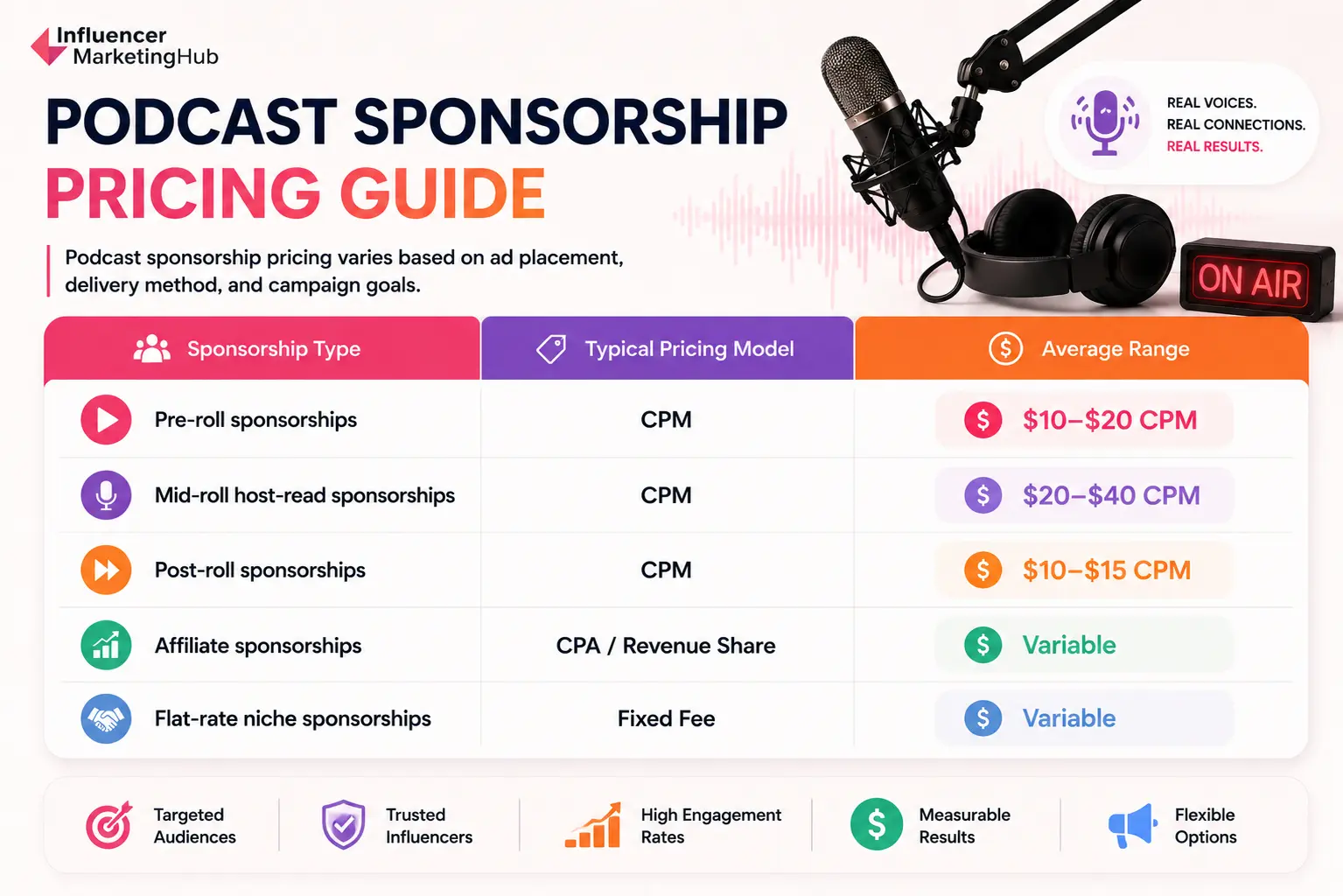
Spotify and podcast advertising use a very different pricing structure because audience trust often matters more than raw impression volume.
Host-read podcast ads commonly command $20 to $40 CPMs, while programmatic podcast inventory through Spotify’s Megaphone ecosystem has been reported closer to $8 to $9 CPM.
Smaller podcast sponsorships may also operate through flat-fee pricing rather than CPM-based buying.
Creator and UGC Production Costs
Production costs changed just as dramatically as media costs.
Many brands now rely on creators and UGC pipelines rather than traditional commercial production because short-form advertising requires continuous creative refreshes.
UGC creators commonly charge $100 to $500+ per video, although pricing increases significantly once brands add paid usage rights, Spark Ads, whitelisting, exclusivity, and more.
So, for example, a creator video that costs $250 to produce can become substantially more expensive once advertisers want to amplify it across TikTok, Instagram Reels, YouTube Shorts, and paid social campaigns simultaneously.
Traditional commercial production still exists, but many modern video campaigns now operate more like ongoing content systems than large one-time advertising shoots.
How Video Advertising Is Measured
Measuring video advertising became much more complicated once campaigns started running across TikTok, YouTube, streaming TV, retail media networks, podcasts, and creator ecosystems simultaneously.
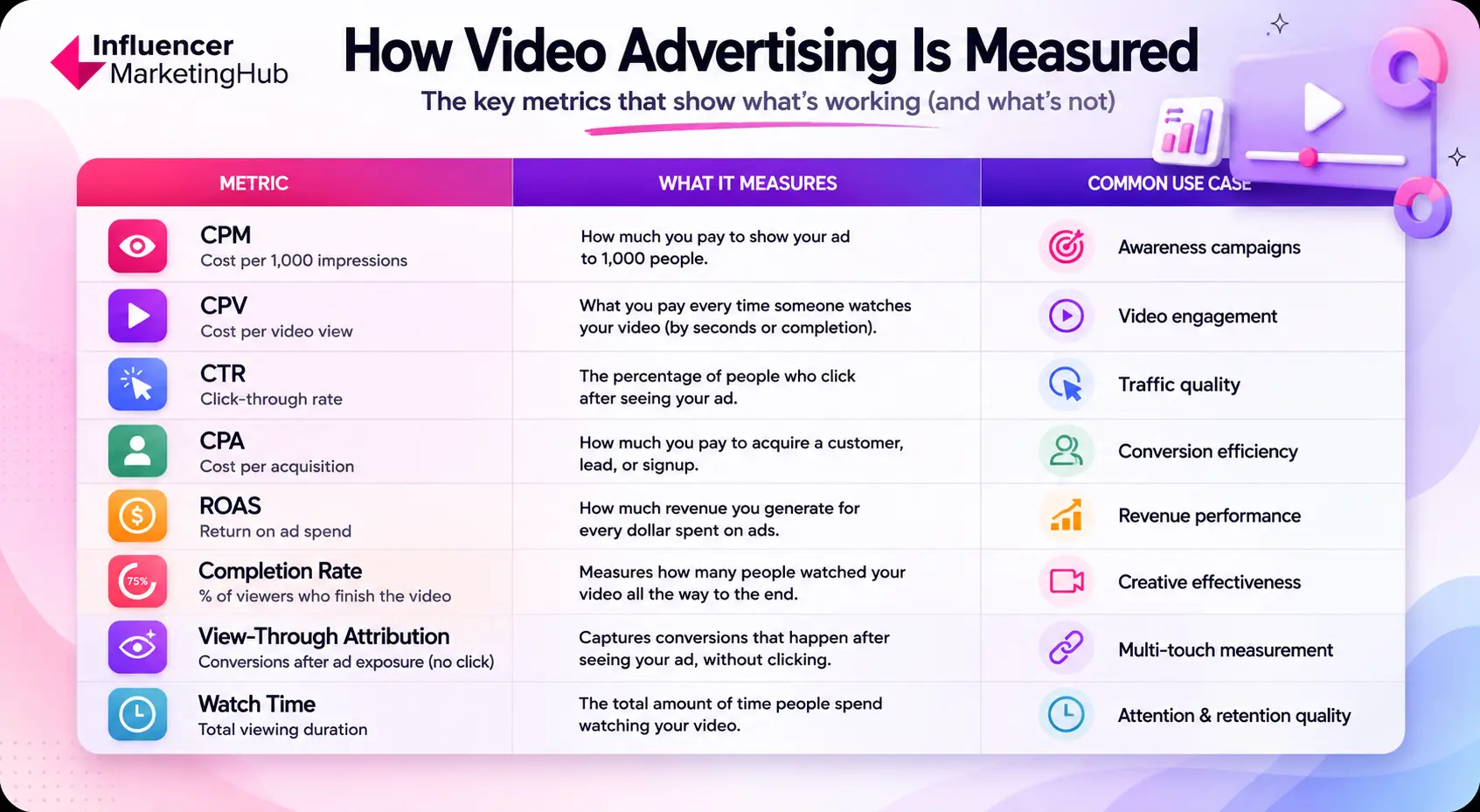
Most advertisers, therefore, no longer rely on one metric alone. Campaign measurement usually changes depending on the platform, the objective, or the conversion type.
Awareness Campaigns Usually Focus on Attention Metrics
Awareness campaigns are typically measured around visibility and attention rather than direct purchases.
Common awareness campaign metrics include:
- impressions
- CPM
- reach
- watch time
- video completion rate
- engagement rate
Completion rates became especially important because they help advertisers understand whether viewers actually stayed long enough to absorb the message.
According to Umbrex benchmark data, average video completion rates often land at around 30% to 60%. Shorter videos generally produce much higher completion rates than long-form ads, especially inside mobile-first environments.
Watch time also became a major signal on platforms like YouTube, TikTok, and Instagram Reels because platform algorithms increasingly prioritize content that retains viewer attention longer.
Conversion Campaigns Prioritize CPA and ROAS
Performance-focused campaigns usually shift attention toward:
- CPA
- ROAS
- conversion rate
- add-to-cart activity
- purchase volume
- customer acquisition efficiency
Ecommerce advertisers often optimize video campaigns directly around actions such as purchases, subscription signups, app installs, lead generation, and checkout behavior.
Calculate and Compare Video Advertising CPA
Use inBeat’s CPA Calculator to calculate total campaign cost, acquisitions, or cost per acquisition. Fill in any two fields, and the calculator will automatically generate the third value.
Switch to advanced mode to compare multiple video campaigns and identify which platform, format, or creative approach generates customers at the lowest cost.
TikTok Shop accelerated this shift because advertisers can now connect creator content, affiliate promotion, livestreaming, and native checkout inside the same platform environment.
Meta, Google, Amazon Ads, and TikTok all expanded conversion reporting significantly over the last few years because advertisers increasingly expect direct attribution visibility rather than awareness-only reporting.
ROAS became especially important in retail media and ecommerce campaigns because advertisers want to measure how much revenue campaigns generate relative to ad spend.
Calculate Your Video Advertising ROAS
Use inBeat’s ROAS Calculator to measure the revenue generated by your video advertising spend. Enter any two values, including campaign revenue, advertising cost, and ROAS, to calculate the third automatically.
Use the results to compare campaigns across platforms and determine where your video advertising budget produces the strongest financial return.
Attribution Became Much More Difficult
Video advertising rarely follows a clean conversion path anymore. Nowadays, video advertising follows a fragmented behavior that starts through a TikTok creator video, continues with a YouTube review, and ends with a purchase a few days later through a different device.
To cope with the attribution challenges, platforms have introduced:
- view-through attribution
- post-view conversions
- assisted conversions
- cross-device reporting
- incrementality testing
to help advertisers measure influence beyond direct clicks.
Connected TV and podcast advertising are especially difficult to track because viewers often consume ads passively through televisions, streaming sessions, or long-form audio experiences without clicking immediately afterward.
Why Last-Click Attribution Often Undervalues Video
Many video campaigns influence purchasing behavior without generating immediate conversions. That is one reason marketers increasingly criticize last-click attribution models.
Last-click reporting often credits the final interaction while ignoring earlier video exposure that influenced the buying decision.
That issue became especially important for:
- Connected TV
- YouTube
- podcasts
- creator sponsorships
- upper-funnel social campaigns
Those formats frequently shape awareness and consideration long before conversion happens.
According to Google research, video campaigns measured through broader attribution models often show stronger conversion influence than last-click reporting alone suggests.
Retail Media and Platform Analytics Changed Measurement
Retail media platforms introduced much stronger closed-loop attribution systems because purchases often happen inside the same ecosystem where ads appear.
Amazon Ads, TikTok Shop, Walmart Connect, and other commerce-focused platforms increasingly integrate ad exposure, product views, add-to-cart behavior, purchases, and repeat-buying activity into a single reporting environment.
That level of visibility became especially valuable for ecommerce advertisers because it gives much clearer purchase attribution than many traditional awareness channels.
TikTok Shop also pushed attribution closer to real-time commerce by merging creator content, affiliate links, livestream shopping, and native checkout into a single platform.
Many advertisers now combine platform reporting with:
- incrementality testing
- branded search lift
- media mix modeling
- post-purchase surveys
- cross-device attribution tools
to understand how video influences the broader customer journey.
Video Advertising Is Becoming the Core of Digital Advertising
Video advertising no longer operates as a separate marketing channel sitting alongside social media, ecommerce, streaming, and creator marketing. Those systems increasingly overlap.
A TikTok creator campaign can drive TikTok Shop purchases, trigger branded searches on YouTube, influence Amazon conversions, and later reappear through Connected TV retargeting or Spotify podcast sponsorships. Video now shapes multiple stages of the customer journey simultaneously.
That shift also changed how brands approach production, targeting, attribution, and budgeting. Modern campaigns rely less on one polished commercial and more on continuous creative testing, creator partnerships, platform-native formats, and data-driven optimization.
As streaming, retail media, AI-assisted production, and creator-led advertising continue expanding, video advertising is becoming one of the most operationally important systems inside modern digital marketing.
Frequently Asked Questions
What is video advertising?
Video advertising refers to promotional video content distributed across digital platforms like YouTube, TikTok, Instagram, streaming TV services, Spotify, websites, and retail media networks to drive awareness, engagement, or conversions.
How much does video advertising cost?
Video advertising costs vary widely depending on platform and targeting. TikTok campaigns may average around $10 CPMs, while Connected TV campaigns often range between $20 and $50 CPMs.
What are the main types of video advertising?
Common video advertising formats include:
- in-stream ads
- short-form social video ads
- Connected TV ads
- outstream video ads
- native video ads
- podcast video sponsorships
- retail media video ads
What platforms are best for video advertising?
The best platform depends on campaign goals. TikTok and Instagram Reels work well for discovery and creator-led campaigns, YouTube supports long-form education and search intent, while Connected TV helps brands reach large streaming audiences.
What is programmatic video advertising?
Programmatic video advertising uses automated systems and real-time bidding technology to buy and place video ads across websites, streaming platforms, apps, and digital media inventory.
How are video advertising campaigns measured?
Video advertising campaigns are commonly measured using:
- CPM
- CPV
- CTR
- CPA
- ROAS
- watch time
- completion rate
- view-through attribution
What is the difference between YouTube ads and YouTube Shorts ads?
YouTube ads often support longer-form viewing and search intent, while YouTube Shorts ads are optimized for vertical short-form discovery inside swipe-based mobile feeds.
Why are creator-led video ads becoming more popular?
Creator-led ads often feel more native to social platforms than traditional commercials. Many brands use creators because short-form audiences respond better to authentic, platform-native video styles.