Audio advertising has changed dramatically over the past decade.
Radio remains part of the landscape, but today's marketers have access to a much broader ecosystem that includes streaming audio ads, podcast advertising, programmatic audio ads, and digital audio advertising across platforms such as Spotify, SiriusXM, and iHeartRadio.
The shift is happening because audiences are spending more time listening. According to Edison Research, 79% of Americans age 12+ listen to podcasts monthly, while streaming audio consumption continues to grow across music, podcasts, and connected devices.
Growth has created new opportunities for advertisers. Modern audio ads can be targeted based on demographics, interests, listening behavior, location, and even real-time context. Spotify's Advertising platform allows brands to reach listeners during workouts, commutes, study sessions, and other moments when visual advertising may be competing for less attention.
Creative execution has evolved as well.
Many of the best audio ads are no longer simple radio spots. Brands now combine storytelling, sonic branding, host-read endorsements, dynamic creative, and audience targeting to create campaigns that are memorable and measurable.
The examples in this guide showcase some of the most effective audio advertising campaigns in recent memory. Each example breaks down the challenge, the strategy behind the campaign, and the results that followed, giving marketers practical insights they can apply to their own digital audio advertising efforts.
- What Makes an Audio Advertisement Effective?
- 1. Spotify
- 2. McDonald's "I'm Lovin' It" Sonic Branding Campaign
- 3. Renault's Multi-Format Spotify Campaign for the Austral
- 4. Issuu's Audience-Based Podcast Advertising Campaign
- 5. Estée Lauder's Interactive Spotify Voice Ad Campaign
- 6. TWO MEN AND A TRUCK's Audience-Targeted Podcast Advertising Campaign
- Lessons Marketers Can Learn From These Audio Advertising Examples
- Great Audio Ads Do More Than Fill Silence
- Frequently Asked Questions
What Makes an Audio Advertisement Effective?
Audio advertising operates under a different set of rules than display, social, or video advertising.
Listeners cannot see a product, read a headline, or click a visual call-to-action. Every impression depends on sound, making creative execution especially important.
The strongest audio ads tend to share a few of these characteristics.
Clear brand identification often appears early in the advertisement rather than waiting until the final seconds. Marketers have only a limited window to capture attention, particularly on streaming platforms where listeners may be multitasking.
Many successful campaigns also use distinctive audio assets. McDonald's "I'm Lovin' It" jingle is one of the most recognizable examples. Still, sonic branding can be as simple as a recurring sound, voice, phrase, or musical cue that helps audiences associate the message with a specific brand.
Relevance matters just as much as creativity.
Modern digital audio advertising platforms allow advertisers to target listeners based on demographics, interests, device type, location, and listening behavior. A well-targeted message often outperforms a more elaborate creative concept delivered to the wrong audience.
The best streaming audio ads also respect the listening experience. Successful advertisers understand the context in which people are listening, whether they're exercising, commuting, working, or relaxing. Creative that feels natural within that environment is more likely to resonate than advertising that interrupts the experience.
Results from the campaigns in this guide show another common theme: simplicity.
Most memorable audio ads focus on a single message, a clear objective, and a straightforward call-to-action rather than trying to communicate multiple ideas at once.
Those principles appear repeatedly across the examples below, regardless of whether the campaign was delivered through Spotify audio ads, podcast sponsorships, traditional radio, or programmatic audio advertising platforms.
1. Spotify
Audio advertising works best when brands find a way to make listeners participate rather than simply listen. Burger King’s Mystery Burger campaign is a great example of that approach.
Instead of using Spotify audio ads as a standalone awareness channel, the company turned music preferences into part of the customer experience.
The Challenge
Burger King France was preparing to launch its Mystery Burger, a limited-time menu item designed to generate curiosity and conversation.
Read More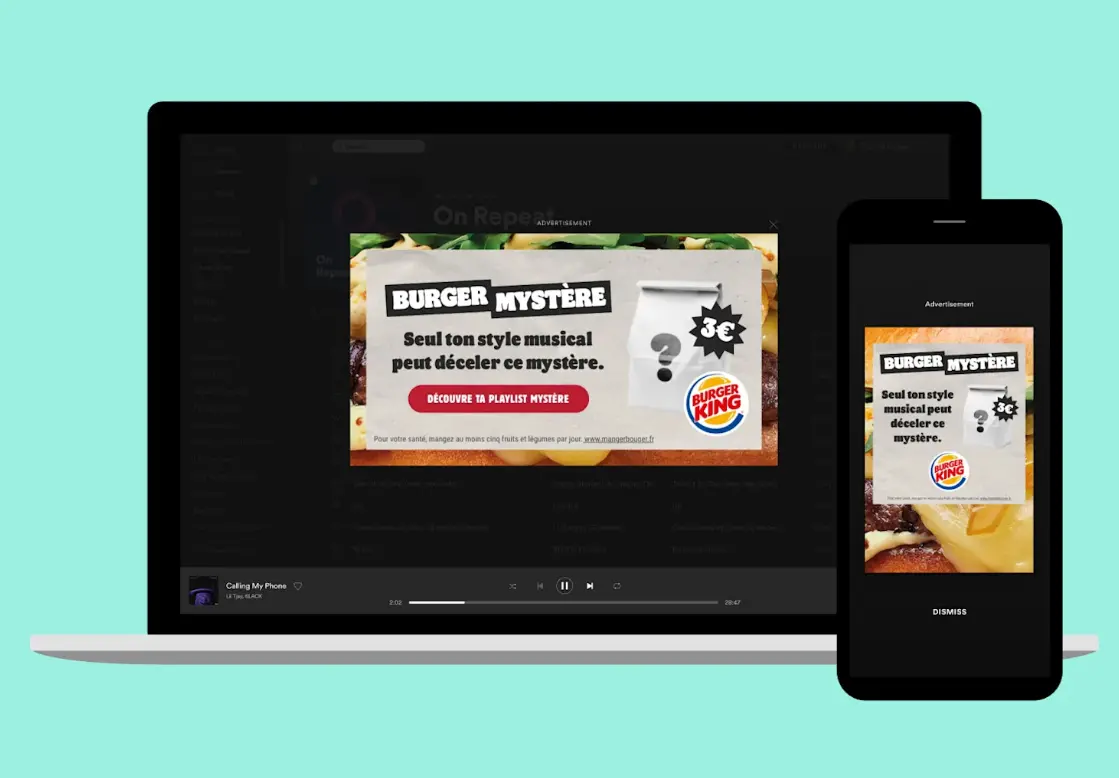

2. McDonald's "I'm Lovin' It" Sonic Branding Campaign
Few audio ads have achieved the level of recognition earned by McDonald’s “I’m Lovin’ It” campaign. More than 20 years after its launch, the five-note sonic logo remains one of the most recognizable brand sounds in advertising.
McDonald’s built an audio asset that became a long-term part of its global brand identity.
The Challenge
In the early 2000s, McDonald’s was looking to modernize its image and create a more consistent brand identity across international markets.
The company operated in dozens of countries, each with different advertising approaches and creative executions. Maintaining brand consistency at that scale was challenging, particularly across television, radio, and emerging digital channels.
Read More3. Renault's Multi-Format Spotify Campaign for the Austral
The campaign is a useful example for marketers because it shows how streaming audio ads can complement television, online video, podcasts, and display advertising rather than compete against them.
The Challenge
Renault wanted to build awareness for the Renault Austral among consumers interested in technology, travel, entertainment, wellness, and finance.
The company was already investing across multiple media channels, including television and online video. The challenge was determining whether Spotify could expand campaign reach beyond audiences already being exposed to those channels.
Renault also wanted a clearer understanding of audio advertising’s contribution within a broader media mix.
The Strategy
Renault partnered with Spotify and measurement provider FLUZO to evaluate the impact of digital audio advertising alongside other media channels.
Read More4. Issuu's Audience-Based Podcast Advertising Campaign
Instead of purchasing placements on individual podcasts, the content publishing platform used Spotify’s audience-based podcast advertising capabilities to reach professionals across multiple shows. The campaign demonstrates how B2B brands can use digital audio advertising to scale awareness without relying on direct relationships with podcast hosts.
The Challenge
Issuu helps marketers, designers, educators, real estate professionals, and other creators publish and distribute content across digital channels.
The company had already invested in podcast advertising, primarily through direct podcast buys. While that approach helped build authentic connections with listeners, it limited scale and required negotiating with individual shows.
Issuu wanted to expand awareness among professional content creators while reaching a larger audience more efficiently.
Read More5. Estée Lauder's Interactive Spotify Voice Ad Campaign
The campaign is notable because it demonstrated how streaming audio ads could move beyond awareness and become an interactive customer acquisition channel.
The Challenge
Estée Lauder was promoting its Advanced Night Repair serum and wanted to introduce the product to new consumers in a highly competitive beauty category.
Product sampling has long been an important part of beauty marketing. Consumers are often more likely to purchase skincare products after trying them first. Traditional sampling programs, however, can be expensive and difficult to scale.
The company needed a way to connect product discovery with a measurable action while reaching consumers through digital channels.
The Strategy
Estée Lauder partnered with Spotify to launch an interactive voice-enabled advertising experience.
Read More6. TWO MEN AND A TRUCK's Audience-Targeted Podcast Advertising Campaign
The campaign demonstrates how podcast advertising can support performance-focused objectives while still benefiting from the engagement that makes audio such a powerful medium.
The Challenge
TWO MEN AND A TRUCK operates in hundreds of locations across North America, making local relevance an important part of its marketing strategy.
The company wanted to increase awareness among consumers who were actively considering a move while maintaining efficiency across multiple markets. Traditional podcast sponsorships can be effective, but scaling them nationally often requires managing relationships with numerous shows and hosts.
The marketing team needed a way to reach potential customers across a broad range of podcast content while maintaining audience precision.
Read MoreLessons Marketers Can Learn From These Audio Advertising Examples
Looking across these campaigns, several clear patterns emerge. Some brands focused on personalization, others invested in sonic branding, and several used audience targeting to improve efficiency.
Despite their differences, the most successful campaigns shared a common goal: creating memorable listening experiences that aligned with specific business objectives.
Personalization Makes Audio Ads More Relevant
Burger King's Mystery Burger campaign stands out because it transformed audio advertising into a personalized experience.
Rather than delivering the same message to every listener, the campaign used Spotify listening habits to create individualized recommendations. The result was a campaign that felt more relevant and engaging than a standard product promotion.
Modern streaming audio ads offer marketers far more targeting capabilities than traditional radio ever could. Audience data, listening behavior, demographics, and contextual signals can all help advertisers deliver more relevant messages.
Personalization alone won't guarantee success, but the examples in this guide show that relevance often drives stronger engagement than broad messaging.
Audio Advertising Can Support More Than Brand Awareness
Many marketers still view audio advertising as an upper-funnel channel.
Several campaigns challenge that assumption.
Estée Lauder used interactive audio to encourage listeners to request product samples. TWO MEN AND A TRUCK focused on reaching consumers likely to need moving services. Both campaigns connected audio exposure to measurable customer actions rather than relying exclusively on awareness metrics.
Digital audio advertising can support awareness, consideration, engagement, and even customer acquisition when campaigns are designed with those goals in mind.
Strong Audio Branding Creates Long-Term Value
McDonald's demonstrates what can happen when brands consistently invest in recognizable audio assets.
The company's "I'm Lovin' It" sonic signature has remained in use for more than two decades. Many consumers can identify the brand from only a few notes.
Visual branding often receives the majority of marketing attention, yet audio branding can be equally valuable. A recognizable sound, voice, tagline, or musical cue can help brands stand out across podcasts, streaming platforms, radio, video, and connected devices.
Few companies achieve the level of recognition earned by McDonald's, but the principle remains relevant for brands of all sizes.
Audience-Based Buying Is Changing Podcast Advertising
Podcast advertising has traditionally revolved around selecting individual shows and partnering directly with creators.
Issuu and TWO MEN AND A TRUCK took a different approach.
Both campaigns relied on audience-based targeting through Spotify Audience Network, allowing them to reach listeners across multiple podcasts without purchasing sponsorships from individual shows.
The shift mirrors broader changes happening across digital advertising. Marketers increasingly focus on reaching specific audiences rather than buying placements in specific environments.
Podcast sponsorships remain highly effective, particularly when host trust and authenticity matter. Audience-based buying, however, provides an additional option for brands prioritizing scale and efficiency.
Audio Works Best as Part of a Broader Media Strategy
Renault's campaign highlights another important lesson.
The company didn't treat audio advertising as a standalone channel. Instead, Spotify audio ads, podcasts, video, display placements, and sponsored playlists worked together as part of a larger campaign.
Many marketers face pressure to evaluate channels individually. Consumer attention rarely works that way. People move between devices, platforms, and content formats throughout the day.
Audio advertising often performs best when integrated with other marketing activities rather than operating in isolation.
The strongest campaigns in this guide weren't successful because they used audio. They succeeded because they used audio strategically, aligning the format with a clear audience, objective, and creative approach.
Great Audio Ads Do More Than Fill Silence
The best audio ads are memorable because they align creative execution with a clear marketing objective.
Different strategies produced different outcomes, but a common theme emerged across every campaign: successful audio advertising starts with understanding the audience and delivering the right message in the right listening environment.
As streaming audio ads, podcast advertising, and programmatic audio continue to grow, marketers who treat audio as a strategic channel rather than an afterthought will be better positioned to capture attention and drive results.
Frequently Asked Questions
What are audio ads?
Audio ads are advertisements delivered through audio-focused channels such as streaming music platforms, podcasts, digital radio, and traditional radio. Common formats include streaming audio ads, podcast ads, and programmatic audio advertising.
Are audio ads effective?
Audio ads can be highly effective when paired with strong creative and audience targeting. Many advertisers use audio advertising to increase brand awareness, improve ad recall, drive consideration, and support customer acquisition campaigns.
What is the difference between audio advertising and digital audio advertising?
Audio advertising is the broader category that includes both traditional radio and digital channels. Digital audio advertising specifically refers to ads delivered through internet-connected platforms such as Spotify, Pandora, podcasts, and streaming radio services.
How do Spotify audio ads work?
Spotify audio ads are delivered between songs and podcast content. Advertisers can target audiences using factors such as age, gender, location, interests, listening behavior, and device type through Spotify Ads Manager.
What is Spotify Ads Manager?
Spotify Ads Manager is Spotify's self-service advertising platform. It allows marketers to create, launch, manage, and measure audio and video advertising campaigns across Spotify's music and podcast inventory.
What are programmatic audio ads?
Programmatic audio ads are bought and sold automatically through advertising technology platforms. Advertisers can use audience data and real-time bidding to deliver audio ads across streaming services, podcasts, and digital radio inventory.
How long should an audio ad be?
Most digital audio ads range from 15 to 30 seconds. Some podcast ads and host-read sponsorships may be longer depending on the campaign objective and content format.
What makes a good audio advertisement?
Strong audio ads typically include a clear message, early brand identification, a compelling voice or sound design, audience relevance, and a simple call-to-action. Many successful campaigns also use sonic branding to improve recognition and recall.