
Influencer marketing is moving toward automation, but execution still depends heavily on manual workflows. Teams spend hours sourcing creators, writing outreach, managing approvals, and compiling performance reports. Even with dedicated platforms, most campaigns rely on fragmented tools that require constant human input.
At the same time, AI adoption within influencer marketing is accelerating. Data from our 2026 Benchmark Report shows that 36.67% of marketers already use AI for creator discovery, while 21.11% apply it to content generation and 13.89% to brief development. These numbers signal that AI is beginning to run campaigns.
AI agents represent the next phase of this evolution. Instead of assisting with individual tasks, they operate as autonomous systems that can execute entire workflows across the campaign lifecycle.
From identifying the right creators to optimizing performance mid-campaign, AI agents reduce the need for manual coordination and allow teams to scale without adding headcount.
For brands, agencies, and marketers under pressure to deliver more campaigns with tighter budgets, this shift is not theoretical.
It directly impacts speed, efficiency, and ROI. The tools covered in this guide reflect that transition. Rather than listing generic AI software, the focus is on platforms and systems that function as true AI agents within influencer marketing.
- What Are AI Agents in Influencer Marketing?
- Why Brands Are Adopting AI Agents for Influencer Marketing
- Best AI Agents for Influencer Marketing
- 1. Kuli
- 2. Creator.co
- 3. Upfluence
- 4. AhaCreator
- 5. Passionfroot
- 6. Stormy AI
- AI Agents vs Influencer Marketing Platforms
- How to Choose the Right AI Agent for Influencer Marketing
- AI Agents Are Reshaping Influencer Marketing
- Frequently Asked Questions
What Are AI Agents in Influencer Marketing?
AI agents in influencer marketing are systems designed to execute tasks independently across a campaign workflow. Unlike AI platforms or tools that require users to input queries, analyze results, and take action manually, AI agents can interpret goals, make decisions, and carry out actions with minimal intervention.
The distinction becomes even clearer when comparing them to standard influencer marketing platforms.
Most platforms act as centralized dashboards. They provide access to creator databases, analytics, and campaign management features, but the responsibility for execution still sits with the user.
AI agents shift that responsibility by handling parts of the workflow autonomously.
From Tools to Autonomous Systems
Traditional influencer marketing tools are built around user-driven actions. A marketer searches through 100+ creators, applies filters, reviews profiles, sends outreach, and tracks performance. Each step requires manual input and decision-making from the user.
AI agents introduce a different model. Instead of guiding the platform, the marketer defines an objective, such as finding fitness creators for a campaign targeting marathon runners. The agent then executes the process by identifying relevant creators, analyzing their content, prioritizing the best fits, and even initiating outreach.
This transition reduces operational friction and allows teams to focus on strategy rather than execution.
Core Capabilities of AI Agents:
AI agents in influencer marketing typically operate across several key areas:
- Creator discovery using advanced data analysis, including content, audience signals, and historical performance
- Automated outreach that adapts messaging based on creator profiles and campaign goals
- Brief generation that translates campaign objectives into structured deliverables
- Campaign coordination, including follow-ups, approvals, and timelines
- Performance tracking with real-time insights and optimization recommendations
The defining characteristic is not the presence of AI features, but the ability to connect these functions into a continuous workflow.
Where AI Agents Fit in the Campaign Lifecycle?
AI agents extend across the entire influencer marketing process.
- During the pre-campaign phase, they accelerate research by identifying creators that align with brand positioning and audience targeting. Instead of relying on surface-level metrics, they analyze content themes, tone, and engagement patterns.
- During campaign execution, they reduce communication overhead by managing outreach, tracking responses, and coordinating deliverables. This is particularly valuable for campaigns involving dozens or hundreds of creators.
- After campaigns conclude, AI agents consolidate performance data and identify patterns that inform future strategy. Rather than producing static reports, they surface actionable insights that can improve subsequent campaigns.
As adoption increases, the role of AI agents is expanding from task automation to full campaign orchestration.
Why Brands Are Adopting AI Agents for Influencer Marketing
So why are brands adoping AI agents? Apart from the obvious automation benefits, AI agents serve a very clear purpose: they allow brands to scale their influencer marketing.
Imagine you're a brand running dozens of campaigns and managing hundreds of creators. Now also imagine that every campaign needs a brief, every creator requires researching, and on top of all, you need to measure and report.
AI agents are used to automate these tasks. But not only that, they allow you to run multiple actions simultaniously.
In traditional influencer marketing, you'd need marketers, researchers, and strategists to run these tasks. With AI agents involved, you leave most of the menial work to these systems and reserve your employees for specialized tasks, like brand/creator communication or strategy development.
While we've simplified the reasons, let's expand more into why exactly brands are adoping agentic platforms or AI agents in influencer marketing.
Scaling Without Increasing Headcount
Most influencer marketing programs are still managed internally, with our 2026 Benchmark Report data showing that 66.3% of teams run campaigns in-house. As campaign volume grows, internal teams quickly reach capacity limits. Moreover, 72% of brands expect to increase influencer budgets by 50% or more.
AI agents reduce the operational burden by automating repetitive tasks such as creator vetting, shortlist building, outreach sequencing, and follow-ups. What previously required hours of manual coordination can now be handled continuously in the background.
This allows brands to scale campaign output without proportionally increasing headcount, which is one of the primary drivers behind adoption.
Faster Campaign Execution
Traditional influencer campaigns follow a step-by-step process. Discovery leads to outreach, which leads to negotiation, then content production, approvals, and reporting. Each stage introduces delays, particularly when managed across multiple tools and communication channels.
AI agents compress this timeline by running processes in parallel. Creator identification, outreach, and qualification can happen simultaneously, reducing the time required to launch campaigns.
We're not making these claims in vain. Data from our 2026 Benchmark Report found that AI adoption is close to the standard, as only 10.56% of marketers do not use AI in any capacity within their influencer marketing toolstack.
Utility directly impacts speed, which directly impacts performance. Faster execution allows brands to act on trends, test more content variations, and iterate campaigns more frequently. This can only be possible if you automate parts of the process.
Improved Decision-Making
Should you really trust AI to make decisions for you? Not if you're using it wrong.
Traditionally, influencer campaigns relied on surface-level metrics such as follower count and engagement rate. For example, you see how many followers a creator has or what's their average engagement rate and decide whether to work with them.
However, these signals provide limited insight into their actual performance.
AI agents analyze deeper data points, including content themes, audience composition, and historical results. This enables more accurate creator selection and reduces reliance on manual judgment.
As a result, brands can make more consistent, data-backed decisions across campaigns, improving overall effectiveness.
The Golden Rule of Creator Selection
Engagement rate will always beat a creators' follower count. But deeper insights into past performance, content formats and themes, and audience data is the industry standard.
Cost Efficiency and ROI Pressure
Influencer marketing budgets continue to increase, with 87.49% of marketers expecting higher investment levels. At the same time, expectations around ROI are tightening.
AI agents help address this pressure by improving efficiency at multiple levels. Better creator selection reduces wasted spend. Automated workflows lower operational costs. Real-time performance monitoring enables adjustments before budgets are fully allocated.
For brands, the ability to improve outcomes without increasing spend is a key reason AI agents are becoming part of the influencer marketing stack.
As campaign demands continue to grow, manual execution becomes a limiting factor. AI agents provide a scalable alternative, enabling brands to run more efficient, data-driven influencer marketing programs without adding complexity.
Best AI Agents for Influencer Marketing
Not every influencer marketing tool is an AI agent. While many platforms offer AI features, only a few can independently execute workflows across discovery, outreach, and campaign management.
The tools below are selected based on how effectively they automate real campaign tasks. Some operate as true AI agents, while others are evolving toward more autonomous systems.
1. Kuli
Best for: Mid-market to Enterprise Consumer brand
Pricing: Upon request
Core Strength: AI-powered content analysis and brand-fit creator discovery
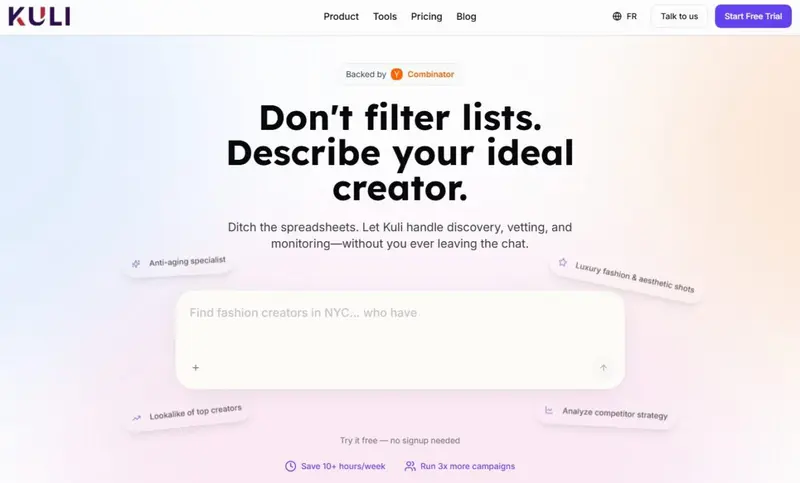
Kuli is an influencer marketing platform with its own AI agent designed to help you discover, vet, and monitor creators across Instagram and TikTok. Unlike traditional AI-powered platforms, Kuli differentiates itself by actually analyzing video content.
How does this work? Well, the Kuli AI watches creator videos frame by frame and evaluates visual tones and styles. It all starts with a simple prompt or natural language query. You tell the AI what you need, and the agent begins its analysis.
Read More
Key Features: Influencer Search & Discovery, Influencer Discovery, Campaign Reporting, Influencer Analysis, Competitor Research, Influencer Campaign Monitoring, Brand Safety, AI Agent, Creator Intelligence, Creator Outreach, Creator Tracking, Comment Analysis, Video Intelligence, Format Analysis, Brief Preparation, Ecommerce Integration, Trend Analysis,
Channels: Instagram, TikTok, YouTube
2. Creator.co
Best for: Brands and Agencies of all sizes
Pricing: From $460 per month
Core Strength: End-to-end campaign automation with AI-powered outreach and workflow management
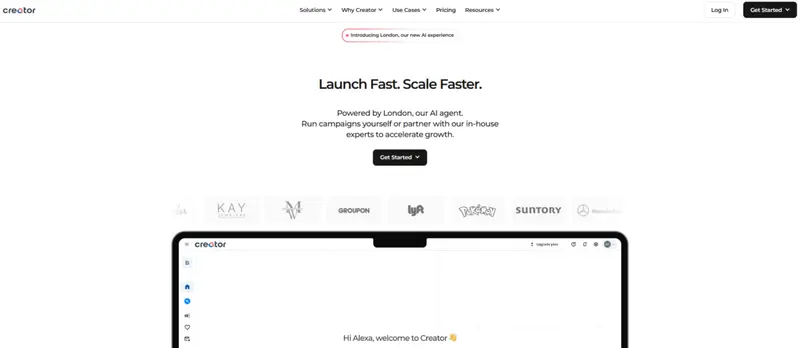
Creator.co is an influencer marketing platform with its own AI agent, London, designed to help you find creators, automate outreach, and manage campaigns from start to finish.
Unlike traditional platforms that focus primarily on discovery or analytics, Creator.co positions its AI agent as a system that can handle execution across the entire campaign lifecycle.
Read More
Key Features: Search/Discovery, Automated Recruiting, Influencer Relationship Management, Influencer Marketplace, Content Review, Content Library, Campaign Management, Campaign Reporting, Influencer Analysis, Audience Analysis, E-commerce Tools, Product/Gifting Tools, Fake Follower/Fraud Detection, Payment Processing, Social Listening, Competitor Research, Creator Marketplace,
Channels: Instagram, YouTube, TikTok
3. Upfluence
Best for: E-commerce businesses of all sizes
Pricing: From $478 per month
Core Strength: AI-powered campaign creation and creator matching built on first-party influencer data
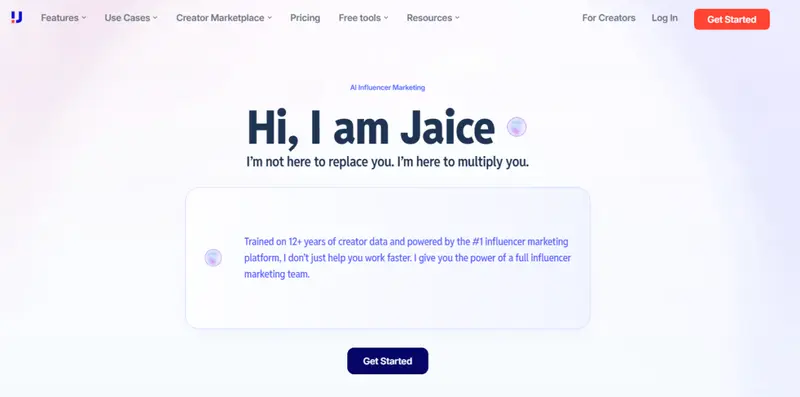
Jaice is the AI agent built into Upfluence, designed to help you find creators, build campaigns, and manage influencer programs from a single system. Unlike standalone AI tools, Jaice is embedded within an established influencer marketing platform, allowing it to operate across discovery, planning, and execution using real campaign data.
Jaice positions its AI agent as a system that can turn ideas into structured influencer programs. It is trained on over a decade of creator data, giving it the ability to evaluate performance signals, audience alignment, and campaign outcomes at scale.
Read More
Key Features: Influencer Search & Discovery, Relationship Management, Campaign Management, Third Party Analytics, Automated Recruiting, Influencer Lifecycle Management, Team Collaboration Tools, Content Review, Campaign Reporting, Audience Analysis, E-commerce Tools, Product/Gifting Tools, Payment Processing, Social Listening, Affiliate Management, Affiliate Campaigns,
Channels: Instagram, Youtube, Facebook, Twitch, Tiktok, Twitter, Pinterest, Blogs
4. AhaCreator
Best for: Mid-market to Enterprise Consumer brand
Pricing: No subscription fees, pay per campaign with a 10% AI agent fee. Minimum campaign cost is $2,000
Core Strength: Fully autonomous campaign execution with AI-driven outreach, negotiation, and workflow management
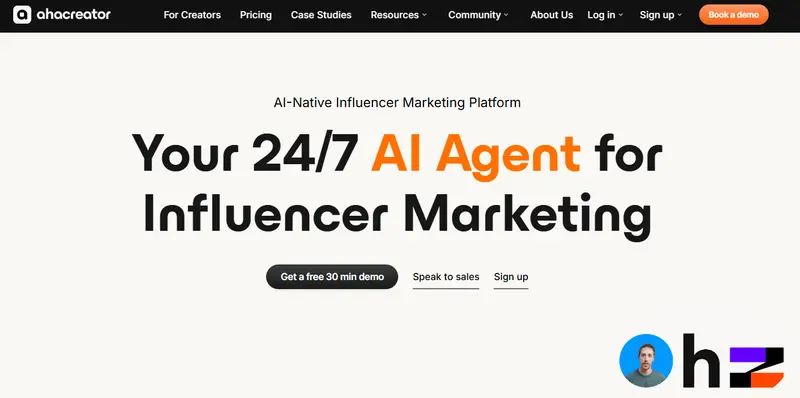
AhaCreator is an AI-native influencer marketing platform built around a 24/7 AI agent designed to run campaigns from start to finish. Unlike traditional platforms that assist with specific tasks, AhaCreator positions its AI as a system that takes over the execution layer of influencer marketing entirely.
How does this work? It starts with campaign creation. Once you define your campaign requirements, the AI agent handles the rest, including sourcing creators, sending outreach, negotiating pricing, and managing follow-ups.
Read More5. Passionfroot
Best for: B2B and growth teams scaling creator-led GTM strategies
Pricing: Platform access with usage-based pricing, available upon request
Core Strength: AI-driven campaign strategy and execution through a centralized agent
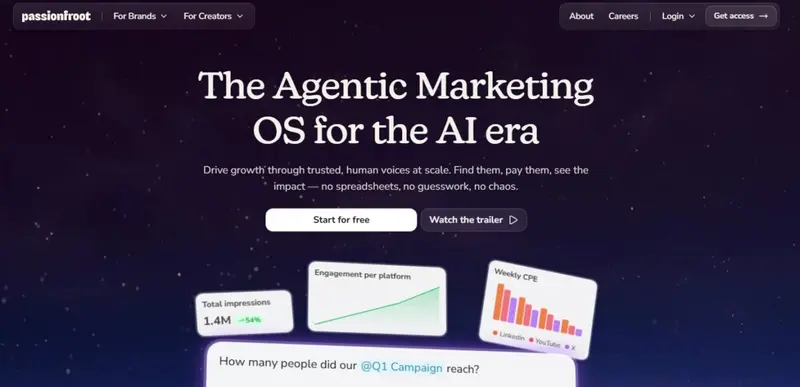
Passionfroot is a creator marketing platform with its own AI agent, Zest, designed to help brands plan, execute, and optimize creator campaigns from a single system. Passionfroot positions its AI agent as a strategy and execution layer that connects campaign planning directly to performance.
Read More6. Stormy AI
Best for: DTC and eCommerce brands running creator-led growth campaigns
Pricing: Free tier available with paid plans for advanced features
Core Strength: AI-driven influencer outreach and campaign execution tied directly to eCommerce performance
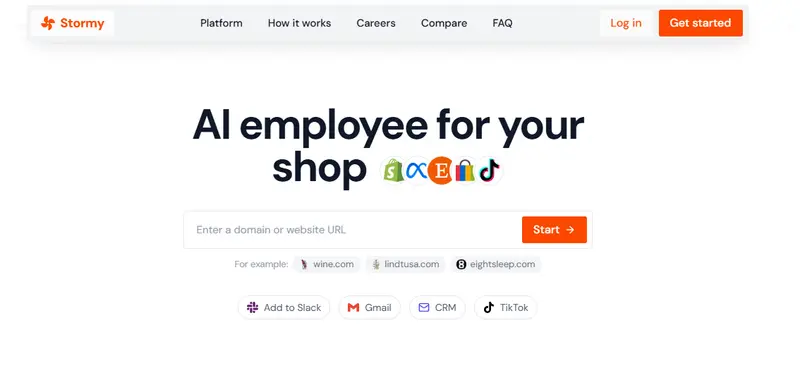
Stormy is an AI-powered growth platform with its own agent designed to handle influencer discovery, outreach, and campaign execution for eCommerce brands.
Unlike traditional influencer marketing tools, Stormy positions its AI as an “AI employee” that operates across creator partnerships, paid media, and storefront performance.
Read MoreAI Agents vs Influencer Marketing Platforms
Many influencer marketing platforms now include AI features, which makes it harder to distinguish between traditional tools and true AI agents. The difference is not in whether AI exists, but in how much of the workflow it can execute independently.
The table below highlights how AI agents compare to traditional influencer marketing platforms across key areas:
|
Category |
Influencer Marketing Platforms |
AI Agents |
| Core Function | Centralized tools for managing campaigns | Autonomous systems that execute campaign workflows |
| Workflow | Manual and user-driven | Automated and continuous |
| Creator Discovery | Filter-based search using databases | AI-driven matching based on content, audience, and context |
| Outreach | Manual messaging or templates | Personalized outreach generated and sent by AI |
| Campaign Execution | Managed step-by-step by users | Managed by AI with minimal input |
| Communication | Spread across tools or centralized inboxes | Automated follow-ups and conversation management |
| Decision-Making | Based on user input and analysis | AI-driven recommendations and prioritization |
| Scalability | Limited by team capacity | Scales without increasing headcount |
| Speed | Sequential processes | Parallel execution across workflows |
| Optimization | Post-campaign analysis | Real-time insights and adjustments |
| Payments and Operations | Often require external tools | Integrated into a single system |
| Role of the User | Operator managing tasks | Strategist overseeing AI execution |
How to Choose the Right AI Agent for Influencer Marketing
Not all AI agents are built the same. Some focus on a single part of the workflow, such as discovery or outreach, while others operate across the full campaign lifecycle.
Choosing the right solution depends less on features and more on how well the system aligns with your workflow, team structure, and campaign goals.
Define Your Primary Use Case
Start by identifying where your current process breaks down.
Some teams struggle with creator discovery, while others lose time managing outreach, follow-ups, and campaign coordination. If your bottleneck is at the top of the funnel, a content-focused discovery agent may be enough. If execution is the issue, a platform that automates outreach and campaign management will deliver more value.
The goal is not to adopt the most advanced system, but to solve the most time-consuming part of your workflow.
Evaluate the Level of Automation
Many platforms include AI features, but that does not make them AI agents. The key difference is the extent to which the workflow can be executed independently. Some tools assist with recommendations, while others actively perform tasks such as sending outreach, managing follow-ups, and coordinating campaigns.
Understanding this distinction helps avoid overestimating what a platform can do. The more autonomous the system, the greater the reduction in manual work.
Consider Team Size and Workflow
The right solution often depends on how your team operates. Smaller teams may benefit from agents that handle multiple stages of the workflow, allowing them to scale without additional resources. Larger teams may prefer systems that integrate into existing processes while maintaining control over execution.
It is also important to consider whether campaigns are managed in-house or through external partners, as this affects how much automation is required.
Look at Integration and Ecosystem Fit
AI agents do not operate in isolation. They need to connect with your existing tools, whether that includes eCommerce platforms, CRM systems, or paid media channels. Platforms that integrate directly into your stack reduce friction and allow campaigns to run more smoothly.
For example, brands running eCommerce-driven campaigns may benefit from systems that connect creator performance to revenue, while content-driven teams may prioritize discovery and analytics.
Assess Pricing in the Context of Efficiency
Pricing is ultimately the deciding factor for many brands.
Luckily, pricing models vary widely, from subscription-based platforms to usage-based systems that charge per campaign or per creator. Instead of comparing costs directly, it is more useful to evaluate how much time and effort the platform saves.
An AI agent that reduces manual workload, shortens campaign timelines, and improves creator selection can offset its cost through operational efficiency. The focus should be on overall impact rather than upfront pricing.
AI Agents Are Reshaping Influencer Marketing
The best AI agents are redefining how influencer marketing gets done. What once required multiple tools, manual outreach, and constant coordination can now be handled by systems that operate across the entire campaign lifecycle.
For brands, this shift is not just about efficiency. It is about staying competitive in a space where speed, scale, and precision directly impact results. The best AI agents for influencer marketing allow teams to move faster, test more creators, and focus on strategy instead of execution.
As adoption grows, these systems will move from advantage to necessity. Brands that integrate AI agents early will be better positioned to scale campaigns, improve ROI, and lead the next phase of creator marketing.
Frequently Asked Questions
What are AI agents in influencer marketing?
AI agents in influencer marketing are systems that can autonomously execute tasks such as creator discovery, outreach, campaign management, and performance tracking. Unlike traditional tools, they reduce manual work by handling workflows independently.
What are the best AI agents for influencer marketing?
The best AI agents for influencer marketing include platforms like Kuli, Creator.co, AhaCreator, Passionfroot, and Stormy AI, each offering different levels of automation across campaign workflows.
How do AI agents find influencers?
AI agents use data such as content analysis, audience demographics, engagement patterns, and brand alignment to identify relevant creators. Some platforms also analyze video content and match creators based on audience fit and purchase intent.
Are AI agents better than influencer marketing platforms?
AI agents go beyond traditional platforms by automating workflows instead of just providing tools. While platforms require manual input, AI agents can handle discovery, outreach, and campaign execution with minimal intervention.
Can AI agents automate influencer outreach?
Yes, many AI agents generate personalized outreach messages, send them at scale, and manage follow-ups automatically. This helps improve response rates while reducing manual effort.
Are AI agents worth it for small brands?
AI agents can be valuable for small brands by reducing the need for large teams and enabling efficient campaign execution. However, the return depends on campaign volume and how much of the workflow is automated.
What is the difference between AI tools and AI agents?
AI tools assist with specific tasks, such as analytics or content generation, while AI agents execute entire workflows. Agents can make decisions, take action, and continuously manage campaigns with minimal input.
How do AI agents improve influencer marketing ROI?
AI agents improve ROI by selecting better-fit creators, automating time-consuming tasks, and optimizing campaigns in real time. This reduces wasted spend and increases overall campaign efficiency.


