
Creating more content has never been easier. Creating content that works together is a different challenge altogether.
Marketing teams now publish across blogs, social media, email, search, video, and influencer campaigns, often with different goals, audiences, and publishing schedules. Without a structured planning process, those assets quickly become disconnected, making it harder to deliver a consistent customer experience or move prospects through the buying journey.
The need for better planning is also reflected in the data. According to research, 74% of B2B marketers say content marketing helps generate demand and leads, while 87% credit it with building brand awareness.
Yet only 29% rate their content marketing strategy as extremely or very effective, highlighting a significant gap between producing content and executing a coordinated strategy.
A content map closes that gap.
Instead of planning individual blog posts or social media updates in isolation, a content map connects your audience, the questions they ask, the stages of their buying journey, the keywords they search for, and the channels they use into a single planning system.
Every piece of content has a defined purpose, making it easier to create consistent experiences, uncover content gaps, and support business goals across every channel.
In this guide, you'll learn how to build that system from the ground up. We'll walk through audience research, customer journey mapping, content planning, keyword alignment, channel selection, and publishing workflows that help transform disconnected content into a coordinated strategy.
Before we dive in, we've packaged the entire process into a practical resource you can use alongside this guide.
IMH Content Mapping Template Pack
Building a content map is much easier when every stage of the planning process has its own dedicated workspace.
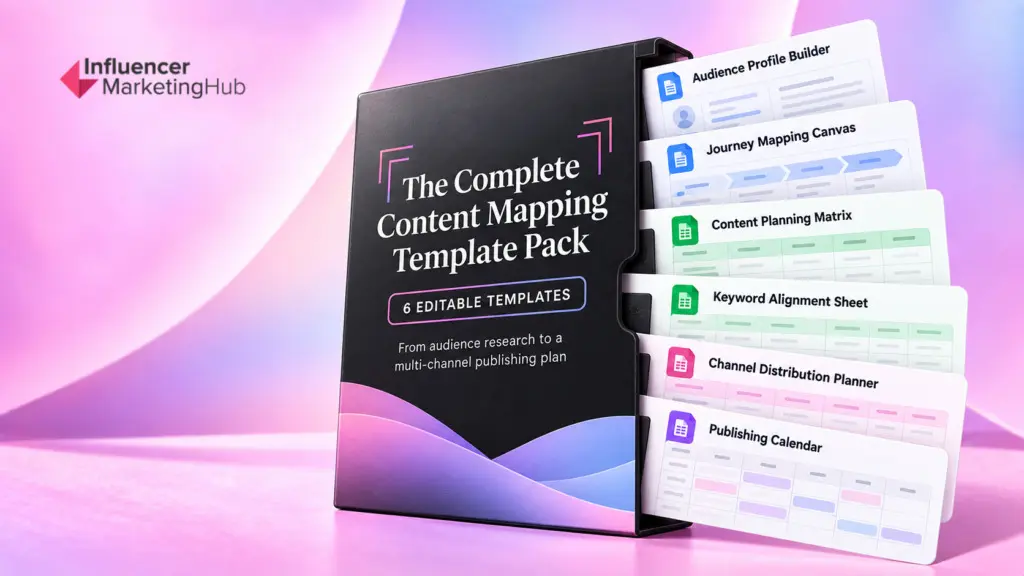
The IMH Content Mapping Template Pack includes six editable templates that work together as a complete content planning system, helping you move from audience research to an organized, multi-channel publishing strategy.
Inside the toolkit, you'll get:
- Audience Profile Builder: Define your ideal audience with actionable persona insights.
- Journey Mapping Canvas: Map customer needs across every stage of the buyer journey.
- Content Planning Matrix: Align content ideas with audience intent and business goals.
- Keyword Alignment Sheet: Connect topics with search intent and SEO opportunities.
- Channel Distribution Planner: Decide where every content asset should be published.
- Publishing Calendar: Turn your strategy into a consistent execution plan.
Get the Content Mapping Template
Why Content Mapping Helps Teams Plan Better Content
Publishing more content doesn't automatically create better marketing outcomes. Success depends on how well every content asset works together to answer audience questions, support the buyer journey, and contribute to business goals.
Many marketing teams struggle with that coordination. According to the latest research, 55% of B2B marketers say creating content that prompts an action is one of their biggest challenges, while 40% struggle to create content that resonates with their audience.
Ultimately, planning content strategically is the biggest challenge, not producing.
A content map provides that structure. Instead of planning blogs, social posts, videos, and email campaigns independently, it connects every asset to a specific audience, objective, and stage of the customer journey. Teams stop asking, "What should we publish next?" and start asking more strategic questions:
- Who is this content for?
- Which stage of the buyer journey does it support?
- What problem does it solve?
- Which channel will deliver the greatest impact?
- What action should the audience take next?
Those answers transform content planning from a publishing schedule into a marketing system.
The impact extends beyond editorial planning. Research shows that only 47% of B2B marketers have a documented content marketing strategy. Among organizations that rate their strategy as only moderately effective or worse, 39% say their content isn't aligned with the customer journey, while 35% say it isn't guided by data.
A content map helps solve both problems by giving every team a shared planning framework.
A documented planning process also improves long-term performance. Organizations with a documented content strategy are 3.5 times more likely to report success than those without one.
Rather than relying on reactive content creation, they build repeatable systems that align audience research, content production, SEO, distribution, and measurement around shared business objectives.
The result is a strategy that's easier to manage and easier to scale. SEO teams can organize keyword clusters around audience intent. Social media managers can support the same campaigns with platform-specific content. Email marketers can build nurture sequences that continue the conversation instead of repeating it.
Every channel contributes to a unified customer experience.
Before You Start
Before building your own content map, it's helpful to understand how those planning activities connect. The next section introduces the six-step process that powers the IMH Content Mapping Template Pack and shows how each planning asset fits into one repeatable workflow.
The IMH Content Mapping Process
A successful content map isn't built in a single spreadsheet. It develops through a series of planning decisions that connect your audience, content, and distribution into one coordinated strategy.
The six-step process below provides a practical workflow you can follow whether you're planning content for a single campaign or managing an ongoing editorial calendar.
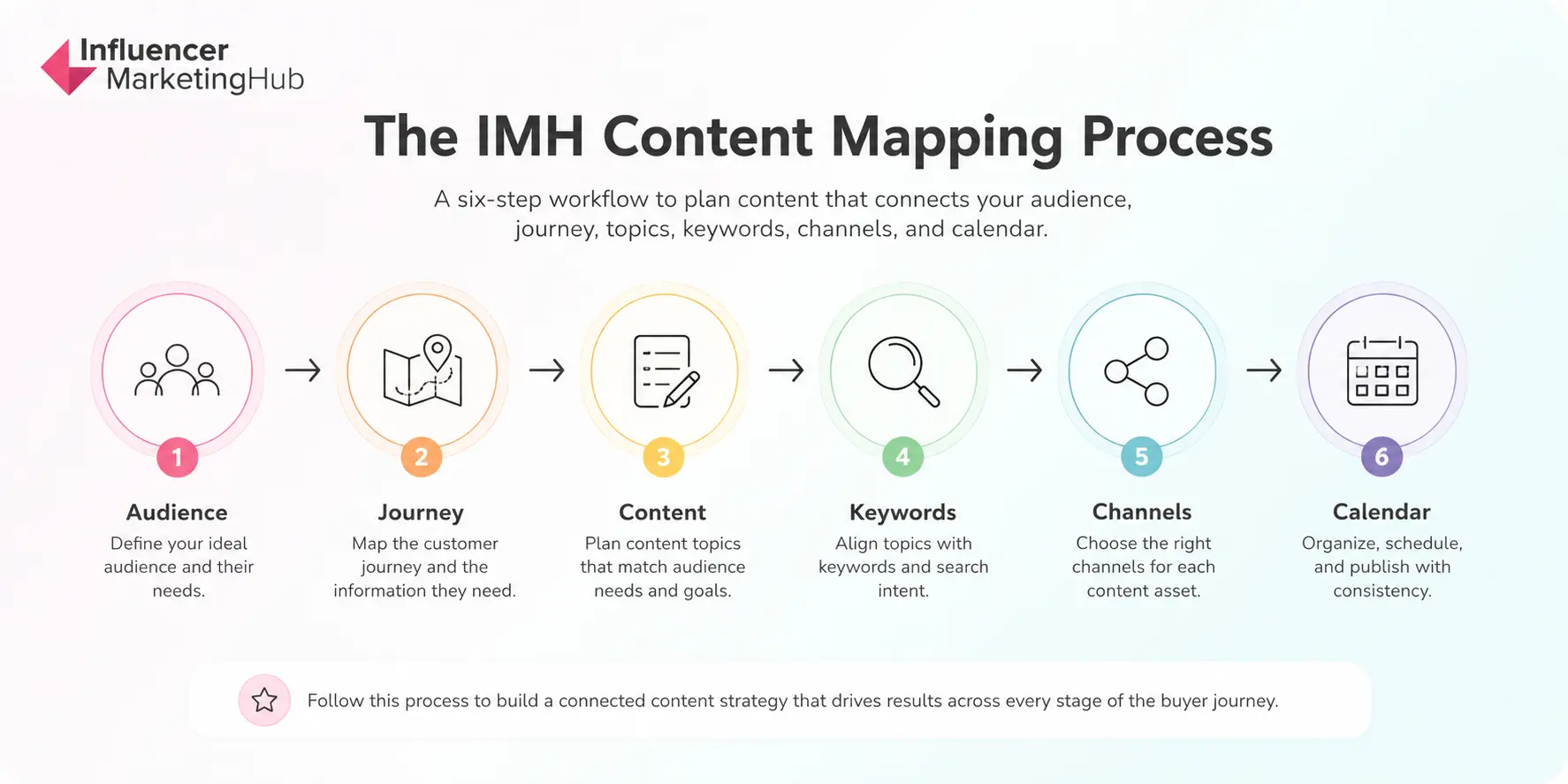
Every stage builds on the one before it, creating a complete planning system instead of a collection of disconnected documents.
1. Build Your Audience Profile
Every effective content map starts with understanding your audience. Before you decide what content to create or where to publish it, you need to know who you're trying to reach and what information they need throughout their buying journey.
That's where buyer personas become essential.
Buyer Persona Definition
A buyer persona is a research-based representation of your ideal customer. It goes beyond demographics to capture goals, challenges, motivations, buying behaviors, and the questions people ask before making a decision.
Instead of planning content for a broad audience, personas help you create experiences tailored to the people most likely to engage with your brand.
Well-developed personas make every subsequent planning decision easier. They help identify relevant content topics, prioritize audience questions, select the right channels, and personalize messaging for different customer segments.
In a LinkedIn post, Dave Bravman, an Account Executive at Semrush, explains that defining target segments comes prior to creating buyer personas. In his words, a buyer persona is basically "an average person in your target group."
When developing a buyer persona, consider:
- Demographic and firmographic information
- Goals and business objectives
- Pain points and common challenges
- Frequently asked questions
- Preferred content formats
- Most active communication channels
- Buying motivations and objections
Gather this information from customer interviews, CRM data, website analytics, surveys, sales conversations, and social media insights. Audience research platforms can also help uncover demographic trends, interests, and online behaviors that strengthen your personas over time.
2. Complete the Journey Mapping Canvas
Once you understand who your audience is, the next step is understanding how they make decisions.
Customers rarely purchase after a single interaction. They research options, compare solutions, evaluate alternatives, and look for reassurance before committing. Every stage presents different questions, concerns, and information needs.
Journey mapping helps organize those moments.
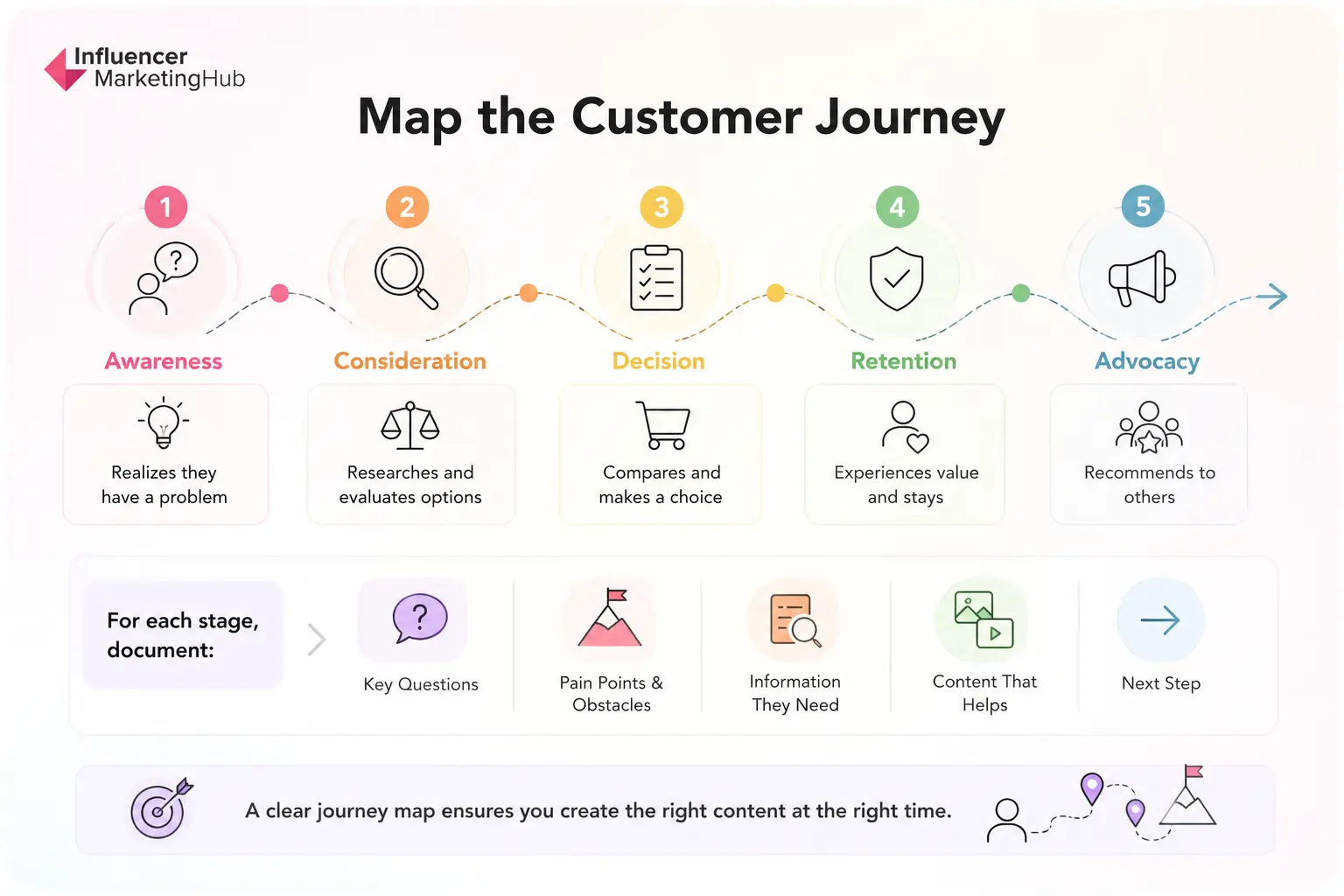
Start by identifying the major stages your customers move through—from awareness and consideration to decision and retention. Then document the questions they ask, the obstacles they encounter, and the content that will help them move confidently to the next stage.
For example, awareness-stage content often focuses on education and problem identification, while decision-stage content typically includes product comparisons, case studies, pricing information, or customer testimonials.
Mapping the journey prevents common planning mistakes, such as producing multiple bottom-funnel assets while neglecting the educational content that attracts potential customers in the first place.
3. Organize Your Content
With your audience and buyer journey established, you can begin planning content that serves a clear purpose.
Rather than brainstorming topics independently, connect every content idea to a specific audience segment, customer question, business objective, and stage of the buyer journey. Every article, video, guide, email, or social media post should help someone accomplish something meaningful.
The Content Planning Matrix becomes the central hub for your strategy. It allows you to visualize how content supports different audiences while identifying opportunities where additional resources may be needed.
As you build your matrix, organize content around:
- Customer questions
- Buyer journey stages
- Content pillars
- Campaign objectives
- Content formats
- Internal linking opportunities
Planning content this way creates stronger consistency across channels while making future editorial planning significantly easier.
4. Connect Every Topic with the Keyword Alignment Sheet
Content planning and SEO work best when they support each other.
Many teams perform keyword research after deciding what to publish. A stronger approach is to incorporate search intent directly into your planning process so every content opportunity is supported by audience demand.
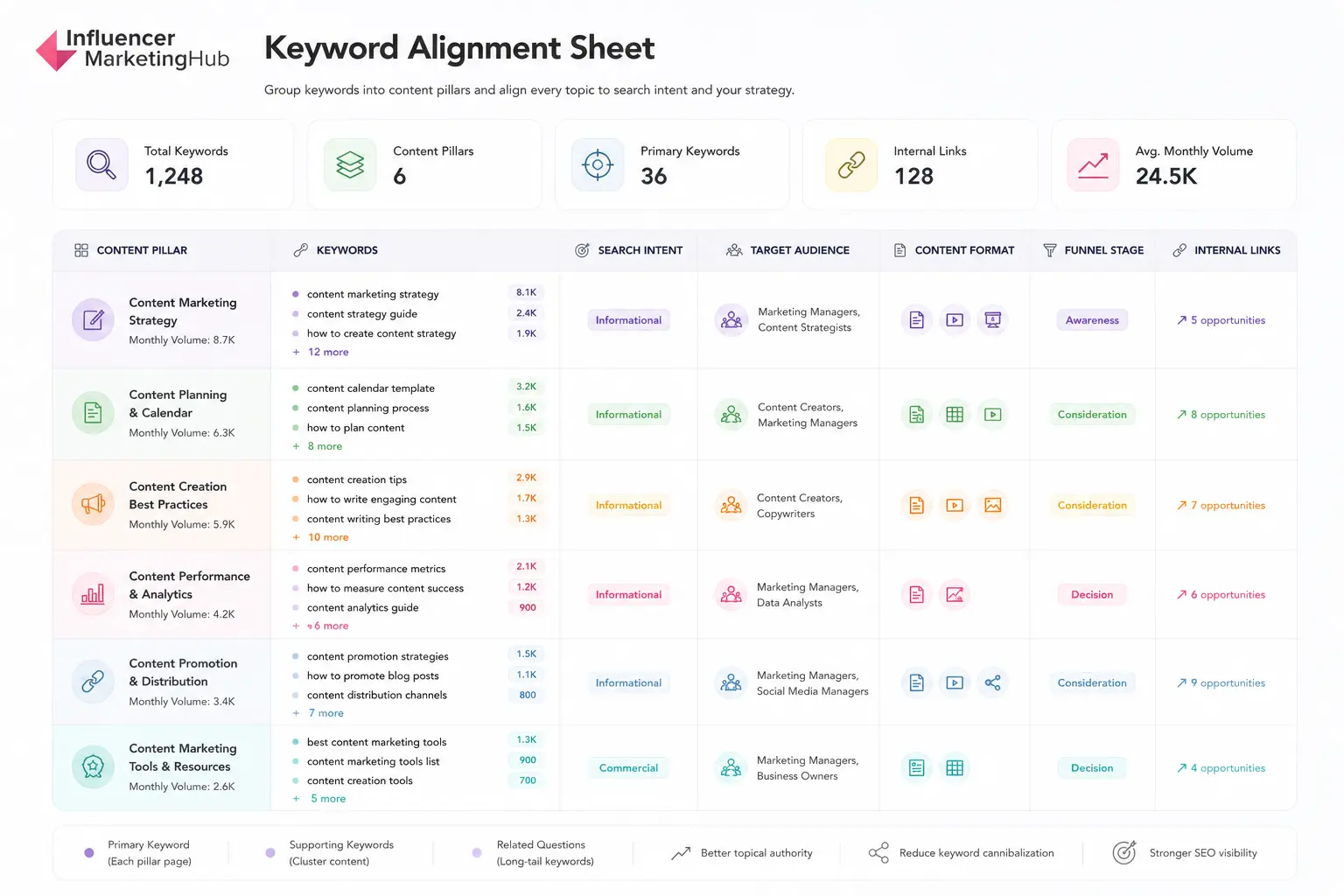
Instead of maintaining isolated keyword lists, group related search terms into topic clusters that align with your content pillars. Assign one primary keyword to each major asset, then support it with secondary keywords, related questions, and semantic variations.
Your Keyword Alignment Sheet should include:
- Primary keyword
- Supporting keywords
- Search intent
- Target audience
- Content format
- Funnel stage
- Internal linking opportunities
Connecting keyword research to your content map helps reduce topic overlap, improve topical authority, and create a more scalable SEO strategy.
5. Build Your Channel Distribution Planner
Publishing great content is only part of the process. Reaching the right audience requires a thoughtful distribution strategy.
Every platform serves a different purpose. Long-form educational content may perform best on your website, while short-form videos, email campaigns, LinkedIn posts, or industry newsletters help extend its reach to different audience segments.
Rather than publishing identical content everywhere, identify how each asset should be adapted for every channel.
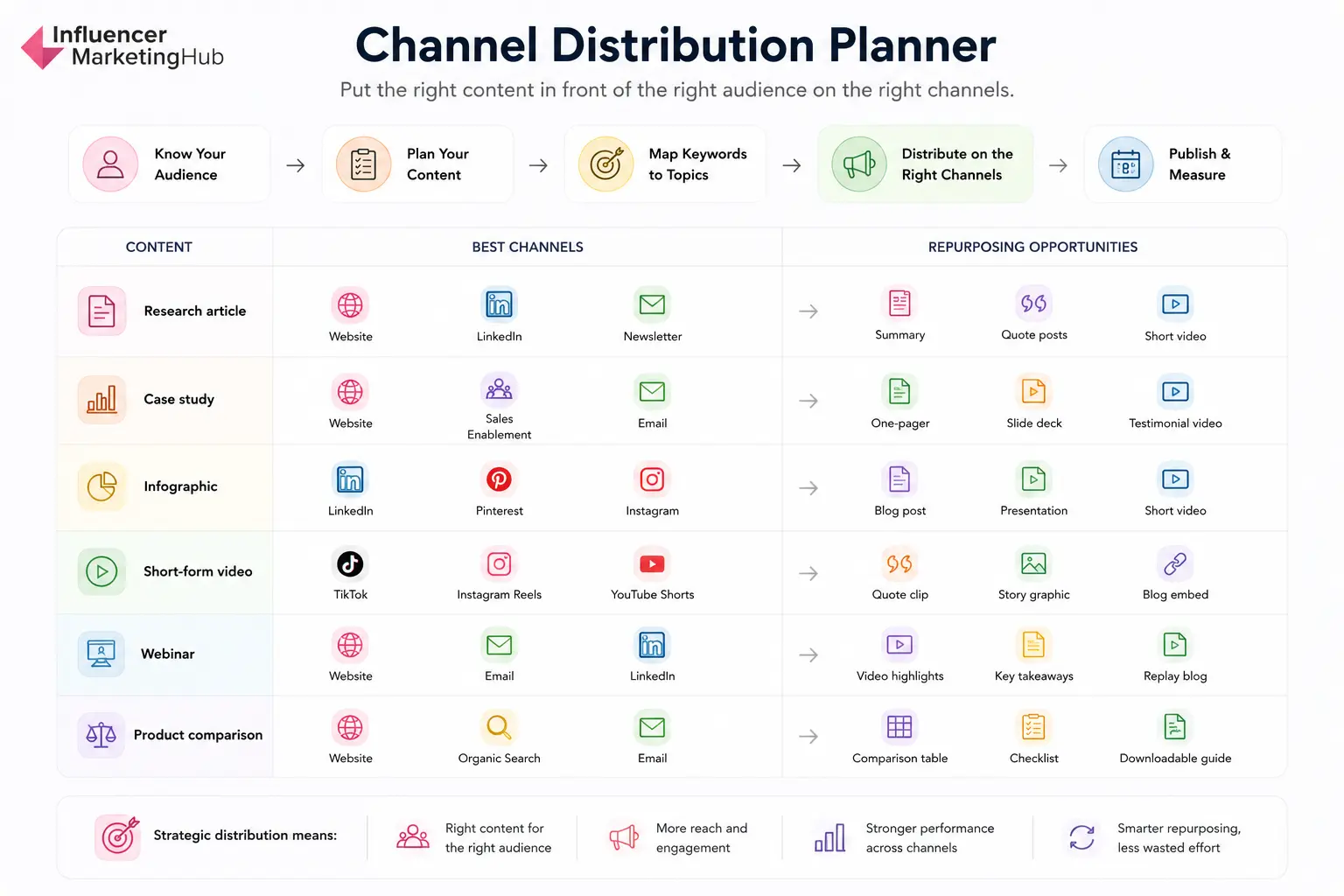
Your Channel Distribution Planner should define:
- Primary publishing channel
- Repurposing opportunities
- Supporting channels
- Distribution schedule
- Content owner
- Success metrics
This approach creates a coordinated multi-channel strategy while reducing duplicated effort across your marketing team.
6. Turn Your Strategy into a Publishing Calendar
The final step transforms planning into execution.
Without a publishing calendar, even the strongest content strategy can lose momentum as priorities change and deadlines shift. A centralized calendar keeps every campaign, channel, and contributor aligned around the same objectives.
Your calendar should include more than publication dates. It should also track ownership, production milestones, review deadlines, campaign launches, seasonal priorities, and promotional activities.
As your content operation grows, the calendar becomes the operational hub that connects strategy with day-to-day execution.
Review it regularly to identify scheduling conflicts, rebalance workloads, and ensure every campaign supports broader marketing goals.
Together, these six planning activities create a repeatable system for developing, publishing, distributing, and improving content. Rather than relying on disconnected spreadsheets or reactive planning sessions, you'll have a structured workflow that connects every stage of your content operation.
Use Our IMH Content Mapping Template Pack
If you'd like to follow this process yourself, the IMH Content Mapping Toolkit includes a dedicated planning template for every step, allowing you to build your strategy as you work through this guide.
- Audience Profile Builder
- Journey Mapping Canvas
- Content Planning Matrix
- Keyword Alignment Sheet
- Channel Distribution Planner
- Publishing Calendar
How to Turn Your Content Map Template into a Repeatable Planning System
Creating individual planning documents is a good start. The real value comes from connecting them into a single workflow that guides every content decision.
Many marketing teams already have buyer personas, keyword research, editorial calendars, and campaign plans.
The challenge is that those resources often exist in separate documents, managed by different teams, and updated independently. A connected content mapping process keeps every planning activity aligned around the same audience, objectives, and customer journey.
Think of each planning document as an input for the next stage.
Your Audience Profile Builder defines who you're trying to reach and what matters most to them. Those insights become the foundation for your Journey Mapping Canvas, where you document customer questions, decision points, and information needs across every stage of the buying journey.
Once the journey is mapped, you can begin building your Content Planning Matrix. Every content idea is connected to a specific audience segment, business objective, and customer need instead of being planned in isolation.
The next step is strengthening those content ideas with search data. Your Keyword Alignment Sheet connects each topic to primary and supporting keywords, helping you build topical authority while ensuring every asset reflects real search demand.
With the content plan complete, your Channel Distribution Planner determines where each asset will deliver the greatest value. Instead of publishing identical content everywhere, you can adapt articles, videos, guides, and infographics for the channels where your audience is most active.
Finally, your Publishing Calendar brings everything together into one operational view. It transforms strategy into execution by organizing deadlines, responsibilities, campaign launches, and publishing schedules across every marketing channel.
Rather than functioning as six independent planning documents, these assets create a continuous workflow.
Audience → Journey → Content → Keywords → Channels → Calendar
Every stage builds on the work completed in the previous one, making your content strategy easier to manage, easier to scale, and easier to improve over time.
Whether you're planning a quarterly campaign or managing an always-on content program, following the same structured process helps every team work from a shared strategy instead of disconnected plans.
Start Building a More Strategic Content Plan
A content map does more than organize ideas. It connects your audience, customer journey, content, SEO, distribution, and publishing strategy into one coordinated planning system.
Following a structured process helps every piece of content serve a clear purpose, whether you're creating a single campaign or managing an ongoing editorial calendar. Instead of planning content one asset at a time, you can build a strategy that supports business goals, improves consistency across channels, and creates a better experience for your audience.
If you're ready to put the process into practice, download the IMH Content Mapping Toolkit. It includes every planning template covered in this guide, helping you build a complete content strategy from audience research through to publication.
Frequently Asked Questions
What is a content map?
A content map is a planning framework that connects your audience, customer journey, content topics, keywords, and distribution channels. It helps marketers create content that supports specific business goals while guiding customers through every stage of the buying journey.
What is the purpose of a content map?
A content map helps organize content around audience needs instead of publishing topics independently. It improves consistency, uncovers content gaps, supports SEO, and ensures every asset has a defined role within your marketing strategy.
What should a content mapping template include?
A comprehensive content mapping template should include audience segments, buyer journey stages, content topics, primary keywords, search intent, content formats, distribution channels, publishing dates, and success metrics.
What's the difference between a content map and a content calendar?
A content map focuses on strategy by defining what content to create and why. A content calendar focuses on execution by scheduling when and where that content will be published.
How do buyer personas improve content mapping?
Buyer personas provide the audience insights needed to create relevant content. They help marketers understand customer goals, pain points, preferred content formats, and the questions people ask throughout the buying journey.
How does keyword research fit into content mapping?
Keyword research helps validate content ideas with real search demand. Mapping keywords to topics and customer journey stages creates stronger topical authority while ensuring content aligns with user intent.
How often should you update your content map?
Review your content map whenever business priorities, customer behavior, or campaign objectives change. Many marketing teams refresh their content maps quarterly to incorporate new audience insights, keyword opportunities, and content performance data.
Can I use content mapping for social media?
Yes. Content mapping applies to every marketing channel, including social media. Once you've identified your audience, content themes, and business objectives, you can adapt the same strategy across platforms while tailoring each asset to the channel's format and audience expectations.
How often should I update my content map?
You should update your content map regularly, ideally every 3 to 6 months. However, you should also consider your audience's changing interests. It's also a good idea to review it whenever there are significant shifts in market trends or customer feedback. Keep a close eye on your CRM and Google Analytics data so that you're prepared for any changes in your audience's behaviors or the way they interact with your content.
Can content maps help improve team collaboration?
When you have a content map, it becomes easier to assign roles and responsibilities to everyone in your team. It helps avoid overlap or gaps in content creation and ensures all team members are aligned on the goals and audience needs. Plus, it makes communication easier since the map serves as a visual reference, so team members can quickly see what's being worked on and what's still needed. For example, in the Semrush Keyword Mapping Template, there's a column for content updates. So everyone on the team can quickly see the phase in which content is. It keeps your team on the same page and moving in the same direction.