

Influencer outreach has become one of the most competitive stages of influencer marketing.
Creators aren't struggling to find brand opportunities; brands are competing to earn creators' attention. According to a joint Impact.com and Adweek survey, 61% of creators receive between five and ten partnership requests every week, while 84% say they receive more collaboration opportunities than they can realistically manage.
As such, standing out requires far more than sending a generic email or direct message. Successful outreach now depends on identifying the right creators, understanding what motivates them, and building genuine relationships long before the first collaboration begins.
The brands that consistently secure high-quality partnerships don't necessarily contact more creators. Instead, they contact the right creators with the right message at the right time. Every stage of the process, from qualification and personalization to follow-ups and relationship management, influences whether a creator responds or ignores your outreach.
In this guide, you'll learn how to build an influencer outreach strategy that is both scalable and personal. We'll introduce the IMH Influencer Outreach Framework, a seven-step process that helps you identify qualified creators, craft more compelling outreach, improve response rates, and build partnerships that extend beyond a single campaign.
- What Is an Influencer Outreach Strategy?
- The IMH Influencer Outreach Framework 🧱
- Step 1: Define Your Outreach Goals Before Contacting Creators
- Step 2: Find and Qualify the Right Influencers
- Step 3: Choose the Right Outreach Channel
- Step 4: Personalize Every Outreach Message
- Step 5: Write Outreach Messages That Start Conversations
- Step 6: Build a Follow-Up Strategy That Doesn't Feel Pushy
- Step 7: Measure and Improve Your Outreach Strategy
- Bonus Step: Turn Outreach Into Long-Term Creator Partnerships
- Common Influencer Outreach Mistakes (and How to Avoid Them)
- Build Better Creator Relationships, Not Just Better Outreach Emails
- Frequently Asked Questions
What Is an Influencer Outreach Strategy?
An influencer outreach strategy is the process brands use to identify, evaluate, contact, and build relationships with creators who align with their marketing goals. Rather than treating outreach as a one-time email or direct message, it establishes a repeatable system for finding the right partners, starting meaningful conversations, and turning those conversations into successful collaborations.
While influencer marketing focuses on the overall campaign, from creator selection and content production to performance measurement, influencer outreach focuses on the first critical interaction. A strong campaign can struggle before it even begins if outreach is rushed, poorly personalized, or sent to creators who aren't a good fit.
That's why effective outreach starts well before writing the first message.
It begins with understanding your campaign objectives, carefully qualifying potential creators, and tailoring your communication to show why the partnership is valuable for both sides.
When each step builds on the one before it, outreach becomes more efficient, response rates improve, and brands are better positioned to develop long-term creator relationships instead of relying on one-off collaborations.
The IMH Influencer Outreach Framework builds on this idea by breaking outreach into a structured, repeatable process, from defining campaign goals and qualifying creators to personalizing communication, managing follow-ups, and optimizing future outreach efforts.
The IMH Influencer Outreach Framework 🧱
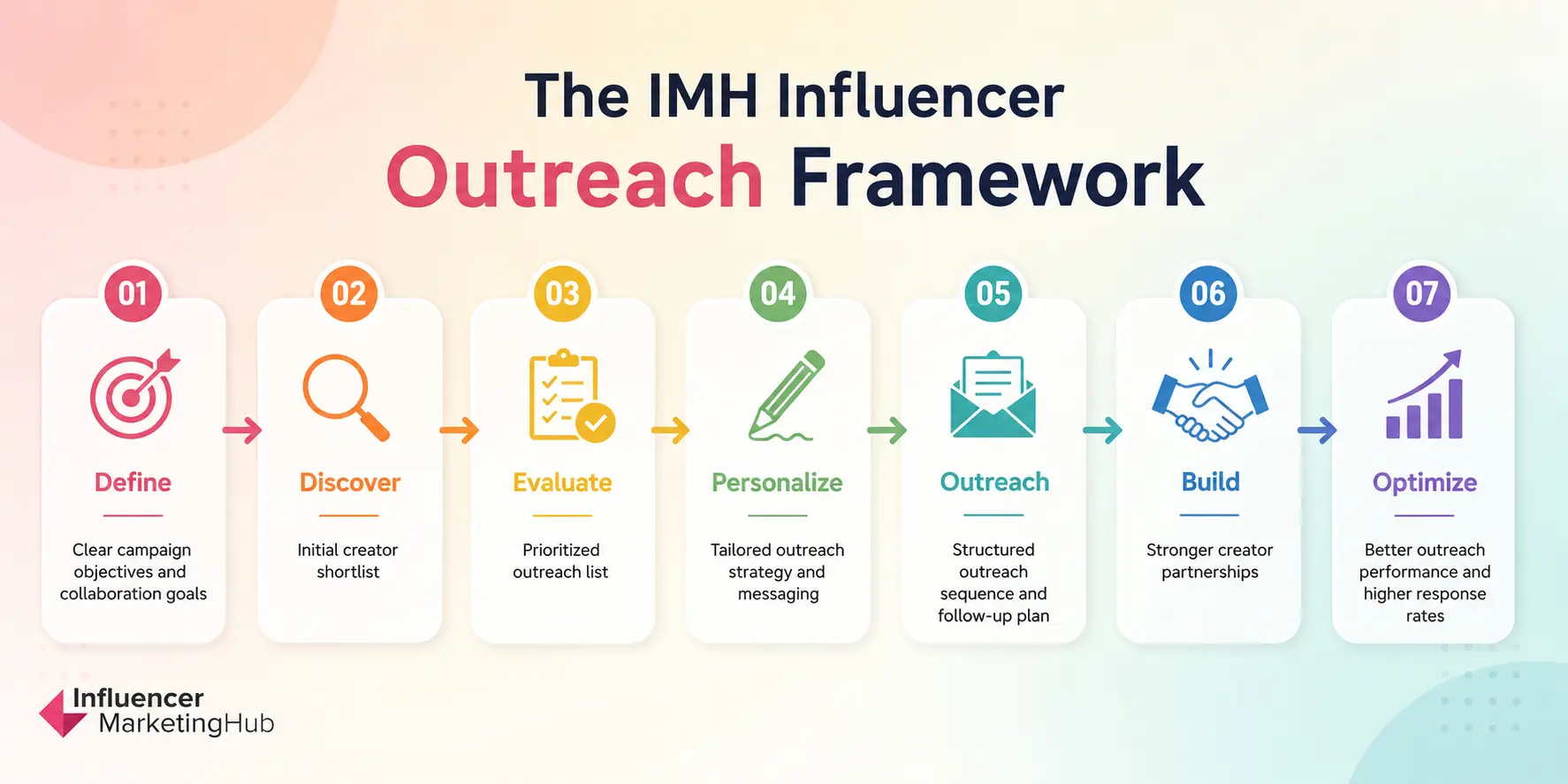
Successful influencer outreach relies on a repeatable process that helps you consistently identify the right creators, communicate effectively, and build lasting partnerships.
Many outreach campaigns fail because brands jump straight to writing messages before they've clearly defined campaign goals or evaluated whether a creator is the right fit.
By approaching outreach as a structured workflow, every stage supports the next. Better qualification leads to more relevant outreach, stronger personalization improves response rates, and effective relationship management creates opportunities that extend well beyond a single campaign.
The IMH Influencer Outreach Framework organizes the entire process into seven practical stages. Each stage answers one critical question and produces a clear outcome before moving to the next.
| Stage | Key Question | Outcome |
| Define | What are we trying to achieve? | Clear campaign objectives and collaboration goals |
| Discover | Which creators should we consider? | Initial creator shortlist |
| Evaluate | Who is the best fit for this campaign? | Prioritized outreach list |
| Personalize | How should we approach each creator? | Tailored outreach strategy and messaging |
| Outreach | How do we start the conversation? | Structured outreach sequence and follow-up plan |
| Build | How do we turn collaborations into long-term relationships? | Stronger creator partnerships |
| Optimize | What can we improve next time? | Better outreach performance and higher response rates |
Rather than viewing outreach as a one-time task, the framework encourages brands to build a repeatable system that becomes more effective with every campaign. As you move through the rest of this guide, we'll break down each stage in detail and show you how to apply it to your own influencer marketing efforts.
Step 1: Define Your Outreach Goals Before Contacting Creators
Effective influencer outreach begins long before the first email or direct message. The most successful campaigns start with a clear understanding of what the business is trying to achieve and what role creators will play in reaching that objective.
Without clearly defined goals, it's difficult to identify the right creators, decide on an appropriate collaboration model, or measure whether outreach has been successful. A campaign focused on generating authentic user-generated content, for example, requires a different outreach approach than one designed to drive affiliate sales or launch a new product.
Start by defining the primary outcome you want your outreach efforts to achieve. That objective should influence every decision that follows.
| Campaign Goal | Recommended Collaboration Type |
| Increase brand awareness | Sponsored content campaign |
| Generate authentic UGC | Product gifting or UGC collaboration |
| Drive ecommerce sales | Affiliate partnership |
| Launch a new product | Product seeding with selected creators |
| Build long-term advocacy | Brand ambassador program |
| Produce reusable creative assets | Paid UGC partnership |
| Grow a niche community | Long-term creator partnership |
Before moving on to creator discovery, make sure your team is aligned on campaign objectives, success metrics, budget, timeline, and the type of partnership you're hoping to build. Clear goals not only improve outreach efficiency but also make it much easier for creators to understand why your opportunity is relevant to them.
Step 2: Find and Qualify the Right Influencers
The success of any outreach strategy depends on one decision: who you choose to contact.
Even the most compelling outreach message is unlikely to succeed if it's sent to creators whose audience, content, or values don't align with your brand.
Many brands make the mistake of evaluating creators using a handful of surface-level metrics, such as follower count or average engagement. While these metrics provide useful context, they rarely tell the full story.
A creator with a smaller but highly relevant audience may deliver stronger campaign results than one with a much larger following but weaker audience alignment.
@itsmodernmillie The most successful influencer campaigns all have one thing in common...👇🏻 Embodiment. When a creator’s personal brand already embodies not just the brand’s aesthetic, but its mission. When your content and mission is in alignment with the brands, it makes the collaboration feel natural, not forced. It's not just about follower size... It’s about the right fit. The right creator. With the right audience. And a personal brand that truly embodies what the brand stands for. This is the pattern I consistently see when analyzing collaborations through tools like Modash. The strongest campaigns aren’t random...they’re strategic. Have questions? Drop them below 😁 #Ad
The goal at this stage is to build the best possible influencer list. The only way to do that is by qualifying creators before the outreach begins. That way, you'll spend less time chasing poor-fit partnerships and more time building relationships with creators who are genuinely positioned to contribute to your campaign objectives.
Where to Find Potential Influencers
There is no single "best" source for discovering creators. The right approach depends on your campaign goals, target audience, and available resources. Many successful outreach campaigns combine multiple discovery methods to build a more diverse shortlist.
| Discovery Method | Best For | Key Advantage |
| Influencer marketing platforms | Scalable creator discovery | Advanced search filters, audience insights, campaign management |
| Native social media search | Niche campaigns | Discover emerging creators through hashtags, keywords, and recommendations |
| Existing customer community | Brand advocacy | Identify loyal customers already talking about your brand |
| Competitor collaborations | Market research | Find creators with proven experience in your industry |
| Employee and partner recommendations | Trusted introductions | Surface creators through existing relationships |
| Creator referrals | Long-term programs | High-quality introductions from creators you've already worked with |
Regardless of where creators are discovered, every potential partner should be evaluated consistently before joining your outreach list.
What Makes a Creator Worth Contacting?
Influencer qualification should extend far beyond audience size. The strongest partnerships are built on relevance, credibility, and mutual value.
Before contacting any creator, consider the following evaluation criteria.
Audience Alignment
Start by asking whether the creator reaches the audience you're trying to influence. Look beyond demographic information and consider shared interests, purchase intent, geographic relevance, and community engagement.
A highly engaged niche audience often delivers better outcomes than a much broader but less relevant following.
Content Quality and Brand Fit
Review recent posts to understand how the creator communicates with their audience. Pay attention to visual consistency, storytelling style, production quality, and how naturally branded content fits alongside organic posts.
Just as importantly, consider whether your brand genuinely belongs in their content. Authentic partnerships are easier to build when products complement the creator's existing themes and audience expectations.
Engagement Quality
Strong engagement isn't simply measured by volume. Look for meaningful conversations, thoughtful comments, recurring audience interactions, and signs of an active community. Large numbers of generic comments or repetitive emoji responses may indicate lower-quality engagement.
Professionalism
A creator's responsiveness and reliability can have just as much impact on campaign success as their audience size. Review how consistently they publish content, whether they've worked with brands before, and how professionally they present partnership information through media kits, contact details, or creator websites.
Long-Term Partnership Potential
The most valuable creators aren't always those who deliver the biggest one-off campaign. Consider whether the creator could become an ongoing ambassador, regularly produce user-generated content, or support future launches. Long-term partnerships often produce stronger authenticity and better campaign efficiency over time.
📥 Get the IMH Influencer Qualification Scorecard
Finding creators is only the first step. Choosing which creators deserve your outreach is where many campaigns succeed or fail.
The IMH Influencer Qualification Scorecard helps you evaluate potential partners using consistent criteria such as audience fit, engagement quality, brand alignment, professionalism, and long-term partnership potential. Instead of relying on intuition, you can objectively score creators, prioritize your outreach list, and focus your efforts on the partnerships most likely to succeed.
Use it to:
- Evaluate creators using a standardized scoring framework
- Prioritize outreach based on campaign fit rather than follower count
- Compare multiple creators side by side
- Build a qualified shortlist before writing your first outreach message
Step 3: Choose the Right Outreach Channel
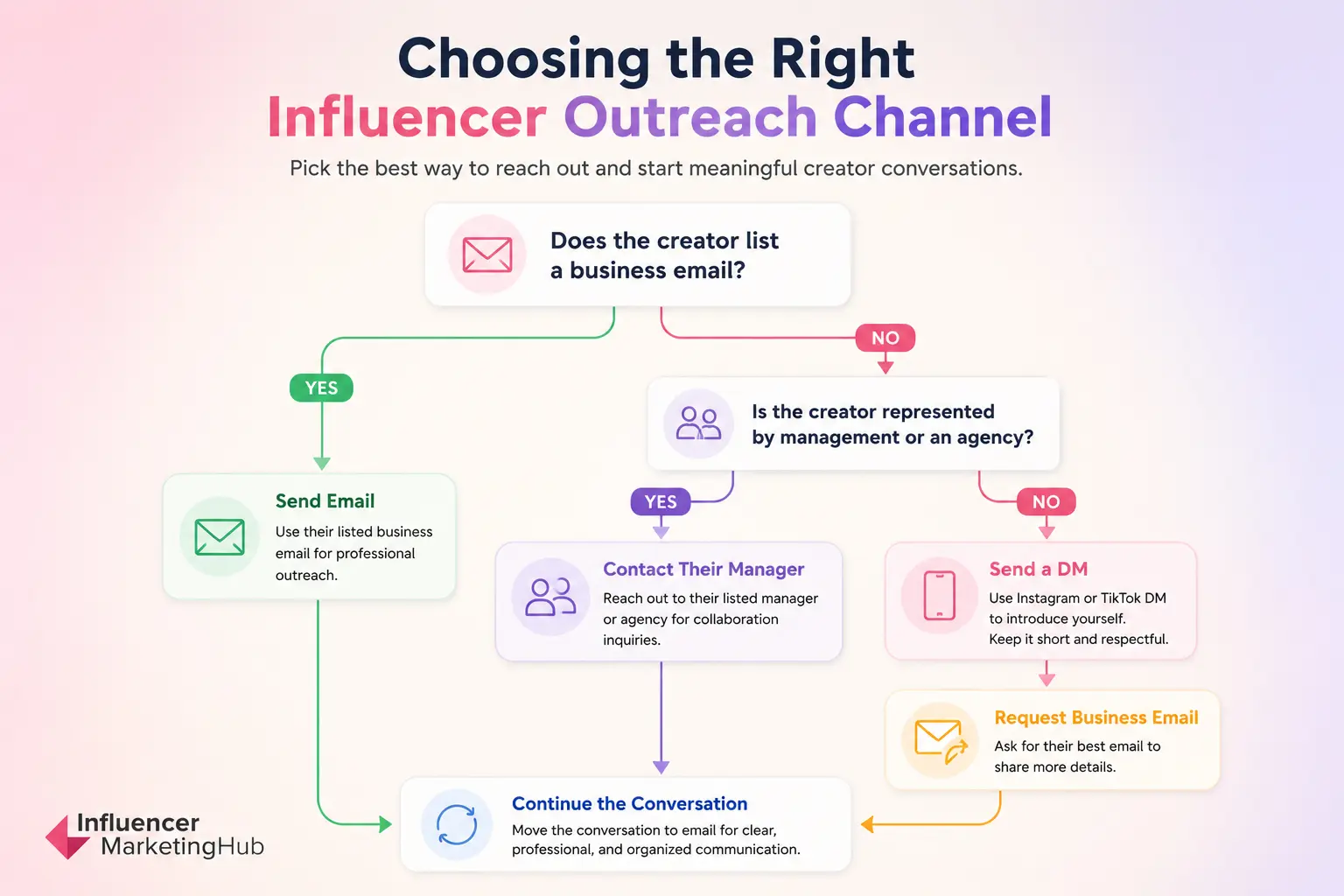
Writing a great outreach message is only half the equation. Choosing the right communication channel can have just as much influence on whether a creator sees your message, responds promptly, or ignores it altogether.
Most creators make it relatively easy to understand how they prefer to handle partnership inquiries.
Some list a dedicated business email in their profile, others work through talent managers, while many smaller creators primarily communicate through direct messages. Respecting those preferences creates a more professional first impression and increases the likelihood of starting a productive conversation.
Rather than using the same approach for every creator, match your outreach channel to both the creator's circumstances and the type of collaboration you're proposing.
| Outreach Channel | Best For | Advantages | Considerations |
| Paid partnerships, ambassador programs, long-term collaborations | Professional, easy to attach briefs and contracts, keeps communication organized | Responses may take longer than social messaging | |
| Instagram DM | Nano and micro influencers, initial introductions | Fast, personal, high visibility for active creators | Messages can be filtered into Requests or overlooked |
| TikTok DM | TikTok-first creators | Convenient for creators who primarily manage their audience on TikTok | Limited functionality compared to email |
| B2B creators, executives, industry experts | Professional networking environment suited to business collaborations | Less appropriate for lifestyle and consumer creators | |
| Talent Manager or Agency | Macro and mega influencers with representation | Streamlined negotiations and centralized communication | Less personal than communicating directly with the creator |
| Influencer Platform Messaging | Campaigns managed through influencer marketing platforms | Keeps outreach, creator management, and campaign communication in one place | Limited to creators using the same platform |
Follow the Creator's Preferred Contact Method
Whenever possible, use the communication channel the creator has already designated for partnership inquiries. If a business email is listed in their profile, treat that as your primary outreach method. It signals that they're open to collaborations and have established a professional process for reviewing opportunities.
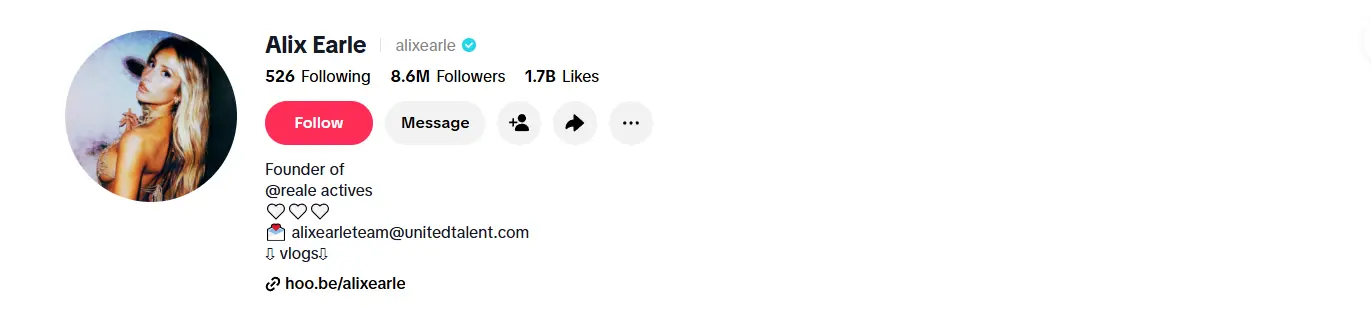
If no contact information is publicly available, a brief, respectful direct message can be an effective starting point. Instead of delivering your entire pitch through social media, introduce yourself, explain that you'd like to discuss a collaboration, and ask for the best email address to continue the conversation.
Know When to Contact Management
Many larger creators work with talent managers or agencies who handle partnership negotiations on their behalf. If management contact details are listed, communicate directly with the representative rather than attempting to bypass them.
Managers can provide campaign availability, pricing, media kits, and contractual information much more efficiently than the creator themselves, helping move discussions forward more quickly.
Keep Your Communication Consistent
Once a conversation begins, avoid switching channels unnecessarily. If outreach starts via email, continue the discussion there unless the creator requests otherwise. Keeping communication in a single location makes it easier to reference campaign details, share documents, and maintain a clear record of decisions throughout the collaboration.
Step 4: Personalize Every Outreach Message
After you've identified the right creators, the next challenge is convincing them that your partnership deserves their attention. Personalization is often described as the key to successful outreach, but many brands interpret that as simply mentioning a creator's latest Instagram post or including their first name in the email.
True personalization goes much deeper. It demonstrates that you've taken the time to understand the creator's audience, content style, and previous collaborations, and that you've thought carefully about why your campaign is a good fit for them specifically.
@femalefounderworld How @alice mushrooms cofounder Charlotte takes on influencer outreach - more tips from her on the show 🤞🏼🍫🪄 #influencermarketing #influencers #businesstips
The goal isn't to impress creators with how much you know about them. It's to make it immediately clear why the partnership is relevant and why it's worth continuing the conversation.
What Should You Personalize?
Instead of relying on generic compliments, focus your research on information that directly supports your collaboration proposal.
| Generic Outreach | Personalized Outreach |
| Mentions a recent post without context | Explains why the creator's content aligns with the campaign objective |
| Focuses on follower count | Highlights audience fit and community relevance |
| Sends identical offers to every creator | Adapts the collaboration based on the creator's strengths |
| Uses generic product descriptions | References how the product naturally fits existing content themes |
| Requests content immediately | Starts with a clear value proposition and mutual benefit |
Strong personalization often includes:
- Why this specific creator was selected.
- How their audience aligns with your campaign.
- Previous content that demonstrates a natural brand fit.
- A collaboration idea tailored to their content style.
- A clear explanation of what's in it for them.
The more relevant your outreach feels, the easier it becomes for creators to picture themselves participating in the campaign.
Step 5: Write Outreach Messages That Start Conversations
Many outreach emails fail because they try to close the deal too early. Long introductions, generic compliments, and lengthy campaign briefs often bury the information creators actually care about.
The first message has a much simpler objective: start a conversation.
A successful outreach message should quickly answer four questions:
- Who are you?
- Why did you choose this creator?
- What opportunity are you offering?
- What happens next?
Keeping the email concise makes it easier for creators to understand the opportunity and decide whether they want to learn more.
Outreach Template: Paid Partnership
Subject: Collaboration Opportunity with {{Brand}}
Hi {{First Name}},
I've been following your content around {{topic}} and particularly enjoyed your recent posts on {{specific example}}. Your approach feels like a natural fit for the audience we're hoping to reach.
We're currently planning a campaign for {{Brand}} and would love to explore a paid collaboration with you. The campaign focuses on {{brief objective}}, and we believe your content style would be a great match.
If you're interested, I'd be happy to share the campaign brief, timeline, deliverables, and budget.
Looking forward to hearing your thoughts.
Best,
{{Name}}
Outreach Template: Product Gifting
Rather than immediately requesting content, product gifting should focus on introducing your brand without creating pressure.
Explain why you think the product would genuinely interest the creator, clarify that there are no obligations unless otherwise agreed, and invite them to share feedback if they enjoy the experience.
This approach often creates more authentic relationships and can naturally lead to future paid collaborations.
Outreach Template: Affiliate Partnership
Affiliate outreach works best when the opportunity is presented as a long-term revenue partnership rather than a one-off campaign.
Clearly explain:
- commission structure
- product fit
- audience relevance
- available marketing support
- expected next steps
Creators should immediately understand how the partnership benefits both sides.
Outreach Template: Brand Ambassador Program
For ambassador outreach, emphasize the relationship rather than the campaign.
Instead of focusing on a single deliverable, explain:
- long-term collaboration opportunities
- early product access
- ongoing campaigns
- exclusive benefits
- opportunities to shape future products or initiatives
This positions the partnership as something creators can invest in over time rather than another transactional sponsorship.
📥 Get the IMH Influencer Outreach Playbook
Building a successful outreach strategy starts with having the right messaging framework. The IMH Influencer Outreach Playbook includes ready-to-use outreach templates, subject line ideas, personalization tips, follow-up examples, and best practices you can adapt for different collaboration types.
Whether you're reaching out for a paid partnership, product gifting campaign, affiliate program, or long-term ambassador opportunity, the playbook provides practical guidance to help you communicate with creators more effectively.
Step 6: Build a Follow-Up Strategy That Doesn't Feel Pushy
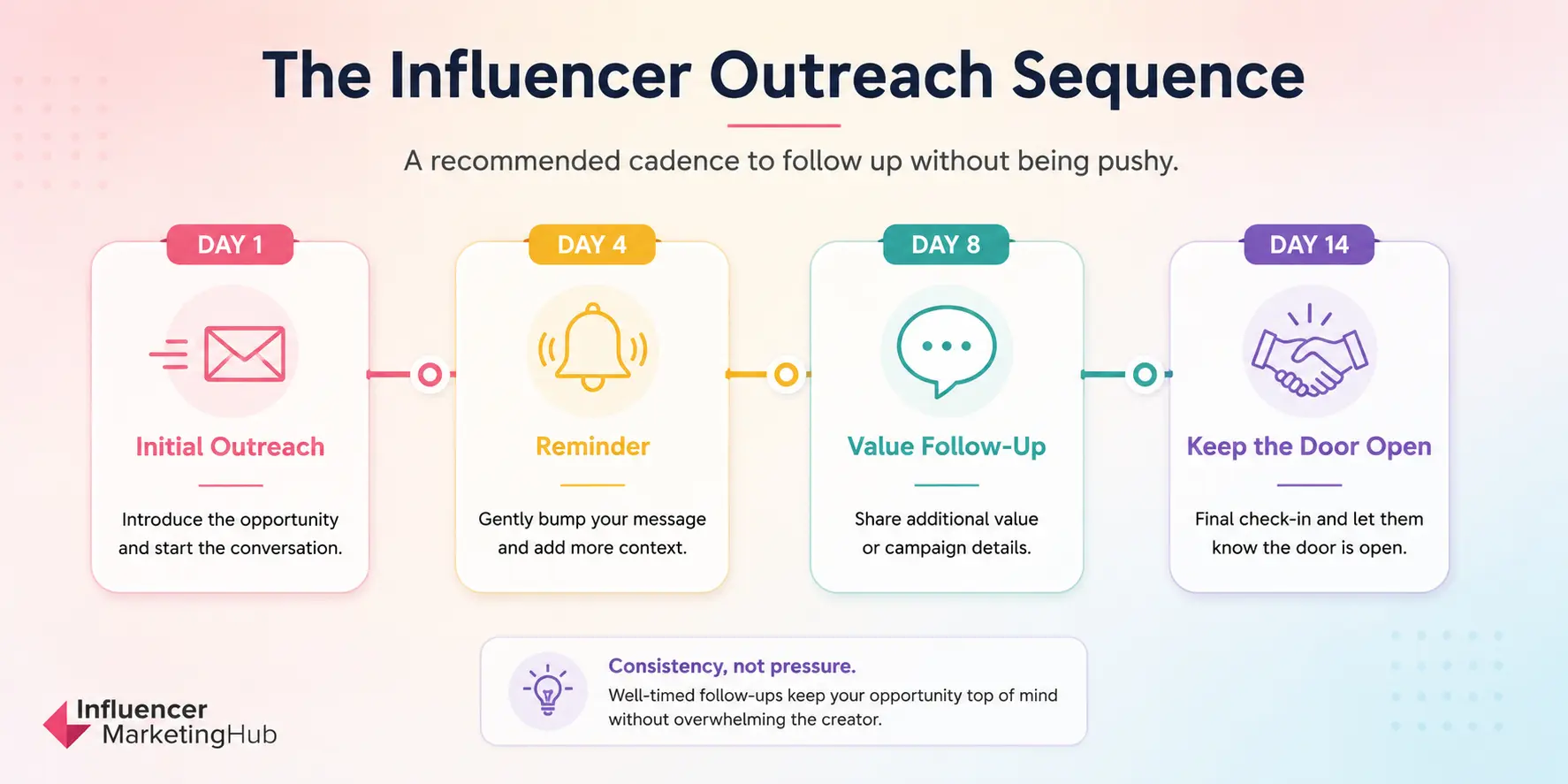
Silence after your first outreach message doesn't automatically mean a creator isn't interested. Inbox overload, travel, content deadlines, and campaign commitments can all delay responses. A thoughtful follow-up process helps keep your outreach visible without overwhelming the recipient.
The key is consistency rather than persistence. Every follow-up should add value or gently remind the creator about the opportunity instead of simply asking whether they've seen your previous email.
A simple outreach sequence might look like this:
| Day | Action |
| Day 1 | Send initial outreach email or message |
| Day 4 | First follow-up with a brief reminder and additional context |
| Day 8 | Second follow-up highlighting campaign timing or value |
| Day 14 | Final follow-up acknowledging this may not be the right opportunity and leaving the door open for future collaborations |
If there's still no response after several well-spaced attempts, move the creator into a nurture list rather than continuing to follow up indefinitely. They may become a better fit for future campaigns, and ending the conversation professionally helps preserve the relationship.
The goal is to make it easy for genuinely interested creators to re-engage when the timing is right.
Step 7: Measure and Improve Your Outreach Strategy
Without measurement, it's impossible to know whether your outreach strategy is improving or simply generating more activity.
Many teams focus exclusively on campaign performance after creators have been recruited. While campaign metrics are important, evaluating the outreach process itself helps identify bottlenecks long before content goes live.
Tracking outreach performance allows you to understand which creator profiles respond most often, which messaging approaches generate conversations, and where adjustments can improve future campaigns.
Consider monitoring metrics such as:
| Metric | Why It Matters | Target Outcome |
| Outreach Response Rate | Measures initial creator engagement | Higher response rates over time |
| Positive Reply Rate | Indicates message quality and creator fit | More creators interested in collaborating |
| Partnership Conversion Rate | Tracks how many conversations become campaigns | Higher percentage of qualified partnerships |
| Average Response Time | Helps plan campaign timelines | Faster communication cycles |
| Follow-Up Success Rate | Measures effectiveness of reminder emails | More replies after follow-ups |
| Repeat Collaboration Rate | Indicates long-term relationship health | More returning creators |
These metrics should be reviewed after every campaign rather than once or twice a year. Small improvements in response rates or creator qualification can compound significantly across larger outreach programs.
📥 Get the IMH Influencer Outreach CRM
As outreach campaigns grow, keeping track of creators, conversations, follow-ups, and campaign stages becomes increasingly difficult without a structured system.
The IMH Influencer Outreach CRM gives you a centralized workspace to manage every stage of the outreach process—from your first contact through active collaborations and long-term partnerships. Instead of relying on scattered spreadsheets and inbox searches, you can monitor progress, organize follow-ups, and maintain stronger relationships across multiple campaigns.
Use it to:
- Track every outreach conversation in one place
- Manage follow-up schedules and campaign stages
- Organize creator contact information and collaboration history
- Monitor partnership progress from outreach to completion
Bonus Step: Turn Outreach Into Long-Term Creator Partnerships
A successful outreach strategy shouldn't end when a creator agrees to collaborate. Some of the highest-performing influencer programs are built on ongoing relationships rather than continuously sourcing new creators for every campaign.
Long-term partnerships benefit both sides. Brands spend less time recruiting and onboarding new creators, while influencers gain a deeper understanding of the products, messaging, and audience they represent.
The result is content that feels more authentic, requires less creative direction, and often performs better because it reflects genuine familiarity with the brand.
Instead of treating every collaboration as a standalone project, look for opportunities to continue working with creators who consistently deliver strong results.
How to Build Stronger Creator Relationships
Long-term partnerships are developed through consistent communication and mutual value rather than repeated sponsorship offers.
After each campaign:
- Share campaign performance and key outcomes where appropriate.
- Provide constructive feedback alongside recognition for successful work.
- Pay creators promptly and communicate clearly throughout the collaboration.
- Keep creators informed about future campaigns and upcoming product launches.
- Offer opportunities that match their evolving content style and audience.
The objective isn't simply to secure another piece of sponsored content. It's to become one of the brands creators genuinely enjoy working with.
As trust develops, creators often become more invested in your success, leading to stronger storytelling, more authentic recommendations, and opportunities for ongoing ambassador relationships.
Common Influencer Outreach Mistakes (and How to Avoid Them)
Even well-planned campaigns can struggle when avoidable mistakes undermine the outreach process. Most issues don't stem from poor email writing—they begin much earlier through rushed research, unclear objectives, or inconsistent communication.
Reviewing your outreach process regularly can help identify patterns that reduce response rates and prevent promising creator relationships from developing.
| Common Mistake | Better Approach |
| Prioritizing follower count over audience fit | Evaluate creators based on audience relevance, engagement quality, and campaign alignment. |
| Sending identical outreach to every creator | Tailor every message around the creator's content, audience, and collaboration opportunity. |
| Contacting creators before defining campaign goals | Establish clear objectives before beginning creator discovery. |
| Explaining the entire campaign in the first email | Keep the first message concise and focus on starting a conversation. |
| Following up too aggressively | Use a structured follow-up sequence with appropriate spacing between messages. |
| Ending the relationship after one collaboration | Continue nurturing high-performing creators for future partnerships. |
| Measuring only campaign performance | Track outreach KPIs alongside campaign results to continuously improve your process. |
Avoiding these common pitfalls creates a more professional experience for creators while helping your team build a scalable outreach process that improves with every campaign.
Build Better Creator Relationships, Not Just Better Outreach Emails
An effective influencer outreach strategy isn't measured by the number of emails you send—it's measured by the quality of the partnerships you build. Every successful collaboration begins with choosing the right creators, personalizing your communication, and following a consistent process that respects creators' time and expertise.
Using our IMH Influencer Outreach Framework, you can transform outreach from a series of one-off messages into a repeatable system for discovering creators, building relationships, and continuously improving campaign performance.
Combined with the Qualification Scorecard, Outreach Playbook, and Outreach CRM, you'll have everything you need to build a scalable outreach process that delivers stronger partnerships and better results over time.
Frequently Asked Questions
What is an influencer outreach strategy?
An influencer outreach strategy is a structured process for identifying, qualifying, contacting, and building relationships with creators who align with your marketing goals. It covers every stage of outreach, from creator discovery and personalization to follow-ups and long-term partnership management.
How do you contact influencers professionally?
Start by researching the creator and personalizing your message around their audience and content. Introduce your brand, explain why you chose them specifically, outline the collaboration opportunity, and finish with a clear next step. Keep your first message concise and avoid overwhelming creators with unnecessary details.
Should I email influencers or send them a direct message?
The best communication channel depends on the creator. Email is generally more appropriate for professional collaborations, while direct messages can work well for smaller creators or initial introductions. Always check whether the creator lists a preferred contact method in their profile or media kit.
How many follow-up messages should I send?
A structured sequence of two or three follow-ups is generally sufficient. Space each message several days apart, provide additional context or value where appropriate, and avoid sending repeated reminders that don't move the conversation forward.
What should an influencer outreach email include?
An effective outreach email should briefly introduce your brand, explain why the creator is a good fit, describe the collaboration opportunity, highlight what's in it for the creator, and include a simple call to action inviting them to continue the conversation.
How do I find influencers for outreach?
You can discover creators through influencer marketing platforms, social media searches, customer communities, competitor research, referrals, and existing partnerships. Once identified, evaluate each creator based on audience alignment, engagement quality, content style, professionalism, and long-term partnership potential before reaching out.
What metrics should I track during influencer outreach?
Monitor outreach-specific metrics such as response rate, positive reply rate, partnership conversion rate, average response time, follow-up success rate, and repeat collaboration rate. These indicators help you improve your outreach process before campaigns even begin.
How can I improve influencer response rates?
Focus on quality over quantity. Personalize every outreach message, contact creators who genuinely fit your campaign, clearly explain the value of the partnership, follow up professionally, and invest in long-term relationships instead of treating every collaboration as a one-off opportunity.

SUGGESTED

Crafting The Perfect Influencer Outreach Email (+ Free Templates)
Learn how to write influencer outreach emails that get replies. Includes 10 free...

Game-Changing Influencer Outreach Tools Every Marketer Needs
Unlock marketing potential with game-changing influencer outreach tools. Essential for...

What Is an Influencer? Definition, Types, and How Influencers Work
What is an influencer? Learn how influencers build trust grow audiences work with brands...