
- TikTok has overtaken Instagram as the leading platform for beauty influencer marketing by total EMV
- The platform generated over $18B in Earned Media Value, with strong year-over-year growth
- Instagram remains relevant but is now driven by format performance rather than platform dominance
- YouTube delivers the highest EMV per post, signaling underutilized potential
- Brands must rethink platform allocation and content strategy to stay competitive
New data from WeArisma signals a clear shift in beauty influencer marketing: TikTok is now the primary driver of value.
According to the platform’s latest Beauty Influencer Index, TikTok has surpassed Instagram in total Earned Media Value (EMV), generating more than $18 billion across beauty campaigns.
The report aggregates performance across leading beauty brands, creators, and campaigns, offering one of the clearest views into where attention, engagement, and ultimately conversion potential are moving.
For marketers, this marks a structural change in how beauty brands market on social media.
⭐Put TikTok’s Beauty Momentum to Work
TikTok now generates more beauty influencer EMV than any other platform, giving brands a timely opportunity to turn creator-led discovery into measurable growth. Create your TikTok Ads account and claim up to $6,000 in ad credits to power your first campaigns through this limited-time offer.
TikTok’s Rise From Discovery Channel to Revenue Driver
TikTok’s growth in beauty has been building for several years, but this dataset confirms its transition from experimental channel to primary investment pillar.
The platform’s format ecosystem plays a central role. Beauty content thrives on tutorials, transformations, product testing, and before-and-after storytelling, all of which align natively with TikTok’s short-form video structure.
Unlike static or overly curated formats, TikTok rewards authenticity, speed, and iteration, allowing creators to produce high volumes of content that can scale rapidly.
The result is not just reach, but compounding visibility. Multiple creators can generate momentum around a single product simultaneously, creating a network effect that traditional platforms struggle to replicate.
@ariellelorre nighttime skincare but ok WHO has tried P-tiox? Im kind of obsessed? We need to discuss 😯
From a performance standpoint, TikTok is driving measurable value at scale.
Explore Insights from Leading Beauty Influencer Marketing Campaigns
Want to see how top beauty and skincare brands are actually driving performance across TikTok, Instagram, and YouTube?
Access real campaign breakdowns, including creator strategies, engagement benchmarks, and EMV performance across leading brands.
👉 Explore Top-Performing Beauty & Skincare Influencer Marketing Campaigns and uncover what’s working right now
Instagram’s Role Is Changing, Not Disappearing
Instagram remains a major player in beauty influencer marketing, but the data shows a clear shift in how value is created on the platform.
According to the same index:
- Reels generate 2-3x higher engagement rates compared to static posts
- Carousel posts continue to outperform single-image posts in saves and deeper engagement
- Static content is declining in relative contribution to total EMV
This signals a structural change. Instagram is no longer a uniform channel where all content types perform equally. Instead, format selection directly impacts campaign outcomes.
For brands, this means optimizing for video-first execution within Instagram rather than relying on legacy feed strategies. Presence alone is no longer enough. Performance depends on how well the content aligns with current consumption behavior.
YouTube Delivers the Highest Value Per Post
While TikTok leads in total EMV, YouTube stands out in efficiency.
The report highlights that YouTube consistently delivers the highest EMV per post across beauty campaigns, with around $26.4K, outperforming both TikTok and Instagram on a per-content basis.
This reflects the nature of long-form content:
- Tutorials, reviews, and deep-dive product content drive higher intent and longer watch time
- Audiences on YouTube are more likely to be in a consideration or purchase mindset
- Fewer posts generate disproportionately higher value
In practical terms, TikTok wins on scale, but YouTube wins on depth.
For marketers, this creates an opportunity. Many brands underinvest in YouTube relative to its impact, focusing heavily on short-form content while overlooking high-intent formats.
Beauty Sub-Sectors Are Diverging Across Platforms
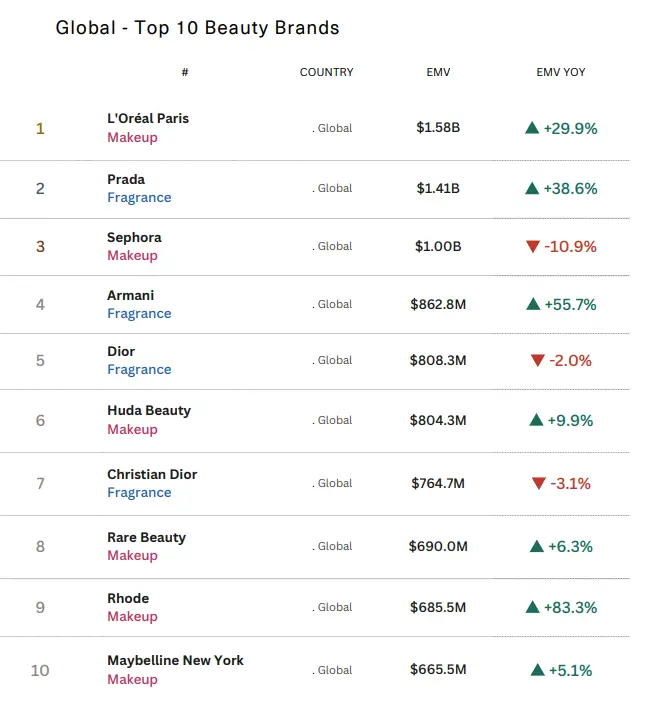
The data from WeArisma shows that “beauty” is no longer a single category. Performance is fragmenting across makeup, skincare, and fragrance, each with distinct growth patterns, platform dynamics, and leading brands.
Makeup Still Dominates, but Growth Is Slowing
Makeup remains the largest segment, generating $27.7B in EMV, which accounts for 61% of total beauty influencer value.
Top performers include:
- L’Oréal Paris at $2.83B EMV (+49.2%)
- Sephora at $1.69B EMV (-1.9%)
- Huda Beauty at $1.29B EMV (+20.9%)
However, growth in the category is more modest at +12.1% YoY, and legacy brands are losing ground. Notably:
- Fenty declined -19.8%
- Pat McGrath Labs dropped -22%
At the same time, founder-led brands are reshaping the category, with Rhode reaching $1.0B EMV (+94.9%).
Platform-wise, makeup is the most competitive vertical:
- TikTok: $13.1B EMV
- Instagram: $11.6B EMV
The takeaway is clear. Makeup still drives scale, but growth is shifting toward newer, creator-native brands and formats.
Top Trends Revolutionizing Beauty & Skincare Marketing
Looking to stay ahead of what’s actually driving performance in beauty right now?
Dive into the latest trends shaping influencer marketing across skincare, makeup, and fragrance, backed by real campaign data, creator insights, and platform performance benchmarks.
👉 Explore the Top Trends Transforming Beauty & Skincare Influencer Marketing and see what leading brands are doing differently
Skincare Is the Fastest-Growing at the Brand Level
Skincare generated $9.3B in EMV, growing +19.4% YoY, making it one of the fastest-expanding verticals on a per-brand basis.
Key brands include:
- Garnier at $765.9M (+18.2%)
- La Roche-Posay at $504.3M (+50.9%)
- CeraVe at $453.7M (+41.6%)
The standout story is K-beauty. Brands like Medicube surged +293%, one of the largest growth spikes across the entire dataset.
Platform distribution is even more telling:
TikTok drives 53% of all skincare EMV, more than Instagram and YouTube combined
This reflects a shift toward education-first content. Skincare creators are not just showcasing products. They are explaining ingredients, routines, and outcomes, which aligns directly with TikTok’s format strengths.
Fragrance Is the Fastest-Growing Overall Category
Fragrance is the breakout vertical, generating $8.4B in EMV, with +22.5% YoY growth, the highest across all beauty sub-sectors.
Top brands include:
- Prada at $1.70B (+42.5%)
- Dior Beauty at $1.06B (+10.9%)
- Armani at $976M (+57.4%)
Unlike other categories, fragrance is still Instagram-led:
- Instagram: $4.67B EMV
- TikTok: $2.36B EMV
This reflects the category’s reliance on aspirational storytelling and luxury positioning.
However, a key shift is emerging through creator-led formats. The “scent layering” trend alone generated $33.4M EMV (+31.5% YoY), driven by tutorial-style content rather than traditional brand imagery.
@aaliyacooll This dusting powder hack will have you turning heads for HOURS! @Josie Maran @LUSH @LOCCITANE #bodycareroutine #dustingpowder #bodycare #howtosmellgood #scentlayering
The Bigger Pattern Across Categories
Looking across all three verticals, a consistent pattern emerges:
- TikTok dominates education, routines, and scalable content (skincare, makeup)
- Instagram remains strong where aspiration and luxury storytelling matter (fragrance)
- Growth is increasingly driven by creators, not legacy brand equity
The implication for marketers is straightforward. Platform strategy cannot be uniform across “beauty.” It must be tailored to how each sub-category behaves and converts.
Best Influencer Marketing Strategies for Beauty & Skincare Brands
Want to move from insights to execution?
Explore proven influencer marketing strategies used by leading beauty and skincare brands to drive engagement, build communities, and convert attention into revenue.
👉 Discover the Best influencer Marketing Strategies for Beauty & Skincare Brands and learn how to apply them to your next campaign
What This Means for Marketers
The data from WeArisma points to a more complex reality for beauty influencer marketing than most teams account for. Performance is no longer dictated by a single platform, format, or creator tier. It is shaped by how well brands align platform dynamics with category-specific behavior.
At the platform level, the divide is clear. TikTok is driving the majority of Earned Media Value through volume and discovery, while Instagram continues to anchor brand storytelling and premium positioning. YouTube, although smaller in share, remains critical for high-intent, long-form education.
Treating these channels interchangeably leads to underperformance.
At the vertical level, the differences are just as pronounced. Makeup thrives on trend velocity and creator scale. Skincare leans into education and trust, with TikTok accelerating both reach and credibility. Fragrance, historically dependent on visual branding, is evolving into a creator-led category where explanation and storytelling now influence purchase decisions.
Taken together, these insights highlight a shift in how programs need to be structured. Successful brands are not asking “Which platform should we invest in?” but rather:
- Where does each category generate the most value?
- Which formats drive engagement versus conversion?
- How should creator roles change across channels?
Execution now requires a more deliberate mix of creators, content formats, and distribution strategies. The brands that win will be the ones that treat influencer marketing less like a channel and more like a coordinated system of platform and category-specific plays.
Turning Beauty Creator Strategy Into a Campaign System
The benchmarks above point to a bigger execution problem for beauty brands: the winning strategy is no longer just “invest more in TikTok” or “add more creators.” Performance now depends on how well the creator mix, content format, platform behavior, and product category are engineered together.
This is where Intuition Media Group offers a useful execution model. The agency builds creator programs around cultural fit, audience alignment, campaign architecture, and performance measurement, which is especially relevant in beauty categories where the same creator strategy will not work equally well for makeup, skincare, and fragrance.
Ready to build a creator strategy tailored to your beauty category?
For example, skincare creators often need credibility, education, and routine-based storytelling. Makeup campaigns usually need trend velocity, visual transformation, and high-volume short-form content. Fragrance, on the other hand, still leans heavily on aspiration and sensory storytelling, which makes creator fit and creative direction even more important. A broad creator list is not enough. Brands need a casting system that can match creators to the role each platform and product category actually requires.
IMG’s approach is built around this idea. Through its IC4 Model and Creator Alignment Score, the agency evaluates creators beyond follower count, looking at cultural relevance, audience quality, content consistency, brand fit, and the creator’s ability to translate a product into content that feels native to their community. That makes the selection process more useful for beauty brands trying to decide whether a creator should drive TikTok discovery, Instagram brand storytelling, YouTube education, or paid creator amplification.
The operational benchmark is also important. In one Canon activation, IMG sourced and activated 22 professional creator partners in four weeks, generating 36M+ impressions and 72K+ engagements. For GoDaddy, the agency built a psychographic creator strategy around three entrepreneur archetypes and produced 75 pieces of content that reached 3M+ consumers. For Washington Prime Group, a multi-market creator campaign generated 40M+ impressions and 52M reach by activating micro and mid-tier lifestyle creators around physical retail experiences.
For Beauty Marketers, the lesson is practical....
Fragmented platform performance requires structured creator architecture. A skincare campaign might need educators and routine-builders on TikTok, deeper review content on YouTube, and paid amplification around the strongest creator assets. A fragrance campaign might need fewer but more aspirational creators who can translate mood, identity, and occasion into content that feels premium. A makeup launch might need broader creator volume to create repetition, trend participation, and transformation-led visibility.
The New Beauty Influencer Playbook Is Fragmented by Design
Beauty influencer marketing is no longer driven by a single formula. The data shows a clear shift toward platform specialization and category nuance, where performance depends on aligning the right creators, formats, and channels with the right product vertical.
For marketers, the implication is straightforward but demanding. Campaigns can no longer be built around broad assumptions. They must be engineered with precision, factoring in how each category performs across platforms and how content formats influence outcomes.
Brands that adapt to this fragmented reality will see stronger returns. Those that do not risk spreading investment too thin across channels that behave very differently.
For a deeper breakdown of the data, benchmarks, and brand-level insights, explore the full report from WeArisma.