
For the risk of stating the obvious, customers expect first-class customer service. Why mention it? Because in 2025, it will become one of their biggest expectations.
Providing a flawless customer experience is already challenging. Add to that the need to be active on various online channels and all of a sudden the already challenging task has just become a whole lot harder.
You see, nowadays consumers expect the same experience, whether they’re browsing the web via their desktop or scrolling down a social media site via a smartphone. A possible solution is to add a digital experience platform to your tech stack. Basically, it will make it a whole lot easier to manage the different touch points.
If it’s all new to you, here’s a quick look at what a digital experience platform is, why it’s a worthwhile investment, and which platforms to trial.
What’s a Digital Experience Platform?
In short, a digital experience platform (aka DXP) is a software solution that helps you to create a first-class digital experience that users can enjoy across all the different touch points such as your business website and official Facebook business page. Though, it shouldn’t get confused with a content management system (CMS).
Content management systems typically concentrate more on websites, whether it’s simply a blog or a site with eCommerce functionality. On the other hand, a DXP works across all digital channels. Let’s call a spade a spade, compared to a CMS, a DXP offers more functionality.
When you use a digital experience platform, you’ll get access to tools and detailed insights that make it much easier not only to manage the digital experience, but also to optimize it. For instance, armed with a better understanding of who your users are, you can make changes to your content strategy. This way, the content that you end up churning out will be more relevant to your actual users.
In addition to improving the experience for customers, it can also help your business to fast-track its processes by digitizing operations.
Three Advantages Offered by DXPs
As touched upon briefly in the previous section, DXPs have benefits in store for both your business and its customers. Here’s how:
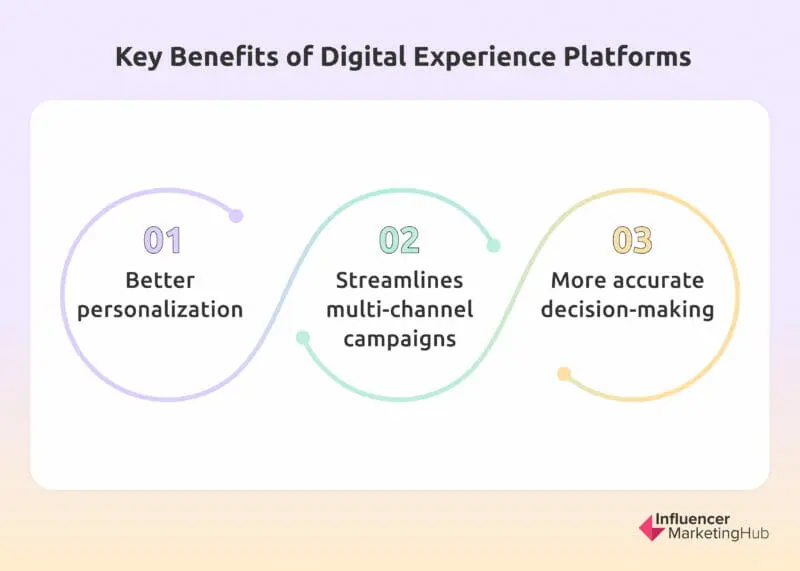
1. Better personalization
If you’re a regular reader of Influencer Marketing Hub or any decent blog about marketing, you would know that personalization is key. From stronger lead nurturing to increased customer loyalty, just by personalizing your website, you can already reap many rewards. With the help of a solid DXP, it becomes a whole lot easier to create personalized content, not just for your business websites but all your channels (which brings us to the next benefit).
2. Streamlines multi-channel campaigns
While your website remains a critical tool, you’ll need more than that to grow your business. The challenge, though, is to implement your marketing campaigns across multiple channels. With the help of a DXP, it becomes much easier to create and maintain an online presence across different channels.
Plus, you don’t have to worry that your brand won’t be portrayed consistently. As it helps with content management, it’s much easier for your marketing team to ensure that critical elements like tone and color schemes have been used correctly on different channels.
3. More accurate decision-making
Software tools and marketing agencies like to use the phrase “data-driven decision-making”. It has become somewhat of a clichéd buzzword. However, with the right DXP in your tech stack, this truly becomes the case.
A solid DXP will be able to track key KPIs automatically. Armed with this data, you’ll be able to access customer data that can give you much better insight into their customer journey. What’s more, your different teams will also be able to coordinate their data more efficiently in real time.
Top Digital Experience Platforms to Demo:
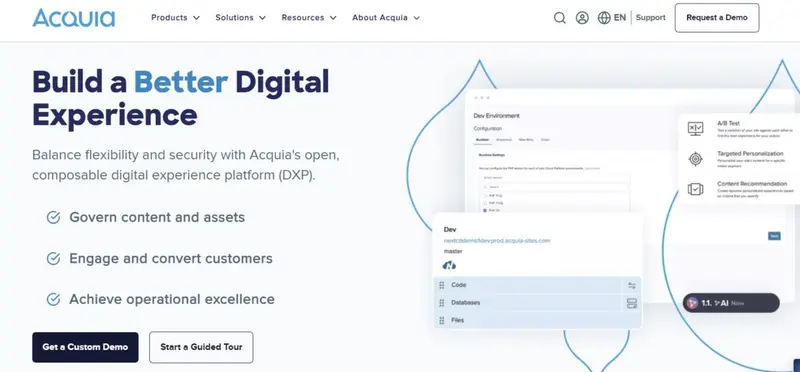
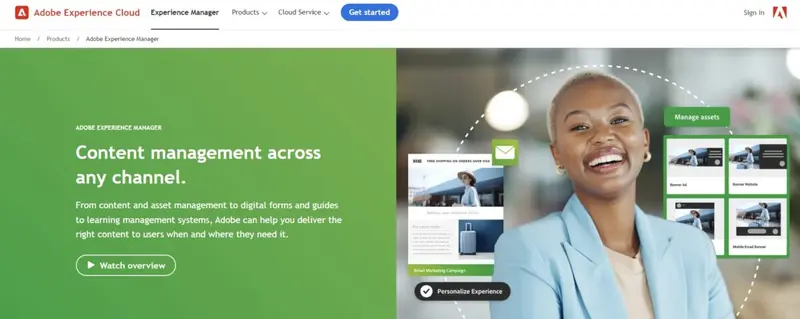
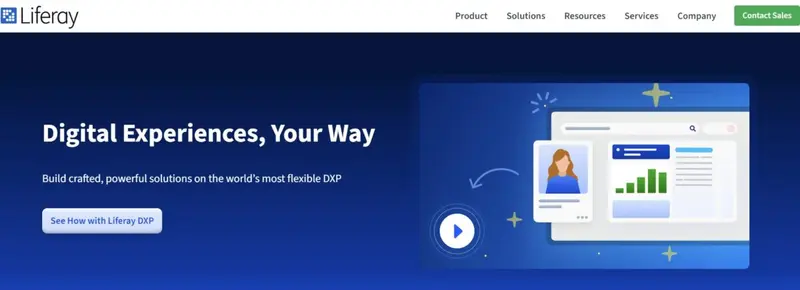
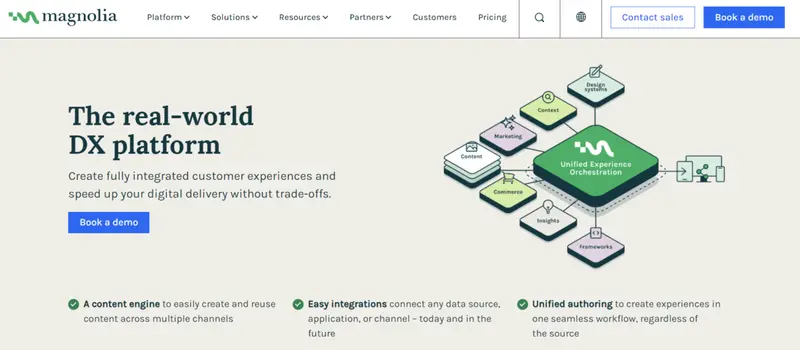
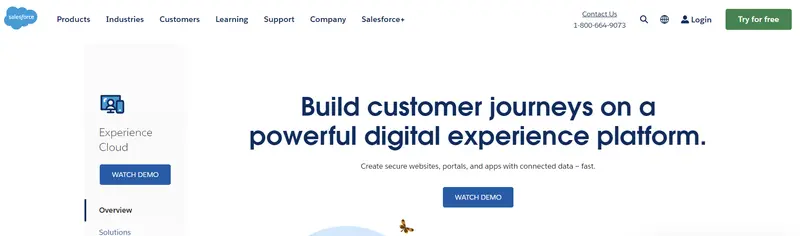
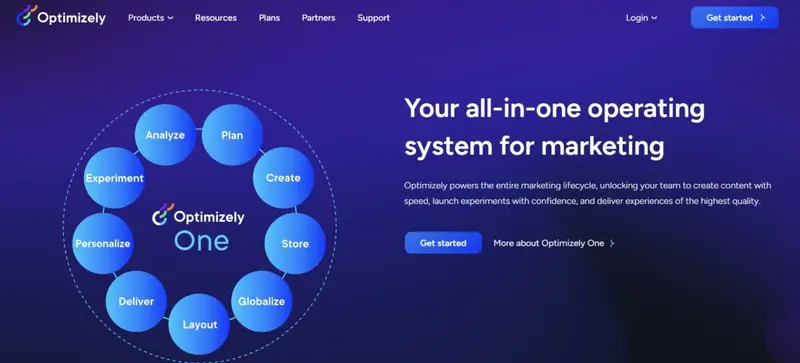
Trusted by names like Crayola, J. Crew, and Johnson & Johnson, Acquia is an open-source digital experience company that was built upon Drupal, a free and open-source CMS. It offers flexible architecture allowing you to use a common framework to create customer and employee applications and assemble digital experiences. It’s an example of an open DXP. What this means is that it combines products from various vendors. This is a great approach to take if you prize flexibility. Plus, the community is quite active which means that new functionality gets introduced regularly and bugs are attended to quickly. While Adobe needs no introduction, you might not be familiar with its Adobe Experience Manager. It merges digital asset management (DAM) with a content management system to help you manage all your content and digital assets. While it’s mainly used by B2C companies, some businesses that operate in the B2B space have also found a good use for it. It’s one of the leaders in this product category. For five years running, it has been identified as one of the leaders in the 2022 Gartner Magic Quadrant for Digital Experience Platforms. Liferay’s award-winning platform allows you to build B2B, B2C, and B2E experiences. They offer a range of solutions, like customer self-service portals and modern intranets, that can help to solve very intricate digital challenges. With regards to its DXP specifically, it includes all the tools you need to manage your content. This way, you can control who sees what. It also makes knowledge sharing across different departments in your business a whole lot easier. You can store all your digital assets in one central place. If you have multiple integrations, Gartner lists Liferay as one of the best solutions. Liferay’s application development and extensibility are two of the standout strong points. Sitecore offers an end-to-end composable digital experience platform that helps their users to consolidate data, commerce, experiences, and content. Trusted by thousands of brands that include a number of well-known global brands like PUMA, Canon, and United Airlines, their platform improves interactions across all touchpoints. Along with Acquia, analysts have identified their platform as one of the leaders nine years running. Sitecore’s range of tools can help with various tasks like: Established in 2004, Kentico is one of the older platforms in this niche. While they’ve been around for nearly two decades, their platform is innovative and flexible. From managers to marketers, everyone on your team will find it valuable and businesses operating in the government, education, manufacturing, retail, and healthcare verticals even more so. More than 35,000 websites are running on Kentico and using it to unify commerce, content management, and digital marketing. For example, if you want to focus on content management, you can use it to repurpose content in your mobile app and marketing campaigns. Not only does this save time, but it also ensures that branding is consistent across all channels. Magnolia’s story started in the late 90s when two software entrepreneurs set out to create a flexible CMS. Fast-forward many, many years and it’s one of the most powerful platforms. As you would expect, if you’ve been that long in business, you also have the client list to show for it. Included in Magnolia’s list of clients are Toshiba, Tesco, and Air Canada to name only a few. Their platform visually consolidates your content, assets, commerce, analytics, and custom data sources. With the help of intuitive tools, your different teams can deliver personalized experiences and manage all of these via a single platform. When Zesty’s founders couldn’t find a platform to help their marketing and IT teams work together seamlessly, they decided to build their own. They wanted to find a platform that offered intuitiveness, agility, security, and stability. The results — a customizable platform aimed at businesses growing quickly. With the help of data, integrations, and testing, users can personalize all the various touchpoints. Not only will customers benefit from personalized experiences, but it will also help different teams to streamline tasks like content creation and omnichannel strategies. Salesforce needs no introduction. It’s one of the leading names in the SaaS industry. Thanks to pre-built apps, drag-and-drop features, and low-code web tools, your team can quickly create digital experiences with its Salesforce Experience Cloud. Here are some examples of the digital experiences that you can create with Salesforce: When you use Salesforce, all the experiences will also be completely responsive and optimized for mobile devices. This is a key feature considering that mobile usage is on the up and up. Other ways that it can help you to boost onsite engagement is by rewarding your most active users with custom profile badges. As their name suggests, Optimizely is best known for its optimization capabilities. According to their website, their goal is to make it easier for users to “unlock their digital potential”. Its DXP offers insights and tools that marketers and developers need to create and optimize. To date, they’ve helped thousands of brands, including the likes of eBay, Mazda, and Toyota, do just that. With it, you can manage the entire content lifecycle. It makes it easy to streamline the process by centralizing content creation, while allowing your team the creative freedom needed for the job. 1. Acquia
2. Adobe Experience Manager
3. Liferay
4. Sitecore
5. Kentico
6. Magnolia
7. Zesty
8. Salesforce
9. Optimizely
Wrapping Things Up
If you’ve been struggling to deliver memorable digital experiences to your entire target audience consistently until now, it will probably become only more difficult, at least if you want to grow your presence online. Expectations of users continuously change. To put it more bluntly — their needs become more demanding.
The reality is that you won’t be able to keep up with the changing demands and trends, without the help of some automation. A digital experience platform isn’t the cheapest software solution, but considering the functionality that it brings to the table, it can make financially sense for bigger businesses. Not only will your customers benefit, but various different teams across your business too. Basically, it’s a great tool to keep both customers and employees (the parties upon which your business depends) happy.
Frequently Asked Questions
What is a digital experience platform (DXP)?
A digital experience platform is an integrated software framework that enables companies to build, deploy, and continuously improve digital products and omnichannel experiences. DXPs provide tools for content management, customer data management, personalization, analytics, and multichannel delivery.
Why should businesses invest in a DXP?
Businesses should invest in a DXP to deliver seamless, personalized digital experiences across all customer touchpoints. DXPs help streamline multi-channel campaigns, enable data-driven decision making, and provide better insights into customer behavior and preferences.
What are some key features to look for in a DXP?
Key features to look for in a DXP include robust content management capabilities, omnichannel delivery options, advanced personalization and customer experience tools, AI integration for intelligent recommendations, and strong security and compliance features.
How do I choose the right DXP for my business?
When choosing a DXP, consider your business goals, scalability needs, integration capabilities with existing systems, ease of use for content creators, and cost-effectiveness. Evaluate how well each platform aligns with your specific requirements and can help you deliver exceptional digital experiences.


