


A macro influencer is a content creator with a large, established audience, typically ranging between 100,000 and 1 million followers. Positioned between micro and mega influencers, they offer a balance of scale, credibility, and professional content that makes them a key asset in modern influencer marketing strategies.
Their role is becoming more defined as brands look to scale reach without fully relying on celebrity-level partnerships. In fact, 20.5% of marketers plan on expanding their influencer marketing campaigns through macro influencers, signaling a clear shift toward creators who can deliver both visibility and structured campaign execution.
Understanding how macro influencers fit into the broader influencer industry, how they compare to other tiers, and when they deliver strong results is critical for brands looking to allocate budgets effectively and drive measurable outcomes.
This guide aims to unpack it all.
- What Is a Macro Influencer?
- Macro Influencer Follower Count and Platform Benchmarks
- Macro Influencer vs Micro Influencer
- Benefits of Working with Macro Influencers
- When Brands Should Use Macro Influencers
- How to Find Macro Influencers
- 1. Resonate by Linqia
- 2. Modash
- 3. Upfluence
- Are Macro Influencers Worth It for Your Campaigns?
- Frequently Asked Questions
What Is a Macro Influencer?
A macro influencer is a social media creator with a substantial following, typically built through consistent content production, niche authority, or mainstream visibility. Unlike smaller creators, macro influencers often operate with a more professionalized approach to content, partnerships, and audience management.
Their scale allows them to reach hundreds of thousands or even millions of users per campaign, making them particularly valuable for brand awareness and large-scale visibility initiatives. At the same time, they maintain a level of relatability that is often lost at the celebrity or mega influencer level.
Micro Influencer Typical Follower Count Range
Macro influencers are generally defined by a follower range of 100,000 to 1 million followers. These influencers sit in the middle of the spectrum, bridging the gap between niche creators and celebrity-level personalities.
- Nano influencers: Typically under 10,000 followers, known for highly engaged niche audiences
- Micro influencers: Usually between 10,000 and 100,000 followers, offering strong engagement and targeted reach
- Macro influencers: 100,000 to 1 million followers, focused on scale and visibility
- Mega influencers: Over 1 million followers, often celebrities or public figures
Macro Influencer Follower Count and Platform Benchmarks
We've established the baseline follower count for macro influencers. But follower count alone does not tell the full story. Platform dynamics, content performance, and audience behavior all influence how reach translates into actual impact.
Why Follower Thresholds Vary by Platform
Follower ranges for macro influencers typically fall between 100,000 and 1 million, but platform mechanics influence how that range is interpreted.
TikTok’s algorithm allows creators to scale rapidly, which means follower count alone often understates actual reach. Brands frequently evaluate average views and content consistency alongside audience size to determine whether a creator operates at a macro level.
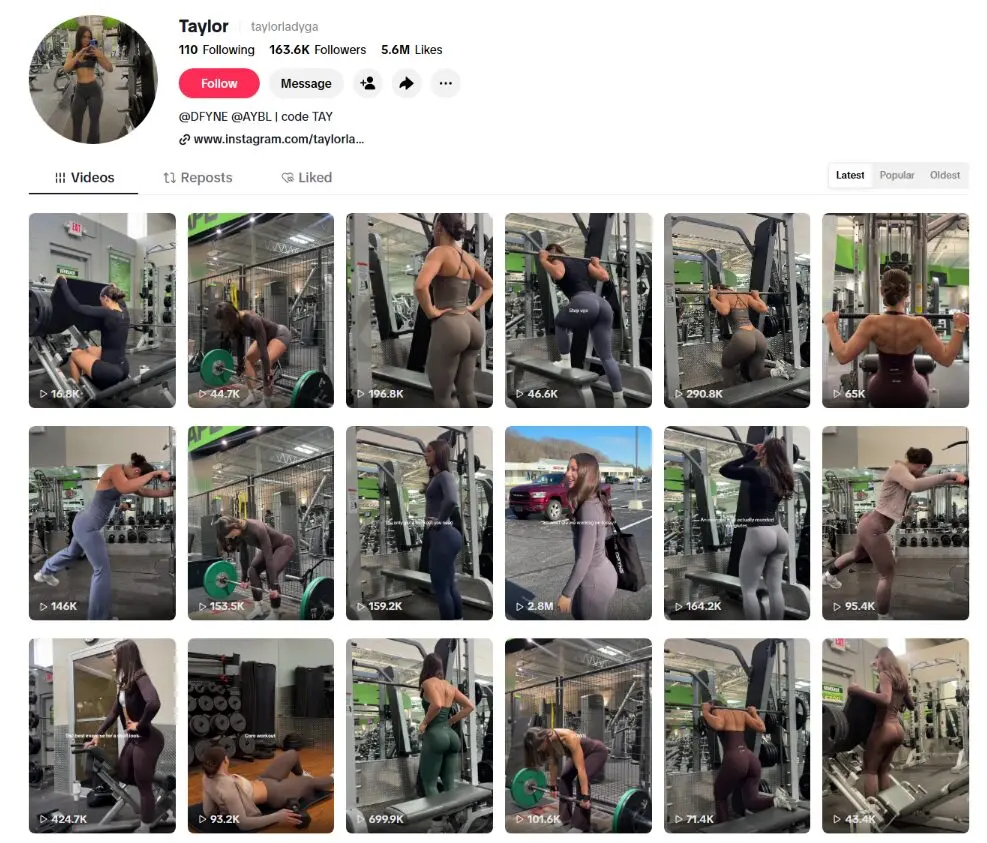
Let's take fitness influencer Taylor Ladyga as an example. Despite having only 163k TikTok followers, which isn't that high for a macro influencer, she regularly gets hundreds of thousands, even millions, of views on her TikTok videos.
These numbers should suggest to brands that the creator operates on a macro level, despite being categorized as a micro influencer.
Unlike TikTok, Instagram remains more follower-driven, although declining organic reach has made performance metrics increasingly important. A large audience does not guarantee consistent visibility, so engagement and impressions must be considered together.
YouTube requires a different lens. Subscriber count is only one signal. Average views per video, watch time, and upload consistency play a central role in defining influence.
Follower count provides a useful benchmark, but performance metrics ultimately determine whether a creator can deliver macro-level results.
Engagement Rates vs Audience Size
Larger audiences tend to come with lower engagement rates. For instance, the average engagement rate for macro influencers is 2.05%, compared to the lowest tier, which is nano influencers with 5.60% and 2.43%.
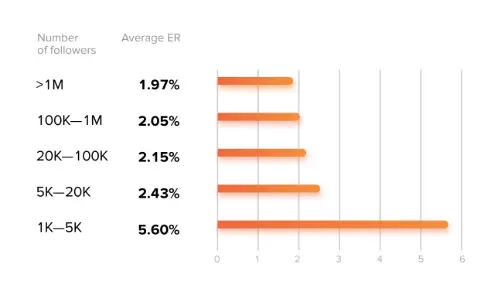
That pattern is consistent across most social platforms and shapes how macro influencers are evaluated.
Smaller creators often maintain tighter communities, which leads to higher interaction rates. Macro influencers, in contrast, generate value through scale and visibility rather than depth of interaction.
Campaign goals should guide how this trade-off is interpreted. Awareness-driven campaigns benefit from large reach, while engagement-heavy strategies may require additional creator tiers to support interaction.
Macro Influencer vs Micro Influencer
Macro and micro influencers serve different roles within influencer marketing strategies. Each tier delivers value in distinct ways, and choosing between them depends on campaign objectives, budget, and desired outcomes.
Reach vs Engagement
Macro influencers are built for scale. With audiences ranging from 100K to 1M followers, a single post can generate significant visibility, especially when combined with algorithmic distribution on platforms like TikTok and Instagram.
Micro influencers, typically in the 10K to 100K range, deliver stronger engagement relative to their audience size. According to our benchmarks, nano influencers average engagement rates of around 5.60%, with rates declining as audience size increases. Micro influencers sit below that, with averages around 2.15%, but still outperform macro creators on a percentage basis.
Lower engagement rates at the macro level do not indicate weak performance. Absolute engagement often remains higher due to larger reach. A macro influencer generating a 1% engagement rate on 500K followers still produces more total interactions than a micro influencer at 3% on 50K.
Campaign structure determines which metric matters more. Reach-driven campaigns prioritize total impressions, while engagement-driven campaigns focus on interaction rate and audience responsiveness.
Cost Differences
Pricing scales with reach, but cost efficiency depends on output and campaign design.
Macro influencers command higher fees due to their audience size and production standards. While exact pricing varies, industry benchmarks consistently show that cost per post increases significantly once creators move beyond the 100K follower threshold.
According to our data, Macro influencers command between $1,000 and $25,000 per post. The costs vary significantly depending on the platform. Here's a breakdown:
Macro Influencer Average Cost Per Platform:
- TikTok: Average cost between $1,250 and $2,500 per post
- Instagram: Average cost between $5,000 and $10,000 per post
- YouTube: Average cost between $10,000 and $20,000 per video
- Facebook: Average cost between $12,500 and $25,000 per post
Micro influencers provide a lower cost entry point, allowing brands to activate multiple creators within the same budget. This approach increases content volume and enables broader testing across formats and audiences.
Here's a breakdown:
Micro Influencer Average Cost Per Platform:
- TikTok: Average cost between $25 and $125 per post
- Instagram: Average cost between $100 and $500 per post
- YouTube: Average cost between $200 and $1,000 per video
- Facebook: Average cost between $250 and $1,250 per post
However, cost per post is not the most useful metric.
Cost per thousand impressions (CPM) and cost per result provide a clearer comparison. Larger creators often deliver more efficient CPMs in awareness campaigns because a single placement generates substantial reach without requiring multiple creators.
Budget decisions should be based on total campaign output and expected performance, not individual creator rates.
Campaign Objectives Each Type Supports
Influencer tier selection should align directly with campaign goals.
Macro influencers are most effective in awareness-driven campaigns. Our data shows that 85% of marketers consider influencer marketing effective, with a growing share of budgets allocated toward scaling reach.
From our 2026 Influencer Marketing Benchmark data, 72.22% of marketers expect influencer budgets to increase by 50% or more, reinforcing the shift toward larger, scalable creator partnerships.
Macro influencers are typically used for:
- Brand awareness campaigns
- Product launches
- Large-scale reach initiatives
Micro influencers are more effective for:
- Community engagement
- Product education
- Conversion-focused campaigns
Clear alignment between influencer tier and campaign objective improves efficiency and results.
When to Choose Each
Choosing between macro and micro influencers depends on how quickly reach is needed, how specific the audience is, and how performance will be measured.
Macro influencers are the stronger choice when:
- Campaigns require rapid reach at scale
- Brand awareness is the primary KPI
- Content will be repurposed for paid media distribution
Micro influencers are more effective when:
- Engagement and audience trust are critical
- Targeting is niche or highly specific
- Campaigns focus on conversions or product education
In practice, most high-performing campaigns combine both tiers. Macro influencers drive initial visibility, while micro influencers reinforce messaging and improve engagement quality.
Benefits of Working with Macro Influencers
The value from macro creators comes from how their scale translates into measurable campaign outcomes across reach, credibility, and content production.
Scalable Reach and Faster Awareness
Macro influencers allow brands to generate large-scale visibility with fewer creators. Instead of coordinating dozens of smaller partnerships, a single macro influencer can deliver reach at scale.
Fewer creators, when selected correctly, can deliver faster market penetration and reduce operational complexity.
Stronger Brand Credibility at Scale
Audience perception changes with creator size. Macro influencers are often seen as more established, which influences how audiences interpret brand partnerships.
Our data indicates that 47% of US TikTok users trust influencer or celebrity recommendations, reinforcing the role of larger creators in shaping purchase decisions.
The level of trust, combined with scale, makes macro influencers particularly effective for campaigns that require both visibility and authority.
Cross-Platform Visibility
Macro influencers rarely operate on a single platform. Many maintain active audiences across TikTok, Instagram, and YouTube, allowing brands to extend campaign reach beyond a single channel.
Platform diversification aligns with how campaigns are executed today. For example, TikTok leads platform selection intent amongst marketers at around 31%, but most campaigns still rely on multi-platform distribution to maximize impact.
Working with macro influencers enables brands to deploy content across multiple channels without rebuilding campaigns from scratch.
Higher Content Quality and Brand Readiness
Macro influencers typically operate with more structured content workflows. Higher production standards, clearer brand alignment, and experience with partnerships reduce execution risk.
That matters as influencer marketing becomes more operational. If we look at the data, which suggests that 66.3% of influencer programs are now managed in-house, there's a growing need for creators who can deliver consistent, campaign-ready content.
Furthermore, our data also shows that 14.7% of marketers plan to increase collaborations with macro creators and 5.8% to launch their first macro creator campaign this year.
Content quality directly impacts performance, especially when assets are repurposed for paid media.
When Brands Should Use Macro Influencers
Macro influencers are most effective in campaigns where scale, speed, and cultural visibility directly impact outcomes. Their value becomes clear when looking at how brands deploy them in real campaigns across product launches, awareness pushes, and performance-driven strategies.
Product Launch Campaigns That Require Immediate Reach
Product launches require immediate visibility. Macro influencers can generate large volumes of impressions within a short timeframe, which is difficult to replicate with smaller creators.
High-reach creators help establish initial awareness, which can then be reinforced through additional creator tiers or paid amplification.
For example, creator Maddie Borge uses her own reach (430k followers on TikTok) to promote her business Pastael, a travel accessory brand. And on launch day, she did just that. Her video announcing the launch of Pastael has over 850k views.
@maddieborge Welcome to a new era of my life ✨ Travel girlie & FOUNDER of @Pastael!! Can believe we launches in less than 24 hours? 🥹😭🎉 (ad for my own brand) Saw @Ambar Lee do this trend, and had to recreate! So fun 😍
Apart from travel and accessory brands, beauty brands also rely on creators at this level as macro influencers in this range allow brands to generate early traction while maintaining relatability and audience trust.
Awareness Campaigns Targeting Specific Audiences
Macro influencers are particularly effective when brands need broad reach within a defined audience segment, rather than mass-market exposure.
Macro influencers are excellent for brand awareness campaigns because they deliver:
- Consistent video views
- Highly targeted audience reach
- Strong engagement
Dollar Shave Club did just that for the launch of the Call of Duty x Dollar Shave Club Bundle. While direct sales for the bundle were part of this campaign, the primary goal was to generate visibility and attention (memes, stream highlights, etc.) in the gaming community.
The brand achieved this by partnering with professional eSports players, streamers, and gamers, like Aydan Conrad (@aydantemp).
@dollarshaveclub When this squad shows up, so does the impact 🎮👏 @Sam "Octane" Larew @IceManIsaac @Joe Bartolozzi @Aydan raised $2K raised, 170K+ viewers, supporting veterans one stream at a time with Call of Duty Endowment 🎮 👀 want your in-game perks? Unlock YOURS with Call Of Duty Warzone x DSC 🪒 available NOW at @target + dollarshaveclub.com #cod #callofdutywarzone #warzone #gaming #gamer
♬ Classic classical gymnopedie solo piano(1034554) - Lyrebirds music
Paid Media Campaigns Built on Macro Creator Content
Macro influencer content is increasingly used as ad creative, especially in performance marketing.
Brands can use macro creators for campaigns where:
- Content from creators is reused in ads
- Affiliate tracking performance is tied directly to creators
Macro creators are preferred in this setup because:
- Content quality is consistent
- Messaging scales across paid channels
- Output can be tested and iterated
This reflects a broader shift where influencer marketing becomes a performance channel, not just awareness.
Key Takeaway
Macro influencers are most effective in campaigns where:
- Reach needs to scale within a defined audience, not mass market
- Content formats are repeatable and platform-native
- Campaigns rely on multiple creators, not single placements
- Content will be reused across paid and organic channels
The strongest real-world campaigns do not rely on one macro influencer. Instead, they use macro creators as part of a systematic, scalable content engine.
How to Find Macro Influencers
Finding macro influencers requires more than just looking at follower counts. The goal is to identify creators who can deliver reach, audience alignment, and measurable performance. Most brands use a combination of influencer platforms and manual validation to build a reliable creator pipeline.
Use Influencer Marketing Platforms
Influencer marketing platforms simplify discovery by aggregating creator data, audience insights, and campaign tools into a single workflow. The right platform depends on how hands-on you want to be and whether your focus is awareness, content, or revenue attribution.
Below are three platforms that align with different macro influencer use cases.
1. Resonate by Linqia
Linqia operates differently from most platforms. Instead of functioning purely as a self-serve tool, it combines technology with managed services, making it more suitable for brands that want execution handled end-to-end.
Linqia is built around its Resonate platform, which uses predictive data to identify creators and optimize campaigns in real time. It also centralizes discovery, content management, approvals, and reporting in one dashboard.
What sets Linqia apart is its focus on performance and risk reduction. Campaigns are continuously optimized using multivariate testing, and brands can scale top-performing creator content while minimizing underperforming spend.
Unlike self-serve tools, Linqia is designed for teams that:
Read More
Key Features: Influencer Search & Discovery, Campaign Management, Fraud Detection and Audience Health, Audience Analysis, Influencer Analytics, Paid Media Amplification, Purchase Funnel Comment Analysis, Google Vision Product/Logo Detection, Conversational AI Campaign Assistance (Marco AI),
Channels: Instagram, TikTok, YouTube, Facebook, Pinterest
2. Modash
Modash is built for self-serve discovery and scaling, making it one of the most efficient tools for sourcing macro influencers at volume.
The platform provides access to a database of over 350 million influencers, allowing teams to filter creators by audience demographics, engagement metrics, and content performance.
Unlike enterprise tools, Modash emphasizes:
- Transparent pricing
- Direct creator access (no marketplace gatekeeping)
- End-to-end workflow control
This makes it particularly useful for brands that:
- Run high-volume creator campaigns
- Need a constant pipeline of macro influencers
- Prefer data-driven selection over managed services
Modash is often better suited for teams that want flexibility and scalability without enterprise-level commitments.

Key Features: Campaign Management, Influencer Discovery, Influencer Analytics, Influencer Campaign Monitoring, Influencer Management,
3. Upfluence
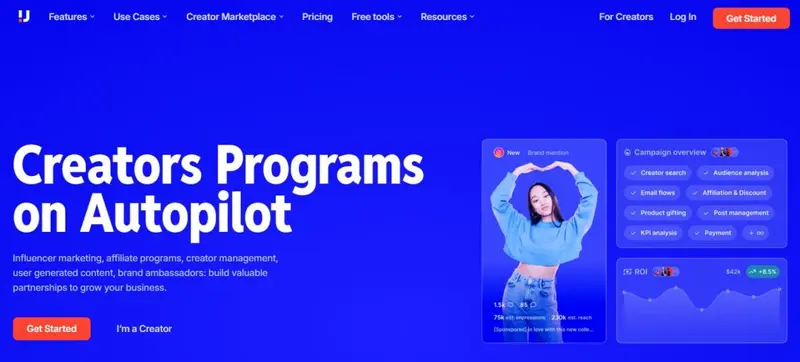
Upfluence is an all-in-one influencer and affiliate platform designed to connect creator activity directly to revenue.
Its key advantage lies in its deep integrations with ecommerce platforms like Shopify, WooCommerce, and Amazon, enabling brands to:
- Track sales per creator
- Generate affiliate links and promo codes
- Measure ROI at a granular level
The platform also includes:
- Influencer discovery tools
- Campaign management workflows
- Automated payments and commission tracking
Upfluence is best suited for brands that treat influencer marketing as a performance channel.
For macro influencer campaigns, this is critical. Larger creators can drive significant traffic, but without proper attribution, their impact is difficult to measure. Upfluence solves that gap by tying creator activity directly to revenue outcomes.
Key Features: Influencer Search & Discovery, Relationship Management, Campaign Management, Third Party Analytics, Automated Recruiting, Influencer Lifecycle Management, Team Collaboration Tools, Content Review, Campaign Reporting, Audience Analysis, E-commerce Tools, Product/Gifting Tools, Payment Processing, Social Listening, Affiliate Management, Affiliate Campaigns,
Channels: Instagram, Youtube, Facebook, Twitch, Tiktok, Twitter, Pinterest, Blogs
Manual Methods for Finding Macro Influencers
Influencer platforms accelerate discovery, but manual research remains critical for validation and context. Platforms surface candidates. Manual analysis determines whether those creators can actually perform within your campaign.
Platform Search and Hashtags
Direct platform search remains one of the most effective ways to identify macro influencers who are actively producing relevant content.
On TikTok, Instagram, and YouTube, search behavior should go beyond generic keywords. Instead of broad terms, use:
- Product-specific queries
- Problem-based searches (e.g., “best skincare routine,” “quick meal ideas”)
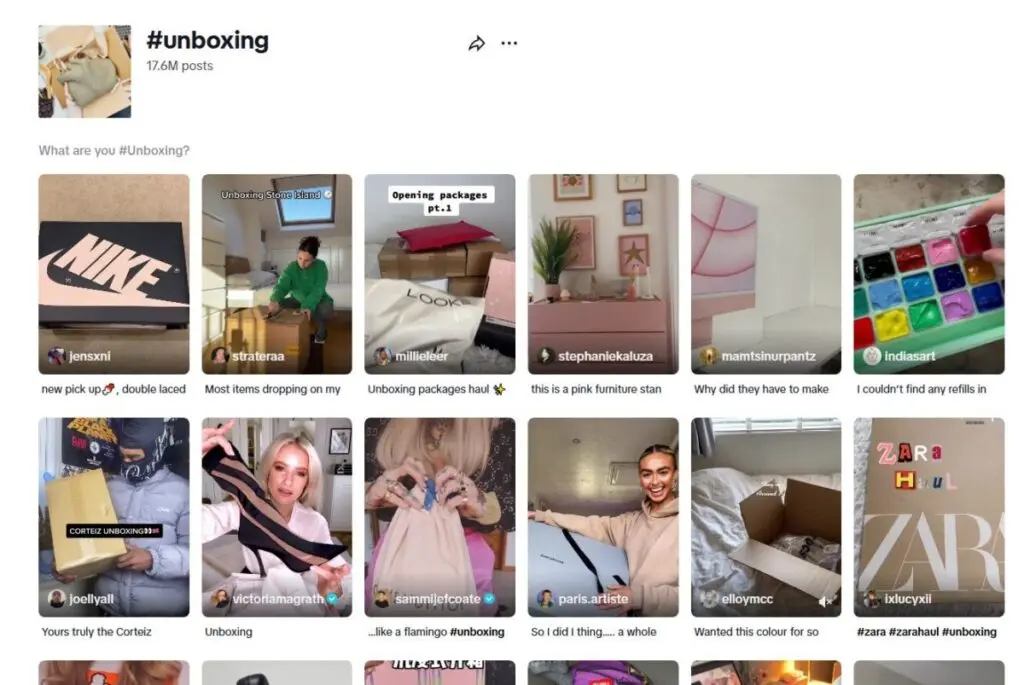
- Format-based keywords (e.g., “TikTok made me buy it,” “review,” “unboxing”)
This approach surfaces creators who are already:
- Creating content aligned with purchase intent
- Using formats that convert
- Engaging audiences in your category
Here's an example from a macro creator we found with the #unboxing hashtag:
@victoriamagrath Unboxing #jimmychoomugler #grwm #unboxing
Hashtags help refine this further. Niche hashtags often reveal:
- Emerging macro creators in the 100K–500K range
- High-performing content clusters
- Repeated formats that signal what the algorithm is pushing
The objective is to identify patterns in content that consistently perform.
Competitor and Brand Analysis
Competitor campaigns provide one of the fastest paths to identifying proven macro influencers.
Start by reviewing:
- Tagged posts and brand mentions
- Paid partnership disclosures (#ad, #sponsored)
- Creator whitelisting campaigns (ads featuring creators)
Again, through manual research, we identified the creator @travelwithsudipa, a travel creator with around 200k followers. The video below is a paid partnership for the Arthur W. Butler Memorial Sanctuary in Bedford, New York. The video is a perfect example of a brand awareness campaign involving a macro creator.
@travelwithsudipa #Sponsored If you love hiking, birdwatching, or just escaping chaos, this is the place for you. The Arthur W. Butler Memorial Sanctuary in Bedford, New York, is a stunning 363-acre preserve with over 6.5 miles of trails, ranging from easy walks to more challenging hikes. And if you’re into birdwatching, the Hawk Watch is an absolute must; it’s one of the best spots in the region to see hawks, falcons, and raptors up close during migration season. It’s open from dawn to dusk, every single day. And the best part, you can reach there without a car. Take the Metro-North from Grand Central Terminal to Bedford hills station and take an uber to the sanctuary. This land has been protected by The Nature Conservancy,a global nonprofit that does work across all 50 U.S. states and more than 80 countries and territories, but got its start right here in New York where it’s still working to create a future with a livable climate, healthy communities, and thriving nature for all generations. In New York alone, they oversee nearly 160 nature preserves across the state, many of them open to the public, just like this one. I don’t always need to travel far - finding a trail nearby sparks just as much joy. That’s why I’m so excited to spend time with The Nature Conservancy in New York this Earth Month as they celebrate 75 years of protecting the places we love. This Earth Month, start small. Explore a nearby preserve, pick up trash on a trail, tell friends why you care about our climate, and try to waste less. Clean air, clean water, thriving wildlife - these things are worth every effort. Head to nature.org/newyork and follow @nature.ny to learn more about gorgeous places to visit and ways to protect nature. #escapenyc #nycgetaways #earthmonth
This reveals:
- Which macro influencers are already trusted in your space
- What types of content brands are investing in
- How creators position similar products
Look for repetition. If the same creator appears across multiple brand campaigns, it often signals:
- Reliable performance
- Strong audience alignment
- Ease of collaboration
Gaps are equally important. If competitors rely heavily on one content format or creator type, there may be an opportunity to:
- Test alternative formats
- Target adjacent audiences
- Differentiate creative direction
Audience and Content Validation
Follower count alone is not a reliable indicator of influence. Macro influencers should be evaluated based on consistency and audience quality, not isolated performance spikes.
Start with engagement patterns:
- Do posts consistently generate interaction, or only occasional spikes?
- Are comments meaningful, or generic and repetitive?
Audience relevance matters just as much:
- Does the creator’s audience match your target demographic?
- Are followers aligned with your product category or intent?
Content analysis is equally important:
- Is the creator’s format repeatable across campaigns?
- Does the content feel native to the platform?
- Can the format be adapted for paid media if needed?
The strongest macro influencers typically:
- Use consistent content structures (e.g., hooks, storytelling, demos)
- Maintain stable performance across multiple posts
- Integrate products naturally into their content
Creators who rely on one viral video or inconsistent formats introduce unnecessary risk.
Key Takeaways
Manual discovery is not about finding more creators. It is about filtering for the right ones.
Effective validation focuses on:
- Content patterns, not one-off performance
- Audience alignment, not just size
- Repeatability, not creativity alone
Platforms can generate a list. Manual analysis determines which macro influencers can actually deliver results within a campaign.
Are Macro Influencers Worth It for Your Campaigns?
Macro influencers are not inherently better or worse than other creator tiers. Their value depends on how well they align with campaign goals, budget structure, and execution strategy. When used in the right context, they can deliver strong returns.
When misaligned, they often become an expensive awareness play with limited downstream impact.
Macro influencers tend to deliver the strongest ROI in campaigns built around scale and structured execution. These influencers often overperform the industry benchmark of $5.78 for every $1 spent. Product launches, brand awareness pushes, and paid media campaigns benefit the most.
Performance also improves when macro influencers are part of a broader system. Combining macro creators with micro or nano influencers allows brands to capture both reach and engagement.
This layered approach reflects how most high-performing campaigns operate today, especially as influencer marketing shifts toward full-funnel execution.
With that said, macro influencers are less effective in campaigns that rely heavily on deep engagement or niche trust signals. Highly targeted audiences, early-stage products, or conversion-first campaigns often perform better with smaller creators who maintain closer audience relationships.
In these cases, macro influencers may drive impressions without generating proportional action.
A simple way to evaluate fit is to assess the campaign against four criteria:
- Reach requirement: Does the campaign need rapid visibility at scale?
- Audience alignment: Does the creator’s audience match your target market?
- Content utility: Can the content be reused for ads or broader distribution?
- Measurement setup: Is performance being tracked beyond impressions?
If most of these conditions are met, macro influencers are likely to deliver value. If not, alternative creator tiers may provide a more efficient path to results.
The decision is not about choosing the largest audience available. It is about selecting the creator tier that aligns with how the campaign is designed to perform.
Frequently Asked Questions
What is a macro influencer?
A macro influencer is a content creator with approximately 100,000 to 1 million followers, typically used for campaigns that require large-scale reach and visibility.
What is the difference between macro and micro influencers?
Macro influencers focus on reach and visibility, while micro influencers (10K–100K followers) typically deliver higher engagement and niche audience targeting.
How much do macro influencers charge per post?
Macro influencers typically charge between $1,000 and $25,000 per post, depending on platform, content format, and usage rights.
When should brands use macro influencers?
Brands should use macro influencers for product launches, brand awareness campaigns, and initiatives that require fast, scalable reach.
How do you find macro influencers?
Macro influencers can be found using influencer platforms like Linqia, Modash, and Upfluence, as well as manual methods such as platform search, hashtags, and competitor analysis.
Do macro influencers drive sales or just awareness?
Macro influencers can drive both awareness and sales, especially when campaigns include strong calls to action, tracking links, and paid media amplification.

SUGGESTED

Macro Influencer Rates in 2026: How Much Do Macro Influencers Charge? | Influencer Marketing Hub
Macro influencer rates explained. Learn how much macro influencers charge across...

Briefing Macro vs. Micro Influencers: What Actually Changes? (+ Free Brief Builder)
Learn how to brief macro and micro influencers effectively with our step-by-step...

What is Influencer Marketing? The Ultimate Strategy Guide for 2026
Learn how influencer marketing drives brand awareness engagement and sales with our...