
Mega influencers sit at the top of the creator economy. They have 1M+ followers on platforms like TikTok, Instagram, or YouTube, placing them closer to celebrities than traditional content creators.
While that level of reach can deliver unmatched awareness, it does not automatically translate into performance. In fact, the higher you sit on the influencer tier, the less engaged your audience becomes.
A clear tradeoff exists between reach and engagement. High visibility drives brand awareness, cultural relevance, and top-of-funnel impact, while engagement and conversion efficiency often decline at scale. Audience alignment, content format, and campaign structure determine how effectively that reach converts into measurable results.
For marketers, the key question is not just what a mega influencer is, but when using one actually makes sense. Understanding that distinction is critical before allocating budget.
This guide will unpack everything there is to know about mega influencers on social media.
- What Is a Mega Influencer?
- How Mega Influencer Scale Is Measured
- Mega vs Macro vs Micro vs Nano Influencers
- Key Characteristics of Mega Influencers
- Benefits of Mega Influencers for Brands
- How to Find Mega Influencers?
- 1. Resonate by Linqia
- 2. Aspire
- 3. IQFluence
- 4. Neon Rose
- 5. United Talent Agency
- 6. Night
- How Much Do Mega Influencers Cost?
- Are Mega Influencers Worth It?
- Mega Influencer Strategy: When Scale Actually Wins
- Frequently Asked Questions
What Is a Mega Influencer?
A mega influencer is a content creator with a massive online following, typically exceeding 1M followers on a single platform. The term is used across influencer marketing to classify creators based on scale, separating them from macro, micro, and nano influencers.
Follower count defines the category, but scale alone does not explain influence. Mega influencers often operate with structured content workflows, established brand partnerships, and production support that resemble media operations rather than individual creators. These distinctions are why many put them closer to celebrities than traditional content creators.
Their content reaches broad, often global audiences, which makes this tier effective for campaigns focused on visibility and reach.
Platform context influences how the threshold is interpreted. On TikTok and Instagram, 1M+ followers remains the standard benchmark. On YouTube, subscriber count matters, but average views, watch time, and audience retention provide a clearer picture of actual reach. Scale remains the defining characteristic across platforms.
Engagement patterns shift as audience size increases. Larger audiences tend to produce lower engagement rates relative to follower count, which directly affects how performance is evaluated.
Campaigns centered on awareness and reach align more closely with this tier, while precision targeting and conversion-focused strategies typically require smaller, more engaged audiences.
Mega influencers function as distribution channels at scale. Their primary value comes from the ability to generate visibility quickly across large audiences, rather than delivering high interaction rates or niche audience targeting.
How Mega Influencer Scale Is Measured
Mega influencer status starts with follower count. Across industry benchmarks, creators with 1M+ followers fall into this category. While the threshold defines scale, performance varies significantly within it.
Engagement data shows a clear and measurable drop as audience size increases. According to our benchmarks, mega influencers average around 1.97% engagement, compared to the massive 5.6% and 2.15% for nano and micro influencers.
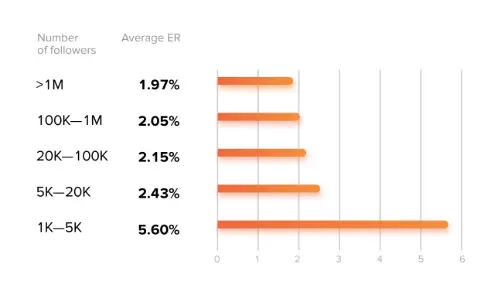
Platform-level benchmarks reinforce the same trend. General engagement across influencers tends to fall within 1% to 3%, with larger creators sitting at the lower end of that range.
The gap becomes even more pronounced on high-engagement platforms like TikTok. Nano influencers can reach 10% engagement, while larger creators operate at substantially lower interaction rates.
Performance differences extend beyond engagement into ROI. Some brands report 2x to 3x higher ROI from nano influencer campaigns compared to campaigns centered on large or celebrity-level creators.
Taken together, we can conclude the following:
- Larger audience → higher reach
- Larger audience → lower engagement
- Lower engagement → weaker conversion efficiency
Mega vs Macro vs Micro vs Nano Influencers
Influencer tiers are defined by follower count, but performance, cost, and use case vary significantly across each level. Understanding these differences is critical before allocating budget.
Influencer Tier Comparison
| Tier | Follower Range | Avg Engagement Rate | Typical Cost per Post | Primary Use Case |
| Nano | 1K–10K | ~5.60% | $10–$100 | Niche targeting, high trust, conversions |
| Micro | 10K–100K | ~2.15% | $100–$1,000 | Community-driven campaigns, engagement |
| Macro | 100K–1M | ~2.05% | $1,000–$25,000 | Scaled reach with moderate engagement |
| Mega | 1M+ | ~1.97% | $25,000–$1M+ | Mass awareness, brand visibility |
*Engagement benchmarks are based on our internal data and reflect typical averages across Instagram. Rates vary by platform, but the relative decline across tiers remains consistent.
Key Characteristics of Mega Influencers
Mega influencers operate differently from smaller creator tiers. Scale changes how content is produced, how audiences behave, and how brands structure partnerships.
Mass Reach Across Global Audiences
Mega influencers reach audiences that often span dozens of countries, age groups, and interests. The top creators on platforms like Instagram and TikTok regularly accumulate audiences in the tens of millions, which allows a single post to generate millions of impressions within hours.
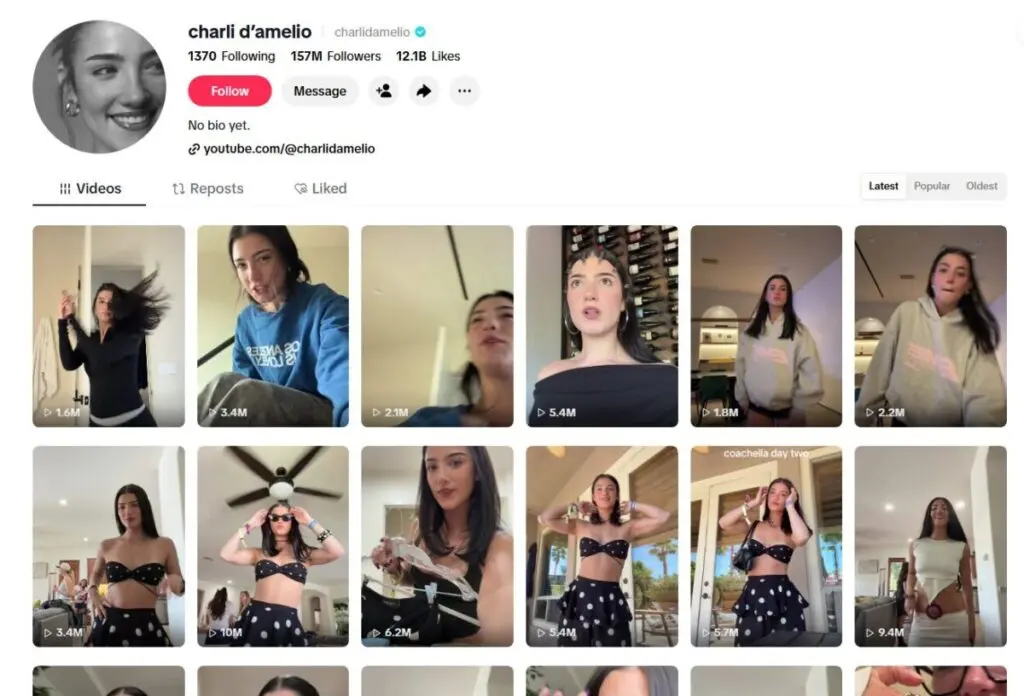
For example, one of the most well-known mega influencers, Charli D'Amelio, has 150m+ followers on TikTok. She is by far one of the biggest content creators with her videos regularly getting millions of views.
Lower Engagement Relative to Size
Large audiences come with reduced interaction rates. Industry benchmarks consistently show that engagement declines as follower count increases, with mega influencers typically operating below 1.97% engagement on social platforms.
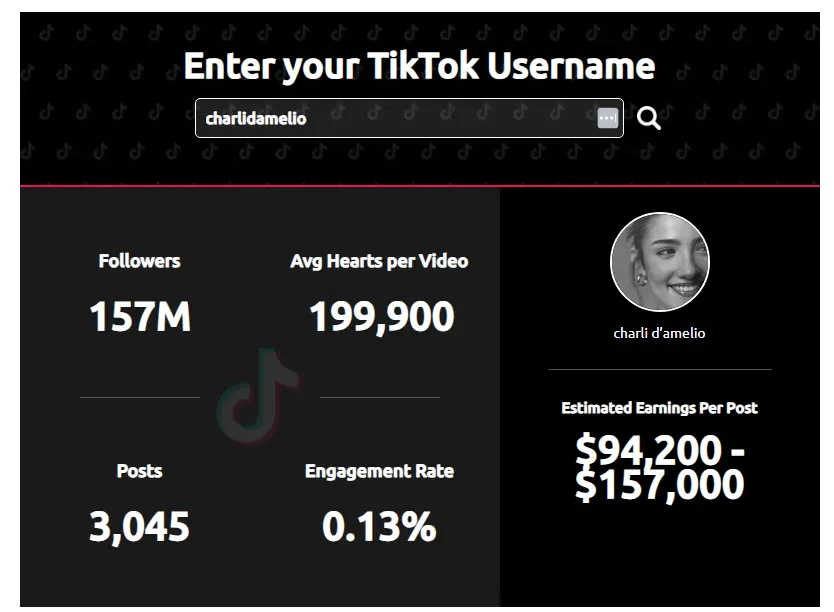
We used our TikTok Money Calculator Tool, which calculates how much an influencer earns on the platform, to measure Chali's average engagement rate. Considering her massive follower count, we weren't surprised at all when her average engagement rate came to around 0.13%.
Let's compare that to another mega influencer with a significantly smaller audience size. For this experiment, we picked TikTok's favorite foodie, Logan Moffitt (@logagm) who has a fraction of Charli's followers at 7M. His average engagement rate was nearly five times higher, at 0.63%.
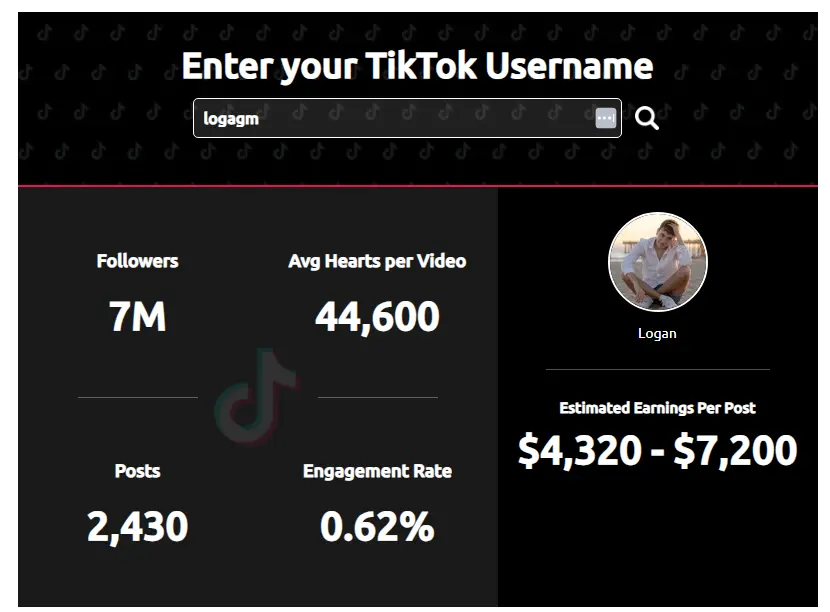
This simple experiment proves that engagement IS relative to a creator's follower size.
More followers = less average engagement
Check ER for Any Influencer
You can use our TikTok Money Calculator Tool to play around and check out how other popular creators or micro personalities compare on the platform. Also check out our:
Content Production at Media Scale
Content output at this level operates more like a media business than an individual creator workflow. Many mega influencers rely on structured teams that handle editing, brand coordination, publishing schedules, and commercial partnerships.
Higher production quality and consistent output follow from that operational setup, which aligns with the expectations of large-scale brand campaigns.
Let's, again, use Charli D'Amelio as an example. Her growth from TikTok creator to global brand involved building a full support system around her content and business operations.
She's represented by United Talent Agency, which positioned her for brand deals, media opportunities, and long-term partnerships. Day-to-day content and brand execution also involve social media managers, creative direction, and production support.
Her parents have also played an active role in managing partnerships and public-facing opportunities, effectively operating as part of the business infrastructure behind her content.
The result is a shift in how content is produced and delivered. Output becomes more consistent, campaigns are executed with greater control, and brand integrations are planned rather than opportunistic.
For marketers, working with mega influencers often means engaging with a coordinated team rather than a single individual.
Multi-Platform Presence
Mega influencers rarely rely on a single platform. Most maintain active audiences across TikTok, Instagram, YouTube, and sometimes additional channels. Multi-platform distribution increases total campaign reach and allows brands to extend visibility across different content formats.
Structured Brand Partnerships
Here's where things get "messy."
Partnerships at the mega influencer level follow formal commercial structures similar to media deals. Contracts define usage rights, licensing duration, and distribution scope, especially when content is repurposed for paid media.
Exclusivity is common. Brands often require influencers to avoid competitors for a set period, particularly in high-spend categories like beauty and fashion. These restrictions are typically reflected in pricing.
Deliverables are also structured. Campaigns include multi-asset packages across formats and platforms, planned around specific launch timelines rather than one-off posts.
Charli D'Amelio’s partnership with Dunkin', for example, extended beyond a single post into a product launch (“The Charli”) and ongoing promotion across channels.
@charlidamelio the best part of any day @Dunkin' dunkinpartner
At this level, brands work with coordinated teams, often involving representation, internal marketing teams, and agencies to manage execution and approvals.
Reach-Driven Campaign Role
Mega influencers are primarily used for awareness. Their ability to generate large-scale visibility makes them effective for product launches, brand repositioning, and global campaigns. Performance is measured in reach, impressions, and brand lift rather than direct conversions.
Benefits of Mega Influencers for Brands
Mega influencers are used when scale is the campaign priority. Their value comes from distribution power, speed of reach, and cultural visibility.
Immediate Reach at Scale
Mega influencers can generate millions of impressions within hours of publishing. A single post reaches an audience size that would otherwise require significant paid media investment. As such, they're most effective for campaigns that need rapid visibility.
Strong Top-of-Funnel Impact
Large audiences drive awareness, recall, and brand familiarity. Campaigns focused on product launches or market entry benefit from this exposure, especially when reach is tied to a specific moment or announcement.
Cultural Relevance and Trend Amplification
Mega influencers often shape platform trends due to their visibility. Content can influence broader conversations, increase search interest, and drive user-generated content when audiences replicate formats or messaging.
A well-documented example is Kylie Jenner’s collaboration with Adidas for the launch of the Adidas Facolns. For this campaign, Adidas used Kylie's massive audience to generate widespread visibility across social platforms. The campaign also centered around a full takeover of Sunset Boulevard.
Campaigns at this scale extend beyond individual posts and contribute to broader cultural exposure.
Multi-Platform Distribution
Mega influencers typically maintain audiences across multiple platforms. Campaigns can extend beyond a single post into TikTok, Instagram, and YouTube, increasing total exposure and reinforcing messaging across formats.
Scalable Campaign Execution
Working with a single mega influencer can deliver the reach equivalent of dozens or hundreds of smaller creators. This simplifies campaign management while maintaining high visibility, particularly for brands with large budgets and broad targeting requirements.
Mega influencers function as distribution channels within marketing strategies. Their primary advantage lies in delivering large-scale visibility quickly, which supports awareness-driven campaigns and high-impact launches.
How to Find Mega Influencers?
Finding mega influencers requires a structured approach. At this scale, creators are often managed through agencies, platforms, or formal business entities, which makes discovery more complex than simple hashtag searches.
Here are a few methods to try.
Use Influencer Marketing Platforms & Talent Agencies and Management Firms
Influencer marketing platforms provide the most efficient way to identify and evaluate mega influencers at scale. These tools combine creator databases, audience analytics, and campaign management features, allowing brands to filter by follower count, engagement metrics, location, and audience demographics.
On the other hand, many mega influencers are represented by talent agencies that handle partnerships, negotiations, and long-term business strategy. Working through these firms gives brands direct access to high-profile creators and structured deal execution.
1. Resonate by Linqia
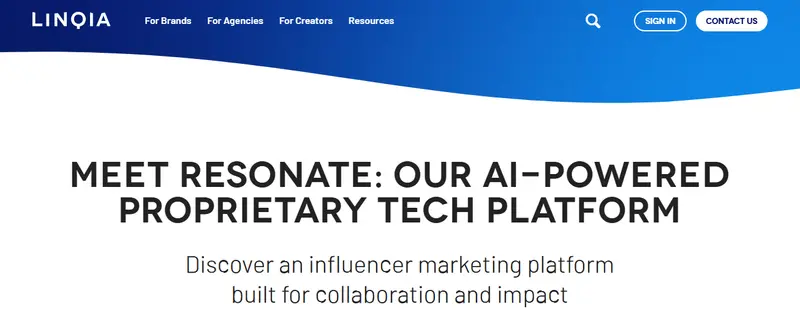
Linqia focuses on performance-driven campaigns supported by first-party data. Its platform emphasizes vetted creators and predictive analytics, which helps brands identify mega influencers based on expected outcomes rather than follower count alone.

Key Features: Influencer Search & Discovery, Campaign Management, Fraud Detection and Audience Health, Audience Analysis, Influencer Analytics, Paid Media Amplification, Purchase Funnel Comment Analysis, Google Vision Product/Logo Detection, Conversational AI Campaign Assistance (Marco AI),
Channels: Instagram, TikTok, YouTube, Facebook, Pinterest
2. Aspire
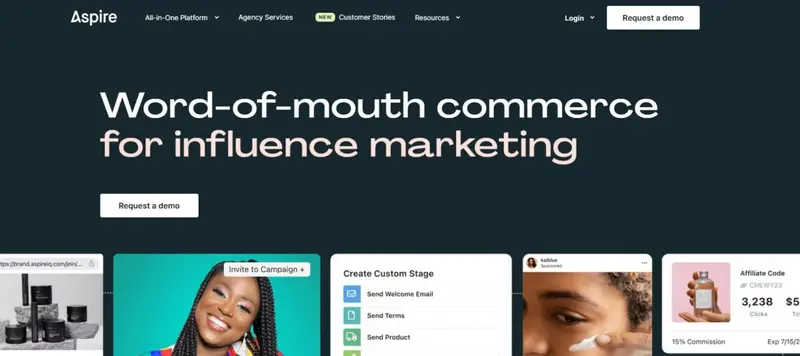
Aspire offers a large creator marketplace with advanced filtering capabilities. Brands can search specifically for mega influencers, analyze audience data, and manage outreach and campaign execution within a single platform.
3. IQFluence
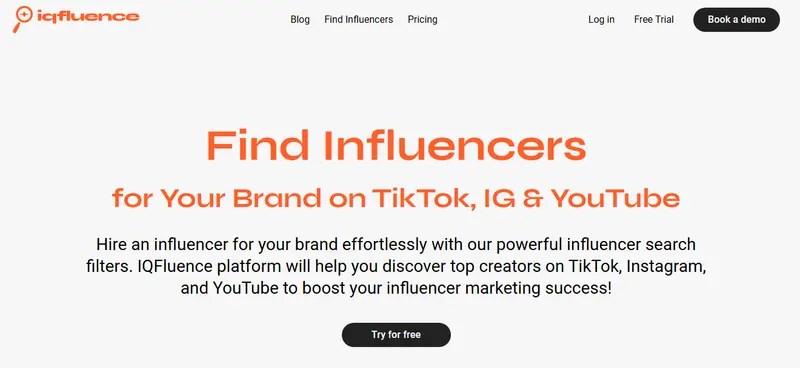
IQFluence provides access to a global influencer database with detailed performance insights. The platform supports discovery across multiple social networks, making it suitable for brands running multi-market campaigns.
Platforms reduce manual research and provide verified data, which is critical when evaluating creators at this level.
4. Neon Rose

Neon Rose is a boutique influencer management agency focused on health, wellness, and lifestyle creators. The agency operates as an intermediary between brands and talent, handling brand partnerships, contract negotiation, and campaign coordination while giving brands access to a curated roster of creators.
5. United Talent Agency

United Talent Agency is one of the largest global talent agencies, representing creators alongside actors, athletes, and media personalities. Its dedicated creator division connects brands with top-tier influencers and manages large-scale partnerships across entertainment and digital media.
6. Night
Night is a digital-first talent management firm representing some of the most influential online creators, including major YouTube and streaming personalities. The company combines talent management with business development, helping creators build brands, launch products, and execute large-scale partnerships.
Platform-Native Discovery
Social platforms remain a direct discovery channel. TikTok, Instagram, and YouTube surface top creators through trending content, recommended feeds, and category leaders. Brands can identify mega influencers by analyzing:
- Consistently high view counts
- Recurring appearances in trending content
- Large, active audiences
This method requires manual validation but helps identify creators who are currently driving attention.
Competitor and Campaign Analysis
Reviewing competitor campaigns reveals which mega influencers are active within a specific category. Brands can analyze:
- Who are the competitors partnering with
- What types of content are being produced
- How audiences are responding
This approach surfaces proven creators who already understand the category and audience.
How Much Do Mega Influencers Cost?
Mega influencer pricing scales with reach, but the data shows that cost is not linear. As follower count increases, pricing accelerates faster than performance, which is why this tier requires careful budget alignment.
Industry benchmarks provide a starting point for what brands actually pay.
- On Instagram, pricing models place mega influencers at $10,000+ per post at a minimum.
- TikTok pricing follows a similar structure but with lower entry points. Mega influencers typically charge $2,500 per post, which is at the lower end. Naturally, pricing depends on audience size and engagement.
- YouTube sits near the top of the pricing spectrum due to production and integration value. Creators with multi-million subscriber bases often charge $20,000+ per video, with higher rates for dedicated integrations.
Again, the cream of the crop influencers charge much, much more than the numbers here.
Alex Earle, for example, charges $450,000 per Instagram Story. And remember, IG Stories disappear after 24 hours!
Mega Influencers Often Charge Much More!
We've analyzed similar influencer marketing cases and can safely say that the most popular mega-influencers often exceed industry benchmarks by 10-20x. Our analysis shows that:
- Instagram posts for 1M+ creators start at $10,000+ and often go into the hundreds of thousands
- YouTube videos for multi-million audiences exceed $40,000+
- Premium branded campaigns regularly push into $50,000–$70,000+ per activation
But single posts rarely represent the full investment. While they are common, large brands usually hire mega-influencers for major activations, often spanning weeks or even months of collaborative work.
As such, most mega influencer campaigns include:
- Multiple deliverables
- Cross-platform distribution
- Paid amplification
As a result, total campaign costs frequently exceed $100,000+, with large-scale activations reaching $500,000 to $1M+ depending on scope and duration.
Are Mega Influencers Worth It?
Mega influencers deliver value when campaign objectives align with scale. Reach alone does not determine ROI. Performance depends on how well budget, goals, and audience strategy match what this tier is designed to do.
When Mega Influencers Deliver ROI
Mega influencers perform best in campaigns where visibility is the primary objective. Product launches, brand repositioning, and large-scale awareness campaigns benefit from rapid reach and repeated exposure. Strong results typically come from campaigns that combine influencer content with paid amplification, extending distribution beyond organic reach.
Budgets also play a role. Campaigns with sufficient investment can support multi-post activations, cross-platform distribution, and content reuse, which increases overall impact. In these scenarios, mega influencers function as high-reach media channels that contribute to brand lift and market visibility.
If brands nail the objective, campaigns could very well exceed the $5.78 for $1 spent ROI ratio.
When Mega Influencers Underperform
Performance declines when campaign goals prioritize precision or efficiency. Conversion-focused campaigns often struggle at this level due to lower engagement rates and broader audiences. Smaller creator tiers tend to deliver stronger interaction and more targeted reach, which improves conversion outcomes.
Limited budgets also reduce effectiveness. A single post without amplification or follow-up content rarely generates sustained results. Campaigns that rely on one-off activations often fail to justify the cost associated with mega influencers.
Campaign Fit Checklist
Mega influencers are a strong fit when:
- Reach and visibility are the primary goals
- Budget supports multi-post campaigns and amplification
- Target audience is broad rather than niche
- Content can be reused across paid and owned channels
Mega influencers are a weaker fit when:
- Conversions and engagement are the main KPI
- Budget limits campaign scope
- Target audience requires precise targeting
- Success depends on sustained interaction rather than exposure
Mega Influencer Strategy: When Scale Actually Wins
Mega influencers sit at the top of the influencer marketing hierarchy, but scale alone does not determine success. Data shows a consistent pattern: reach increases as follower count grows, while engagement and conversion efficiency decline. That tradeoff defines how this tier should be used.
Brands that treat mega influencers as awareness channels see the strongest outcomes. Product launches, global campaigns, and brand-building initiatives benefit from their ability to generate immediate visibility. Campaigns structured with multiple touchpoints and paid amplification tend to extract more value from that reach.
Misalignment is where most campaigns fail. Using mega influencers for conversion-driven objectives or limited budgets reduces efficiency and inflates cost per result. Smaller creator tiers often outperform in those scenarios.
Mega influencers are effective when scale is the goal. Success depends on using them with clear intent, supported by the right budget and campaign structure.
Frequently Asked Questions
What is a mega influencer?
A mega influencer is a creator with 1M+ followers on a single platform. This tier focuses on large-scale reach and brand visibility rather than high engagement or niche targeting.
How many followers does a mega influencer have?
Mega influencers typically have at least 1 million followers. Many operate well beyond that threshold, especially on platforms like TikTok and Instagram.
What is the difference between mega and macro influencers?
Macro influencers usually have 100K to 1M followers, while mega influencers exceed 1M+. Mega influencers offer greater reach, while macro influencers tend to deliver higher engagement rates and better cost efficiency.
What are mega influencers best used for
Mega influencers are best suited for:
- product launches
- brand awareness campaigns
- global or multi-market campaigns
- trend-driven marketing
Their strength lies in reach and visibility rather than conversions.
How much do mega influencers charge per post?
Mega influencer pricing varies by platform, but typical ranges include:
- Instagram: $10,000+ per post
- TikTok: $2,500+ per post
- YouTube: $20,000+ per video
Final pricing depends on reach, engagement, and campaign scope.
Do mega influencers have low engagement rates?
Yes. Engagement rates decline as follower count increases. Mega influencers often average between 1%-2% engagement, while smaller creators achieve higher interaction rates.
Are mega influencers worth it for small brands?
Mega influencers are usually not cost-effective for small brands. Campaigns require significant budgets to deliver meaningful results, especially when combined with multiple posts and paid amplification.
How do brands find mega influencers?
Brands typically find mega influencers through:
- influencer marketing platforms
- talent agencies and management firms
- direct platform research on TikTok, Instagram, and YouTube
Platforms provide the most efficient way to filter creators by audience size, engagement, and demographics.


