Brand perception no longer forms in a single place. Consumers now discover, evaluate, and discuss brands across TikTok, Reddit, review platforms, search engines, creator content, and increasingly, AI-generated search experiences.
A strong campaign can improve sentiment overnight, while a viral complaint, creator controversy, or negative review cycle can quickly shift public perception in the opposite direction.
Brand tracking helps companies measure those perception shifts over time. Rather than relying on assumptions or isolated campaign metrics, marketers use brand tracking to monitor awareness, sentiment, loyalty, purchase intent, and competitive positioning through a combination of surveys, social listening, market research, and performance analysis.
Modern brand tracking has also expanded beyond traditional survey research. Many companies now combine brand health studies with real-time monitoring systems that track online conversations, customer feedback, search visibility, and AI-generated brand mentions.
As consumer journeys become more fragmented, continuous brand intelligence has become increasingly important for measuring how audiences actually perceive a brand across digital channels.
This guide explains how brand tracking works, which metrics matter most, the methods companies use to measure brand health, and the tools helping marketers monitor brand perception more effectively.
- What Is Brand Tracking?
- Why Brand Tracking Matters
- Key Brand Tracking Metrics
- Brand Tracking vs Brand Monitoring
- How Brand Tracking Works and Which Methods To Use
- Best Brand Tracking Tools
- 1. Brandwatch Consumer Intelligence
- 2. YouScan
- 3. Chatbeat
- 4. Brand24
- 5. Qualtrics
- 6. Quantilope
- 7. GWI
- Brand Tracking Has Become Continuous Brand Intelligence
- Frequently Asked Questions
What Is Brand Tracking?
Brand Tracking Definition
Brand tracking is the process of measuring how consumers perceive a brand over time. Companies use brand tracking to monitor changes in awareness, sentiment, consideration, loyalty, and overall brand health across different audiences and channels.
Unlike one-time market research studies, brand tracking focuses on continuous measurement.
The goal is not simply to collect feedback once, but to identify how perception changes as campaigns launch, competitors enter the market, customer expectations shift, or broader conversations influence public opinion.
Most brand tracking programs combine data from multiple sources. These include brand tracking surveys, social listening platforms, review analysis, customer feedback, search behavior, competitor benchmarking, and sentiment analysis.
Many companies also track digital visibility signals such as search presence, creator mentions, and AI brand references to understand how discoverability influences perception.
Modern brand tracking has also become more operational. Marketing teams increasingly use continuous tracking systems rather than quarterly reports alone.
Real-time monitoring helps brands detect reputation risks earlier, evaluate campaign impact faster, and identify changes in audience sentiment before they materially affect customer acquisition or retention.
At its core, brand tracking helps companies answer several critical questions:
- How well-known is the brand?
- How do consumers perceive it?
- How does it compare to competitors?
- Which factors influence trust and loyalty?
- How is brand perception changing over time?
- Which channels or campaigns are driving those changes?
Why Brand Tracking Matters
Brand perception has become increasingly volatile across digital channels. Search & social is no longer the primary channel to evaluate brands. Nowadays, we're seeing AI recommendations, third-party reviews, UGC content, and online communities used by consumers as "trust signals" for purchase decisions.
Many consumers would first "research" a brand before visiting their website and making a purchase.
Research consistently shows that brand trust, awareness, and perception directly influence business performance.
Nielsen found that, on average, a 1-point increase in brand metrics such as awareness and consideration drives a 1% increase in sales. Brand familiarity also improves purchase intent and market share performance, particularly in competitive product categories.
Trust has also become a major commercial factor. According to the 2025 Edelman Trust Barometer, 80% of people say they trust the brands they use to do what is right, while authenticity increasingly shapes buying decisions and long-term loyalty.
Continuous brand tracking helps marketers understand how those perception shifts happen over time rather than relying only on campaign-level performance metrics.
Campaign Performance Analysis
Brand tracking helps companies measure whether campaigns influence awareness, recall, sentiment, and purchase consideration. Another Nielsen report across more than 1,000 influencer, podcast, and branded content campaigns found that median brand recall exceeded 70% among exposed audiences.
Performance indicators such as recall, sentiment shifts, and brand consideration often appear before revenue impact becomes visible, making brand tracking useful for evaluating campaign effectiveness earlier in the customer journey.
Competitive Benchmarking
Most purchase decisions happen in competitive environments where consumers compare multiple brands simultaneously. Brand tracking helps companies measure:
- comparative awareness
- preference
- perceived quality
- sentiment
- loyalty
- share of voice
Longitudinal tracking also helps marketers detect market shifts, competitor momentum, and changing consumer expectations before those trends materially affect revenue performance.
Reputation and Sentiment Monitoring
Online sentiment can change quickly across TikTok, Reddit, YouTube, review platforms, and creator ecosystems. Real-time monitoring helps companies identify perception changes early and respond before reputational issues escalate into broader brand damage.
The growing role of AI discovery systems adds another layer of complexity. Consumers increasingly encounter brand information through AI summaries, recommendation engines, and generative search experiences rather than traditional branded channels alone.
Customer Loyalty and Retention
Strong brand equity improves customer retention, advocacy, and repeat purchasing behavior. Metrics such as Net Promoter Score (NPS), purchase intent, and brand preference help companies measure whether customer relationships are strengthening or weakening over time.
Brand tracking also helps marketers understand which experiences, campaigns, or perception shifts influence long-term loyalty rather than isolated transactions.
Strategic Decision-Making
Brand tracking gives marketing and leadership teams a more objective view of how audiences respond to:
- product launches
- pricing changes
- creator partnerships
- rebrands
- crisis events
- market expansion
- messaging changes
Continuous measurement reduces reliance on assumptions and provides a clearer understanding of how the market actually perceives the brand across channels and customer segments.
Key Brand Tracking Metrics
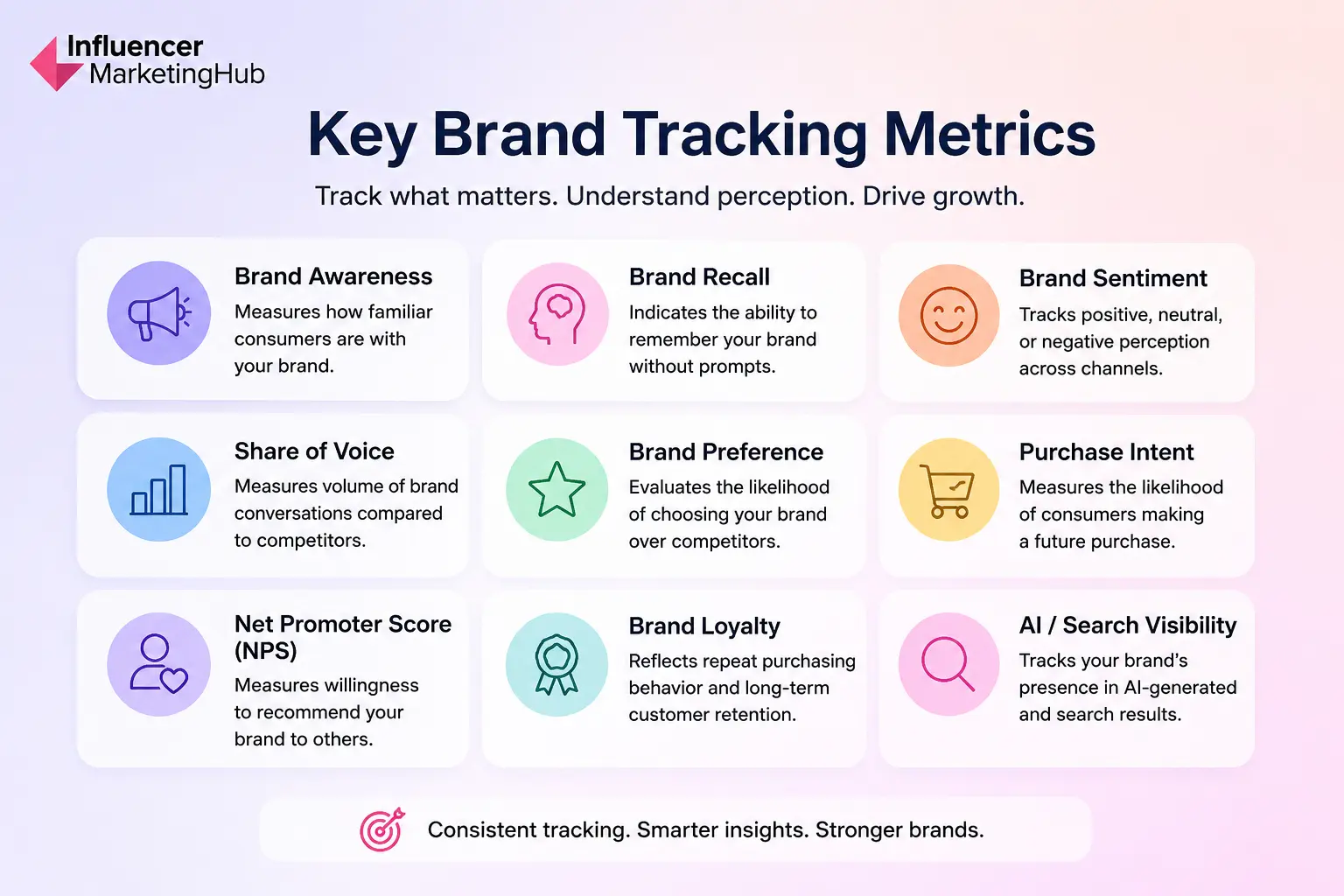
Brand tracking programs rely on a combination of awareness, perception, loyalty, and behavioral metrics to measure overall brand health. Most companies track these metrics continuously to identify changes in consumer sentiment, campaign impact, and competitive positioning over time.
Different metrics serve different purposes. Some measure visibility and recognition, while others evaluate emotional perception, loyalty, or future purchasing behavior.
Brand Awareness
Brand awareness measures how familiar consumers are with a brand. Most companies evaluate both:
- aided awareness
- unaided awareness
Unaided awareness measures whether consumers recall the brand without prompts, while aided awareness tests recognition after seeing a name, logo, or category reference.
Awareness tracking helps marketers understand whether campaigns are increasing visibility across target audiences and markets.
Brand Sentiment
Brand sentiment measures how consumers emotionally perceive a brand across surveys, reviews, social platforms, creator content, and online discussions.
Sentiment analysis has become increasingly important as consumer conversations move across fragmented digital ecosystems. Negative sentiment trends often appear before measurable declines in conversion or retention rates.
Many companies now combine:
- social listening
- review analysis
- survey feedback
- creator monitoring
to build a broader picture of audience perception.
Want to Monitor Brand Sentiment More Effectively?
Brand tracking helps companies measure long-term perception shifts, but sentiment monitoring platforms provide the real-time visibility needed to detect conversations, reputation changes, and audience reactions as they happen.
Explore our guide to the Top Sentiment Monitoring Tools to compare the platforms helping brands track consumer sentiment, social conversations, reviews, and online reputation across digital channels.
Share of Voice
Share of voice measures how often a brand appears in conversations compared to competitors.
Traditional share-of-voice analysis focused heavily on media mentions and advertising exposure. Modern tracking systems now include:
- social conversations
- creator mentions
- search visibility
- review ecosystems
- AI-generated references
A growing share of voice often signals increasing market relevance and consumer attention.
Brand Tracking vs Brand Monitoring
Brand tracking and brand monitoring are closely related, but they serve different purposes within a marketing or research strategy.
Brand tracking focuses on long-term measurement. Companies use it to understand how awareness, perception, loyalty, and purchase intent change over time. Most brand tracking programs rely on recurring surveys, sentiment analysis, customer feedback, and competitive benchmarking to measure overall brand health.
Brand monitoring focuses on real-time observation. Monitoring platforms track online mentions, social conversations, reviews, creator discussions, news coverage, and sentiment changes as they happen.
Both systems help companies understand perception, but they operate on different timelines and answer different business questions.
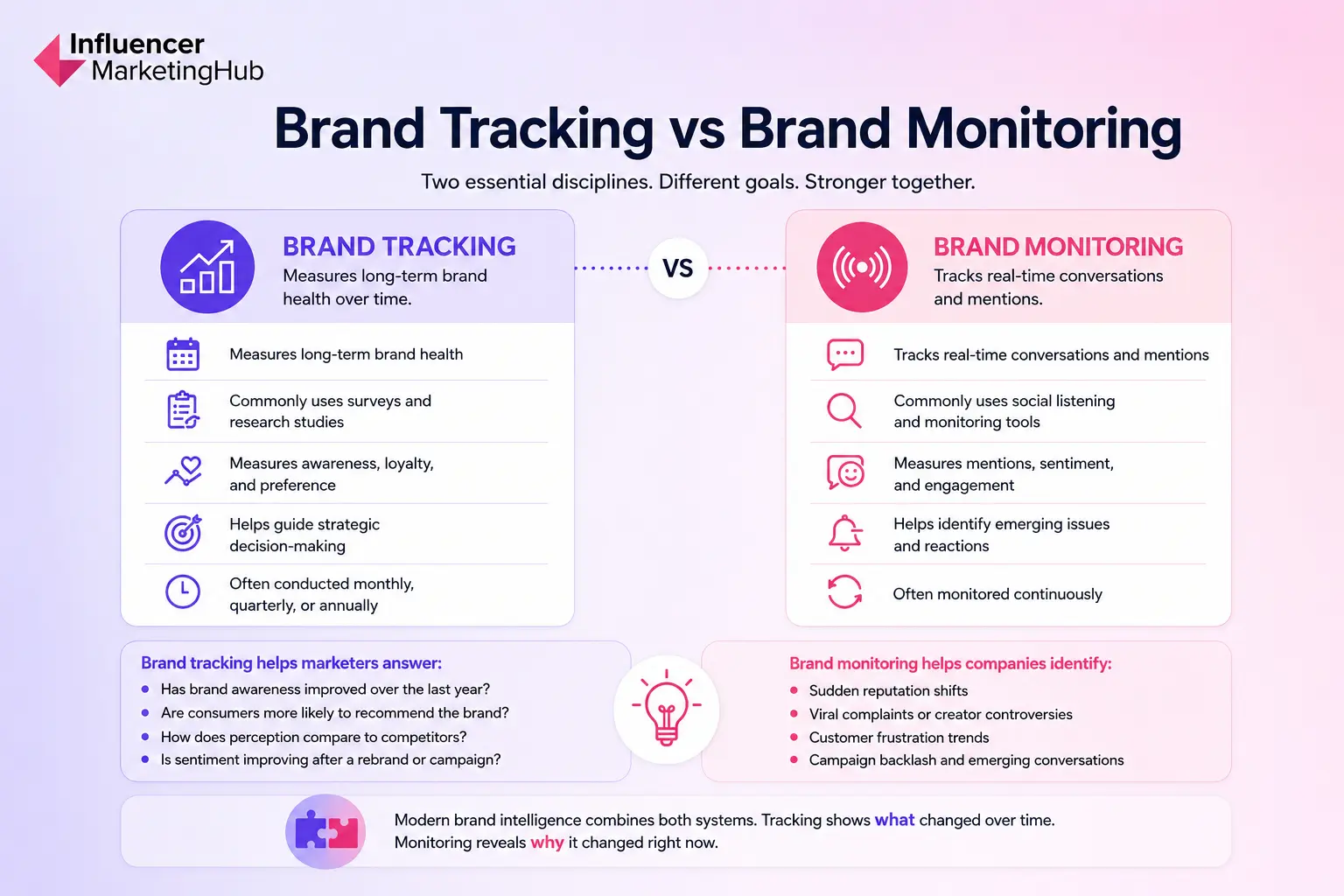
Brand tracking helps marketers answer questions such as:
- Has brand awareness improved over the last year?
- Are consumers more likely to recommend the brand?
- How does perception compare to competitors?
- Is sentiment improving after a rebrand or campaign?
Brand monitoring helps companies identify:
- sudden reputation shifts
- viral complaints
- creator controversies
- customer frustration trends
- campaign backlash
- emerging social conversations
Modern marketing teams increasingly combine both systems rather than treating them separately.
A quarterly brand tracking study may reveal declining sentiment among younger audiences, while real-time monitoring tools can identify the specific conversations, creator discussions, or product complaints driving that perception change.
Combining longitudinal measurement with continuous monitoring gives marketers a much clearer understanding of both what changed and why it changed.
AI-generated search experiences are also starting to blur the line between tracking and monitoring. Many companies now monitor citation response frequencies from LLMs, AI brand mentions, AI sentiment summaries, and conversational search visibility as part of broader brand intelligence programs.
How Brand Tracking Works and Which Methods To Use
Brand tracking used to be much simpler. Companies would run a survey once or twice a year, measure awareness and sentiment, compare the results against previous reports, and build a strategy from there.
Modern brand tracking works very differently. Brand perception now shifts constantly across TikTok conversations, Reddit threads, creator content, reviews, search engines, and AI-generated discovery systems long before those changes appear in a quarterly report.
Surveys Still Matter, But They’re No Longer Enough
Surveys still sit at the center of most brand tracking programs because they provide structured, longitudinal data. Companies use them to measure awareness, loyalty, purchase intent, recommendation likelihood, and overall brand perception over time.
Running the same questions consistently helps marketers identify patterns instead of reacting to isolated moments. A campaign may increase awareness while weakening trust. A rebrand may improve perception among younger audiences while confusing existing customers. Tracking studies help surface those changes.
Survey data becomes more useful when companies compare responses across different audience segments, regions, or customer types rather than looking only at top-level averages.
Brand Tracking Starts With Better Survey Design
Strong brand tracking programs depend on asking the right questions consistently over time. Poorly structured surveys often produce unreliable sentiment, awareness, and purchase intent data that makes long-term tracking difficult to interpret.
Read our guide on How to Design Brand-Lift Surveys to learn how marketers structure survey questions, measure perception shifts, and build more reliable brand tracking studies.
Social Listening Adds Real-Time Context
Survey reports often tell marketers that perception changed without explaining why it changed.
That gap is one reason social listening has become such an important part of modern brand tracking. Monitoring conversations across TikTok, Reddit, YouTube, Instagram, reviews, and online communities gives marketers much faster visibility into how people are reacting to campaigns, products, creators, and customer experiences.
A spike in negative sentiment may begin with frustrated customer reviews, creator criticism, or a viral complaint long before it appears in broader brand health reports.
Most monitoring systems now track signals such as:
- sentiment shifts
- share of voice
- creator mentions
- recurring customer complaints
- competitor conversation volume
The growing influence of digital conversations is now reshaping purchasing behavior itself. Research examining AI-driven personalization and social sentiment systems found that algorithmic recommendations and sentiment analysis increasingly influence consumer trust, loyalty, and buying decisions across digital platforms.
Competitive Benchmarking Changes the Interpretation
Brand metrics become much more useful when viewed in a competitive context.
A drop in awareness may look concerning until competitor tracking shows the entire category experiencing the same decline. Rising conversation volume may look positive until sentiment analysis reveals competitors are generating stronger reactions or higher recommendation intent.
Most mature brand tracking programs therefore benchmark awareness, sentiment, visibility, share of voice, and preference against direct competitors instead of measuring internal performance alone.
Customer Feedback Often Explains the Real Problem
Structured metrics are useful for identifying trends, but direct customer feedback usually reveals what is actually driving them.
Open-ended survey responses, support conversations, product reviews, and creator commentary often surface recurring issues before dashboards fully capture them.
Pricing frustration, shipping problems, customer service complaints, or backlash around influencer partnerships tend to emerge first through customer language rather than numerical scoring systems.
Many companies, therefore, combine quantitative tracking with qualitative research methods such as interviews, review analysis, and focus groups to better understand the reasoning behind perception shifts.
Edelman’s 2025 findings showed that consumers increasingly trust peer experiences, reviews, and community feedback over top-down messaging from brands or institutions.
AI Visibility Is Becoming Part of Brand Tracking
Search behavior is changing quickly, and brand tracking is changing with it.
Consumers increasingly discover products through AI recommendations, conversational search tools, creator content, and algorithmic feeds rather than traditional search engines alone.
Capgemini research found that 58% of consumers had already replaced traditional search engines with generative AI tools for product and service recommendations.
That shift is creating an entirely new visibility layer for brands. A recent Trustpilot analysis of 800,000 AI-generated responses found that brands with strong review visibility appeared significantly more often across systems like ChatGPT, Gemini, and Perplexity, while companies with little or no review presence were largely absent from AI-generated answers.
Many companies now monitor:
- AI-generated brand mentions
- LLM citation frequency
- conversational search visibility
- creator-driven discoverability
as part of broader brand intelligence programs.
The strongest brand tracking systems combine all of these signals into one continuous view of brand perception rather than treating surveys, monitoring, and digital visibility as separate activities.
Best Brand Tracking Tools
Brand tracking platforms have become much more specialized over the last few years. Some platforms focus heavily on survey-based brand health tracking, while others specialize in social listening, sentiment analysis, reputation monitoring, or AI visibility tracking.
Let's look at the best systems.
1. Brandwatch Consumer Intelligence

Tool Category: Social Listening and Brand Monitoring Platform
Best For: Medium and Enterprise Companies
Pricing: Custom pricing
Brandwatch is one of the most established platforms in the social listening and brand intelligence space. The platform focuses heavily on monitoring online conversations, tracking sentiment trends, measuring share of voice, and analyzing consumer behavior across social platforms, forums, reviews, and news sources.
The platform combines social listening with broader consumer intelligence capabilities, allowing brands to track perception changes alongside competitor activity and campaign performance. Brandwatch also places significant emphasis on AI-powered analysis, audience segmentation, and trend identification.
Read More
2. YouScan

Tool Category: AI-Powered Social Listening and Visual Brand Intelligence Platform
Best For: Brands and Agencies of all sizes
Pricing: From $299 per month
YouScan combines traditional social listening with visual recognition technology, allowing companies to monitor not only text-based mentions but also brand appearances inside images and user-generated content.
The platform focuses heavily on AI-powered sentiment analysis, audience insights, and trend detection across social platforms and online communities.
Visual monitoring has become increasingly important as platforms like TikTok and Instagram shift consumer engagement toward image and video-first content. Many brands use YouScan to identify how products, logos, and campaigns appear inside creator content and customer posts even when the brand is not directly tagged.
Read More
3. Chatbeat
Tool Category: AI Brand Visibility and Generative Search Tracking Platform
Best For: Brands and agencies that need to track how AI systems describe, position, and recommend them
Pricing: Plans start at $99 per month
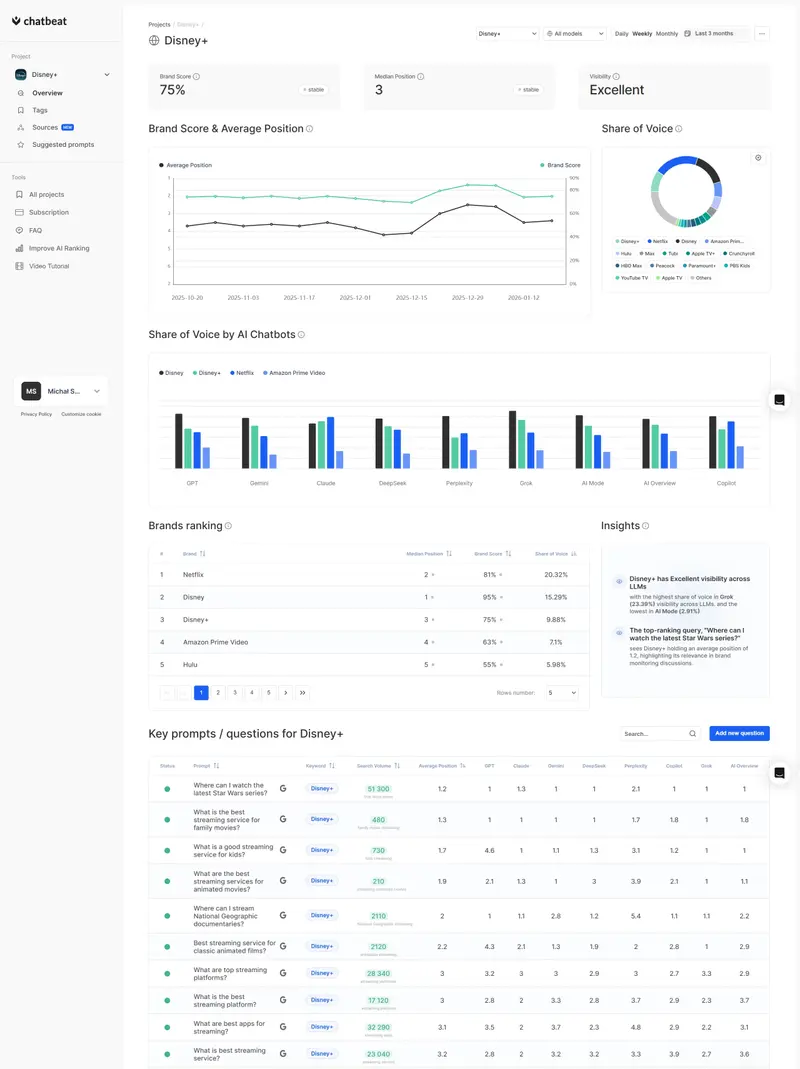
Chatbeat extends brand tracking into AI-generated discovery. It monitors customer-like questions across major AI assistants and Google AI Overviews, recording how often a brand appears, its position in the answer, its share of voice, and the sentiment surrounding it.
Read More
4. Brand24

Tool Category: Social Listening and Brand Monitoring Platform
Best For: Small to mid-sized businesses that need real-time brand monitoring, sentiment tracking, and media mention analysis without enterprise-level complexity.
Pricing: Plans start at approximately $199/month.
Brand24 focuses on real-time monitoring of online conversations across social media, news sites, blogs, podcasts, forums, and review platforms. The platform is designed to help brands track visibility, monitor reputation changes, and measure sentiment as conversations develop across digital channels.
One of Brand24’s strongest capabilities is its accessibility. The platform combines monitoring, sentiment analysis, alerts, influencer identification, and reporting into a system that is easier to operationalize than many larger enterprise-focused listening platforms.
Read More
5. Qualtrics
Tool Category: Survey-Based Brand Tracking and Experience Management Platform
Best For: Enterprise Companies
Pricing: Custom Pricing; Free Survey Tool
Qualtrics is one of the most widely used platforms for brand tracking surveys and structured perception research. The platform allows companies to measure awareness, sentiment, brand preference, customer satisfaction, and purchase intent through recurring survey programs designed to track perception changes over time.
Unlike social listening platforms that focus primarily on online conversations, Qualtrics is built around structured research and audience measurement.
Many companies use it to run continuous brand health studies across different markets, audience segments, and customer groups while combining survey results with broader customer experience data.
Read More6. Quantilope

Tool Category: Consumer Research and Automated Brand Tracking Platform
Best For: Brands and Research Teams
Pricing: Custom Pricing
Quantilope focuses heavily on automated market research and agile brand tracking. The platform helps companies run continuous brand health studies, audience segmentation research, and perception analysis without relying on slower traditional research processes.
One of Quantilope’s biggest strengths is its automation layer.
The platform streamlines survey creation, data collection, visualization, and reporting so teams can launch tracking studies faster and analyze results more efficiently. Many companies use Quantilope to monitor awareness, preference, and brand equity across multiple customer segments and markets simultaneously.
Key Differentiators
- Automated end-to-end research workflows
- Fast-turnaround brand tracking studies
- Advanced consumer segmentation capabilities
- Built-in analytics and visualization tools
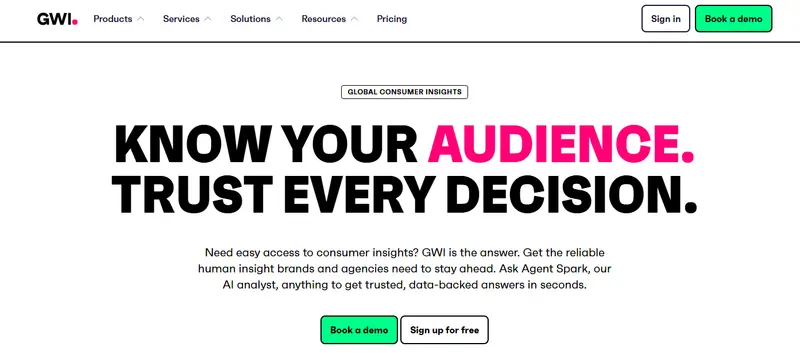
7. GWI
Tool Category: Consumer Intelligence and Audience Research Platform
Best For: Brands and Agencies
Pricing: Custom pricing
GWI approaches brand tracking through large-scale consumer intelligence and audience research rather than traditional social monitoring alone.
The platform gives marketers access to global survey data covering consumer attitudes, behaviors, platform usage, purchasing habits, and brand perception across different demographics and regions.
Many companies use GWI to understand how specific audience groups perceive their brand relative to competitors, especially when evaluating younger demographics, platform behavior, or emerging consumer trends. The platform is particularly useful for connecting brand perception data with broader lifestyle and behavioral insights.
Read MoreBrand Tracking Has Become Continuous Brand Intelligence
Brand tracking is no longer limited to annual surveys and static brand health reports. Consumer perception now shifts constantly across social platforms, creator ecosystems, reviews, search engines, and AI-generated discovery systems.
Modern brand tracking programs combine surveys, sentiment analysis, social listening, competitive benchmarking, and visibility monitoring to build a more complete understanding of how audiences perceive a brand over time.
Companies that treat brand tracking as a continuous intelligence system rather than a reporting exercise are better positioned to identify perception shifts early, respond faster to reputation risks, and adapt their marketing strategies as consumer behavior continues to evolve.
Frequently Asked Questions
What is brand tracking?
Brand tracking is the process of measuring how consumers perceive a brand over time. Companies use it to monitor awareness, sentiment, loyalty, purchase intent, and overall brand health across different channels and audience segments.
What metrics are used in brand tracking?
Most brand tracking programs measure metrics such as brand awareness, sentiment, share of voice, purchase intent, customer loyalty, Net Promoter Score (NPS), and brand preference.
What is the difference between brand tracking and brand monitoring?
Brand tracking focuses on long-term perception measurement, while brand monitoring focuses on real-time conversations and reputation changes across digital channels.
How often should companies conduct brand tracking studies?
Most companies run brand tracking studies monthly, quarterly, or bi-annually depending on campaign activity, market competition, and reporting needs.
What are brand tracking surveys?
Brand tracking surveys are recurring surveys designed to measure changes in awareness, sentiment, loyalty, recall, and purchase intent over time.
Which tools are used for brand tracking?
Popular brand tracking tools include Brandwatch, Qualtrics, Brand24, Quantilope, YouScan, BrandMentions, and GWI.
What is AI brand visibility tracking?
AI brand visibility tracking measures how often a brand appears in AI-generated recommendations, conversational search results, and LLM-generated responses.
Why is social listening important for brand tracking?
Social listening helps companies monitor real-time conversations, customer sentiment, creator mentions, and reputation changes across platforms like TikTok, Reddit, YouTube, and review sites.