
Brands running creator programs are seeing conversion rate lifts of 30%, 40%, even 214% — not from better creators, not from higher commissions, but from changing one thing: where the traffic goes after the click.
That's the pattern across thousands of creator programs we've watched over the past 18 months. The creator's job is to earn the click. What happens to it afterward is a different problem, and most brand teams are barely paying attention to it. They audit creator selection. They renegotiate commission rates. They rework creative briefs.
They almost never question the landing experience.
The evidence points consistently in one direction: influencer marketing's conversion gap is a destination problem, not a creator problem. The creator did their job. The landing page didn't.

- What a creator-specific landing page looks like in practice: the creator's identity, their curated picks, and the brand's checkout on the brand's own domain. The trust that drove the click stays intact through purchase.
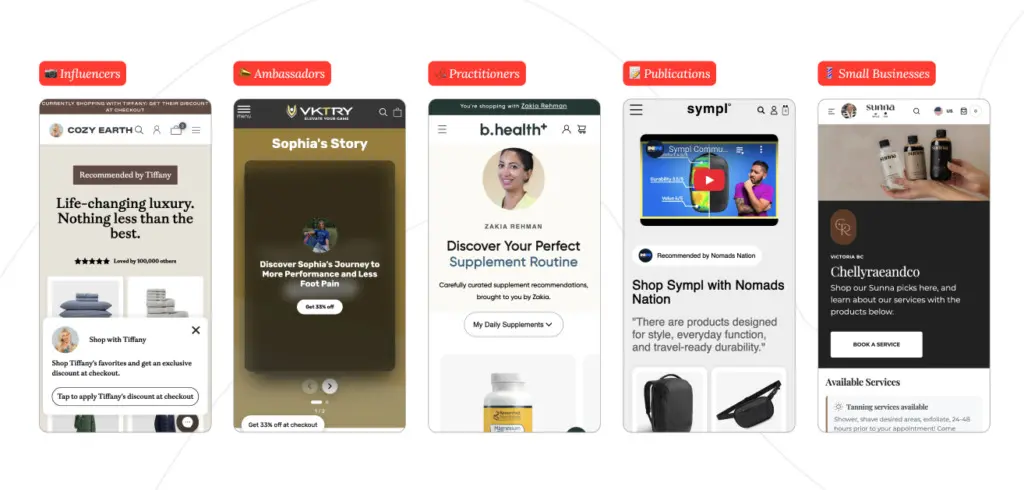
The Warm Click, Cold Page Problem
Here's what actually happens when a creator posts a link.
The creator has spent months, sometimes years, building a specific context with their audience. They're a skincare influencer, a cooking expert, a fitness creator. Their audience trusts their recommendations inside that context. The click is warm: the follower clicked because the trust was already there.
Then they land on the brand's homepage. Or a generic product page. Or a discount-code lander that looks the same for every creator in the program.
The page doesn't know who sent them. It doesn't know they came from someone they've followed for two years. It doesn't know they're already half-sold. It loads the same experience as someone who typed the brand name into Google. The creator's context, the thing that made the click warm in the first place, is gone.
This is the warm click, cold page problem. The affiliate mechanics work fine: the click tracked, the attribution fired. But the customer-facing experience at the arrival page does nothing to extend the relationship between the creator and the buyer. It's a cold handoff. Cold handoffs don't convert.
The fix isn't about the affiliate link itself. Most affiliate links in creator marketing resolve to one of three places: the brand's homepage, a standard product page, or a discount-code lander. None of these were built for creator-referred traffic. None of them know who the creator is. None of them carry the trust the creator built with their audience into the moment of purchase. The gap widens as programs scale — a brand managing 500 creator relationships can't hand-craft a landing experience for each one unless the infrastructure exists to do it without engineering work per creator.
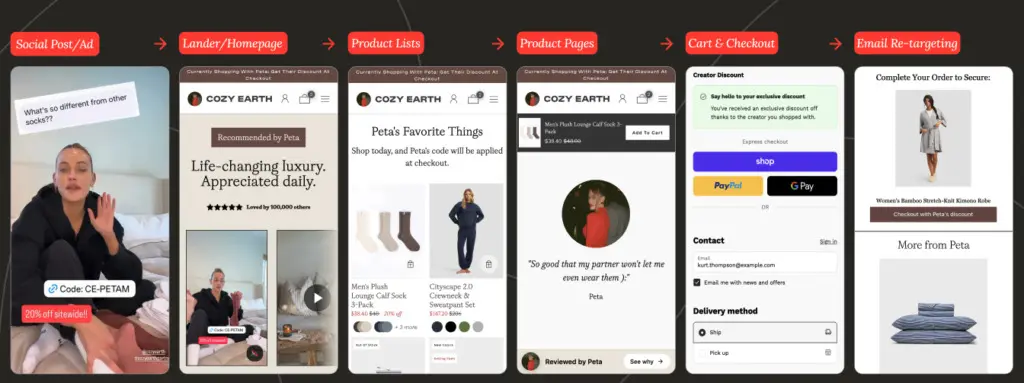
What the Data Looks Like
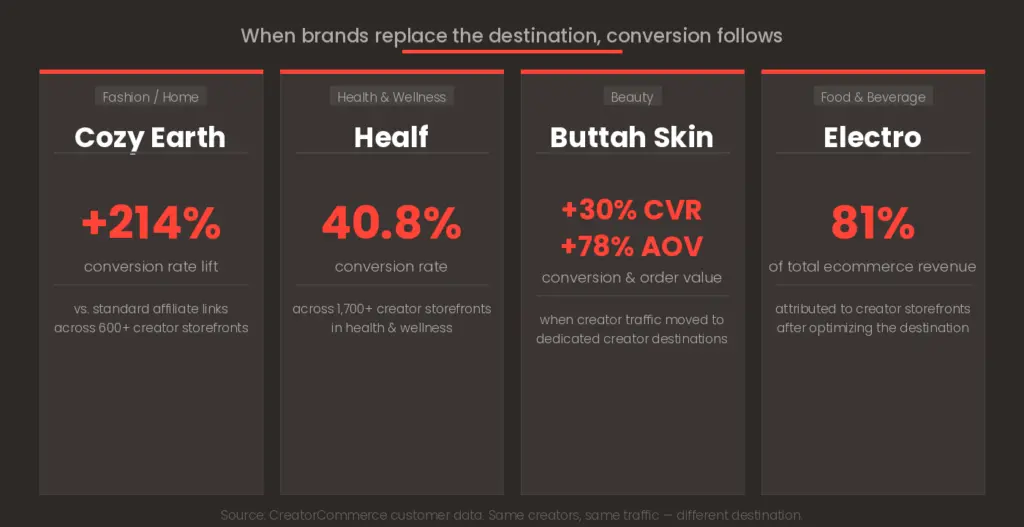
The numbers across four brands make our hypothesis concrete.
Cozy Earth ran this comparison across their creator program and saw an average 214% increase in conversion rate when they moved creator traffic from standard affiliate links to co-branded creator pages on their own domain. Average order value increased 67% alongside it. Same traffic. Same creators. Different arrival experience.
Healf, a UK health and wellness marketplace running more than 1,700 creator partnerships, reached a 40.8% conversion rate across their creator-referred traffic, a number that outperforms virtually every ecommerce baseline in the health category. Their affiliate lead noted the creator-page model was what "opened the door to attracting more affiliates" because creators were sharing pages they were genuinely proud of, while also earning more!
Buttah Skin measured the same structural shift in beauty: 30% higher conversion and 78% higher average order value when creator traffic landed on dedicated creator pages instead of standard product pages.
Electro, an electrolyte gum brand, reported that creator storefronts now account for 81% of their total ecommerce revenue — not from scaling creator spend, but from optimizing where that traffic lands.
The magnitude varies by brand, category, and program maturity. The direction doesn't.

- Conversion lift when brands replaced generic affiliate links with creator-specific landing pages. Data from four DTC brands across fashion, health, beauty, and food/beverage.
Two Patterns That Separate Creator Pages That Convert
Looking across programs that compound over time versus ones that extract once and plateau, two patterns show up consistently on the landing experience side.
Curation depth beats catalog size. Creator pages with 6–15 curated products consistently outperform pages that mirror the full brand catalog, by a factor of two to three in relative conversion. The shopper arriving from a creator's link has already been sold by that creator's taste. The landing page's job is to confirm it — not restart the consideration process with 200 options. When a creator picks 10 products they actually use, writes a sentence about each one, and pins the page to their bio, the shopper arrives already primed. The page just has to not break that.
The creator has to stay visible through purchase. It's not enough to match landing page copy to the creator's content. The creator — their name, their image, their voice — has to be present on the page itself. When the creator disappears after the click, the warm-click trust disappears with them. When they stay visible through checkout, the context that drove the click is preserved through the moment that actually matters. This is the structural difference between a creator page and a campaign landing page: the campaign lander is optimized for conversion; the creator page is optimized for trust continuity, and trust continuity is what drives conversion.
The 30-Day Test
The intervention doesn't require rebuilding the creator stack. For smaller teams, a simple landing page builder can be enough to test creator-specific pages before asking engineering to support every creator relationship manually. Run this test before changing creators, commissions, or content strategy.
Take 5–10 active creator relationships and build creator-specific landing pages for each — pages that carry the creator's identity, their curated picks, and the brand's checkout on the brand's own domain. Send their traffic there instead of the homepage. Keep everything else constant for 30 days. Track three numbers:
Conversion rate from the creator page versus your current affiliate link destination. A well-built creator page should lift CVR by at least 20–30% in the first 30 days. If it doesn't, the page is probably still behaving like a catalog rather than a creator-curated experience — check whether the creator's identity is actually visible, and whether the product selection is genuinely curated or just a filtered view of the full range.
Average order value. Creator pages with editorial curation — the creator's own language describing each product, arranged in a narrative order — consistently lift AOV alongside CVR. If conversion lifts but AOV stays flat, the page is carrying the creator's traffic but not the creator's taste. Add the editorial layer.
30-day repeat rate of the acquired cohort. This is the metric that tells you whether the warm click became a real customer or a one-time transaction. Creator pages that maintain the creator's context through purchase consistently produce higher repeat rates than generic arrival pages, because the audience arrived with genuine alignment — not just curiosity. If repeat rate underperforms after 30 days, that's your signal that the landing experience matched the traffic volume but not the audience fit.
A quick diagnostic to run before the test: if you're seeing under 2% conversion from creator links at a brand whose own product pages convert at 3–4%, the gap is almost certainly landing-experience-driven. Check where the clicks land before you renegotiate with the creators.
Why the Warm Click, Cold Page Problem Gets Worse at Scale
Creator programs are maturing fast. Brands that built early momentum on volume and discount codes are running out of easy wins. The programs compounding now are the ones treating the landing experience as part of the creator relationship — building creator pages that creators are proud to share, that audiences trust to buy from, and that convert the warm traffic creator content already generates.
The operational question at scale — 100, 500, 1,000+ creator relationships — is whether you can build and maintain creator-specific pages without an engineering ticket per creator. That's the unlock. For brands without internal CRO, design, or web production resources, landing page agencies can help turn creator traffic into a more structured conversion system. Crocs drove 350,000 sessions from a single creator page tied to a product drop with Kai Cenat. That kind of event-scale result doesn't happen by sending creator traffic to the homepage.
The brands still routing all creator traffic to a generic homepage are leaving most of the value on the table — not because their creators aren't performing, but because the warm clicks they're generating are landing cold.
The warm click, cold page problem, defined:
Creator traffic converts poorly not because of creator quality, audience size, or commission structure — but because the arrival page erases the context the creator spent months building. A warm click sent to a cold page loses the trust that made it click-worthy. Fix the landing experience, and the conversion economics of your entire creator program change.