
Gen Z has never known a world without social media.
For older generations, social platforms were originally designed to help people stay connected. Gen Z uses them differently.
Social media has become a search engine, entertainment hub, shopping destination, product discovery tool, and source of community all at once.
Those shifts matter because Gen Z's influence extends well beyond its own purchasing power. Younger consumers often shape broader digital behaviors, platform adoption, content formats, and online shopping trends that eventually influence other age groups as well.
Many marketing strategies still assume social media works primarily as a distribution channel. Gen Z increasingly treats social platforms as part of the entire customer journey.
For instance, did you know that 83% of TikTok Shop users actually discover products on the platform? Or that the majority, 88%, of Gen Zs spend their time on YouTube following their favorite creators and watching content?
It shows that understanding how Gen Z uses social media is becoming less about tracking the latest viral trend and more about understanding the behaviors that influence attention, trust, and buying decisions.
In this guide, we'll examine the biggest Gen Z social media trends shaping marketing in 2026 and explore what they mean for brands, advertisers, and marketers.
- Gen Z by the Numbers
- The Top Social Media Platforms Used by Gen Z
- Trend #1: Short-Form Video Continues to Dominate Attention
- Trend #2: Social Search Is Replacing Traditional Search
- Trend #3: Creators Are More Trusted Than Brand Accounts
- Trend #4: Authentic Content Outperforms Highly Produced Campaigns
- Trend #5: Product Discovery Happens on Social Media First
- Trend #6: Community Is Becoming More Valuable Than Reach
- Trend #7: Shopping and Entertainment Continue to Merge
- Gen Z Is Redefining How Social Media Influences Buying Decisions
- Frequently Asked Questions
Gen Z by the Numbers
Before exploring the latest Gen Z social media trends, it's helpful to understand the scale of the audience marketers are trying to reach.
Gen Z typically refers to people born between 1997 and 2012. According to the U.S. Census Bureau, there are more than 69 million Gen Z consumers in the United States alone, making them one of the largest consumer groups in the country.
Their influence goes far beyond population size.
Research from NielsenIQ estimates Gen Z's global spending power will reach 12T by 2030. Many purchasing decisions involving fashion, entertainment, technology, food, and consumer goods are influenced directly or indirectly by Gen Z preferences.
Social media sits at the center of that influence. Data from GWI shows social networks remain one of the primary ways Gen Z discovers brands, products, creators, and entertainment content.
Social platforms increasingly function as discovery engines rather than simply communication tools.
But the way Gen Z behaves in the face of FOMO (Fear of Missing Out) probably paints the most accurate picture. Namely, 65% of Gen Z feel pressured to keep up with online and social media trends. It means impulsive decisions play a key role in Gen Z social behavior.
The result is a generation that moves fluidly between content consumption, product research, community participation, and online shopping without leaving social media ecosystems.
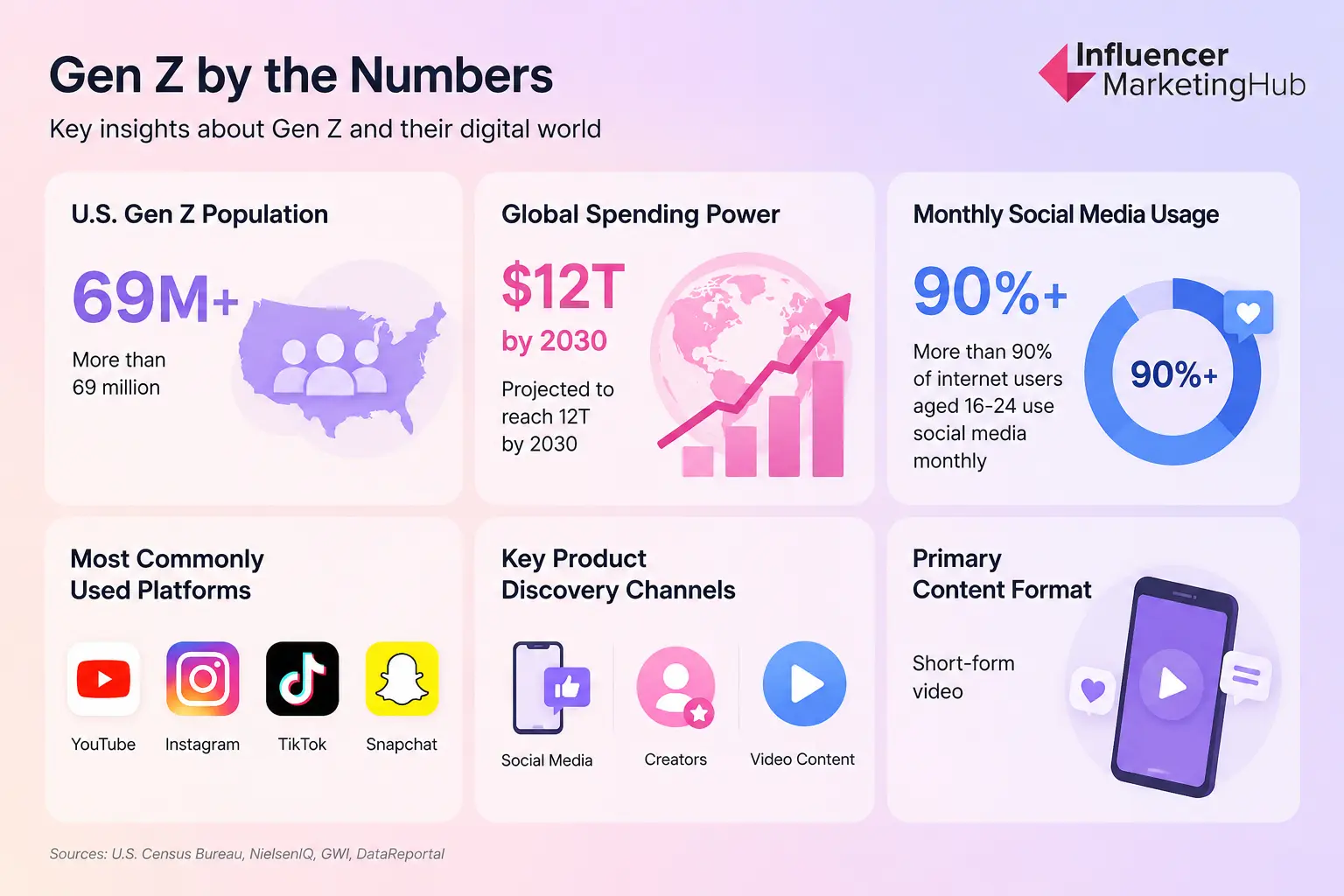
Numbers alone don't tell the full story.
Platform usage, content preferences, and purchasing behavior continue to evolve rapidly. Understanding where Gen Z spends time and how they use different platforms helps explain why certain social media trends are gaining momentum while others are fading.
The Top Social Media Platforms Used by Gen Z
Gen Z is active across multiple social platforms, but usage alone doesn't tell the full story.
A common mistake marketers make is treating every platform as interchangeable. Gen Z uses different platforms for different purposes.
TikTok is often where discovery happens. YouTube is where deeper research takes place. Instagram helps users maintain identity and social connections. Reddit and Discord serve entirely different roles centered around research and community.
| Platform | Primary Use Case |
| TikTok | Discovery |
| Identity & Social Connection | |
| YouTube | Learning & Entertainment |
| Snapchat | Private Communication |
| Research | |
| Discord | Community |
Recent platform usage data shows Instagram, YouTube, and TikTok remain the dominant platforms among Gen Z users. According to Sprout Social research, 89% of Gen Z use Instagram, 84% uses YouTube, and 82% uses TikTok.
The more interesting story is how those platforms fit into the customer journey.
TikTok has become one of Gen Z's primary discovery engines. Product recommendations, creator content, tutorials, and trend-driven videos frequently introduce users to new brands. Research shows that 41% of Gen Z now start online searches on social platforms such as TikTok or Instagram rather than using traditional search engines first.
YouTube plays a different role.
While TikTok excels at discovery, YouTube often supports research and consideration. Product reviews, tutorials, comparisons, and long-form creator content help users evaluate products before purchasing. In fact, YouTube is the second most-used social platform globally and the second-biggest website behind Google.
Instagram remains important because it combines content discovery, creator influence, messaging, and social proof within a single ecosystem. 9 in 10 consumers encounter products through creators, continue researching through Reels and Stories, and eventually engage with shopping features without leaving the platform.
Snapchat continues to hold a unique position among younger audiences. Unlike public-facing platforms, Snapchat's strength comes from private communication and close friend interactions.
Marketers often overlook Snapchat because it generates fewer public conversations, but its daily engagement levels among younger demographics remain significant.
Reddit and Discord represent a different shift altogether.
Gen Z increasingly seeks recommendations from communities rather than brands. Reddit discussions, niche forums, and Discord servers often influence purchasing decisions during the consideration stage. Community validation can carry more weight than traditional advertising because recommendations come from peers rather than marketers.
The biggest takeaway for brands is simple.
Gen Z does not move through a single platform journey. Discovery might happen on TikTok, research on YouTube, validation on Reddit, and purchase after seeing an Instagram ad.
Social media platforms increasingly work together as part of a broader decision-making process rather than operating independently.
With that said, let's go into the Gen Z social media trends marketers should pay attention to.
Trend #1: Short-Form Video Continues to Dominate Attention
Short-form video remains the defining content format for Gen Z.
TikTok's growth helped establish the format, but the trend now extends well beyond a single platform. Instagram Reels, YouTube Shorts, Snapchat Spotlight, and other video-first experiences have adopted similar content models because user demand continues to favor quick, highly personalized video consumption.
The popularity has resulted in 71% growth YoY in short-form content.
Platform investment reflects that reality.
YouTube Shorts now reaches more than 2 billion logged-in users every month, while TikTok, Instagram Reels, and Shorts collectively account for a substantial share of Gen Z's daily content consumption.
Video dominance is also changing how Gen Z discovers information.
As mentioned, research indicates that 41% of Gen Z starts searches on social media platforms before turning to traditional search engines. Many of those searches happen through video content rather than text-based results.
Users increasingly search for restaurant recommendations, product reviews, travel ideas, tutorials, and shopping advice directly within TikTok, Instagram, or YouTube.
The shift helps explain why creator content often outperforms traditional brand messaging.
Video allows creators to demonstrate products, provide context, answer questions, and share experiences in ways that static content cannot. Review videos have become particularly influential.
Spotify for Creators Shows How Podcasts Are Becoming Video-Led Creator Channels
The same video-first behavior shaping TikTok, Instagram Reels, and YouTube Shorts is also changing how Gen Z consumes podcasts.
Podcasting is no longer limited to passive audio listening. For younger audiences, it increasingly overlaps with social discovery, creator fandom, visual context, and community interaction. Edison Research found that 63% of Americans ages 13 to 24 listened to or watched a podcast in the last month, representing an estimated 35 million people. The discovery path also looks highly social: 28% of Gen Z discover podcasts most often by searching on YouTube, while 26% discover them through social media posts.
That helps explain why Spotify for Creators is pushing video so heavily. Gen Z already expects creators to show their faces, demonstrate ideas, react naturally, and build relationships beyond a single post. Among Gen Z monthly podcast listeners, 84% have consumed a podcast with a video component, and 71% actively watch while listening. The reason is not only entertainment. Nearly half say video helps them better understand context and tone, while 45% say it makes them feel more connected to podcasters.
Spotify for Creators - Start Now
Spotify for Creators is built around that shift. The platform now gives podcasters tools to upload video, create Clips, manage comments, customize show pages, track analytics, and monetize through video and audio. Spotify says 350 million people streamed a video podcast on the platform in the past year, while more than 430,000 shows now upload video.
Research found that 67% of Gen Z consumers say review/unboxing-style videos influence purchasing decisions.
Attention patterns are evolving as well.
YouTube recently surpassed Netflix in average daily viewing time globally, demonstrating how digital video continues to absorb larger shares of consumer attention. Younger audiences remain a major driver of that trend.
For marketers, the implication is not simply "create more video."
Creative strategy matters more than volume.
Short-form video works because it feels native to how Gen Z consumes information. Creator-led content, product demonstrations, customer stories, educational clips, and user-generated content often perform better than highly polished advertisements because they match the viewing experience users expect.
Brands entering Gen Z-focused channels should generally start with short-form video as the default creative format. Platform-specific optimization can follow later. Ignoring video entirely increasingly means missing the format Gen Z uses most often for discovery, learning, and product research.
Trend #2: Social Search Is Replacing Traditional Search
Google remains important, but Gen Z increasingly discovers information through social platforms first.
The shift is significant because it changes where brands need to be visible during the discovery phase of the customer journey.
Research from Google found that nearly 40% of young people use TikTok or Instagram when searching for places to eat rather than Google Search or Maps. Deloitte found that 61% of consumers discover brands and products through social media.
Since then, multiple studies have confirmed that social search behavior continues to expand beyond restaurants into categories such as fashion, beauty, technology, travel, and consumer products.
TikTok's search volume reflects that trend. The platform has evolved far beyond entertainment. Users now actively search for:
- Product reviews
- Brand recommendations
- Travel destinations
- Tutorials
- Buying guides
- Local businesses
YouTube serves a similar function at a deeper level. Product comparisons, tutorials, and review videos help users evaluate options before making purchasing decisions.
Reddit is also becoming increasingly important during the research stage. Google's own search results frequently surface Reddit discussions because users often trust recommendations from real consumers more than brand-created content.
The behavior creates a new challenge for marketers.
Traditional SEO strategies were designed around websites ranking in search engines. Social search requires content that can be discovered directly inside TikTok, Instagram, YouTube, and Reddit.
Many brands still optimize exclusively for Google while ignoring platform search behavior.
Gen Z increasingly expects answers to exist where they already spend time.
For marketers, social SEO is becoming just as important as traditional SEO.
Content titles, captions, creator collaborations, hashtags, video descriptions, and platform-specific keywords all influence discoverability. Brands that understand how Gen Z searches inside social platforms often gain visibility long before a consumer visits a website.
The practical takeaway is straightforward.
Search behavior is becoming decentralized. Winning discovery opportunities increasingly depend on showing up across multiple platforms rather than relying on Google alone.
Trend #3: Creators Are More Trusted Than Brand Accounts
Gen Z has grown up surrounded by advertising.
Years of exposure to traditional marketing messages have made younger consumers more selective about who they trust.
Creators often fill that trust gap.
A recommendation from a creator can feel more authentic because it comes from an individual rather than a corporate brand account. Audiences follow creators for specific expertise, entertainment, education, or shared interests, creating a relationship that many brands struggle to replicate on their own.
The numbers support the trend.
Research found that 50% of Gen Z trust influencers' recommendations more than recommendations from traditional celebrities. Meanwhile, creator-led content continues to outperform many brand-led campaigns across engagement metrics.
Trust becomes even more important during the product discovery process.
According to a survey, 61% of consumers trust influencer recommendations when making purchasing decisions.
The difference helps explain why influencer marketing has become a core component of many Gen Z campaigns.
Creators provide something that traditional advertising often cannot: Context.
A creator can demonstrate a product in use, answer common questions, compare alternatives, and explain personal experiences. Consumers gain information that feels practical rather than promotional.
The trend also explains the continued growth of user-generated content.
Many brands now use creator-style videos within paid advertising because the format often feels more native to social platforms. Creator partnerships frequently generate assets that can be repurposed across organic social, paid campaigns, product pages, and ecommerce experiences.
Trust does not mean Gen Z accepts every influencer recommendation.
Authenticity remains critical.
Research from Sprout Social found that 90% of Gen Z will unfollow creators who appear inauthentic, overly promotional, or disconnected from their audience.
For marketers, the lesson is not simply to work with more influencers.
The better approach is partnering with creators who have genuine credibility within specific communities.
Trend #4: Authentic Content Outperforms Highly Produced Campaigns
Production quality still matters, but authenticity often matters more.
Gen Z grew up consuming creator content alongside traditional advertising. As a result, highly polished campaigns don't automatically generate trust or engagement. Content that feels genuine, useful, and relatable often performs better than content that looks overly scripted.
The preference for authenticity appears consistently across consumer research.
According to a study, 82% of consumers say authenticity is an important factor when deciding which brands they support. Younger consumers place even greater emphasis on real social causes when evaluating brands.
Social media platforms have reinforced that behavior.
TikTok's growth was built largely on casual, creator-driven content rather than professionally produced advertising. Instagram Reels and YouTube Shorts followed a similar pattern. Content that feels native to the platform often attracts more engagement because it aligns with what users expect to see in their feeds.
The shift has changed how many brands approach creative development.
Instead of investing entirely in studio-produced campaigns, marketers increasingly combine polished brand assets with:
- User-generated content
- Creator partnerships
- Customer testimonials
- Social causes
- Product demonstrations
- Behind-the-scenes content
User-generated content is often perceived as more trustworthy than brand-created content. Research from Nosto also found that 79% of consumers believe user-generated content has a stronger impact on purchasing decisions than influencer content or professional photography.
Authenticity doesn't mean low quality.
Gen Z can quickly recognize content that feels forced, misleading, or manufactured to appear authentic.
Successful campaigns typically focus on:
- Real experiences
- Useful information
- Honest recommendations
- Clear value propositions
For marketers, the takeaway is simple.
Creative should feel native to the platform where it appears. Social media users generally engage with content that looks like it belongs in their feed, not content that interrupts the experience.
Trend #5: Product Discovery Happens on Social Media First
Social media is no longer just a channel for brand awareness.
For many Gen Z consumers, it has become the starting point of the buying journey.
The previously mentioned GWI research shows that social networks rank among the top sources Gen Z uses to discover brands. Product discovery increasingly happens through creators, recommendations, reviews, tutorials, and short-form videos rather than through traditional advertising channels.
The behavior spans multiple platforms.
- TikTok drives discovery through recommendation algorithms and creator content.
- Instagram combines discovery with social proof through Reels, Stories, and creator partnerships.
- YouTube helps consumers evaluate products through reviews, comparisons, and tutorials.
- Reddit provides community-driven recommendations during the research phase.
Each platform contributes differently to the decision-making process.
Recent research from HubSpot found that 43% of Gen Z consumers have purchased a product directly through social media in the past three months, making them the generation most likely to engage with social commerce.
The influence of creators remains a major factor.
Product discovery has become increasingly decentralized.
A typical Gen Z purchase journey may look something like this:
- Discover a product on TikTok
- Watch a review on YouTube
- Read discussions on Reddit
- See additional creator content on Instagram
- Purchase through an eCommerce store or social commerce feature
Traditional marketing funnels rarely capture the complexity of that process.
Multiple touchpoints contribute to the final purchase decision, even when attribution systems credit only the last interaction.
For marketers, visibility during discovery matters as much as visibility during conversion. Brands that appear early in the research process often gain a significant advantage because they become part of the consumer's consideration set before competitors enter the conversation.
Social media increasingly functions as the front door to the customer journey.
Understanding where Gen Z discovers products helps marketers allocate budgets more effectively across creators, content formats, paid campaigns, and social commerce initiatives.
Looking for the Right Influencers to Reach Gen Z?
Creator recommendations play a major role in how Gen Z discovers products online.
Explore our guide to the best influencer marketing platforms to find creators, manage campaigns, and measure campaign performance more effectively.
Trend #6: Community Is Becoming More Valuable Than Reach
Follower counts still matter, but many brands are placing greater emphasis on community engagement.
Gen Z increasingly values participation over passive consumption.
The trend helps explain the growth of platforms and features built around smaller groups, private conversations, and niche interests. Discord servers, private communities, group chats, Close Friends lists, and subreddit communities have all benefited from this shift.
Research from Sprout Social found that Gen Z is more likely than other generations to say brands should prioritize interacting with their audiences on social media. Separate Sprout research also found that 44% of consumers feel more connected to brands that actively participate in relevant conversations online.
The behavior reflects a broader change in how younger consumers interact online. Large public audiences can generate visibility.
Communities generate relationships. A user may follow hundreds of accounts on TikTok or Instagram while spending significant amounts of time interacting within a much smaller community where trust and participation are higher.
Gaming communities provide one example. Discord has grown into one of the most important community platforms for younger audiences, supporting millions of active servers built around gaming, entertainment, technology, education, and creator-led communities.
Reddit demonstrates a similar pattern. Many users visit Reddit not for content distribution but for discussion, recommendations, and problem-solving. Product conversations often emerge organically within communities rather than through formal advertising campaigns.
Community-driven engagement also affects purchasing behavior. Consumers frequently seek validation from peers before making decisions. Recommendations from community members often feel more credible because they are not perceived as sales messages.
Mass reach can generate awareness quickly. Communities often generate stronger trust, loyalty, and advocacy over time. Brands focused exclusively on audience size may miss opportunities to build deeper relationships with highly engaged groups of consumers.
Community-building strategies can take many forms:
- Creator-led communities
- Discord servers
- Reddit participation
- Ambassador programs
- Loyalty communities
- Exclusive customer groups
Success increasingly depends on creating environments where consumers can interact with one another, not just with the brand itself.
As Gen Z continues to prioritize authenticity, belonging, and shared interests, community engagement is becoming a competitive advantage that is difficult to replicate through paid reach alone.
Trend #7: Shopping and Entertainment Continue to Merge
Gen Z rarely separates content consumption from product discovery.
Entertainment, recommendations, reviews, and shopping increasingly happen within the same experience.
The trend helps explain why creator-led commerce has grown so rapidly across social platforms. Product discovery happens naturally as part of the content experience.
Platform investments reflect the opportunity.
TikTok Shop continues expanding globally. Instagram Shopping remains integrated across posts, Reels, and creator content. YouTube has invested heavily in shopping features that allow creators to showcase products directly within videos.
Creators sit at the center of much of this activity. Many purchasing decisions now begin with a creator demonstrating a product rather than with a brand advertisement.
The format works because it reduces friction.
Traditional eCommerce journeys often require consumers to move between multiple websites, search results, and product pages.
Social commerce compresses that process.
Consumers can discover, research, validate, and purchase products without leaving the platforms they already use daily.
Affiliate marketing has benefited from the trend as well.
Many creators now operate as media channels and sales channels simultaneously. Product recommendations, affiliate links, storefronts, and creator partnerships increasingly blur the line between content and commerce.
The shift creates both opportunities and challenges for marketers.
Brands gain access to consumers earlier in the buying journey, often during moments of entertainment rather than active shopping.
At the same time, competition for attention becomes more intense because consumers encounter products alongside an endless stream of content. Successful campaigns typically focus less on direct selling and more on creating content that feels valuable, entertaining, or educational.
For marketers, the lesson is clear.
Gen Z does not always distinguish between discovering content and discovering products. The brands that perform best are often those that integrate naturally into the content experiences consumers already enjoy rather than interrupting them with traditional advertising.
Gen Z Is Redefining How Social Media Influences Buying Decisions
Gen Z's relationship with social media extends far beyond communication and entertainment. Social platforms now influence how younger consumers discover products, research brands, evaluate recommendations, and make purchasing decisions.
Several trends are driving that shift. Short-form video continues to dominate attention. Social search is changing how information is discovered. Creator recommendations often carry more weight than traditional advertising. Social commerce is reducing friction between discovery and purchase.
Marketers who understand these behaviors can build more effective strategies across content, influencer marketing, paid social, and ecommerce. Success increasingly depends on showing up where Gen Z spends time, creating content that feels native to each platform, and building trust through creators and communities.
Social media is no longer just a marketing channel. For Gen Z, it has become part of the entire customer journey.
Frequently Asked Questions
What social media does Gen Z use the most?
Instagram, YouTube, TikTok, and Snapchat remain among the most widely used social media platforms among Gen Z. Platform usage varies by purpose, with TikTok often used for discovery, YouTube for research and entertainment, Instagram for social connection, and Snapchat for private communication.
Which social media platform is most popular among Gen Z?
Instagram, YouTube, and TikTok consistently rank among the most popular platforms used by Gen Z. Many users actively engage with multiple platforms throughout the day rather than relying on a single social network.
How much time does Gen Z spend on social media?
Research from GWI shows that social media remains one of Gen Z's primary digital activities. Many users spend several hours per day across platforms consuming content, interacting with creators, researching products, and communicating with friends.
Why is TikTok so popular with Gen Z?
TikTok combines entertainment, discovery, and search within a single platform. Personalized recommendations help users find content, creators, products, and trends quickly, making the platform particularly appealing to younger audiences.
How does Gen Z discover new products on social media?
Many Gen Z consumers discover products through creator recommendations, short-form videos, product reviews, tutorials, and user-generated content. TikTok, Instagram, YouTube, Reddit, and other social platforms often serve as product discovery channels.
Which generation uses social media the most?
Younger generations generally spend more time on social media than older age groups. Gen Z remains one of the most socially connected generations and uses social platforms throughout the discovery, research, and purchasing process.
What type of content performs best with Gen Z?
Short-form video, creator content, user-generated content, product demonstrations, educational videos, and authentic behind-the-scenes content tend to perform particularly well with Gen Z audiences.
How can brands market effectively to Gen Z on social media?
Brands can improve their results by creating platform-specific content, investing in creator partnerships, optimizing for social search, prioritizing authenticity, and treating social media as both a discovery and commerce channel rather than simply a distribution platform.