

User-generated content has become a foundational element of modern marketing, not just a supporting tactic. As trust in traditional advertising continues to decline, brands are increasingly turning to content created by real customers and communities.
Today, roughly 56% of brands actively prioritize UGC as part of their marketing strategy, reflecting a clear shift toward authenticity-driven growth rather than polished brand-led messaging.
Yet adoption does not always equal clarity.
- How do brands reliably generate high-quality UGC without running constant campaigns or depending on unpredictable creator outreach?
- And once that content is in hand, how do marketers handle approvals, usage rights, moderation, and performance tracking without adding friction to already complex workflows?
This guide explains how UGC works in practice, breaking down the systems, processes, and decisions brands use to turn user content into a scalable, measurable marketing engine.
- What Is User Generated Content (UGC)?
- Why UGC Works in Marketing
- Types of UGC Brands Can Use, With Real Examples
- How UGC Works - Step by Step for Brands
- Organic UGC vs Paid UGC
- Where UGC Works Best Across the Funnel
- UGC Moderation, Rights, and Risk Management
- How Brands Measure UGC Performance
- How to Get Started With UGC as a Brand
- From Content Tactic to Trust Engine
- Frequently Asked Questions
What Is User Generated Content (UGC)?
User-generated content, commonly referred to as UGC, is any content created by real users rather than the brand itself. In a marketing context, this typically means customers, fans, or community members sharing their genuine experiences with a product, service, or brand in their own words and style.
UGC can take many forms. The most familiar examples include:
- Customer reviews and ratings on product pages
- Photos shared on social media
- Short-form videos showing how a product is used
- Testimonials
- Questions and answers submitted by buyers.
What all of these formats have in common is authorship. The content originates from the user, not from a brand brief or in-house creative team. More on all these formats later.
It's also important to draw a clear line between UGC and other adjacent content types. Brand-produced content, even when designed to look casual or native, is not UGC.
Influencer content can overlap with UGC in appearance, but when it is paid, scripted, or commissioned, it follows a different operational and legal model. True UGC reflects unsolicited or lightly prompted user expression, which is why it carries such strong credibility with audiences.
For brands and marketers, understanding what qualifies as UGC is the first step toward building a strategy that is both authentic and scalable.
Why UGC Works in Marketing
UGC works because it aligns with how people actually make decisions. Buyers trust other buyers more than brands, especially in crowded digital environments where traditional advertising is easy to ignore.
In fact, these behaviors are much more evident in the B2B world, where as much as 87% of buyers trust content created by industry influencers.
When potential customers see real people using, reviewing, or recommending a product, it reduces uncertainty and shortens the path to confidence.
At its core, UGC functions as social proof. Reviews, photos, and videos from existing customers signal that a product is credible, relevant, and already validated by others. This is particularly powerful in eCommerce and performance marketing, where even small trust signals can influence conversion rates and purchase intent.
UGC also feels native to modern platforms.
Short form videos, casual photos, and unscripted testimonials blend naturally into social feeds, product pages, and ads. Because the content mirrors how users already communicate online, it attracts attention without triggering the same resistance as overt brand messaging.
For brands, the result is marketing that feels more authentic, more relatable, and often more effective across both upper funnel engagement and lower funnel conversion.
Types of UGC Brands Can Use, With Real Examples
As mentioned, user-generated content can take many forms, but not every format serves the same purpose. Some types of UGC are best suited to building trust at the point of purchase, while others are more effective for awareness, engagement, or community participation.
For brands, the key is not just to collect more UGC. It is to understand which formats are most useful in specific placements and how each type contributes to marketing performance.
Below are the main types of UGC brands can use, along with examples of how they appear in practice.
Reviews and Ratings
Reviews and ratings are among the most established forms of UGC. They are especially valuable in eCommerce because they help buyers evaluate product quality, usability, and reliability at the moment of decision.
This type of content works best on product pages, retailer listings, app stores, and review platforms, where trust signals can directly influence conversion. Even short written reviews can reduce hesitation, while star ratings provide immediate social proof at scale.
A clear example of this approach appears on the product pages of Boujee Hippie, a lifestyle brand on a mission to support women to love themselves. In addition to written customer reviews and star ratings, many of these pages feature user-submitted photos and short video testimonials showing customers using the products or sharing their results.
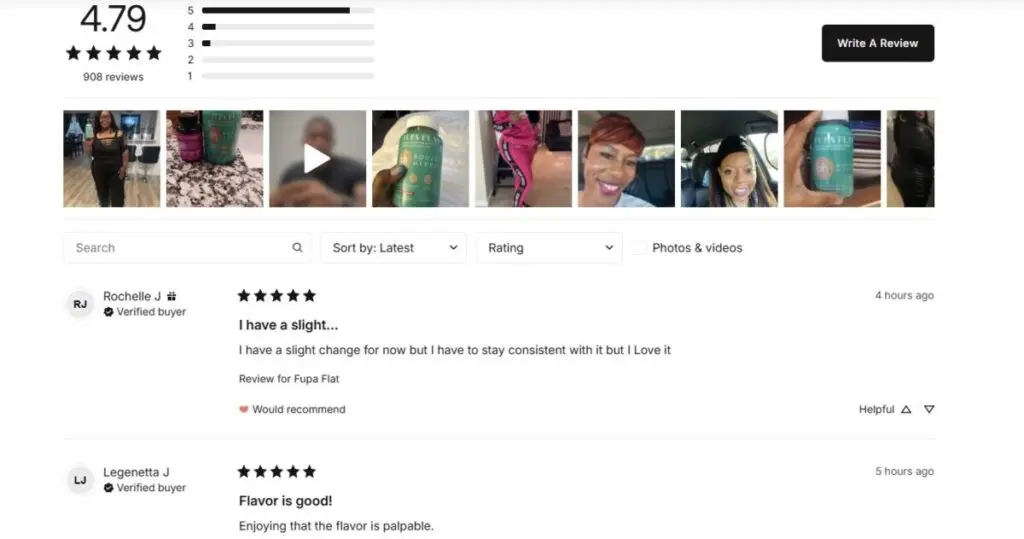
By combining traditional text reviews with visual UGC, the brand provides multiple layers of social proof. Shoppers can read about other customers’ experiences while also seeing real users demonstrate the products, which helps reduce uncertainty and reinforces credibility at the point of purchase.
Customer Photos
Customer photos show how products look in real life rather than in a controlled brand shoot. This makes them particularly useful for categories where fit, styling, texture, or visual proof matter, such as fashion, beauty, home, travel, and food.
These assets are often sourced through hashtags, tagged posts, direct submissions, or post-purchase prompts. Brands may republish them on social media, product galleries, landing pages, or email campaigns.
A well-known example comes from the clothing brand ASOS. The company encourages customers to share outfit photos using branded hashtags, then selects and reposts some of these images across its social channels.
It also integrates customer photos into a dedicated “ASOS Looks Good On You” page on its website, where shoppers can browse real customer looks and shop the featured items directly.

By showcasing how customers actually style the products, this form of UGC helps bridge the gap between studio photography and real-world wear, making it easier for potential buyers to imagine how the items might look in their own wardrobe.
Customer Videos
Video UGC is one of the most flexible formats because it can support both upper-funnel engagement and lower-funnel persuasion. Short videos often perform well on social platforms because they feel native, unscripted, and easier to trust than polished brand creative.
Brands use customer videos for product demos, unboxings, before-and-after content, reactions, tutorials, and testimonial clips. In paid media, these assets are often adapted into UGC-style ads because they can communicate proof quickly and naturally.
A well-known example comes from GoPro, whose content ecosystem relies heavily on footage captured by its customers. Through initiatives like the GoPro Awards, the company actively encourages users to submit photos and videos filmed with their cameras.
Participants can upload raw clips, edited videos, or images for the chance to receive rewards such as cash prizes, camera gear, or featured placement across GoPro’s social channels.
By turning customer submissions into challenges and recognition programs, GoPro consistently generates a large stream of authentic video UGC that showcases the product in real-world environments.
The result is a marketing engine where the most compelling demonstrations of the product are created by the users themselves rather than by the brand’s production team.
Testimonials
Testimonials are direct statements from customers describing their experience with a product, service, or brand. They are often more structured than reviews and usually focus on outcomes, satisfaction, or a specific problem solved.
Brands use testimonials on landing pages, in email campaigns, on sales pages, and in paid social creative. They are especially effective when paired with context, such as the customer type, use case, or measurable result.
For service-based businesses and B2B brands, testimonials often act as proof of credibility. For consumer brands, they can reinforce trust when placed near key conversion points. Even a single sentence from a real user can be more persuasive than a longer block of brand copy if it addresses a common objection clearly.
Social Media Mentions and Posts
Not all UGC needs to be formal. A simple social post, story mention, or positive comment can still be valuable if it reflects genuine customer sentiment. These light-touch formats work well for brand awareness, community engagement, and ongoing social proof.
Brands often monitor mentions, tags, and branded hashtags to find content worth resharing. This can include a customer posting about a recent purchase, a creator casually mentioning a favorite product, or a fan sharing an everyday use case without being prompted.
LaCroix is a well-known example of a brand that has built visibility through this kind of socially native UGC. By resharing a broad mix of customer content rather than relying only on highly polished creators, brands can make their feeds feel more accessible and community-driven.
@cornellsdt These boots were made for walkin’ home to SDT 🫶 @LaCroix Sparkling Water #cornell #sigmadeltatau #sdt #recruitment #sigdelt
Questions, Answers, and Community Contributions
UGC is not limited to praise or visuals. Questions and answers submitted by buyers can also be valuable because they help future customers understand product details, fit, usage, or compatibility.
This format is especially useful on product pages, marketplace listings, and community forums, where potential buyers often look for practical clarification before purchasing. Unlike branded FAQs, customer-submitted questions tend to reflect real uncertainty in the buyer journey.
For brands, this kind of UGC can surface recurring objections, identify missing product information, and improve the overall purchase experience. It may not be visually engaging, but it is highly functional and often conversion-relevant.
Blog Posts, Articles, and Long-Form Mentions
In some categories, UGC appears in long-form written content such as blog reviews, personal essays, travel recaps, or product comparisons. This is especially common in beauty, SaaS, parenting, travel, and consumer tech, where users document detailed experiences and recommendations.
Brands can amplify these mentions by quoting excerpts, requesting reuse permission, or directing traffic to trusted third-party reviews. Long-form UGC often carries weight because it provides richer context than a social caption or short testimonial.
Travel platforms and hospitality brands, for example, often benefit from customer-written trip recaps or destination reviews because these pieces combine storytelling with validation from real users.
Employee-Generated Content
Employee-generated content is not always included in basic UGC discussions, but it can be a useful category for brands, especially in early-stage programs or service-led businesses. This includes content created by employees that shows behind-the-scenes processes, company culture, customer support moments, or product expertise.
While it does not carry the same neutrality as customer-created content, it can still feel more human and credible than formal brand publishing. It is particularly effective on LinkedIn, employer branding channels, and founder-led social accounts.
A well-known example comes from LinkedIn through its #LinkedInLife initiative. Employees regularly share posts about their work, team projects, and daily experiences inside the company, offering a behind-the-scenes look at product development, collaboration, and company culture.
These posts give audiences a more authentic view of the organization while simultaneously expanding the brand’s reach through employees’ personal networks.
For brands with limited customer content volume, employee participation can help build the habit of content sharing while reinforcing authenticity in a different way.
Brand Advocate and Community Content
Some of the most valuable UGC comes not from one-time customers, but from repeat buyers, loyal fans, or active community members. These contributors often create content consistently, participate in branded campaigns, and help sustain the brand’s visibility over time.
This type of UGC is often more emotionally invested and more aligned with brand values than casual customer posts. It can include repeat reviews, challenge participation, community submissions, or ambassador-style content from unpaid advocates.
Gymshark’s broader community ecosystem is a useful example of how advocacy can evolve into a recognizable content engine.
@markblighfitness This one is more of a reminder for myself to not compare my unique journey to others and to write my own story @Gymshark #gymshark66#gymshark66challenge#gym#motivation
While not every advocate is simply a customer, the principle remains important. Brands that cultivate participation from their most engaged communities often generate more durable and more scalable UGC over time.
Choosing the Right UGC Type for the Job
The most effective UGC strategy does not rely on one format alone. Reviews may be strongest at the bottom of the funnel, while videos drive attention in paid social and customer photos strengthen product page trust. Testimonials can support landing pages, and community content can reinforce loyalty long after the first purchase.
What matters is not just collecting user-generated content, but matching the right type of UGC to the right channel, audience need, and business goal.
When brands understand these distinctions, UGC becomes easier to source, easier to deploy, and far more valuable across the customer journey.
How UGC Works - Step by Step for Brands
UGC does not work by accident. The brands that see consistent results treat it as an operational system. While the content itself may look spontaneous, there is almost always structure behind how it is sourced, filtered, approved, and deployed.
Understanding each step in the process helps brands avoid common pitfalls like unusable assets, rights issues, and inconsistent performance.
Below is a practical breakdown of how UGC actually works inside modern marketing teams, from the first strategic decision to ongoing optimization.
Step 1: Start With the Placement, Not the Content
UGC performs differently depending on where it appears. Before you source a single asset, decide the primary placement and the job it needs to do.
A product detail page needs proof, clarity, and objections handled, so review snippets, before and after photos, and use case demonstrations usually matter more than entertainment value.
Paid social needs strong hooks, fast pacing, and a clear angle in the first seconds, so short-form video and testimonial-style clips tend to win. On the other hand, email needs scannable credibility, so a single quote plus a product shot often outperforms a long review.
When brands begin with placement, they naturally define the right format, length, messaging, and creative constraints, preventing the creation of a pile of content that looks authentic but cannot be used.
Step 2: Define What “Good” Looks Like With a Simple UGC Brief
Even organic UGC benefits from structure. Brands that get consistent results define a lightweight UGC brief that covers do and do not guidelines without scripting the creator.
This includes the core product promise, 2 or 3 audience pain points, the top objections to address, preferred visual context, and required disclosures. It also includes practical requirements like aspect ratio, length ranges, caption needs, and whether sound on viewing is assumed.
The goal is not to control the story; it is to remove ambiguity so customer content is usable across channels. A good brief also clarifies what disqualifies an asset, such as competitor mentions, medical claims, unsafe usage, or incorrect product information.
Here's a TikTok video rundown of how that looks:
@plotworkspace How to creative a creative brief for ✨content creators✨ #deliverables #taskmanagement #techtok #creatives #agencylife #marketers #creativedevelopment #taskmanagement #projectmanagementtips #engagementstrategy #creativebrief
Step 3: Choose a Sourcing Model That Matches Your Volume Needs
UGC sourcing works best when brands understand that different models solve different problems. Most mature UGC programs rely on more than one sourcing approach, balancing authenticity, control, and output predictability depending on campaign goals and timelines.
Organic UGC Sourcing
Organic UGC collection is the most natural form of sourcing. This includes content customers already share through brand mentions, tagged photos, hashtags, reviews, and comments. Its biggest strength is credibility.
The content is unsolicited and often highly trusted by audiences. The downside is control. Volume fluctuates, formats are inconsistent, and many assets are unusable for paid or owned placements without additional context or permissions.
Organic sourcing works well for social proof, community building, and always-on-brand presence, but it is rarely sufficient on its own for performance-driven campaigns.
Here's an example of organic UGC content:
@glamzilla THE NEW SELENA GOMEZ BRONZER!! Available in 7 inclusive shades the new @Rare Beauty Warm Wishes Soft Matte Powder Bronzer comes in a variety of different undertones from warm to neutral and even a purple undertone! Here’s what you need to know: this formula is buildable, matte and applies ultra smooth! Watch the full video to see how I apply it! #rarebeauty #selenagomez
Prompted UGC Sourcing
Prompted UGC sourcing adds light structure without fully commissioning content. Brands guide customers through post-purchase emails, review prompts, loyalty programs, or incentives that encourage specific formats such as short videos, photos, or testimonials.
This model improves consistency and relevance while maintaining an authentic feel. It is especially effective for eCommerce brands that want reliable review volume or product usage content.
However, it still requires internal coordination and manual effort to collect, review, and manage permissions at scale.
Platform-Based UGC Sourcing
Platform-based UGC sourcing is designed for brands that need predictable volume, centralized workflows, and repeatable execution. Platforms like Brandwatch help brands discover and aggregate organic UGC across social channels, while tools such as Humanz and Creator.co support structured sourcing through creator communities and managed submissions.
Solutions like Twirl and Billo focus on scalable content production by connecting brands with creators who deliver UGC style assets on demand.
The advantage of platform-based sourcing is operational clarity. Content flows into a single system, moderation rules are standardized, and rights management is built into the process.
This makes it easier to support paid media, rapid testing, and multi-channel distribution. The tradeoff is that platform-sourced UGC often sits closer to paid creator content than purely organic customer content, which means brands must be intentional about how and where it is used.
Key Takeaway
The most effective UGC strategies align sourcing models with business reality. Organic collection fuels authenticity, prompted sourcing improves relevance, and platform-based sourcing delivers scale. Expecting one model to cover every use case is where most UGC programs break down.
Step 4: Moderate and Curate for Quality, Safety, and Relevance
Not all UGC is usable, and treating everything as publishable is a common mistake.
Moderation is where brands protect themselves and their audience. This step involves checking content for accuracy, tone, visual quality, brand safety, and compliance with internal and platform rules.
Curation then narrows the pool further by selecting assets that align with campaign goals and placements. High-performing brands tag and categorize UGC by product, theme, sentiment, and funnel stage so assets can be reused strategically instead of disappearing after a single post.
Step 5: Secure Rights and Define Usage Clearly
UGC cannot be reused freely just because it exists online. Brands must explicitly secure permission before repurposing content in ads, emails, or owned properties. This step defines where the content can appear, how long it can be used, and whether paid amplification is allowed.
Clear rights management reduces legal risk and prevents last minute creative blocks when high performing assets cannot be scaled. Many brands formalize this step through standardized permission requests or platform-managed consent workflows.
Step 6: Publish, Measure, and Refine the System
Once approved, UGC is deployed across selected channels and measured based on its role. Performance metrics vary by placement, from engagement and watch time in social to conversion influence on product pages and ads.
The most effective brands treat this data as feedback, using it to refine briefs, sourcing prompts, and placement decisions over time. When this loop is in place, UGC stops being a one-off experiment and becomes a repeatable growth system.
Organic UGC vs Paid UGC
Not all user-generated content emerges in the same way. Some content appears naturally when customers share their experiences without being asked, while other content is created after a brand encourages or compensates contributors to produce it.
Understanding the distinction between organic and paid UGC helps marketers choose the right sourcing model for their goals.
Difference Between Organic and Paid UGC
Organic UGC
Organic UGC refers to content customers create and share voluntarily. This might include a social post about a recent purchase, a product review left on a retailer site, a photo showing how an item fits into everyday life, or a short video demonstrating how a product works.
Because it originates without direct brand involvement, organic UGC is often perceived as the most authentic form of customer expression. It reflects genuine enthusiasm, feedback, or everyday usage, which is why it carries strong credibility with potential buyers.
Brands typically discover organic UGC through social mentions, tagged posts, review platforms, and community conversations. Once identified, the content can often be reshared on brand channels, provided the creator grants permission.
For many companies, organic UGC serves as the foundation of their social proof. Customer photos on product pages, real-life testimonials in emails, and user mentions on social feeds all fall into this category.
The main limitation is predictability. Because customers create this content on their own terms, volume and format can vary widely. Some brands may see large amounts of organic UGC, while others receive only occasional contributions.
Paid UGC
Paid UGC refers to content created after a brand offers compensation, products, or incentives in exchange for content creation. While it is still designed to resemble authentic customer content, the process is more structured and predictable.
In practice, paid UGC is often produced by independent creators who specialize in filming product demonstrations, testimonials, or lifestyle clips designed to feel native to social platforms.
These creators may not necessarily have large audiences. Instead, their role is to produce relatable content that brands can repurpose across ads, landing pages, and social channels.
This model has become increasingly common as brands seek consistent creative output for performance marketing. By working with creators directly or through UGC platforms, companies can generate multiple content variations quickly and test which messages or formats perform best.
Paid UGC does introduce additional considerations. Brands must clearly define usage rights, determine where the content can be distributed, and comply with disclosure requirements when content appears as sponsored material.
Choosing the Right Model
Most mature UGC strategies rely on a mix of both models. Organic UGC provides credibility and community engagement, while paid UGC ensures a steady stream of content that can be tailored for specific campaigns.
When used together, these approaches allow brands to maintain authenticity while also producing the volume and consistency needed for modern digital marketing.
Where UGC Works Best Across the Funnel
UGC is most effective when it is deployed intentionally across different stages of the customer journey. While many brands associate UGC primarily with social media, its real impact comes from how well it supports specific funnel objectives, from discovery to conversion and retention.
At the upper funnel, UGC drives attention and relatability.
Short form videos, casual testimonials, and lifestyle photos perform well in social feeds and awareness campaigns because they blend into native environments.
At this stage, the goal is not persuasion through detail but resonance. Content that looks like it came from a peer lowers resistance and encourages viewers to stop, watch, and engage.
@bondijunctionpandora I love this brand 💗 #pandora #pandoracharms #pandorabracelet
In the mid funnel, UGC helps prospects evaluate options. Here, content that demonstrates use cases, answers common questions, or shows real outcomes becomes more valuable. Product walkthroughs, before and after visuals, and longer form reviews work well on landing pages, retargeting ads, and social profiles.
This is where authenticity reduces uncertainty and keeps buyers moving forward.
@chrustal Girly morning routine ૮ ․ ․ ྀིა I used: @rhode skin pineapple refresh cleanser @medicube global pdrn pink niacinamide milky toner @SKIN1004 US tone brightening capsule ampoule medicube pdrn pink collagen capsule cream anillo hair essence morningroutine cleangirl girlygirl pinkaesthetics kbeauty
At the lower funnel, UGC supports conversion. Reviews, ratings, customer quotes, and user photos on product pages provide reassurance at the moment of decision. In performance ads, UGC style testimonials often outperform polished creatives because they feel credible and specific.
Even a single authentic review snippet can tip a hesitant buyer toward purchase.
@jeffreestar Trying @SHEGLAM for the VERY first time… Full face first impressions!! Are they Jeffree Star Approved?! #jeffreestar #sheglam #beautyreview #sheglampartner
Beyond conversion, UGC also plays a role in retention and advocacy. Featuring customer content in email, community channels, or loyalty programs reinforces belonging and encourages repeat engagement.
Key Takeaway
UGC does not work everywhere in the same way. Its value comes from matching the format and message to the job each stage of the funnel needs to accomplish.
UGC Moderation, Rights, and Risk Management
UGC introduces authenticity, but it also introduces responsibility.
Without clear moderation and rights processes, even well-intentioned UGC programs can create brand safety, legal, or operational issues. This is where many brands struggle, not because the rules are complex, but because they are often informal or inconsistent.
Moderation is the first line of defense. Every UGC asset should be reviewed for accuracy, tone, visual quality, and alignment with brand guidelines before it is published or reused. This includes checking for misleading claims, unsafe product usage, offensive language, competitor mentions, or content that could be interpreted out of context.
For regulated industries, moderation also helps prevent compliance violations that can carry serious consequences.
Rights management is equally critical. Just because content exists publicly does not mean a brand can reuse it freely. Brands must secure explicit permission from the creator before repurposing UGC in ads, emails, websites, or other owned channels.
This permission should clearly define usage scope, duration, and whether paid amplification is allowed. Failing to do so can result in takedown requests, reputational damage, or legal exposure.
@creativelylinda Usage Rights 101! Organic and paid ads usage rights - what they are, how much to charge, how they work ☺️ More resources in my bio! #ugccontracts #ugctips2023 #ugchowtostart #ugcusagerights #ugcrates
Finally, risk management requires consistency. Brands running always on UGC programs benefit from standardized approval criteria, documented workflows, and centralized storage. This reduces reliance on ad hoc decisions and ensures UGC remains an asset, not a liability.
When moderation and rights are treated as part of the system, not an afterthought, UGC becomes safer, more scalable, and easier to operationalize.
How Brands Measure UGC Performance
UGC performance cannot be evaluated with a single metric or dashboard. Because user-generated content supports different objectives depending on where it appears, measurement must always be tied to intent.
The goal is not to prove that UGC “works” in general, but to understand which types of UGC drive specific outcomes across the funnel and where it delivers the greatest leverage.
Measuring UGC Performance Across the Funnel
Measuring UGC in Awareness and Engagement Placements
When UGC is used at the top of the funnel, success is primarily about attention and relevance. Metrics such as video view rate, watch time, saves, shares, and meaningful comments help brands understand whether the content feels native and compelling in social environments.
Strong performance here suggests that the creative format, creator perspective, and hook align with audience expectations. Brands often compare UGC engagement against brand-produced content to assess whether authenticity is improving feed-level performance.
Measuring UGC in Paid Media and Performance Campaigns
In paid environments, UGC is evaluated against efficiency and contribution. Click-through rate, cost per click, cost per acquisition, and creative level conversion data show whether UGC style assets are driving stronger results than traditional ads.
Many brands also track creative fatigue and frequency, as UGC often maintains performance longer due to its less polished, more varied feel. Iterating based on top-performing hooks and angles is critical at this stage.
Measuring UGC on Product Pages and Conversion Surfaces
On product pages, UGC acts as reassurance rather than a traffic driver. Metrics such as conversion rate lift, add to cart rate, time on page, and bounce rate help quantify how reviews, photos, and testimonials reduce hesitation.
Qualitative signals, including review sentiment and recurring themes, also provide insight into what buyers care about most at the moment of decision.
Measuring UGC in Retention and Lifecycle Channels
When UGC is used in email, community spaces, or loyalty programs, measurement shifts toward sustained engagement. Open rates, click rates, repeat purchases, and participation signals show whether featuring customer voices reinforces trust and belonging. Over time, brands can identify whether UGC contributes to stronger lifetime value and advocacy.
The most effective teams treat UGC performance as a learning system. By tagging assets by source, format, message, and placement, they can continuously refine sourcing, briefs, and distribution strategies based on real impact rather than assumptions.
How to Get Started With UGC as a Brand
Getting started with UGC does not require a full-scale overhaul of your marketing stack. The brands that succeed early focus on building clarity and consistency before chasing volume. The following tips are designed to help teams move from intention to execution without unnecessary complexity.
Tip 1: Start Small Before Committing to Always On UGC
Many brands assume UGC only works at scale, which often leads to stalled launches. A better approach is to start with a single use case, such as adding reviews to product pages or testing UGC style videos in paid social.
This allows teams to understand sourcing, moderation, and performance in a controlled environment. Once workflows are clear and results are measurable, expanding into an always-on model becomes far easier and more sustainable.
Tip 2: Decide Who Owns UGC Internally
UGC touches multiple teams, including marketing, social, eCommerce, legal, and sometimes customer support. Without clear ownership, content gets stuck in review loops or never gets published.
Assign a primary owner responsible for sourcing, approvals, and deployment, even if execution is shared. Clear ownership ensures UGC is treated as an operational priority rather than an ad hoc creative experiment.
Tip 3: Align UGC Goals With Business Outcomes
UGC performs best when it is tied to a specific objective. Before collecting content, define whether the goal is trust building, conversion lift, creative testing, or retention. This clarity informs what formats to collect, where to publish, and how to measure success. Without defined outcomes, teams often collect content that feels authentic but delivers limited impact.
Tip 4: Build Simple Guidelines, Not Rigid Scripts
UGC loses its value when it becomes overly controlled. Instead of scripting contributors, provide lightweight guidelines that clarify expectations while leaving room for personal expression. Focus on what must be included and what should be avoided, rather than dictating exact wording or structure. This balance preserves authenticity while improving usability.
Tip 5: Avoid Common Early Mistakes
Early UGC programs often fail due to preventable issues. Common mistakes include:
- Collecting content without securing rights
- Sourcing assets without knowing where they will be used
- Overvaluing quantity over quality
- Treating UGC as a one-time campaign rather than a system
Addressing these early helps teams build momentum instead of reworking processes later.
By approaching UGC as a structured but flexible system, brands can move from experimentation to consistency and unlock long term value from user-generated content.
From Content Tactic to Trust Engine
User-generated content works best when it is treated as a system rather than a one-off creative tactic. For brands and marketers, the real value of UGC lies in its ability to build trust at scale, using real voices to support every stage of the customer journey.
When sourcing, moderation, rights, and measurement are clearly defined, UGC becomes easier to manage and more impactful across channels.
As audiences continue to favor authenticity over polish, UGC will only grow in importance. Brands that invest in structure early can turn user content into a reliable performance driver, not just a brand signal. The key is consistency.
When UGC is intentional, measurable, and aligned with business goals, it becomes a long-term advantage rather than an ongoing challenge.
Frequently Asked Questions
How does UGC impact SEO for brands?
UGC can improve SEO by continuously adding fresh, relevant content that reflects how real users talk about products. Reviews, Q&A sections, and user-submitted media naturally introduce long tail keywords and semantic variation, which strengthens relevance signals, especially when paired with structured markup and internal linking as part of a broader UGC SEO strategy.
Can UGC be used directly in ecommerce stores like Shopify?
Yes. Many brands integrate UGC into product pages, landing pages, and galleries to improve buyer confidence. Video testimonials and customer demos are especially effective when embedded alongside product details, and brands often rely on dedicated UGC video tools to manage sourcing, formatting, and placement within Shopify storefronts.
How does UGC work for short form video platforms?
On platforms like YouTube Shorts, UGC works best when content mirrors native creator behavior rather than traditional advertising. Brands often test multiple hooks, formats, and creators to find what resonates, then scale winners using workflows similar to those used by UGC video makers focused on short-form distribution.
Is UGC the same as influencer marketing?
UGC and influencer marketing overlap visually but differ operationally. UGC centers on authentic customer expression or creator-style content without audience leverage, while influencer marketing is built around reach and distribution.
Understanding this distinction is critical when designing programs that align with modern user-generated content strategies rather than traditional sponsorship models.
When should brands use UGC video agencies instead of sourcing internally?
UGC video agencies are often used when brands need rapid scale, consistent output, or specialized creative direction without building in house workflows. This is common during launches or aggressive testing phases, where partnering with UGC video agencies helps maintain momentum while internal teams focus on optimization and distribution.
How important is editing in UGC performance?
Editing plays a major role in how UGC performs, especially in paid placements. Subtle cuts, captions, and licensed music can dramatically improve retention while preserving authenticity. Many brands rely on video editing tools that include built-in music libraries to streamline compliance and creative iteration.
Can UGC be used for product demonstrations?
UGC is increasingly used for product demos because it shows real usage rather than idealized scenarios. Customer-led walkthroughs help address objections and build confidence, particularly for complex products, which is why many teams adopt UGC demo software to standardize formats without scripting contributors.
Does UGC work for paid advertising?
UGC is widely used in paid ads because it often outperforms polished brand creative in engagement and conversion efficiency. Testimonial style clips, unboxings, and problem solution videos are common formats, especially when deployed as UGC video ads that blend seamlessly into social feeds.

SUGGESTED

How To Create A User-Generated Content Campaign For Your Brand
User-Generated Content Campaigns can help you grow your social media presence. Read on to...

The Rise of User-Generated Content (UGC)
Explore the rise of user-generated content as a popular and authentic advertising method...

How to Effectively Leverage User-Generated Content (UGC) for B2B
The social media landscape is no longer just a playground for consumer marketers. It's...