Influencer campaigns can involve sponsorship fees, free products, affiliate commissions, ambassador arrangements, and other relationships between creators and brands. When one of those relationships could affect how an audience evaluates a creator's recommendation, it needs to be made clear.
That is the basic principle behind an FTC disclosure. The challenge for marketers is turning that principle into something creators can apply consistently across Instagram posts, TikToks, YouTube videos, livestreams, affiliate content, and other formats.
However, the confusion lies in the fact that the FTC does not publish a completely different set of endorsement rules for every social network. Its guidance focuses on whether a material connection exists and whether that connection is disclosed clearly and conspicuously.
Platforms then add their own branded-content tools and policies on top of those principles. The FTC's current endorsement framework continues to rely on its Endorsement Guides, revised in 2023, alongside its guidance for influencers and advertisers.
For brands and agencies, disclosure therefore needs to become part of campaign QA rather than something left entirely to the creator at publishing time. This guide explains what to check and how those checks should change across platforms.
Disclaimer: This guide and the accompanying checklist are provided for educational and operational purposes only and do not constitute legal advice. FTC guidance and platform policies can change. Brands should review current official guidance and seek qualified legal counsel where appropriate.
- What Is an FTC Disclosure?
- When Does a Creator Need to Make an FTC Disclosure?
- What Does “Clear and Conspicuous” FTC Disclosure Mean?
- FTC Disclosure Examples for Common Creator Relationships
- FTC Disclosure Checklist by Platform
- FTC Disclosure for Affiliate Links, Promo Codes, and Gifted Products
- FTC Disclosure Mistakes to Catch Before Publishing
- How Brands and Agencies Should Manage FTC Disclosure
- Make FTC Disclosure Part of Your Campaign QA
- Frequently Asked Questions
📥Get the FTC Disclosure Checklist by Platform
Managing FTC disclosure across dozens of creators and multiple social platforms becomes difficult when every content review relies on memory.
The IMH FTC Disclosure Checklist by Platform gives influencer marketing teams a repeatable Google Sheets workflow for reviewing creator content before it goes live. Use it to identify material connections, check disclosure wording and placement, confirm relevant platform tools, record approvals, and flag content that still needs attention.
The checklist includes:
- A campaign-level creator content QA tracker
- Material connection and disclosure checks
- Platform-specific disclosure guidance
- Video, visual, and affiliate-content review fields
- Ready to Publish, Needs Review, and Do Not Publish statuses
- Reviewer and evidence fields for documenting completed checks
- Official platform sources and last-verified dates
What Is an FTC Disclosure?
An FTC disclosure tells an audience about a relationship between an endorser and a brand that viewers might not otherwise expect and that could affect how they evaluate the endorsement.
The FTC generally refers to this as a material connection. It can include a financial relationship, but money is only one example. Employment, family and personal relationships can also qualify, as can receiving free or discounted products or other things of value from a brand.
For influencer marketers, the important distinction is between the endorsement and the disclosure.
The endorsement is the creator's advertising message, such as recommending a skincare product, demonstrating a kitchen appliance, or telling followers about a new app. The disclosure tells the audience about the creator's connection to the company behind that product or service.
A disclosure matters because audiences should be able to evaluate a recommendation knowing whether the creator has a commercial or other relevant relationship with the brand.
FTC Disclosure In One Sentence
An FTC disclosure makes a creator's material connection to a brand clear to the people seeing the endorsement.
That sounds straightforward, but compliance becomes more complicated once the same creator relationship moves between Stories, Reels, livestreams, long-form video, affiliate links, and platform-provided sponsorship labels.
That is why marketers should begin with the relationship rather than the platform.
The below TikTok is an example of a properly disclosed paid collaboration:
@naturally.nish #ad Beauty doesn’t always have to come with a luxury price tag. ✨ Sharing a few affordable beauty and self-care finds from @Dollar Tree that prove you can keep your routine stocked without overspending. 💚 #DollarTree
When Does a Creator Need to Make an FTC Disclosure?
Before deciding whether a Reel needs #ad, whether a TikTok needs an on-screen disclosure, or whether a YouTube description needs affiliate language, establish whether there is a material connection in the first place.
FTC guidance tells influencers to disclose financial, employment, personal, and family relationships with brands. Financial connections extend beyond cash payments. Free or discounted products and other perks can also create a relationship audiences should know about.
A useful first step for marketers is therefore:
Would knowing about this relationship potentially change how someone evaluates the creator's recommendation?
If the answer is yes, the relationship should be reviewed for disclosure.
Common Creator Relationships that Can Require Disclosure
| Creator-brand relationship | Material connection? | Disclosure typically needed? | Example |
| Paid sponsorship | Yes | Yes | Brand pays a creator to publish a Reel |
| Gifted product | Yes | Yes when the creator endorses it | Brand sends a free product that appears in creator content |
| Discounted product or service | Potentially yes | Often, depending on the relationship | Creator receives a special brand-provided discount in connection with promotion |
| Affiliate commission | Yes | Yes | Creator earns commission from purchases through a tracked link |
| Brand ambassador relationship | Yes | Yes | Creator has an ongoing commercial relationship with the brand |
| Employment or business relationship | Yes | Yes when it would not otherwise be obvious | Employee recommends their employer's product |
| Family or personal relationship | Potentially yes | Yes when relevant to how audiences evaluate the endorsement | Creator promotes a family member's business |
| Independent personal purchase | No brand relationship | Generally no sponsorship disclosure | Creator buys a product normally and recommends it without any brand relationship |
The last example is particularly important.
Brands do not need marketers flagging every organic mention on social media as a disclosure failure. The FTC specifically explains that someone who bought a product themselves and has no relationship with the brand does not need to announce that they have no brand connection.
At the same time, marketers should not assume that the absence of a cash payment means no disclosure is needed.
Paid Sponsorships
This is the clearest case. If a brand pays a creator to endorse or promote its product, the commercial relationship should be disclosed.
The amount paid does not determine whether the connection exists. A one-off creator fee, long-term retainer, performance bonus, or other compensation can all establish a financial relationship.
@notsophiesilva Who knew the steadiest thing in Miranda Priestly’s world would be my camera 💃🏻 could you handle the job? #ad #SamsungPartner
Pay attention to the "Paid Partnership" label on the above TikTok. It's yet another example of a clearly disclosed paid partnership.
Gifted Products and Services
Product seeding deserves particular attention because the creator may not have been paid and may not even have been required to post.
FTC guidance says that if a brand provides a free or discounted product or another perk and the creator then mentions or endorses the product, the relationship should be disclosed. The FTC also advises against assuming that audiences will know the item was gifted.
@madimae54
For campaign teams, gifting should therefore be recorded in the creator brief and QA process even when publication is optional.
Affiliate Links and Commissions
Affiliate relationships also create a financial connection.
If a creator earns money when followers purchase through a link or code, viewers should be able to understand that relationship. The FTC's endorsement FAQ gives the example of telling readers that the publisher receives commissions for purchases made through links in the content.
@spamxoxoxooxo Thank you @rihoas_official, use SPAMXO for 20% off 💋💋 #rihoas #inrihoas #beenlikethis #dojacat
We will look more closely at affiliate links and promo codes later in this guide because the appropriate disclosure needs to remain clear even when the content itself was not created as a traditional sponsored post.
- For more information, you can check out our Ultimate Guide to Affiliate Marketing on TikTok.
Ambassador, Employee, Family, and Other Relationships
Some connections are less obvious than a campaign fee.
A creator may be a brand ambassador, work for the company, have a financial interest in it, or have a personal or family relationship with someone involved. Where that connection could affect how audiences evaluate the endorsement and is not otherwise apparent, it should be disclosed clearly.
@gracekellyanneats #AD Let’s review H-E-B’s NEW snacks 😍🔥 inside scoop as a @H-E-B ambassador #heb #foodreview #eating #eatwithme
For marketers, the safest operational approach is to capture the connection type during campaign setup, rather than trying to determine disclosure requirements after the creator has already produced the content.
What Does “Clear and Conspicuous” FTC Disclosure Mean?
Identifying the material connection is only the first step. The disclosure also needs to be presented in a way people are likely to notice and understand.
The FTC's guidance focuses on three practical questions: where the disclosure appears, whether people can read or otherwise perceive it, and whether the wording makes the relationship clear. Its FAQ specifically points to placement, readability, and clarity when evaluating social-media disclosures.
This is where marketers need to be careful about turning good operational practices into invented legal rules.
The FTC does not prescribe one universal font size, one three-second standard, or one mandatory disclosure location that applies to every social platform and content format. Instead, the effectiveness of the disclosure depends on the context in which people encounter the endorsement.
| FTC principle | What marketers should check |
| Hard to miss | Can viewers reasonably encounter the disclosure while consuming the sponsored content? |
| With the endorsement | Is the disclosure attached closely enough to the endorsement rather than hidden elsewhere? |
| Easy to understand | Does the language clearly communicate the creator-brand relationship? |
| Readable and noticeable | Does the disclosure stand out sufficiently from surrounding text or visuals? |
| Appropriate to the content format | Has the disclosure been adapted for static, video, audio, or live content? |
| Not dependent on extra actions | Does the audience need to open a profile, click “more,” or search elsewhere to understand the relationship? |
Make the Disclosure Hard To Miss
FTC guidance says the disclosure should appear with the endorsement itself. It warns that disclosures are more likely to be missed when they appear only on a profile page, at the end of content, behind a “more” interaction, or buried in a collection of hashtags or links.
For marketers, that creates a useful QA question:
Would someone consuming this content normally encounter the disclosure without having to look for it?
If the answer is uncertain, the placement deserves another review.
Use Language People Can Understand
Clear disclosure does not require complicated legal language.
The FTC points to straightforward terms such as “#ad,” “#advertisement,” and “@sponsored” and gives examples that directly explain when a brand provided a free product. It also cautions against vague shorthand such as "sp", "spon", or "collab" when those terms do not clearly communicate the relationship.
This distinction matters during creator briefing. The goal is not to create the shortest possible disclosure. It is to make the relationship understandable to an ordinary viewer.
Match the Disclosure To the Medium
A disclosure that works in a static caption may not be adequate for a video or livestream.
For image-led formats such as Stories, FTC guidance recommends superimposing the disclosure over the image and allowing viewers enough time to notice and read it. For video endorsements, the disclosure should appear in the video rather than relying only on the accompanying description.
The FTC notes that viewers may be more likely to notice a disclosure presented through both audio and visual means because some watch without sound while others may miss on-screen text.
Livestreams create another problem: viewers enter and leave at different points. FTC guidance therefore recommends repeating the disclosure periodically so people who see only part of the stream still have an opportunity to receive it.
The important point for marketers is that “clear and conspicuous” is a communication standard, not a universal timer setting.
Don't Assume the Platform Disclosure Tool Settles the Issue
Instagram, TikTok, YouTube, X, and other platforms provide their own ways to identify branded or paid content. These tools can be an important part of the publishing process, but marketers should distinguish platform compliance from the broader disclosure review.
A built-in platform tool is not automatically sufficient. It evaluates factors such as placement, readability, and whether the wording clearly communicates the relevant connection. The FTC guidance also places responsibility for making a clear disclosure on the influencer and brand rather than the platform itself.
FTC Disclosure Examples for Common Creator Relationships
Once a material connection has been identified, the next question is how to communicate it clearly.
There is no single disclosure phrase that works for every creator relationship. The wording should tell the audience what kind of relationship exists in language an ordinary viewer can understand.
For marketers, therefore, the goal should be to provide creators with a small number of approved disclosure patterns while still adapting the wording to the actual relationship.
Disclosing Paid Sponsorships
When a creator receives payment to promote a brand, the wording should make the commercial relationship obvious.
Clear starting points include:
- Ad: I'm partnering with [Brand] to show you...
- Sponsored by [Brand].
- Paid partnership with [Brand].
The creator can integrate the disclosure naturally into their content. What matters is that viewers understand the relationship rather than having to infer it from a brand tag or campaign hashtag.
For video content, marketers should also consider how the sponsorship is disclosed inside the video itself. A video endorsement should contain the disclosure in the video rather than relying only on the description. It also notes that people are more likely to notice a disclosure presented through both visual and audio means.
Disclosing Gifted Products
A free product can create a material connection even when there is no campaign fee.
Clear wording can simply explain what happened:
- [Brand] sent me this product for free.
- I received this product free from [Brand].
Creators should disclose when a brand provides a free or discounted product and the creator subsequently mentions it, even when the brand did not require the post.
For marketers running product seeding programs, that means the disclosure expectation should be included in creator guidance before products are shipped, rather than introduced only after a creator decides to post.
Affiliate Links and Commissions
Affiliate disclosure needs to tell viewers that the creator can benefit financially from their purchase.
A practical example is:
- I earn a commission if you purchase through these links.
Or:
- Affiliate links: I may earn a commission from qualifying purchases.
Simply labeling a URL as an “affiliate link” may be less useful if the audience does not understand what the term means. The stronger approach explains the economic relationship directly.
We cover affiliate content in more detail later in this guide because the disclosure may need to work across a social post, link destination, video description, or other content format.
Brand Ambassador Relationships
The word “ambassador” on its own can be ambiguous.
Someone may interpret it as an informal fan relationship rather than a commercial arrangement. FTC guidance specifically cautions against relying on stand-alone terms such as “ambassador” without clearer context.
Where the creator has a paid ambassador relationship, clearer wording could be:
- I'm a brand ambassador for [Brand].
Or:
- Paid partnership with [Brand].
Marketers should match the disclosure to the actual arrangement rather than defaulting to the creator's campaign title.
Employee, Owner, Family, or Personal Relationships
Less conventional material connections can be even harder for an audience to identify.
If an employee promotes their employer's product, for example, a simple statement such as:
- I work for [Brand].
can make the connection clear.
The same principle applies to ownership interests and relevant personal or family relationships. The disclosure should explain the relationship that viewers would otherwise be unlikely to know.
Disclosure Wording Marketers Should Review Carefully
Several approaches can leave too much open to interpretation:
| Wording or approach | Why it can be problematic |
| #collab | Does not necessarily communicate payment or another material connection |
| #sp or #spon | Shorthand may not be understood |
| “Thanks [Brand]” | Does not explain what the creator received |
| Brand tag alone | Shows the brand is mentioned, not why |
| “Ambassador” alone | May not communicate a commercial relationship |
| Disclosure only in creator bio | Separated from the endorsement |
| Disclosure after a large block of hashtags | Easy to overlook |
| Disclosure only after clicking “more” | Requires an additional action to find |
FTC guidance recommends keeping disclosure with the endorsement itself and warns against burying it in profile pages, at the end of content, behind a “more” interaction, or among groups of hashtags and links.
The practical lesson for brands is simple: don't give every creator one mandatory phrase and assume the job is finished. Give them clear examples, then review how the disclosure actually appears in the final content.
FTC Disclosure Checklist by Platform
FTC disclosure principles do not reset when a campaign moves from Instagram to TikTok or YouTube.
The same underlying questions still matter:
Is there a material connection? Is it disclosed? Can viewers notice it? Can they understand it?
What changes from platform to platform is the format in which the endorsement appears and the disclosure functionality provided by the platform.
For each channel below, we therefore separate three things:
- FTC guidance: the underlying disclosure principle.
- Platform requirement: what the social network requires through its own branded-content rules and tools.
- Influencer Marketing Hub pre-publish check: what a brand or agency should verify before approving creator content.
Let's start.
Instagram FTC Disclosure Checklist
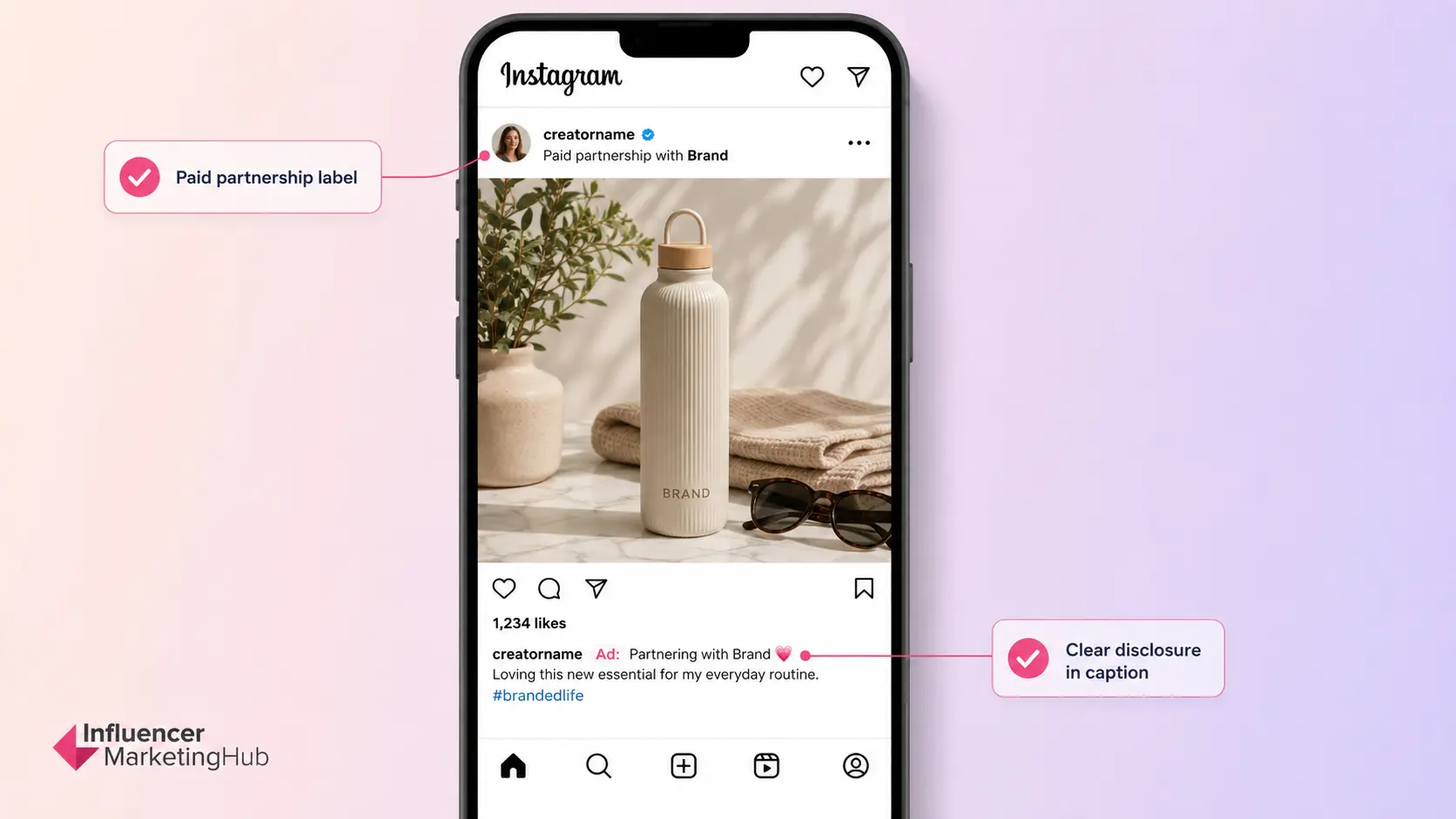
Instagram campaigns can include feed posts, Reels, Stories, carousels, affiliate content, gifted-product posts, and paid creator partnerships. The format changes, but marketers should begin with the same question: what material connection needs to be made clear to the viewer?
FTC Guidance for Instagram Content
For image-based endorsements such as Stories, the FTC recommends placing the disclosure over the image and giving viewers enough time to notice and read it.
For video endorsements, the disclosure should be part of the video rather than existing only in the caption or description. Using both visual and spoken disclosure can make the relationship more noticeable across different viewing behaviors.
The FTC does not prescribe a universal three-second overlay, fixed font size, or other Instagram-specific numerical threshold.
For marketers, the appropriate test is whether the disclosure is prominent and understandable in the context of the actual creative.
Instagram's Paid Partnership Label
Meta treats content as branded content when a creator's content features or is influenced by a business partner in exchange for value.
Its current policy requires creators to use Instagram's Paid Partnership label when publishing branded content. Meta explicitly includes:
- Paid creator posts
- Free or gifted products and services
- Affiliate content where the creator earns commissions
within situations that require the Paid Partnership label.
The platform label should therefore be part of the campaign QA process whenever the content qualifies as branded content under Meta's policy.
It should not, however, replace the broader disclosure review.
FTC guidance warns marketers and creators not to automatically assume that a platform disclosure tool is sufficient on its own.
Influencer Marketing Hub's Instagram Pre-Publish Check
Before approving an Instagram creator asset, confirm:
- The creator-brand material connection has been identified.
- A clear creator disclosure has been included where necessary.
- Instagram's Paid Partnership label is enabled when Meta's branded-content policy requires it.
- The disclosure is easy to notice in the content format being used.
- Stories and other image-led formats display disclosure where viewers can see it.
- Reels and other video endorsements have been reviewed for disclosure within the video itself.
- Affiliate or gifted relationships are described clearly rather than being left for viewers to infer.
- The final published version will be checked after go-live.
These checks should appear as individual fields in the downloadable FTC Disclosure Checklist by Platform, allowing teams to record both the creator's disclosure and use of Meta's platform feature.
Instagram Disclosure Example
For a paid Reel:
- Ad: I'm partnering with [Brand] to show you how I use [Product].
The creator could communicate the same relationship naturally in the video while also using Instagram's Paid Partnership label.
For gifted content:
- [Brand] sent me this product for free. Here's what I thought after trying it.
The wording is different because the relationship is different.
The objective isn't to force every creator into #ad. It is to make the actual connection understandable.
TikTok FTC Disclosure Checklist
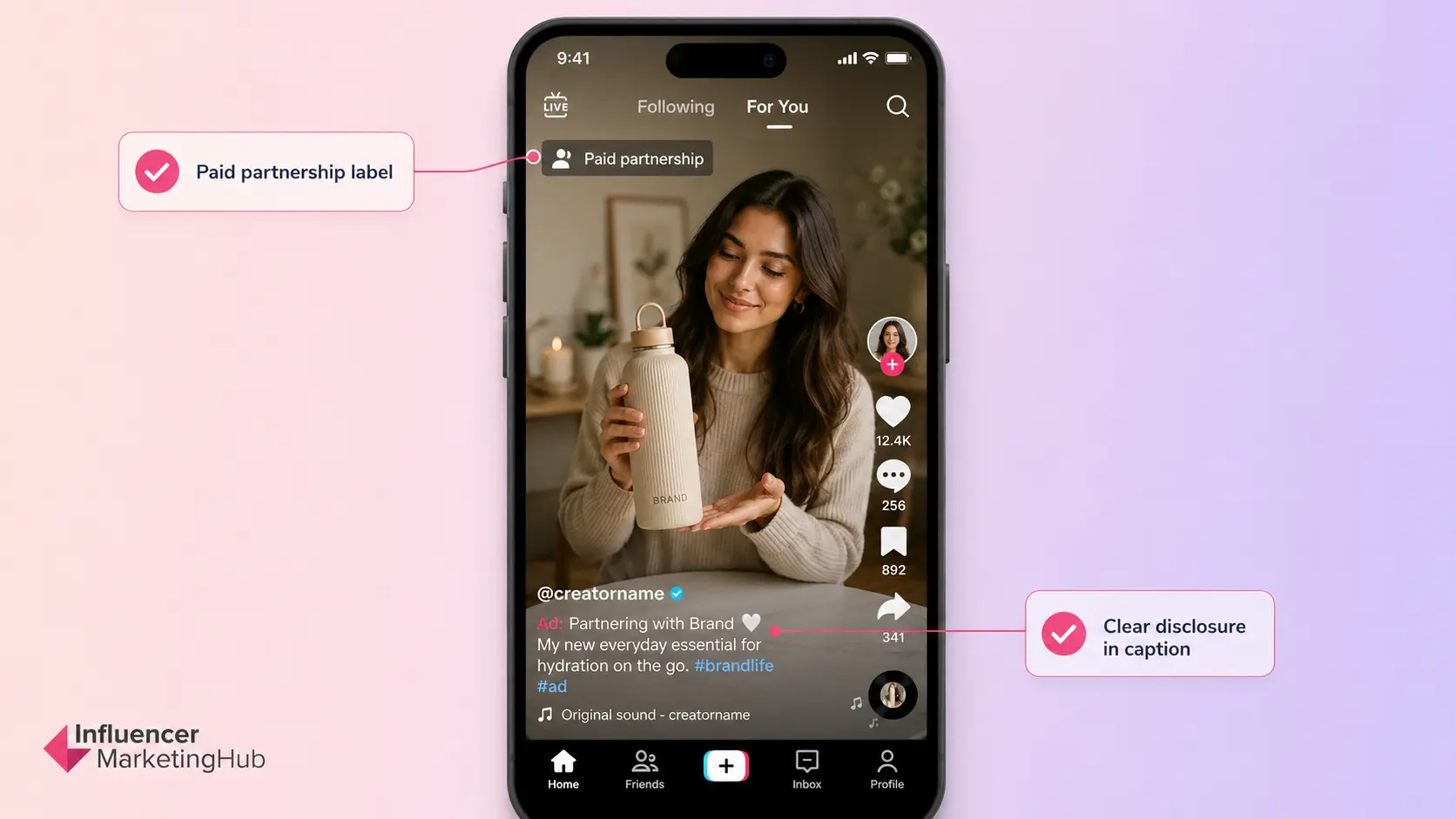
TikTok requires especially careful review because the endorsement often happens almost entirely inside short-form video rather than in a long caption.
A creator can verbally recommend the product, show it on screen, tag the brand, add a product link, and use TikTok's commercial-content functionality within a single asset. The disclosure process needs to account for all of those elements.
FTC Guidance for TikTok Content
FTC guidance for video endorsements is directly relevant.
If the endorsement occurs in the video, the disclosure should also appear in the video rather than relying solely on text elsewhere. The FTC also notes that combining audio and visual disclosure can increase the chance that viewers notice the relationship.
That doesn't create a universal rule requiring creators to say a particular phrase within the first three seconds of every TikTok.
For campaign QA, brands should instead ask:
Can someone watching the actual TikTok reasonably understand that the creator has a material connection to the brand?
That is the standard we should build into briefs and reviews.
TikTok's Content Disclosure Setting
TikTok has a separate platform requirement.
Its current guidance says creators posting content that promotes a brand, product, or service must turn on the content disclosure setting. TikTok includes both promotion of the creator's own business and promotion of a third-party brand in exchange for payment or another incentive.
For third-party branded content, enabling the setting produces a Paid partnership label. Content promoting the creator's own business is labeled Promotional content.
TikTok also says that posts can be removed or restricted if the appropriate commercial-content disclosure is not displayed. The setting is available for standard posts and LIVE content.
That makes the platform toggle a mandatory TikTok QA field for applicable creator campaigns.
Platform Label and FTC Disclosure Are Different Checks
Marketers should avoid treating:
TikTok label enabled = FTC review complete.
TikTok's setting addresses TikTok's commercial-content requirements. FTC disclosure still needs to be evaluated within the context of the endorsement itself.
For example, a creator's video might display TikTok's Paid Partnership label while the actual sponsored recommendation begins immediately and never otherwise explains the relationship. The marketer should still consider whether the material connection is sufficiently clear to viewers based on the full presentation.
That is why the Google Sheet will track Platform Tool Used? and Disclosure Checked? separately.
Influencer Marketing Hub's TikTok Pre-Publish Check
Before approving sponsored TikTok content, verify:
- The material connection has been documented.
- TikTok's content disclosure setting is enabled where required.
- Third-party branded content is correctly categorized.
- The creator's disclosure clearly explains the relationship.
- The disclosure is present within the video where the endorsement occurs.
- Visual and spoken disclosure have been considered based on how viewers will consume the content.
- Affiliate links, promo codes, or TikTok commerce elements have been reviewed separately where relevant.
- The disclosure remains visible and understandable in the final edit.
- The live post is checked after publication rather than relying exclusively on the approved draft.
For LIVE campaigns, disclosure needs additional attention because viewers join at different points. FTC guidance recommends repeating disclosure periodically so viewers entering later can still understand the material connection.
We should not convert “periodically” into an invented universal interval such as every 15 minutes.
TikTok Disclosure Example
For a paid product demonstration, a creator could open naturally with:
- Ad: I'm working with [Brand] to try their new [Product].
The relationship can also be communicated verbally and visually within the video, with TikTok's content disclosure setting switched on.
For a gifted product:
- [Brand] sent me this for free, so I wanted to show you how it works.
The wording should reflect the actual arrangement. A gifted product should not be described as a paid sponsorship if no sponsorship fee exists, just as a paid collaboration should not be reduced to a vague “thanks to [Brand].”
YouTube FTC Disclosure Checklist
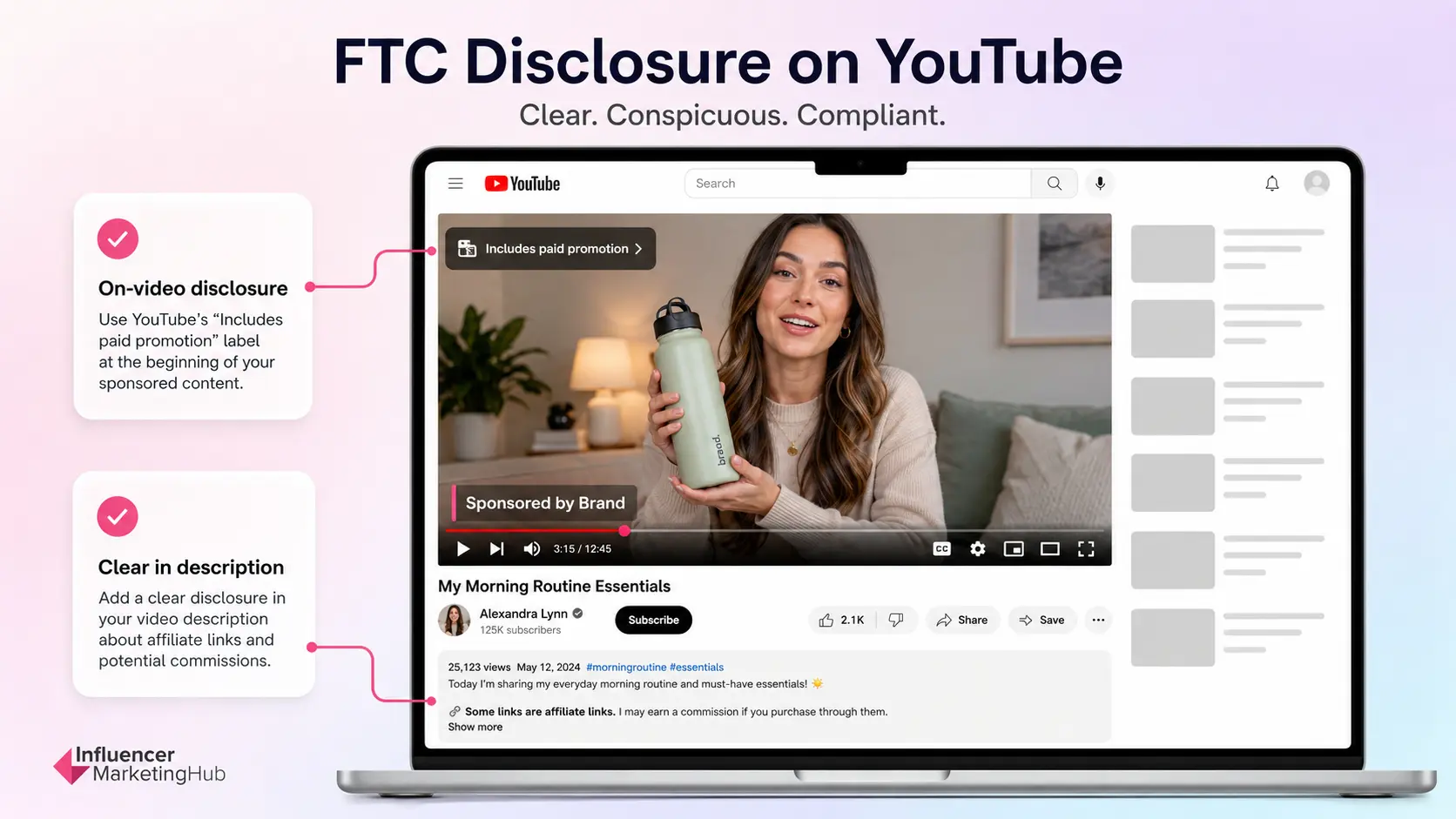
YouTube creator partnerships can be more complex than short-form social posts because the commercial relationship may appear across several surfaces at once: the video itself, a verbal sponsor segment, product placement, description links, pinned comments, Shorts, or livestreams.
For marketers, the disclosure review therefore needs to consider the actual endorsement inside the content, not simply whether the description contains #ad.
FTC Guidance for YouTube Content
FTC guidance says that when an endorsement is made in a video, the disclosure should appear in the video itself, rather than only in the accompanying description. It also notes that disclosures made through both audio and visual means are more likely to be noticed because viewers consume video in different ways.
That does not mean every sponsored YouTube video needs the same scripted opening or a fixed-length lower-third.
Instead, marketers should evaluate whether someone watching the sponsored portion of the video can reasonably recognize the creator's relationship with the brand.
This matters particularly in long-form content. A sponsorship disclosure made only at the beginning may be less useful if the actual endorsement appears much later, while a disclosure buried solely below the description fold may never be seen by someone who watches without opening the description.
YouTube's Paid Promotion Declaration
YouTube requires creators to tell the platform when content includes a paid product placement, sponsorship, endorsement, or another commercial relationship by selecting the paid promotion declaration in YouTube Studio. YouTube says this applies to branded content influenced by a brand partner in exchange for something of value, including payment, free products, or sponsorships.
When the creator declares paid promotion, YouTube displays a disclosure to viewers at the beginning of the video. YouTube also makes clear that creators and brands remain responsible for meeting any additional legal disclosure requirements that apply to them.
This area is actively evolving. On September 3, 2026, YouTube announced further changes to its branded-content controls, including an updated paid-promotion label and additional disclosure tooling.
The YouTube Label Is One Part of the Review
The presence of YouTube's paid-promotion label does not mean marketers can ignore the disclosure inside the creator's content.
The platform itself tells creators that legal obligations can require additional disclosure.
For an integrated sponsor read, for example, the reviewer should consider:
- Whether the creator verbally explains the sponsorship
- Whether viewers can identify the commercial relationship when the endorsement occurs
- Whether any relevant visual disclosure is clear
- Whether affiliate relationships in the description are explained
- Whether the platform paid-promotion declaration has been completed
The Google Sheet should therefore treat YouTube Paid Promotion Declared? and Creator Disclosure Reviewed? as separate checks.
Influencer Marketing Hub's YouTube Pre-Publish Check
Before approving sponsored YouTube content, confirm:
- The material connection has been identified.
- The creator has enabled YouTube's paid-promotion declaration where required.
- The sponsorship is disclosed within the video itself.
- Spoken and visual disclosure have been considered based on the format of the endorsement.
- The disclosure appears close enough to the sponsored segment to make the relationship understandable.
- Affiliate links or commission-based relationships in the description are clearly disclosed.
- Shorts receive the same disclosure review rather than being treated as ordinary long-form video.
- Livestream sponsorships account for viewers joining at different times.
- The final uploaded version matches the approved draft.
- The live video and disclosure label are verified after publication.
YouTube Disclosure Example
For an integrated sponsor segment:
- This portion of the video is sponsored by [Brand].
The creator can then transition naturally into the endorsement.
If the description also contains affiliate links:
- Some links below are affiliate links. I may earn a commission if you purchase through them.
Those are two different material relationships and should be reviewed accordingly.
Facebook FTC Disclosure Checklist
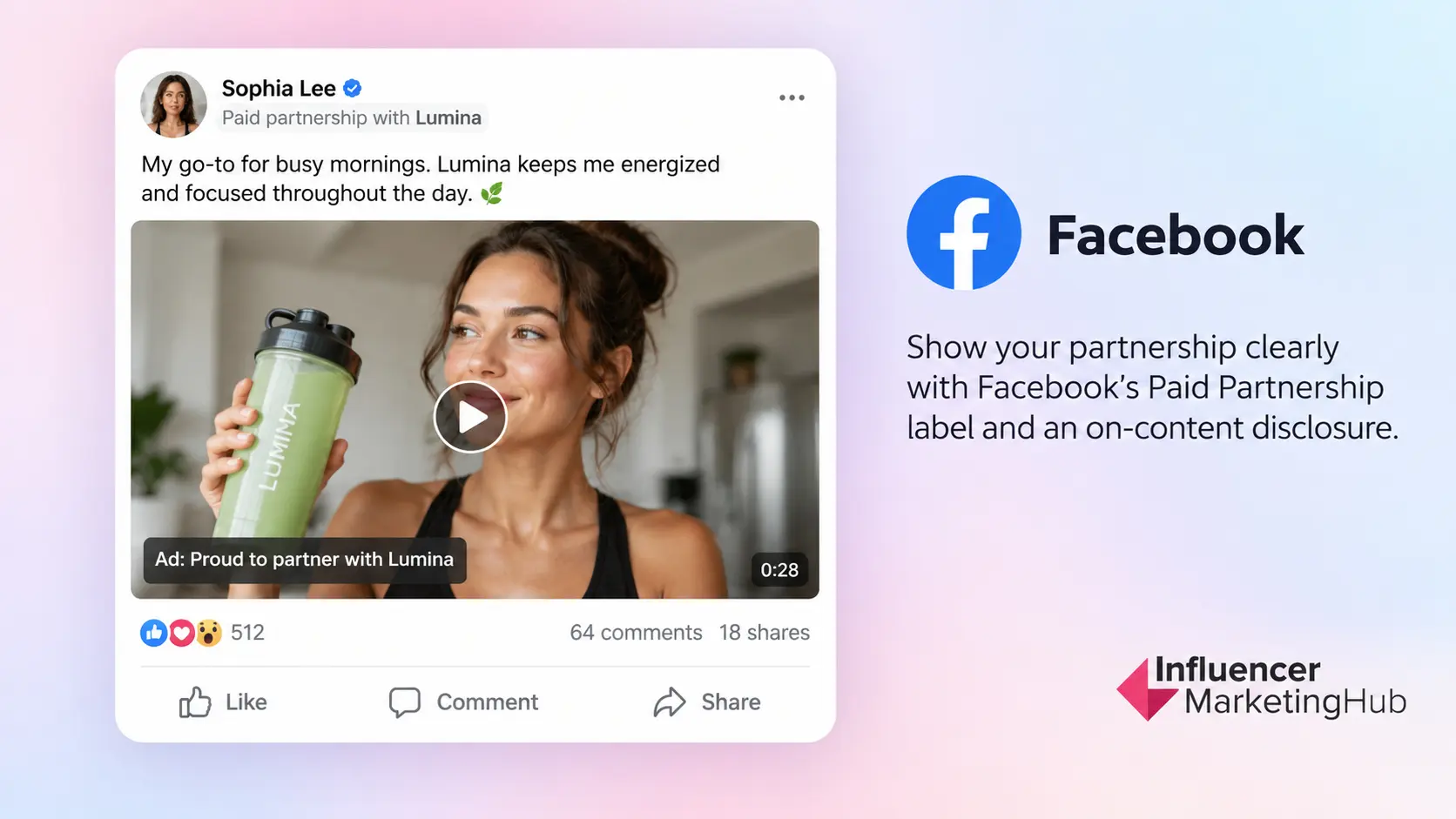
Facebook creator campaigns can include standard posts, Reels, Stories, video, livestreams, and affiliate content. Much of the FTC logic is therefore familiar from Instagram, but marketers should still review the final Facebook asset independently, particularly when content is cross-posted.
FTC Guidance for Facebook Content
The same material-connection standard applies.
If a creator receives payment, free products, commissions, or another thing of value in exchange for an endorsement, the relationship should be disclosed in a way viewers can notice and understand. For video, the disclosure should appear in the video rather than existing only elsewhere.
Cross-posting does not remove that responsibility.
A Reel that was properly reviewed for Instagram should still be checked in its Facebook presentation. Caption truncation, platform labels, formatting, and other elements may display differently once the content is published.
Facebook's Paid Partnership Label
Meta uses Paid Partnership labeling for branded content across Facebook and Instagram. Its current Branded Content section in the Meta Ad Library surfaces creator content associated with paid partnerships on both platforms.
For marketers, the practical takeaway is the same as on Instagram: the Meta label belongs in the platform QA process, but it should not replace the underlying disclosure review.
Influencer Marketing Hub's Facebook Pre-Publish Check
Before approving Facebook creator content, verify:
- The material connection has been documented.
- A clear disclosure appears with the endorsement.
- The relevant Meta branded-content / Paid Partnership functionality has been reviewed.
- Video disclosures appear within the video where appropriate.
- Gifted or affiliate relationships are described clearly.
- Cross-posted content has been checked in its Facebook format.
- The final live post is reviewed after publication.
Facebook Disclosure Example
For a sponsored Reel:
- Ad: I'm working with [Brand] to show you [Product].
For a gifted product:
- [Brand] sent me this product for free.
Again, the wording should reflect the actual relationship.
Threads FTC Disclosure Checklist
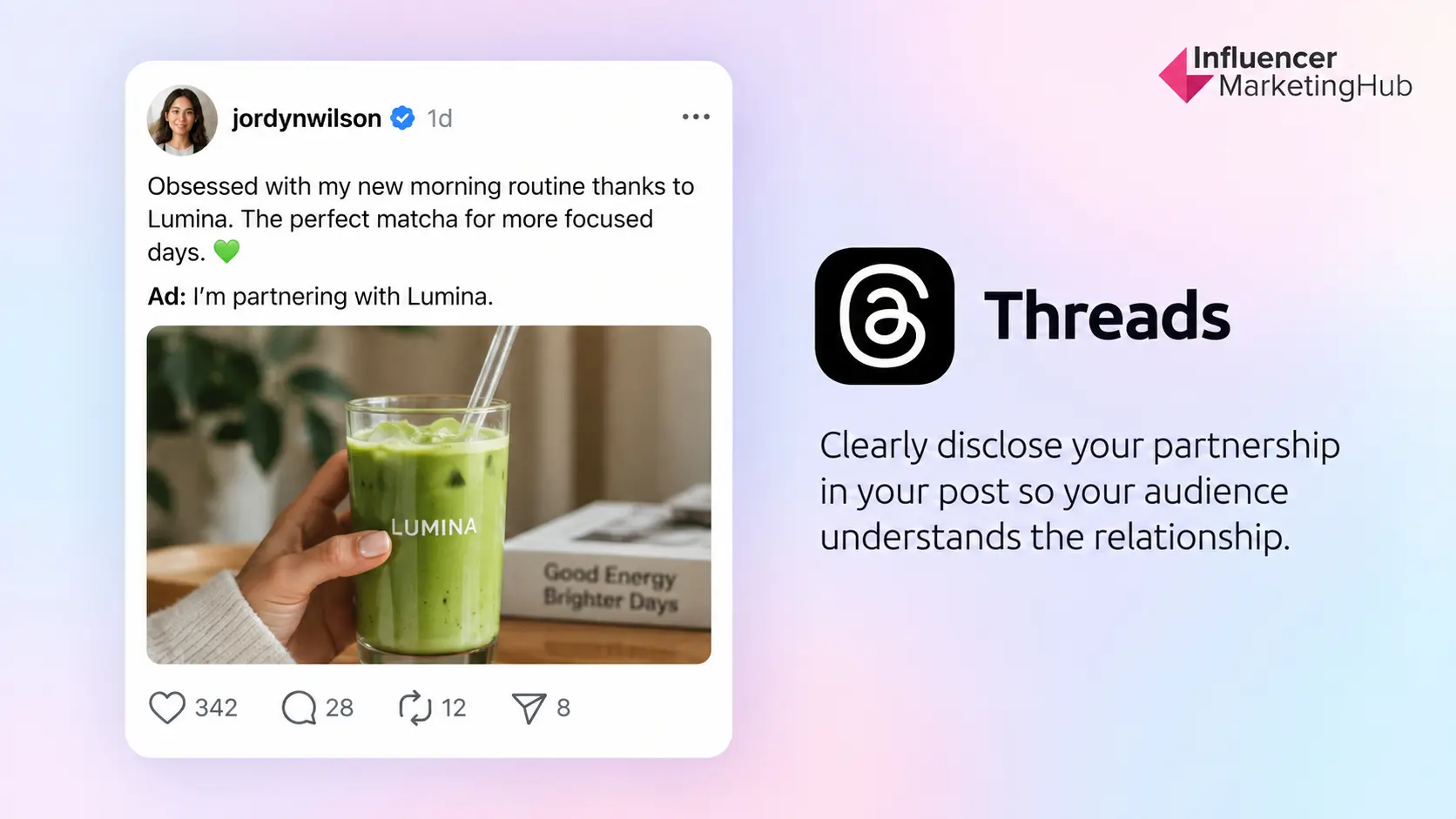
Threads is more text-led than Instagram or TikTok, which can make disclosure look simpler. However, short posts, replies, affiliate links, and conversational brand mentions can also make commercial relationships easier to blur into ordinary discussion.
For marketers, Threads should be treated like any other creator channel: establish whether a material connection exists, then make sure someone reading the post can understand it without needing additional context.
FTC Guidance for Threads Content
The FTC specifically warns against disclosures that require users to click elsewhere or that are hidden away from the endorsement. It also recommends straightforward disclosure language rather than unclear shorthand.
For a predominantly text-based post, that means the disclosure should be incorporated directly into the post in a way that clearly communicates the relationship.
Character or presentation constraints are not a reason to make the relationship ambiguous.
Threads Paid Partnership Label
Threads supports a Paid Partnership label for branded posts. However, Threads-specific branded-content documentation is less centralized than Meta's Instagram guidance, so marketers should verify the current in-app functionality during campaign setup rather than relying on an old workflow document. Current platform reporting shows the label available through the post creation process.
This is another reason for including Official Source / Last Verified fields in the downloadable checklist. Platform interfaces evolve faster than FTC principles do.
Influencer Marketing Hub's Threads Pre-Publish Check
Before approving a creator partnership on Threads, confirm:
- A material connection has been identified.
- The post clearly explains the commercial relationship.
- Any available Paid Partnership functionality has been enabled where applicable.
- The disclosure appears within the actual post rather than solely in the creator's bio or elsewhere.
- Affiliate links or codes are accompanied by a clear explanation of the financial relationship.
- Replies or follow-up posts that contain additional endorsements are reviewed where necessary.
- The live post is checked after publication.
Threads Disclosure Example
For a paid partnership:
- Ad: I've been working with [Brand] and testing [Product] for the past two weeks. Here's what stood out...
This preserves the conversational style of Threads while making the relationship clear immediately.
X FTC Disclosure Checklist
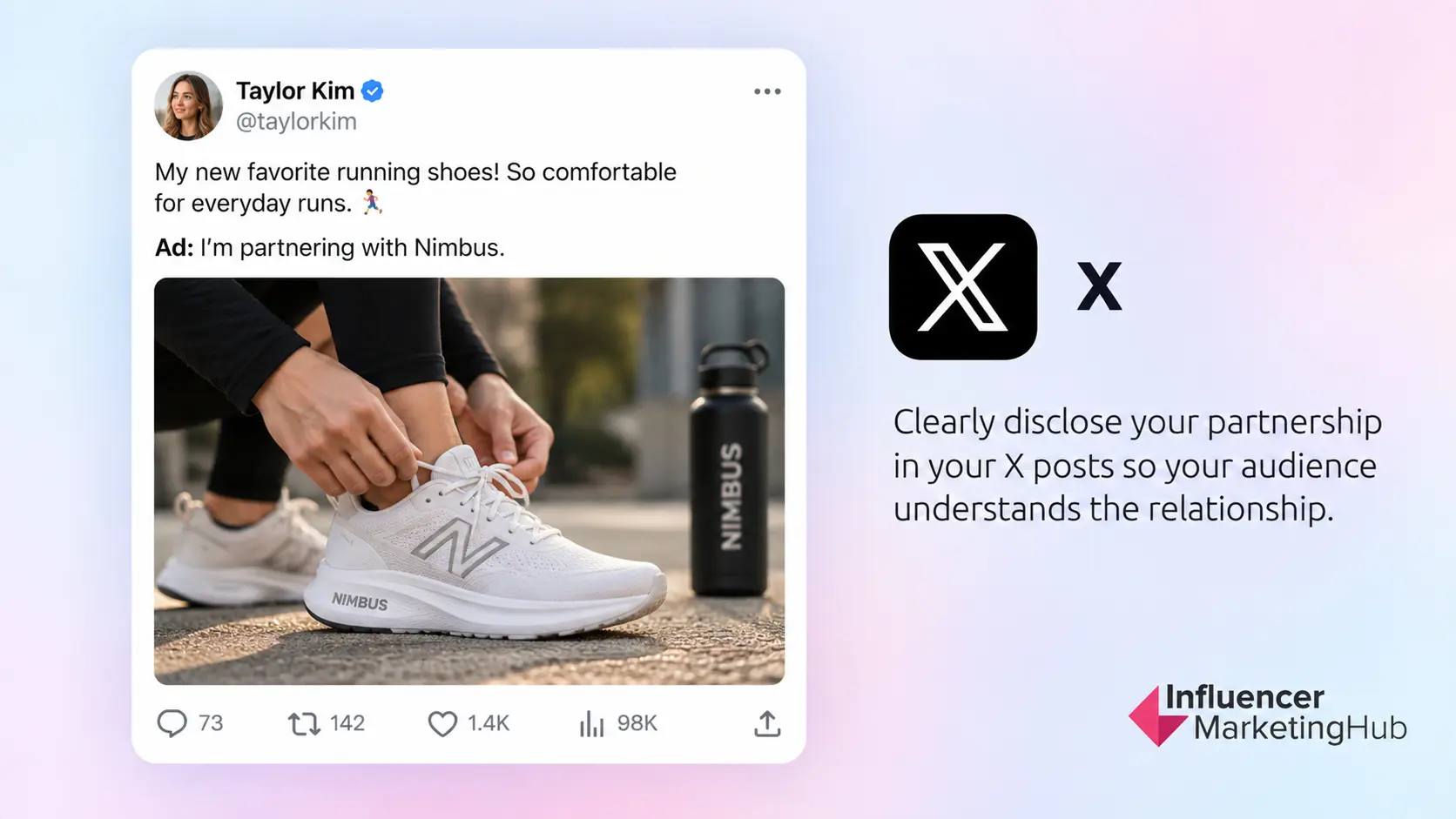
X deserves particular attention in a 2026 update because the platform has introduced a formal Paid Partnership disclosure system.
Its current policy covers far more than traditional flat-fee sponsorships.
FTC Guidance for X Content
The basic FTC principle remains unchanged: a material connection needs to be disclosed clearly and with the endorsement.
Short-form text does not remove that obligation. The FTC's own influencer guidance notes that disclosures can be concise, but vague shorthand should still be avoided.
A limited amount of space is therefore a reason to use clearer language, not less disclosure.
X's Paid Partnership Disclosure
X's current Paid Partnerships Policy defines paid partnerships broadly. It includes:
- Gifted products or services
- Monetary or in-kind compensation
- Affiliate links and discount codes generating commission
- Commercial arrangements such as brand ambassadorships
For organic posts that form part of a paid partnership, X requires the creator to switch on the Paid Partnership disclosure through its Content Disclosure settings. The platform then automatically labels the post as Paid Partnership content. X also explicitly states that creators remain responsible for complying with applicable advertising law, including FTC requirements where relevant.
This is a useful example of why our checklist separates:
Platform disclosure completed
from
FTC disclosure reviewed.
They are related checks, but they are not identical.
Influencer Marketing Hub's X Pre-Publish Check
Before approving an X creator post, verify:
- The material connection is documented.
- X's Paid Partnership disclosure is enabled where the policy applies.
- The commercial relationship is understandable within the post itself.
- Affiliate links and discount codes that create commissions are disclosed.
- Gifted products are treated as a material connection where applicable.
- The disclosure isn't dependent on a profile, reply, or linked page.
- The final published post contains the expected platform label.
- Any connected thread containing additional sponsored claims has been reviewed.
X Disclosure Example
For an affiliate creator post:
- Ad / affiliate: I may earn a commission if you purchase through this link.
For a traditional sponsorship:
- Sponsored by [Brand]: here's what I found after testing [Product]...
X's own Paid Partnership label should then be used where required by its policy.
Twitch and Livestream FTC Disclosure Checklist
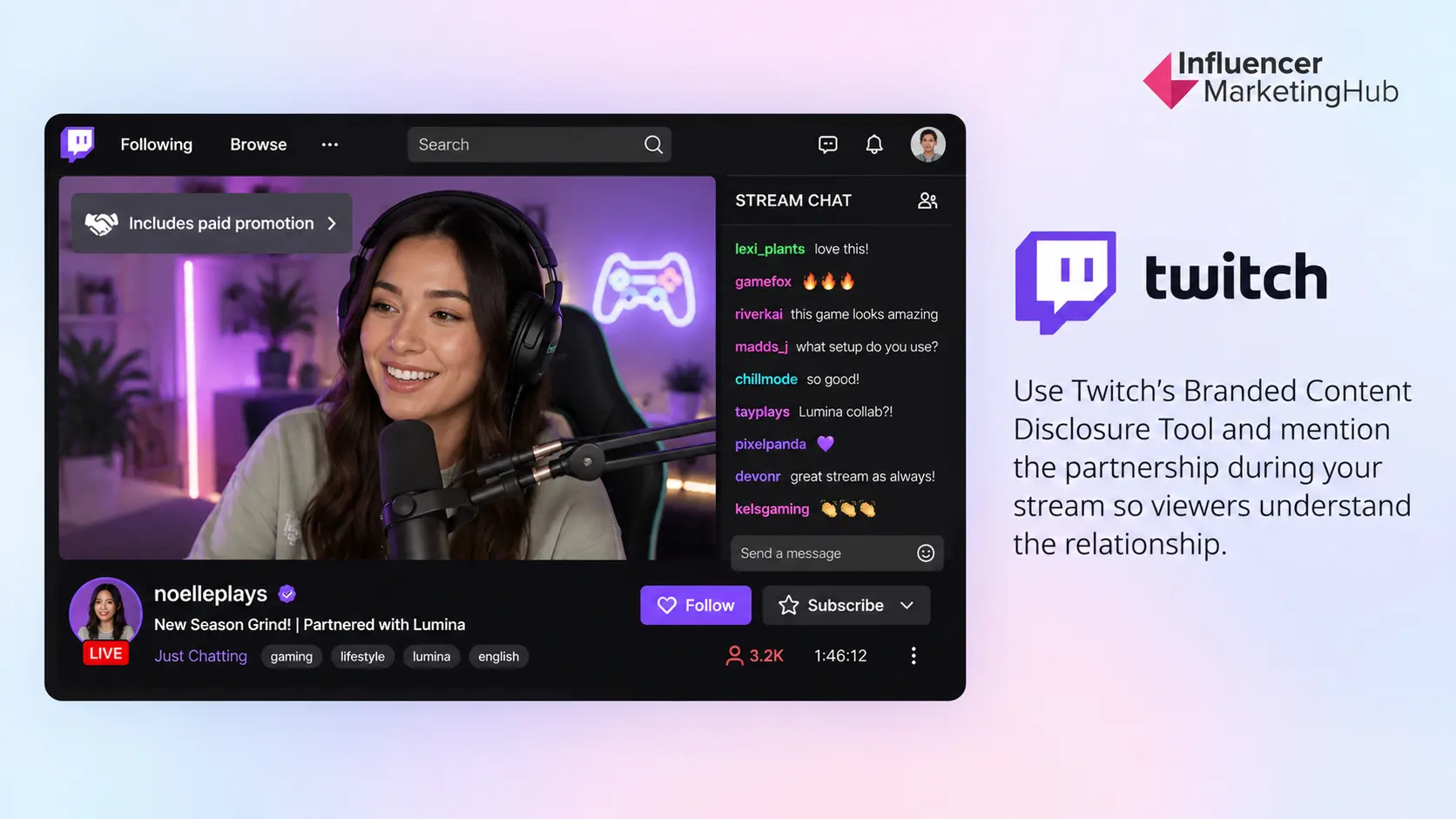
Livestreaming creates a different disclosure problem from feed-based social content.
Someone viewing an Instagram post generally encounters the asset from the beginning. Someone joining a two-hour Twitch stream might arrive 47 minutes after the sponsorship was initially explained.
That makes ongoing visibility important.
FTC Guidance for Livestreams
FTC guidance specifically addresses this situation. When an endorsement is made during a livestream, the disclosure should be repeated periodically so people who see only part of the stream still receive it.
Notice what the FTC does not do: prescribe a universal interval.
There is no general FTC rule saying that disclosure must be repeated every 10, 15, or 20 minutes.
For marketers, the appropriate campaign instruction should therefore focus on whether viewers entering at different points have a reasonable opportunity to understand that the stream is sponsored.
Twitch's Branded Content Disclosure Tool
Twitch defines branded content as content created in exchange for value, including paid product placements, endorsements, sponsored gameplay, paid unboxings, channel sponsorships, and brand-logo integrations.
When branded content is a central and intentional part of a livestream, Twitch requires creators to use its Branded Content Disclosure Tool in Stream Manager. Enabling it triggers a disclosure informing viewers that the stream includes paid promotion.
Twitch also makes an important point that mirrors the rest of this guide: using its platform tool does not automatically satisfy every legal disclosure obligation. Creators and brands remain responsible for understanding applicable law.
Build Repeated Disclosure Into the Sponsorship Plan
Livestream disclosure should therefore be planned as part of the run-of-show rather than improvised by the creator.
A campaign brief might specify disclosure:
- When the sponsored segment begins
- When the creator returns to the sponsored product later
- At sensible intervals during extended sponsored gameplay or demonstrations
- After significant breaks where a new group of viewers may have joined
Those are operational recommendations, not fixed FTC timing rules.
Teams should also decide how the disclosure appears:
spoken
on-screen
platform disclosure tool
or a combination appropriate to the campaign.
Influencer Marketing Hub's Twitch and Livestream Pre-Publish Check
Before a sponsored livestream begins, confirm:
- The creator-brand material connection is documented.
- Twitch's Branded Content Disclosure Tool is enabled where required.
- The opening sponsorship disclosure is planned.
- Repeated disclosure points have been built into longer streams.
- Spoken and visual disclosure are considered for the sponsorship format.
- Affiliate links, codes, panels, or other commercial elements are reviewed separately.
- Moderators and production teams know the disclosure plan.
- The recorded VOD is checked if the sponsored content remains available after the live broadcast.
- Evidence of the completed campaign review is retained.
Twitch Disclosure Example
At the beginning of a sponsored segment:
- This stream is sponsored by [Brand], who I'm partnering with today to show you [Product/Game].
If the sponsored activity continues for an extended period, the creator should repeat the relationship periodically rather than assuming everyone watching heard the first disclosure.
FTC Disclosure for Affiliate Links, Promo Codes, and Gifted Products
Not every creator partnership looks like a traditional sponsored post. Affiliate commissions, discount codes, and gifted products can all create material connections that audiences should understand, even when there is no flat campaign fee.
For brands and agencies, these relationships are worth checking separately because they often sit outside the standard sponsored-content workflow.
| Situation | What creates the material connection | What marketers should check |
| Affiliate link | Creator earns commission from purchases | Financial relationship is explained clearly near the endorsement or link |
| Commission-based promo code | Creator benefits when followers use the code | Audience can understand that the creator may earn from use of the code |
| Gifted product | Brand provides a free or discounted product or service | Creator makes the gift clear when endorsing the product |
| Fee + commission | Creator receives sponsorship payment and performance compensation | Disclosure reflects the commercial relationship clearly rather than relying on the affiliate element alone |
Affiliate Links
The FTC says affiliate marketers should disclose their relationship to the retailer clearly and conspicuously so audiences can evaluate the recommendation with that financial connection in mind. It gives wording such as explaining that the publisher receives commissions from purchases made through links in the content.
Placement matters as well. When an endorsement and affiliate link are separated, viewers may not connect a disclosure elsewhere on the page with the link that generates commission. The FTC therefore advises keeping the disclosure close to the recommendation.
For marketers, a straightforward example is:
- I may earn a commission if you purchase through these links.
Using “affiliate link” on its own can be less clear because some consumers may not understand that the creator receives money when someone purchases through it.
Promo and Discount Codes
A personalized discount code can signal that a relationship exists between a creator and a brand, but it may not tell viewers what that relationship is.
The FTC specifically notes that a unique creator code may not make it clear that the creator earns money when followers use it. When that financial relationship is not obvious, a clearer disclosure is appropriate.
So instead of relying on:
- Use NADIA20 for 20% off.
a creator receiving commission could make the relationship explicit:
- I earn a commission when you use my code NADIA20.
The marketer's QA check should focus on compensation, not merely the existence of a promo code. A generic consumer discount does not automatically create an affiliate relationship.
Gifted Products
Free products and services can also create material connections.
FTC guidance says creators should disclose when a brand gives them a free or discounted product or another perk and they subsequently endorse the product, even when the brand did not require them to post about it.
That makes product seeding particularly important for influencer teams.
A creator may receive a product with no guaranteed deliverable, decide independently that they like it, and later feature it organically. The post may feel organic from a campaign-management perspective, but the original gift still creates a connection viewers may want to know about.
A simple disclosure can be enough:
- [Brand] sent me this product for free.
The FTC also says that if a creator received a free product specifically to review, that relationship should be disclosed wherever the creator endorses it, not just on the platform where the original review was requested.
When Creators Receive More Than One Form of Compensation
Some partnerships combine a campaign fee, free products, and affiliate commission.
Marketers do not need to turn the disclosure into a list of every contractual payment term. The important question is whether the audience understands the relevant commercial relationship.
However, the affiliate element should not disappear simply because the content is already described as sponsored. For example, if a YouTube creator receives the product for free and also earns commissions through links in the description, FTC guidance says the affiliate relationship should also be disclosed appropriately.
That is why the IMH FTC Disclosure Checklist by Platform tracks sponsorship, gifting, and affiliate relationships separately. Different forms of compensation can require different QA checks even when they appear within the same creator asset.
FTC Disclosure Mistakes to Catch Before Publishing
Most disclosure failures are not caused by a complete lack of sponsorship language. More often, the problem is that the relationship is disclosed in a way viewers can easily miss or misunderstand.
For brands and agencies, these are the 8 mistakes worth catching during final content review.
| Mistake | What marketers should check instead |
| Disclosure appears after “more” | Keep the disclosure with the endorsement and visible without extra clicks |
| Creator uses vague wording such as #collab | Use language that clearly communicates the commercial relationship |
| Brand tag is treated as the disclosure | Explain why the creator is connected to the brand |
| Platform label is treated as sufficient on its own | Review the creator's disclosure in addition to the platform tool |
| Video disclosure appears only in the description | Check that the disclosure also appears within the video |
| Gifted relationship is left unexplained | Make it clear when a product or service was provided for free |
| Affiliate commission is not disclosed clearly | Explain that the creator may earn money from purchases |
| Only the draft is reviewed | Verify the final live post after publication |
📥 Run Creator Content Through the FTC Disclosure Checklist
Remembering every disclosure check becomes difficult once a campaign spans several creators, content formats, and platforms.
The IMH FTC Disclosure Checklist by Platform gives teams one place to track material connections, disclosure wording and placement, platform tools, final approval, and live-post verification.
How Brands and Agencies Should Manage FTC Disclosure
FTC disclosure should not be treated as a creator-only responsibility or a final caption check. Brands and agencies need a process for setting expectations, reviewing content, and addressing problems when creator posts do not meet disclosure requirements.
FTC guidance specifically recommends that advertisers instruct influencers on disclosure responsibilities, monitor what members of their creator network are saying, and take appropriate action when they identify questionable practices. The FTC also notes that outsourcing an influencer program to an influencer marketing agency or PR firm does not remove the advertiser's responsibility to maintain appropriate oversight.
For most influencer teams, that does not require a complex compliance operation. It requires a consistent process at three stages.
Before the Campaign
Disclosure expectations should be established before creators begin producing content.
The campaign brief or agreement should identify:
- The creator's material connection to the brand
- The disclosure expectations for the planned content
- Any platform disclosure tools that need to be enabled
- Relevant restrictions around product or performance claims
- Who to contact when the creator is unsure how to disclose the relationship
Brands should also give creators clear guidance about what they can and cannot say about the product. The FTC recommends that advertiser monitoring programs address both disclosure requirements and the objective product claims creators are permitted to make.
The goal is to make disclosure part of the creative requirements from the beginning rather than requesting changes immediately before publication.
Before Publishing
The final creator asset should be reviewed in the format audiences will actually see.
That means checking more than the caption.
For each piece of content, reviewers should confirm the material connection, disclosure language, placement, relevant platform functionality, and any format-specific considerations such as video or livestream disclosure.
Where creators are working across several platforms, teams should review each version separately. A disclosure that works in a YouTube video may not translate appropriately when the same clip is adapted for TikTok or Instagram Stories.
This is the stage where the IMH FTC Disclosure Checklist by Platform becomes the working QA document. Each creator asset can be reviewed against the same set of core disclosure checks while still accounting for platform-specific functionality.
After Publishing
Approval should not necessarily end when the creator presses Publish.
The live asset may differ from the draft that was reviewed. Captions can be changed, platform labels may be omitted, edits can affect on-screen disclosure, or creators may publish the wrong version.
A simple post-publication check allows the campaign team to confirm that:
- The approved disclosure appears on the live content
- The relevant platform partnership label is active
- Links and affiliate disclosures remain correct
- The published asset matches the version that was approved
If a disclosure problem is identified, the team should act rather than simply record the error. FTC guidance tells advertisers to take appropriate steps when monitoring uncovers questionable practices and to make reasonable efforts to understand what creators in their programs are saying.
For ongoing creator relationships, monitoring should also be proportionate to the program. The FTC does not prescribe one fixed monitoring period or require marketers to track every creator indefinitely. Instead, it describes a reasonable approach based on the circumstances and the relationship.
Make FTC Disclosure Part of Your Campaign QA
FTC disclosure works best when it is built into the campaign process from the start, not added as a last-minute publishing check.
For brands and agencies, that means identifying the creator’s material connection, giving clear disclosure guidance, reviewing the final asset in context, checking the relevant platform tools, and verifying the live post after publication.
The underlying FTC principles are relatively consistent, but platform features and branded-content policies can change quickly. A repeatable review process helps teams apply those principles more consistently across Instagram, TikTok, YouTube, Facebook, Threads, X, and livestream content.
Use the IMH FTC Disclosure Checklist by Platform to standardize those checks, document approvals, and flag content that needs another review before it goes live.
Frequently Asked Questions
How can I include crisis-preparedness clauses in my influencer contracts to handle potential disclosure breaches?
Embedding a robust crisis-preparedness clause ensures you can swiftly pause or remove non-compliant content. For best practices on drafting these provisions—covering remediation steps, notification timelines, and indemnity—review the guide on crisis-prep clauses in influencer campaigns.
What should I be aware of when running influencer campaigns across the EU under increased regulatory scrutiny?
The EU’s tighter view on undisclosed promotions means adapting both your disclosure language and data practices. A concise overview of current EU regulations can be found in the article on how the EU is scrutinizing influencer marketing practices.
Are there specific endorsement rules I need to follow when engaging influencers in India?
Absolutely—India’s ASCI guidelines require clear sponsorship labels and forbid hidden affiliate links. For full details on compliance under ASCI, see the primer on ASCI rules for influencer marketing in India.
How does GDPR affect the way influencers collect and share audience data in campaigns?
Whenever influencers collect demographic or behavioral insights, they must secure explicit user consent and uphold stringent data handling protocols. For an overview of social media data compliance, check out this GDPR & social media summary.
Beyond the FTC’s 2025 proposals, where can I find a comprehensive summary of existing U.S. social media guidelines?
The FTC’s foundational rules on endorsements, testimonials, and native advertising remain critical. For a broad recap of these guidelines, consult the overview of FTC social media guidelines.
How do disclosure requirements differ when working with macro- versus micro-influencers?
Both tiers must disclose paid partnerships, but micro-influencers often need more hands-on platform guidance while macro-influencers require tighter legal review. Learn strategic briefing differences in the guide on briefing macro vs. micro-influencers.
What are the essential components of an FTC-compliant influencer campaign brief?
Your brief should include exact disclosure phrasing, placement specifications, escalation protocols, and audit procedures. A step-by-step framework is detailed in how to create an influencer campaign brief.
How can I adapt a single influencer brief template for campaigns in multiple geographic regions?
Use a modular structure that swaps out region-specific disclosure rules and platform requirements. For a practical approach to localization, see localizing a single influencer brief for multiple regions.
What does an “always-on” influencer program look like, and how do disclosures fit into that model?
An always-on model schedules continuous content with rotating creators, requiring standardized disclosure playbooks to maintain consistency. A helpful blueprint is laid out in the article on always-on influencer programs.