


PR packages have become one of the most misunderstood yet high-leverage tactics in influencer marketing. Often reduced to “free product sends,” they are, in reality, a structured product seeding strategy used by brands to generate user-generated content, build awareness, and test creators at scale.
As short-form content continues to dominate platforms like TikTok and Instagram, brands are shifting budgets toward formats that can produce repeatable, authentic creative. That shift is already visible in the data.
According to 2026 Influencer Marketing Benchmark Report, 80% of marketers consider short-form videos as highly effective content format, signaling a broader move toward scalable creator-led strategies.
PR packages sit at the center of that shift. Unlike traditional paid campaigns that require upfront investment and fixed deliverables, PR seeding allows brands to distribute products across a wider creator pool, generating organic content that can later be amplified through paid media.
High-performing teams treat PR packages as a content acquisition engine, where each send is tied to creator fit, expected output, and downstream performance.
But to unlock real value, brands need to understand when PR packages outperform paid campaigns, how to structure them for consistent content output, and how to connect them to measurable ROI. This guide aims to unpack all of that.
What Are PR Packages in Influencer Marketing
PR packages are product seeding kits that brands send to creators, influencers, or media contacts to generate organic content, brand awareness, and user-generated content (UGC). In influencer marketing, they function as a low-cost acquisition channel for content, where the exchange is not cash but product value in return for potential exposure.
Unlike traditional public relations, where samples are sent to journalists for editorial coverage, modern PR packages are designed specifically for social-first distribution. The ultimate goal of PR packages is to create content that fits platforms like TikTok, Instagram, and YouTube.
At a practical level, a PR package includes:
- The core product or product bundle
- Custom packaging designed for unboxing moments
- Messaging inserts or brand storytelling elements
- Optional personalization based on the creator
However, the defining characteristic is not the packaging itself. It is the intended outcome.
For marketers, PR packages are used to:
- Seed products across a wide pool of creators
- Generate multiple pieces of organic content
- Test creator fit before committing to paid partnerships
- Build a pipeline of assets that can be repurposed into ads
This is what separates PR packages from simple gifting. Product gifting is often unstructured and transactional. PR packages, when executed properly, are part of a repeatable campaign system tied to content output and performance.
Another key distinction is expectations. While PR packages do not always guarantee posts, most brands operate with soft expectations or opt-in agreements, where creators understand that content is encouraged in exchange for receiving the product. High-performing programs balance this flexibility with clear targeting, ensuring products reach creators who are likely to engage.
PR packages, nowadays, are less about sending products and more about building a scalable content engine. Each send represents an opportunity to generate authentic, platform-native content that can inform future campaigns, support paid media, and strengthen brand presence across channels.
PR Packages vs Paid Influencer Campaigns
For marketers, the key decision is whether to use PR packages instead of or alongside paid influencer campaigns. Each approach serves a different role within a broader creator strategy, and understanding that distinction is critical for performance.
Cost Structure and Risk Profile
PR packages operate on a product-for-content exchange, meaning the primary cost is inventory, packaging, and logistics. There are no guaranteed deliverables, which lowers upfront financial risk but introduces variability in output.
@echolanedesigns Replying to @Bravo_2_Niner sorry I look a mess. Been under the weather. This is responding to a video I made that said I was too old for PR and Millie’s too young so we are just chillin and vibing on our own 😆 Anywho, PR Defined! #BrandTok #PRLife #InfluencerMarketing #SmallCreatorBigImpact #microinfluencer #genxmom
Paid influencer campaigns, on the other hand, require:
- Fixed fees per creator
- Defined deliverables
- Contractual obligations
This makes paid campaigns more predictable, but also more expensive and less flexible when testing new creators or content formats.
👉 Strategic Takeaway:
Use PR packages when the goal is low-cost testing and content volume. Use paid campaigns when you need guaranteed reach and controlled execution.
How PR Packages Work in Influencer Marketing
PR packages follow a structured workflow, even if the output appears organic on the surface.
The brands that consistently generate content from seeding programs must treat them as repeatable campaign systems, not one-off product sends. Each stage, from creator selection to content amplification, directly impacts how much content is generated and how useful that content becomes for downstream marketing.
Creator Selection
The process starts with identifying creators who are likely to turn a product into content. High-performing teams move beyond follower count and prioritize content behavior. Repeatable formats, consistent engagement, and audience alignment matter more than raw reach.
Creators who already produce tutorials, routines, or unboxing-style content are significantly more likely to generate usable assets. This is why many brands rely on influencer marketing platforms like Linqia or Upfluence to filter creators based on performance signals rather than surface-level metrics.
Pro Tip:
Influencer marketing platforms are the preferred choice by brands when it comes to identifying creators for PR campaigns. Check out our guide on the best influencer marketing platforms used by leading brands.
There are also ways to identify creators manually. The best way to do that is to go directly to TikTok, Instagram, or any other social media app and just type in "PR package" or search by hashtag (#prpackage) in the search box.
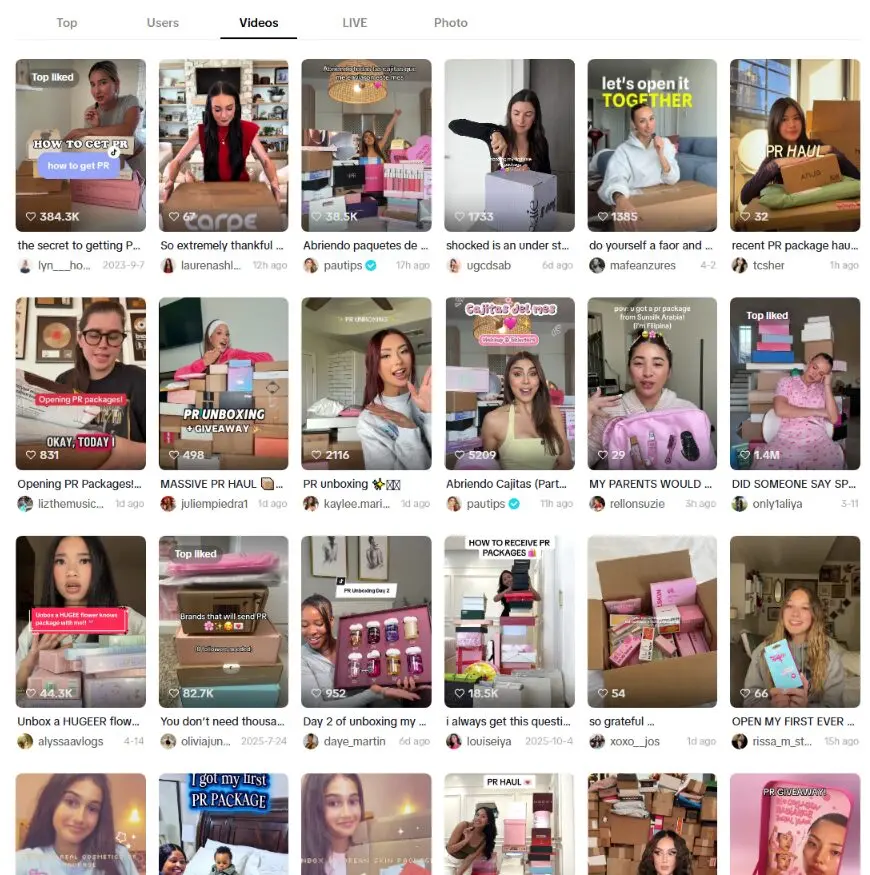
From there, the process is a bit more complex. Brands would need to manually vet the creators they come across. Suffice to say, influencer marketing platforms and tools simplify the process.
Outreach and Opt-In
Once creators are identified, outreach defines the tone of the relationship. PR packages typically operate on a soft agreement model, where product is exchanged for potential exposure rather than guaranteed deliverables.
That flexibility does not mean a lack of structure. Effective outreach clearly communicates the product value, the campaign context, and suggested content directions. Some brands introduce opt-in forms or creator portals to confirm participation, which improves tracking and sets clearer expectations from the start.
For example, the recently launched Urban Outfitters creator program runs through Klarna's Creator Platform and Rakuten's Link Share portals.
Packaging and Fulfillment
Packaging is often mistaken for a branding exercise, but its real purpose is to increase the likelihood of content creation. Every design decision should support how the product will appear on social platforms.
Unboxing experiences, layered reveals, and personalized elements all increase the chances of creators filming the interaction. Timing also plays a critical role. Coordinated sends tied to product launches or campaign windows tend to produce significantly higher content output than unstructured deliveries.
Content Creation Phase
Once products are delivered, control shifts over to the creator. Unlike paid campaigns, PR packages rely on the creator's interpretation rather than strict briefs. This results in a wider range of content styles, from casual mentions to full integrations.
While this variability introduces uncertainty, it also generates valuable insights. Patterns begin to emerge quickly. Certain hooks, formats, or use cases consistently outperform others, giving marketers real-world signals they can use to refine future campaigns.
@ugcdsab shocked is an under statement @Saie I have under 10k followers on my lifestyle IG and get PR packages every week without being an influencer! follow my business ig @abundancegirlera to learn how xx #saiebeauty #prunboxing #contentcreator #pr #unboxing
Amplification and Reuse
The final stage is where PR packages deliver the most value. The goal is not just to generate content, but to build a library of assets that can be reused across channels.
High-performing posts are often turned into paid ads, embedded into product pages, or repurposed for ongoing social content. This extends the lifespan of each PR send and reduces the overall cost per asset. Platforms like Creator.co help brands manage this transition from organic content to scaled campaigns.
Strategically speaking, PR packages function as a continuous feedback loop. Creator selection informs content output, and content performance informs future partnerships. Over time, brands refine their approach and build a more predictable system for generating and scaling creator content.
How to Build a PR Package Strategy That Scales
PR packages scale when brands stop treating them as one-off gifting moments and start managing them as a structured creator acquisition system. The goal here is to create a repeatable process that identifies the right creators, generates usable content, and turns strong performers into longer-term partners.
Define the Role of PR Packages in Your Funnel
Before selecting creators or designing packaging, marketers need to decide what the PR package is meant to achieve. A launch campaign, an always-on creator seeding program, and a UGC acquisition campaign all require different execution.
For a product launch, PR packages should create concentration. A brand might send products to a tighter group of creators within the same week to build visibility around a specific release. For always-on seeding, the focus shifts to consistency.
The brand may send a smaller number of packages every month to keep creator content flowing. For UGC acquisition, the priority is asset volume, meaning creator selection should favor people who produce repeatable formats such as tutorials, routines, unboxings, comparisons, or first impressions.
Product seeding is often described as a low-cost campaign model because brands send products without requiring creators to post.
Insight 🌟
When creators genuinely like the product, they may share it organically, making the format useful for testing potential paid partners before committing budget.
Build a Creator Selection Framework
A scalable PR package strategy depends on targeting quality. Sending 500 packages to poorly matched creators will produce weaker results than sending 50 packages to creators whose content already fits the product.
A common trend we see on social media is influencers opening dozens of PR packages at once. This happens because the influencers are getting swamped with PR packages from brands just like yours. So instead of filming each opening, they bundled these packages into a single video. Although highly amusing to watch, it's the last thing brands want.
@kaylee.marina PR unboxing ✨🫶🏼 thank you to all these amazing brands: @moiracosmetics @Chasing summer everyday @Versed Skin @Hard Candy @Westman-Atelier @amika @Maxcomfi @Vivrelle @evolvetogether @ColourPop Cosmetics @Kaja Beauty @BondiBoost @ESW BEAUTY #unboxing #prhaul #prunboxing #pr #haul
To avoid getting ignored or finding out an influencer has just opened your PR package with ten more and posted on TikTok, brands should assess creators across four core criteria:
- Audience fit: Does the creator reach the buyer segment the brand wants to influence?
- Content behavior: Does the creator already post product-led content without it feeling forced?
- Format match: Does the creator produce videos, reviews, routines, or unboxings that can naturally feature the product?
- Performance consistency: Do posts regularly generate engagement relative to audience size?
BURGA is a useful example of successful creator seeding at scale. According to Modash, the brand sends products to more than 500 creators monthly and generates around 800 to 1,000 influencer posts, while also using affiliate codes to track performance.
@wambamdancam I don’t eat sardines but I support the culture. @BURGA I’m officially your biggest fan!! #burga #unboxing #pr #haul
Segment Creators Before You Send
Not every creator should receive the same package. Segmentation helps marketers control cost, personalize the experience, and match product value to creator potential.
A practical segmentation model could include:
- Nano and micro creators for content volume, niche relevance, and authentic product discovery.
- Mid-tier creators for stronger reach and a higher chance of polished content.
- Top-performing past partners for premium packages, early access, or exclusive drops.
- Media and tastemakers for credibility, category visibility, or launch amplification.
Segmenting also helps prevent unnecessary backlash.
Tarte Cosmetics faced public criticism after creators compared different PR gifts, including a $700 Hermès bracelet sent to some influencers and different gifts sent to others.
@halleykate @tarte cosmetics THANK YOU??!
The reactions online were hilarious and show why brands need a clear rationale for tiering packages and why inconsistent gifting can become part of the public conversation.
@debbie_peaches @tarte cosmetics is FUNNY !!!! 😂 atp they are doing this on purpose lol you really gave that girl candy and the other girls hermes bracelets #tartecosmetics #tarteprpackage #tartehermes #hermes
Create a Clear Value Exchange
PR packages are often unpaid, but they should never feel vague. Creators need to understand what the brand is offering, why they were selected, and what kind of content is welcome.
For marketers, the safest structure is to avoid implying guaranteed deliverables unless there is a formal agreement. Instead, outreach can frame the package as an invitation:
The creator receives the product with no obligation to post, but the brand provides suggested angles, campaign context, hashtags, usage guidance, and contact information. If the brand expects specific deliverables, timelines, exclusivity, or usage rights, it should shift into a paid campaign or written agreement.
This matters because unclear expectations create friction. Creators may feel pressured to post without compensation, while brands may assume content is owed because product was sent. A scalable program needs clean rules from the start.
Design the Package Around Content Creation
The best PR packages are designed to make content easier to create.
Marketers should think through the creator’s filming experience:
- Is the product easy to reveal on camera?
- Does the package communicate the campaign story without needing a long explanation?
- Are there props, inserts, or product combinations that encourage a natural hook?
- Can the creator understand the key product benefit within seconds?
- Does the packaging feel worth filming?
A strong package gives creators a reason to record the opening moment, but it should not overshadow the product. Overly expensive packaging can create attention, but it can also shift the conversation away from the brand’s actual value.
Chipotle’s National Fork Day PR package, which included more than 20 forks and a year of free entrees for a creator, generated viral attention but also attracted mixed reactions about influencer gifting culture.
@acquiredstyle I can’t 🤣🤣🤣
Time Sends Around Campaign Moments
Timing is one of the easiest ways to improve content density. Random sends can work for always-on awareness, but campaign-based PR packages need coordination.
Brands should align sends with:
- Product launches
- Seasonal moments
- Retail drops
- Limited-edition releases
- Cultural moments relevant to the product category
- Paid media windows
Coordinated timing creates a cluster effect, where multiple creators post within the same period. This helps the product feel more visible across social feeds and gives marketers a better read on which creators and angles are resonating.
Track Every Package Like a Campaign Asset
A PR package should not disappear once it leaves the warehouse. At minimum, marketers need a tracking system that connects each send to the creator details, package value, shipping status, content output, engagement, and follow-up actions.
For stronger measurement, brands can add:
- Unique promo codes
- Affiliate links
- UTM links
- Creator-specific landing pages
- Social listening tags
- Content usage fields
Tracking is what turns gifting into a performance system. Without it, brands may generate content but still struggle to prove whether the campaign worked.
BURGA’s use of affiliate codes alongside monthly creator seeding is a good example of how brands can connect PR packages to measurable creator performance, instead of relying only on impressions or anecdotal engagement.
Build a Follow-Up Workflow
The follow-up process is where many PR package campaigns lose value. Sending the product is only the first half of the campaign. The second half is relationship management.
A strong follow-up workflow includes:
- Confirming delivery
- Thanking creators who post
- Requesting permission to reuse content when appropriate
- Saving high-performing content into an asset library
- Inviting strong performers into paid campaigns
- Removing poor-fit creators from future sends
This is how brands turn PR packages into a creator pipeline. The best creators from a seeding campaign should not remain one-off contacts. They should become a warm pool for paid partnerships, affiliate programs, product launches, and ambassador campaigns.
Turn Organic Winners Into Paid Partners
PR packages are especially valuable as a testing layer. Instead of choosing paid influencers based only on follower count or media kits, brands can observe how creators naturally respond to the product.
Creators who post without being required to often signal stronger brand affinity. If their content performs well, the next step is to formalize the relationship through a paid brief, usage rights agreement, or affiliate partnership.
This creates a cleaner progression:
PR package → organic post → performance review → paid partnership → content amplification
For marketers, this lowers risk. Paid budget goes toward creators who have already shown they can produce content that fits the brand and resonates with their audience.
Balance Scale With Brand Safety
As PR package programs grow, brand safety becomes more important. More creators means more exposure, but also more risk. Brands need clear criteria for who qualifies, what categories are excluded, and how creator content will be reviewed before amplification.
This does not mean controlling every organic post. It means having guardrails for:
- Creator vetting
- Product claims
- disclosure expectations
- age-appropriate targeting
- category sensitivity
- content reuse rights
Recent scrutiny around young skincare influencers shows why brands need responsible creator selection, especially in categories like beauty, wellness, and personal care. The recent #ToddlerSkincare trend sparks concerns around children promoting skincare products, unpaid participation, parental consent, and unclear legal protections for child influencers.
@kendrathemom_ Skincare with my toddler 💙 #toddlerskincare #kendrathemom #skincare
Create a Monthly PR Package Operating System
To scale PR packages sustainably, brands need a monthly operating rhythm. A simple model could look like this:
Monthly PR Package System
- Week 1: Identify and approve creators
- Week 2: Send outreach and collect opt-ins
- Week 3: Ship packages and confirm delivery
- Week 4: Track posts, save content, and shortlist paid partners
Over time, this creates predictable output. The brand knows how many creators are contacted, how many opt in, how many post, which formats perform, and which creators are worth reinvesting in.
That is the difference between gifting and strategy. Gifting ends when the package is delivered. A scalable PR package strategy continues until the brand has learned something useful, captured content, and improved the next campaign.
How to Measure ROI From PR Package Campaigns
PR packages rarely deliver immediate, clean attribution in the same way paid campaigns do. Their value compounds across content generation, creator testing, and downstream performance.
That means ROI needs to be measured as a system, not a single metric. Brands that struggle here tend to look only for direct sales, while high-performing teams evaluate how PR packages reduce content costs, improve creative performance, and inform future spend.
Define What “Return” Actually Means
The first step is aligning internally on what success looks like. PR packages are not designed to function as a direct-response channel in isolation. They operate higher up the funnel, but influence performance further down.
Return typically comes from three areas.
Content output is the most immediate, since each package has the potential to generate one or more usable assets. Conversion impact is less direct but still measurable when tracking mechanisms are in place. The third, and often overlooked, is creator insight. Every PR send provides data on who performs well, who aligns with the brand, and who is worth investing in later.
Without defining these outcomes upfront, campaigns often appear underwhelming simply because they are being judged against the wrong benchmarks.
Track Content Output and Cost Efficiency
The most reliable way to evaluate PR packages is to treat them as a content acquisition channel. Instead of asking how many sales were generated, start by asking how much content was created and what it would have cost to produce that content elsewhere.
A simple model brings clarity.
Pro Tip
If a brand sends 100 packages with an average cost of $50, the total investment is $5,000. If 40 creators post and generate 80 pieces of content, the cost per asset lands at $62.50. When compared to paid UGC production, which can easily exceed $150 to $500 per asset, the efficiency becomes clear.
This framing shifts PR packages from a “nice to have” tactic into a measurable production engine. Even before considering conversions, the brand has already reduced creative costs while building a content library.
Measure Engagement Quality, Not Just Volume
Content volume alone does not tell the full story. Two creators may both post, but the impact of their content can differ significantly.
What matters is how audiences respond. Engagement should be evaluated relative to the creator’s size and typical performance, not just raw numbers. A smaller creator generating strong interaction often provides more valuable signals than a larger account with passive reach.
Patterns begin to emerge quickly when campaigns are tracked properly. Certain formats, hooks, or product angles consistently outperform others. These insights become critical when deciding which content to reuse or which creators to prioritize for paid campaigns.
Introduce Conversion Tracking Where It Makes Sense
While PR packages are not inherently conversion-driven, they can still contribute to revenue when the right tracking layer is applied. The goal is not to force direct attribution onto every creator, but to create optional pathways for measuring impact.
The most commonly used methods include:
- Promo codes tied to individual creators
- Affiliate links that track clicks and purchases
- UTM parameters for traffic attribution
These tools provide directional insight rather than perfect attribution. According to our data, promo codes are the most widely adopted method for influencer tracking, followed by affiliate links and native shopping features.
That aligns well with PR package workflows, where lightweight tracking is often more practical than strict performance contracts.
Evaluate Creator Progression Into Paid Partnerships
PR packages also function as a filtering mechanism. Rather than selecting paid influencers based on assumptions, brands can observe real behavior first.
Some creators will post without prompting and produce content that aligns naturally with the brand. Others may receive the product but never engage. This distinction is valuable. It allows marketers to move forward with creators who have already demonstrated interest and performance.
Over time, this creates a more efficient pipeline:
- Initial seeding identifies potential
- Organic content reveals performance
- Paid partnerships are reserved for proven creators
This reduces wasted spend and improves the overall quality of influencer campaigns.
Build a Practical ROI Model
To bring everything together, marketers need a simple way to frame PR package performance. Instead of forcing a single metric, it is more useful to combine multiple value drivers into one view.
A practical way to think about it is:
PR Package ROI Calculation
ROI = content value + conversion impact + creator insights, relative to total campaign cost
Content value reflects how much was saved on production. Conversion impact captures any measurable revenue driven by the campaign. Creator insights represent the long-term benefit of identifying high-performing partners.
This model is not perfect, but it reflects how PR packages actually function in modern influencer marketing. They are not a direct-response tool in isolation. They are a multiplier that improves content quality, reduces risk, and makes paid campaigns more effective.
Turn PR Packages Into A Scalable Content Engine
PR packages have evolved far beyond simple product sends. For brands that approach them strategically, they represent one of the most efficient ways to generate content, test creators, and improve overall campaign performance.
Instead of relying solely on paid influencer campaigns, marketers can use PR packages to build a continuous pipeline of creator-led assets that reflect how audiences actually engage with products on platforms like TikTok and Instagram.
The real value comes from structure. When PR packages are tied to clear objectives, supported by creator selection frameworks, and connected to performance tracking, they shift from unpredictable outreach to a repeatable system. Each send becomes an opportunity to generate content, identify high-performing creators, and refine future campaigns.
As influencer marketing continues to scale, brands that treat PR packages as a core part of their strategy, not an afterthought, will be better positioned to produce authentic content at volume while maintaining efficiency across their marketing spend.
Frequently Asked Questions
What are PR packages in influencer marketing?
PR packages are products sent by brands to creators to generate organic content, build awareness, and test potential influencer partnerships without upfront payment.
Are PR packages free for influencers?
PR packages are typically free for creators, but they are not without expectations. Brands usually send products with the intention of receiving content or exposure in return, even if it is not contractually required.
Do brands expect influencers to post PR packages?
In most cases, brands operate with soft expectations rather than guaranteed deliverables. Some creators will post organically, while others may not. If posting is required, the collaboration usually shifts into a paid agreement.
How do brands decide who receives PR packages?
Brands select creators based on audience fit, content style, engagement consistency, and how naturally the product fits into their existing content. Follower count alone is rarely the deciding factor.
How many PR packages should a brand send?
The number depends on campaign goals. Smaller campaigns may involve 20 to 50 creators, while scaled seeding programs can reach 100 or more per month, especially when focused on generating consistent UGC.
Can small brands use PR packages effectively?
Yes. Smaller brands often benefit the most from PR packages because they can generate content without large upfront budgets. Targeting niche creators with strong audience alignment is key to making this approach work.
How do PR packages drive ROI if there is no guaranteed content?
ROI comes from content generation, creator testing, and content reuse. Brands can reduce production costs, identify high-performing creators, and repurpose UGC into paid ads or social content.
What is the difference between PR packages and influencer gifting?
PR packages are part of a structured marketing strategy tied to content and performance, while gifting is often unstructured and not connected to measurable outcomes.

SUGGESTED

Product Seeding Strategy: How to Turn Free Gifts into Paid Partnerships
Turn no-ask gifting into a growth engine: discover how influencers use curated seeding...

PR Email for Influencers: Templates That Actually Get Brand Replies (+ Tracker)
PR email for influencers guide with outreach templates PR tips and strategies to help...

10 Best Product Seeding Platforms to Boost Your Brand's Reach in 2025
Explore the top product seeding platforms for 2025. Streamline influencer collaborations...