

Influencer campaigns rarely fail because marketers choose the wrong creator tier. More often, they fall short because every creator receives the same brief.
A brief that works perfectly for a micro-influencer can feel unnecessarily restrictive to one creator while leaving another without the guidance they need. The difference is mainly in how creators produce content, collaborate with brands, manage approvals, and measure success.
Micro influencers, typically those with 10,000 to 100,000 followers, often thrive on authenticity, niche expertise, and close audience relationships. Macro influencers, with 100,000 to 1 million followers, usually operate at a larger scale with more structured workflows, higher production standards, and broader campaign objectives.
As those differences grow, so should your briefing strategy.
This guide introduces the IMH Creator Briefing Framework, a practical seven-step methodology for adapting influencer briefs based on creator tier. You'll learn what should remain consistent, what needs to change, and how to build briefs that give every creator the clarity they need to produce stronger campaign results.
- Why One Brief Doesn't Fit Every Creator
- The IMH Creator Briefing Framework
- Step 1: Define Campaign Objectives
- Step 2: Understand the Creator Before You Write the Brief
- Step 3: Adapt Creative Direction to the Creator
- Step 4: Customize Deliverables Around the Creator
- Step 5: Set Collaboration Expectations
- Step 6: Align Success Metrics With the Creator's Role
- Step 7: Review the Brief Before You Hit Send
- Should You Use One Brief for Every Influencer?
- Common Briefing Mistakes to Avoid
- Conclusion: Better Briefs Create Better Partnerships
- Frequently Asked Questions
📥 Get the IMH Influencer Brief Builder
The best influencer briefs are tailored to the creator, campaign, and collaboration style.
The IMH Influencer Brief Builder is a guided document that helps you create briefing documents specifically designed for micro and macro influencers. Rather than starting from scratch every time, you'll follow a structured framework that adapts each section of the brief—from creative direction to deliverables and success metrics—based on the creator you're working with.
Use it to:
- Build creator-specific briefs in minutes.
- Adjust creative direction for different influencer tiers.
- Standardize briefing across your marketing team.
- Reduce revisions by setting clearer expectations from the start.
Why One Brief Doesn't Fit Every Creator
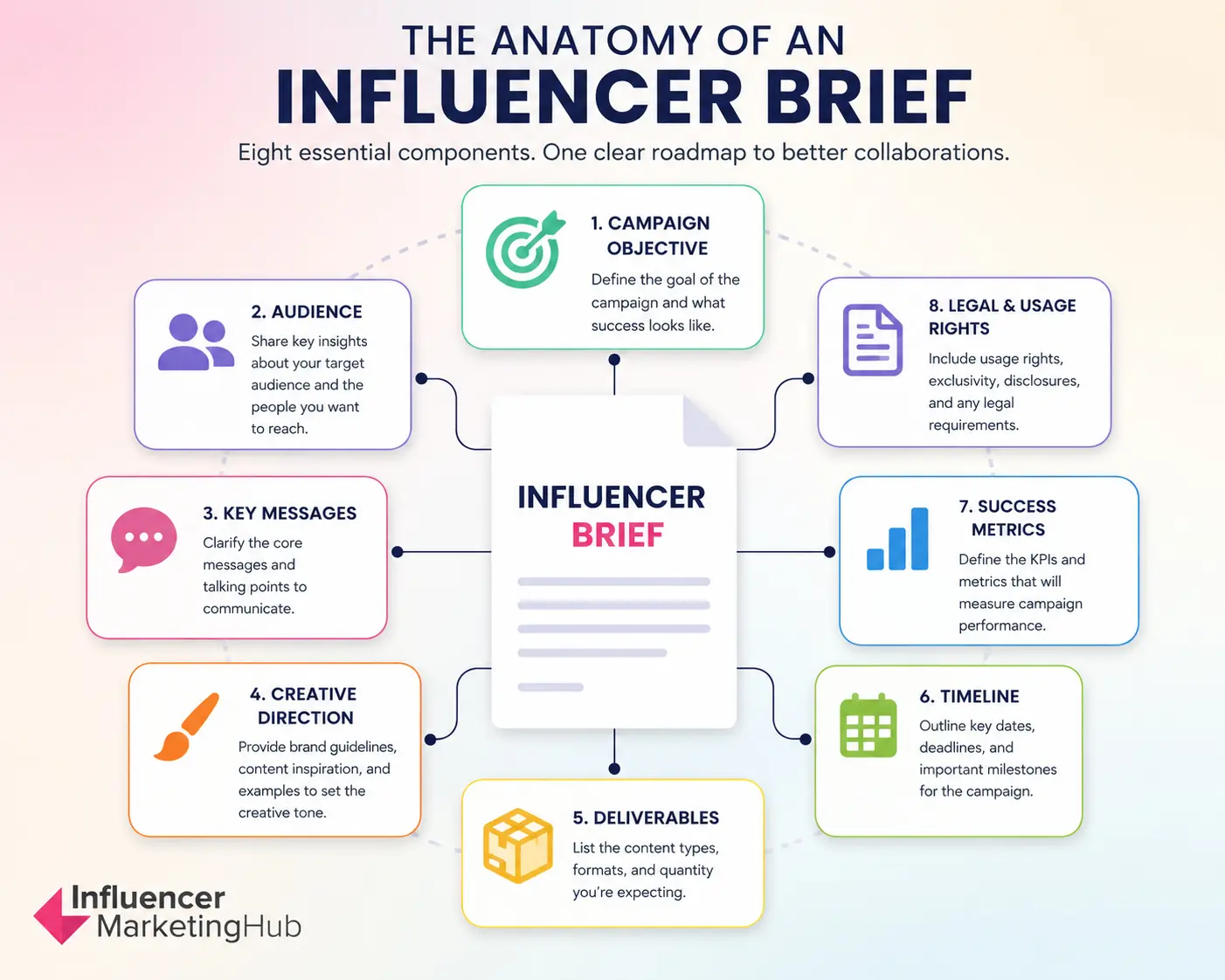
At first glance, briefing a micro influencer and a macro influencer can seem like the same exercise. Both need to understand your campaign goals, key messaging, deliverables, deadlines, and brand guidelines.
The difference lies in how that information should be presented.
A micro influencer often succeeds because their content feels personal, conversational, and closely connected to their community. Overly prescriptive briefs can limit the authenticity that makes their recommendations effective.
In many cases, brands benefit from providing clear objectives while allowing creators significant flexibility in how they communicate the message.
Macro influencers typically operate differently. Larger audiences, more sophisticated production workflows, management teams, and higher campaign investments usually require more structured briefing. Expectations around creative approvals, usage rights, reporting, and production quality tend to be defined in greater detail to ensure consistency across larger campaigns.
Neither approach is inherently better. The most effective briefing strategy matches the level of guidance to the creator's role within the campaign.
| Briefing Factor | Micro Influencers | Macro Influencers |
| Follower Range | 10K–100K | 100K–1M |
| Primary Campaign Goal | Trust, engagement, community influence | Reach, awareness, large-scale visibility |
| Creative Direction | Flexible with broad guidelines | More structured with detailed requirements |
| Content Production | Organic, authentic, creator-led | Higher production quality and planning |
| Approval Process | Typically lighter and faster | Often includes multiple review stages |
| Communication Style | Direct and collaborative | Formal, often involving managers or agencies |
| Success Metrics | Engagement, conversions, community response | Reach, impressions, awareness, share of voice |
Rather than creating entirely different campaign strategies, think of your brief as a flexible framework. The campaign objective may stay the same, but the level of detail, creative freedom, collaboration process, and measurement criteria should evolve alongside the creator tier.
That's exactly what the Influencer Marketing Hub Creator Briefing Framework is designed to help you do.
The IMH Creator Briefing Framework
Most influencer briefs contain the same core information: campaign objectives, deliverables, timelines, and brand guidelines.
What separates high-performing briefs from ineffective ones is in how that information is adapted to the creator receiving it.
The IMH Creator Briefing Framework is designed to help marketers make those adjustments consistently. Rather than creating entirely different briefing documents for every campaign, the framework identifies which parts of the brief should remain consistent and which should evolve depending on whether you're working with a micro or macro influencer.
The framework follows seven practical steps, taking you from campaign planning through final review before the brief is shared.
| Step | Focus | Outcome |
| 1. Define Campaign Objectives | Establish campaign goals and success criteria | A clear strategic foundation |
| 2. Understand the Creator | Evaluate how the creator works and what their audience expects | Appropriate briefing approach |
| 3. Adapt Creative Direction | Balance creative freedom with brand requirements | Content guidance suited to the creator |
| 4. Customize Deliverables | Adjust outputs, timelines, and rights | Realistic campaign expectations |
| 5. Set Collaboration Expectations | Define approvals, communication, and responsibilities | Smoother campaign execution |
| 6. Align Success Metrics | Match KPIs to campaign objectives and creator tier | More meaningful performance evaluation |
| 7. Review Before Sending | Validate clarity, completeness, and consistency | A briefing document ready for execution |
While every campaign is different, following these seven steps helps ensure your briefing process stays consistent without forcing every creator into the same workflow.
Step 1: Define Campaign Objectives
Before considering follower counts, content style, or deliverables, define what success looks like for the campaign itself.
Many briefing problems occur because marketers jump directly into writing instructions before agreeing internally on the campaign objective. As a result, creators receive briefs filled with tactical requests but little strategic context.
@thegosocial Have you wondered how to structure a great influencer brief? Our Influencer Specialist Brittany Green shares her top 3 tips. InfluencerMarketingTips CreatorStrategy SocialMediaInsights
♬ original sound - Go Social | Social Agency - Go Social | Social Agency
Regardless of whether you're working with a micro or macro influencer, every brief should answer the same foundational questions:
- What is the campaign trying to achieve?
- Who is the target audience?
- What action should the audience take?
- What message must remain consistent?
- How will success be measured?
These elements form the strategic foundation of every influencer brief. They should remain consistent across every creator participating in the campaign, even when execution varies.
For example, a product launch campaign may involve both macro and micro influencers. The overall objective—introducing a new product to market—doesn't change. What changes is how each creator contributes to achieving that objective.
Starting with clearly defined objectives also makes later briefing decisions much easier. Creative direction, deliverables, timelines, and reporting should all support the campaign goal rather than exist as isolated instructions.
Step 2: Understand the Creator Before You Write the Brief
Once the campaign objective is established, the next step is understanding the creator you're briefing.
Too often, marketers adjust their briefs based solely on follower count. While audience size influences campaign planning, it doesn't tell you how a creator produces content, collaborates with brands, or communicates with their audience.
Instead, evaluate the creator across several dimensions before building the brief:
- Content style and production quality
- Audience expectations and engagement patterns
- Previous brand partnerships
- Typical storytelling approach
- Posting frequency and preferred formats
- Level of creative independence
Micro influencers often build trust by producing highly personal, community-driven content. Their audiences generally respond best when creators can communicate in their own voice, making flexibility an important part of the briefing process.
Macro influencers frequently operate within larger production workflows and may collaborate with talent managers, editors, or creative teams. As campaigns become larger and more visible, briefs usually require greater structure to coordinate approvals, production timelines, and brand consistency.
@brendangahan Micro-influencers vs Macro-influencers: Which is the most effective influencer marketing technique? When it comes to influencer marketing, bigger isn’t better. Micro isn’t better. Better is better. Micro-influencers are touted as having: - higher engagement rates - lower pricing - more credibility In reality it is not that simple. Micro-influencers being more effective is not a universal marketing principle. There is the common misconception that micro-influencers are more engaging. While it is often true that micro-influencers have higher engagement rates than macro-influencers, that doesn’t mean they’re a more efficient cost per engagement (CPE) for advertisers. It is true that when influencers grow their engagement declines But, their costs don’t scale at the same rate. The average cost per engagement (CPE) is 16X higher for smaller influencers (2k-5k followers) than it is for larger ones (500k-1MM). Additionally, one factor that is often overlooked in working with influencers is the time spent to manage influencers. Working directly with an influencer that has 10 million subscribers is often just as much work as working with an influencer that has 10 thousand. Regardless, with influencer marketing there is no ‘one size fits all’. Few brands and marketers are willing to put in the time and effort to focus on identifying creators that are truly relevant. Instead, there’s an increasing reliance on marketplaces focused on scale. As the saying goes, the last mile is always the least crowded. None of this is rocket science, but like most good things, it takes patience, focus, and a long-term outlook vs looking for quick fix solutions. #influencermarketing #microinfluencers #macroinfluencers #macroinfluencer #microinfluencer
♬ Monkeys Spinning Monkeys - Kevin MacLeod & Kevin The Monkey
The goal isn't to create completely different campaign strategies for different influencer tiers. It's to understand how each creator naturally works so the brief supports their strengths instead of disrupting them.
By investing time in understanding the creator before writing the brief, you'll produce guidance that feels more relevant, easier to execute, and far more likely to result in high-quality content.
Step 3: Adapt Creative Direction to the Creator
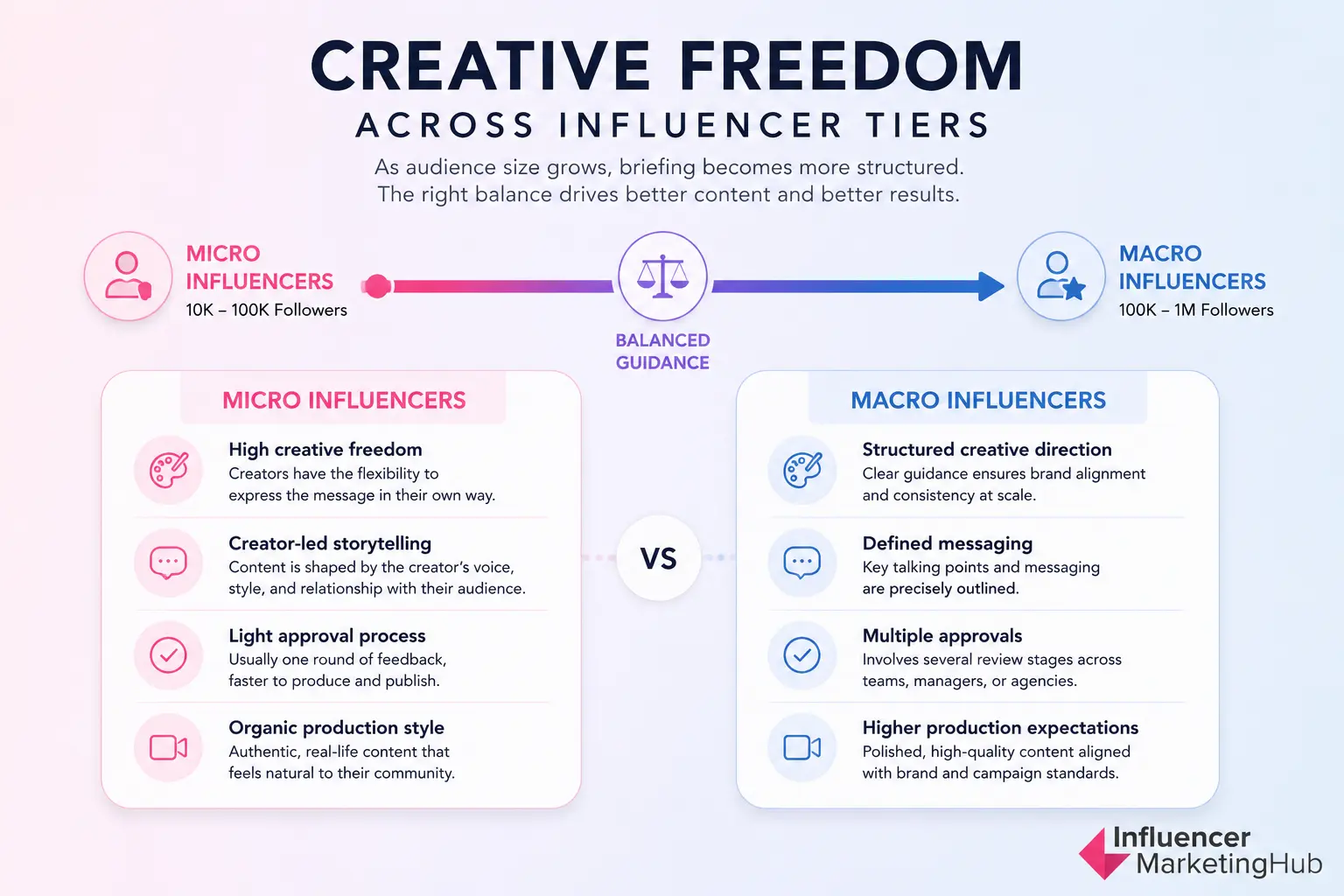
Creative direction is often where briefing succeeds or fails.
Many brands assume consistency comes from giving every creator the same instructions. In practice, the opposite is often true. The most effective campaigns provide enough guidance to protect the brand while leaving enough flexibility for creators to produce content that feels natural to their audience.
How much flexibility you provide should largely depend on the creator you're working with and the industry you're operating in.
@businessclasspod Should brands give influencers creative freedom? #influencer #influencers #influencertips #influencermarketing #influencertiktok @Mia McGrath | Frugal Chic®
Micro influencers typically earn trust through authentic, conversational content. Their audiences follow them because their recommendations feel personal rather than scripted. Overly detailed creative briefs can unintentionally remove that authenticity, making sponsored content feel forced.
Macro influencers usually operate at a larger scale with greater visibility and higher production expectations. Campaigns involving macro creators often require tighter alignment with brand messaging, visual identity, legal requirements, and approval workflows. Providing more detailed creative guidance helps reduce revisions while ensuring consistency across larger campaigns.
The goal, ultimately, is to provide the right level of direction for the creator's role in the campaign.
How Creative Direction Changes
| Briefing Element | Micro Influencers | Macro Influencers |
| Creative Freedom | High | Moderate |
| Mandatory Talking Points | Limited | Clearly defined |
| Brand Guidelines | Essential principles only | Detailed visual and messaging guidelines |
| Content Structure | Creator-led storytelling | Structured around campaign objectives |
| Review Process | Often one approval round | Multiple review and approval stages |
| Production Expectations | Authentic, everyday content | Higher production quality and polish |
As a general rule, the larger the creator's audience and campaign investment, the more structured the creative brief becomes. Smaller creators often produce their best work when brands communicate outcomes rather than prescribe every creative decision.
Step 4: Customize Deliverables Around the Creator
Once creative direction has been established, the next step is defining exactly what the creator is expected to produce.
While campaign goals may remain consistent across different influencer tiers, the deliverables required to achieve those goals often vary considerably. Treating every creator as though they can produce the same volume, formats, or production quality usually leads to unrealistic expectations on both sides.
Instead of building deliverables around follower count alone, consider the creator's content style, production capabilities, audience behavior, and role within the campaign.
Deliverables That Commonly Change
| Deliverable | Micro Influencers | Macro Influencers |
| Content Formats | Often one or two organic formats | Multiple content formats across channels |
| Posting Frequency | Typically fewer deliverables | Larger content packages may be required |
| Production Quality | Authentic, creator-produced | Higher production standards expected |
| Usage Rights | Often limited to organic use | Expanded licensing frequently negotiated |
| Whitelisting | Sometimes optional | More commonly included |
| Exclusivity | Campaign dependent | Frequently negotiated for competitive categories |
| Revision Expectations | Minimal | More structured review cycles |
Not every macro influencer requires extensive licensing or exclusivity clauses, and not every micro influencer prefers minimal guidance. These decisions should always reflect the campaign objectives rather than assumptions about creator size.
Focus on Outcomes, Not Volume
A common briefing mistake is assuming larger creators simply need more deliverables.
In reality, the emphasis should be on outcomes.
For example:
- A macro influencer might produce fewer pieces of content but deliver significantly greater campaign reach.
- A group of micro influencers may collectively generate dozens of authentic assets that can later be repurposed across paid media, email marketing, or product pages.
When defining deliverables, ask:
- Does this content support the campaign objective?
- Is the requested workload realistic for this creator?
- Are licensing and usage rights clearly explained?
- Have production expectations been communicated?
- Does the creator understand what success looks like?
Well-designed deliverables create clarity before content production begins, reducing revisions while giving creators the confidence to focus on producing their best work.
Step 5: Set Collaboration Expectations
A well-written brief should also establish how the partnership will work.
Many campaign delays stem from unclear expectations rather than creative disagreements. Questions around approvals, communication, payment, reporting, or timelines often surface only after content has been produced, creating unnecessary revisions and frustration for both brands and creators.
Addressing these operational details in the brief helps eliminate ambiguity before the campaign begins.
While every collaboration should clearly define expectations, the amount of detail required typically increases as campaigns become larger and involve more stakeholders.
Collaboration Expectations That Commonly Change
| Briefing Element | Micro Influencers | Macro Influencers |
| Primary Contact | Brand marketing contact | Brand team, agency, or talent manager |
| Communication Style | Direct and conversational | Structured with scheduled updates |
| Approval Workflow | Usually one review round | Multiple stakeholder approvals |
| Contracts | Often straightforward | More comprehensive legal agreements |
| Payment Structure | Simple fixed fee or gifting | Milestone-based or contractual payments |
| Reporting Requirements | Basic performance reporting | Detailed post-campaign reporting |
| Campaign Coordination | Individual collaboration | Coordinated with broader campaign activity |
The objective isn't to introduce unnecessary process. Instead, the briefing should provide enough operational clarity for everyone involved to understand how the collaboration will progress from kickoff to campaign completion.
Clarify Responsibilities Early
Before the campaign begins, every brief should answer questions such as:
- Who is responsible for approving content?
- How many revision rounds are included?
- What are the expected response times for feedback?
- When will payment be processed?
- Which performance metrics should creators provide?
- Who should creators contact if campaign requirements change?
Answering these questions upfront reduces misunderstandings and allows creators to spend more time producing content instead of seeking clarification.
Step 6: Align Success Metrics With the Creator's Role
Not every influencer campaign is designed to achieve the same outcome, which means not every creator should be measured using identical KPIs.
One of the most common briefing mistakes is assigning the same performance expectations to every influencer, regardless of their audience size or campaign role.
Instead, define success based on why that creator was selected in the first place.
How Success Metrics Typically Differ
| KPI | Micro Influencers | Macro Influencers |
| Engagement Rate | Primary performance indicator | Supporting metric |
| Community Interaction | High priority | Moderate priority |
| Clicks & Conversions | Frequently emphasized | Campaign dependent |
| Affiliate Sales | Often used | Less common |
| User-Generated Content | High value output | Secondary objective |
| Reach & Impressions | Supporting metrics | Primary campaign objective |
| Brand Awareness | Secondary objective | Core success metric |
| Share of Voice | Rarely measured independently | Frequently tracked in larger campaigns |
For example, a campaign built around dozens of micro-influencers may prioritize authentic conversations, product education, affiliate sales, and reusable UGC assets. The same campaign featuring several macro influencers may instead focus on maximizing reach, visibility, and brand awareness during a product launch.
Neither measurement framework is inherently better—they simply reflect different roles within the marketing strategy.
Match KPIs to Campaign Objectives
Rather than beginning with a predefined list of metrics, work backwards from the campaign objective.
Ask:
- Why was this creator selected?
- What business outcome are they expected to influence?
- Which metrics best demonstrate that contribution?
- Does the creator understand how success will be evaluated?
When expectations are aligned from the beginning, creators can make more informed creative decisions while brands gain more meaningful campaign insights.
Step 7: Review the Brief Before You Hit Send
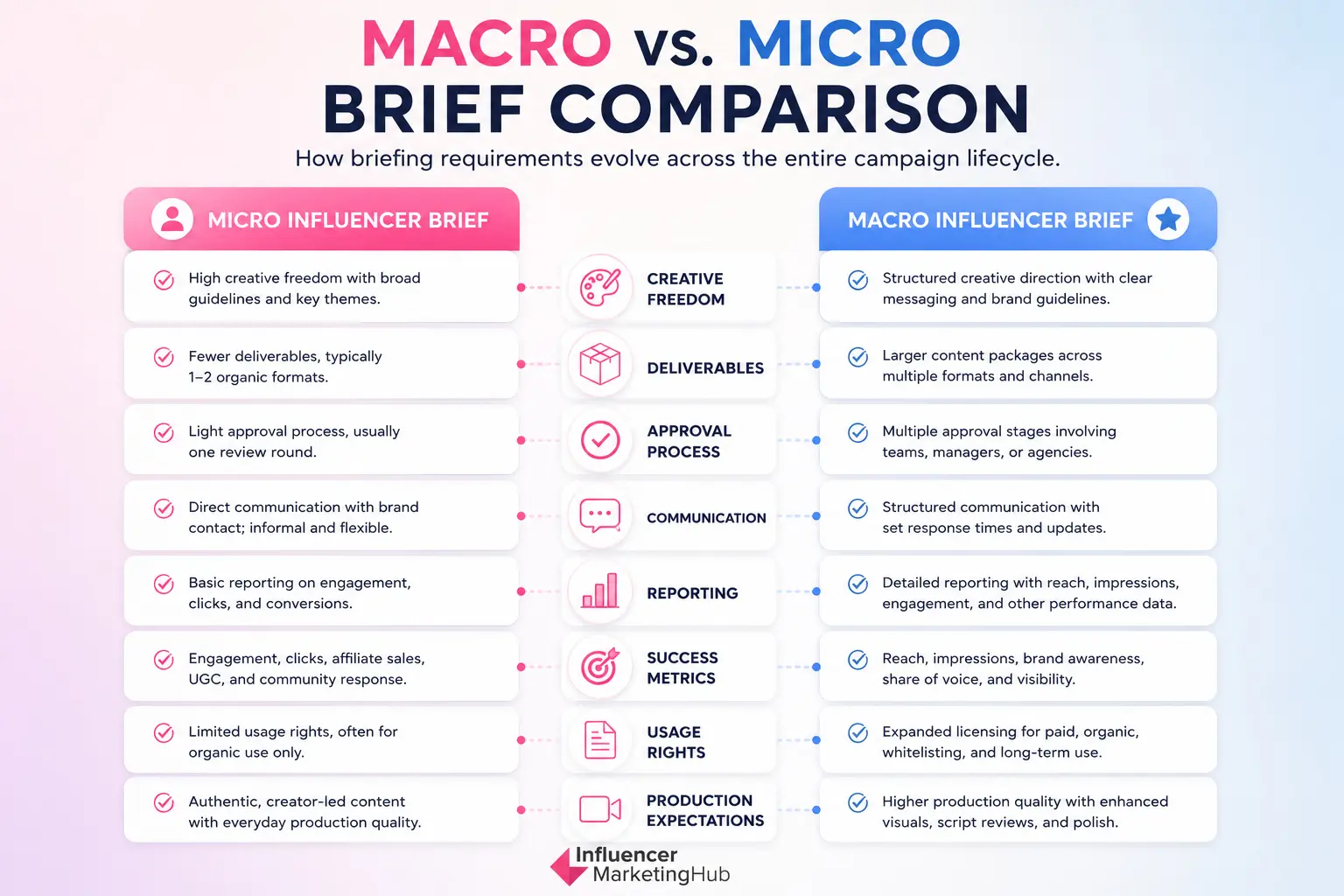
Before sharing your brief, take one final pass through the document.
This step is all about confirming that the brief gives creators everything they need to produce successful content without unnecessary back-and-forth.
A final review helps identify missing information, conflicting instructions, or unrealistic expectations before the collaboration begins.
The Pre-Send Brief Checklist
Before sending your brief, confirm that you can answer yes to each of the following:
- Is the campaign objective clearly defined?
- Does the creator understand the target audience?
- Have deliverables been explained clearly?
- Is the level of creative freedom appropriate for this creator?
- Are timelines and deadlines realistic?
- Are approval workflows clearly documented?
- Have usage rights and licensing been specified?
- Are success metrics aligned with the creator's role?
- Does the creator know who to contact with questions?
- Is the brief concise enough to be easily understood?
A good brief should answer questions before creators have to ask them. If parts of the document still rely on assumptions or verbal explanations, it's worth refining them before the campaign starts.
Following this final review ensures that every creator receives a briefing that is clear, actionable, and tailored to how they work, whether they're a micro-influencer building trust within a niche community or a macro-influencer leading a large-scale brand campaign.
Should You Use One Brief for Every Influencer?
The short answer is no.
While every influencer brief should follow the same underlying structure, using an identical document for every creator rarely produces the best results. The most effective campaigns standardize the campaign fundamentals while adapting the execution details to the creator's role.
Think of your influencer brief as a modular document rather than a fixed template.
Campaign objectives, target audience, messaging, timelines, and brand values should remain consistent across every creator. These elements ensure everyone contributes toward the same business outcome.
The sections that should change are the ones directly influenced by how creators produce content and collaborate with brands. Creative direction, deliverables, approval workflows, communication style, reporting expectations, and success metrics should all be adjusted to match the creator tier and campaign role.
This approach creates consistency without sacrificing authenticity.
When One Standard Brief Is Enough
A single briefing document may be appropriate when:
- Every creator is producing the same content format.
- Campaign budgets and production expectations are similar.
- The creator group falls within the same influencer tier.
- Approval processes are identical.
- Success metrics are shared across participants.
For example, a gifting campaign involving twenty micro-influencers creating Instagram Stories around a product launch may only require one standardized brief with minor personalization.
When You Should Customize the Brief
Customization becomes increasingly important when campaigns involve:
- Both micro and macro influencers.
- Multiple content formats.
- Paid usage rights or whitelisting.
- High-budget product launches.
- Agency-managed talent.
- Different campaign objectives across creator groups.
In these situations, forcing every creator into the same briefing process often creates unnecessary revisions while reducing creative effectiveness.
A Hybrid Approach Often Works Best
Many of today's influencer campaigns combine multiple creator tiers.
A macro influencer may introduce a product to a broad audience, while dozens of micro influencers reinforce credibility through authentic reviews and community conversations.
Rather than creating completely separate briefing documents, start with a shared campaign foundation and customize only the sections that need to evolve.
For example:
| Universal Brief Sections | Customized by Creator Tier |
| Campaign objective | Creative direction |
| Brand story | Deliverables |
| Target audience | Approval workflow |
| Timeline | Reporting expectations |
| Brand guidelines | Success metrics |
| Key messaging | Usage rights |
This modular approach allows marketing teams to maintain consistency across campaigns while giving creators the level of guidance they actually need.
Common Briefing Mistakes to Avoid
Even experienced marketing teams can undermine influencer campaigns with briefing mistakes that seem minor at first but create confusion once content production begins.
Here are some of the most common issues to watch for.
Treating Every Creator the Same
Follower count isn't the only factor that should influence your brief.
Creators differ in production capabilities, storytelling style, audience expectations, and collaboration preferences. Adapting your brief to those differences produces better content than forcing every creator into the same workflow.
Over-Scripting Micro Influencers
Micro influencers typically succeed because their recommendations feel authentic and personal.
Providing page after page of scripted messaging often removes the voice that attracted their audience in the first place.
Focus on outcomes, key messages, and brand requirements while allowing creators flexibility in how they communicate them.
Under-Briefing Macro Influencers
The opposite problem occurs with macro creators.
Larger campaigns usually involve more stakeholders, production planning, legal requirements, and approval stages. Assuming experienced creators need very little guidance can result in avoidable revisions and inconsistent brand messaging.
Defining Deliverables but Not Success
Creators should understand not only what they're producing but why it matters.
Explaining whether the campaign prioritizes awareness, engagement, conversions, affiliate sales, or content creation helps creators make stronger creative decisions throughout production.
Leaving Usage Rights Until the End
Questions around licensing, paid amplification, whitelisting, and content ownership should never be introduced after content has already been created.
Including these expectations in the original brief protects both the brand and the creator while reducing contract revisions later.
Forgetting the Human Relationship
A brief should create clarity, not replace communication.
Even the most detailed document can't anticipate every creative decision or campaign change. Encourage creators to ask questions, provide feedback, and collaborate throughout the campaign rather than treating the brief as a rigid set of instructions.
Conclusion: Better Briefs Create Better Partnerships
Influencer briefs shouldn't become longer as creators become larger—they should become smarter.
The most effective briefs balance consistency with flexibility, giving every creator the information they need without overwhelming them with unnecessary detail.
By keeping campaign fundamentals consistent while adapting creative direction, deliverables, collaboration expectations, and success metrics to the creator tier, brands can reduce revisions, strengthen partnerships, and produce content that feels authentic to each audience.
The IMH Creator Briefing Framework provides a repeatable way to do exactly that. Instead of relying on one-size-fits-all documents, you'll build briefs that reflect how different creators actually work, helping every campaign start with clearer expectations and end with better results.
Frequently Asked Questions
Do micro-influencers always deliver stronger engagement than macros?
Generally yes. Our latest Influencer Marketing Benchmark Report shows that creators under 100k followers record the highest average engagement across major platforms, while rates decline as follower counts rise.
What fee band should I budget for an Instagram Reel?
Micro talent often quotes between $200 and $1000 per video, whereas macros may start around $ 10,000 and go considerably higher once usage rights and whitelisting are added.
How can I check whether a micro creator’s audience is genuinely purchase-oriented?
First, run a quick engagement-quality scan; then compare follower location with your shipping footprint. The step-by-step process is outlined in our Micro-Influencer Marketing Guide, which recommends combining manual comment audits with third-party authenticity tools.
Are exclusivity clauses advisable when partnering with micros?
Yes—but keep them tight. A 30-day, single-category lockout is common; anything longer can feel punitive, as discussed in our pros-and-cons breakdown of working with smaller creators.
Where do nano influencers fit in the mix, and does the brief change?
Nano creators (<10k followers) usually need even lighter direction—often a simple product card plus talking-point bullets—because their content is highly conversational. The distinctions among nano, micro, and macro tiers are mapped clearly in the tier comparison and the broader types-of-influencers primer.
What’s a proven way to scale briefs when activating 50+ micro creators at once?
Brands often rely on creator-friendly SaaS dashboards that auto-generate coupon codes and track fulfillment. A shortlist of vetted platform options highlights tools with built-in briefing modules and automated asset requests.
Are there industries where macros still outperform micros on ROI?
Yes. In categories such as global luxury, blockbuster entertainment, or national charity appeals, the sheer reach of a macro can compress CPMs below micro averages. Five clear exceptions are explained in this look at when smaller is better—and when it isn’t.
How many talking points is “too many” for a micro brief?
Campaign audits show that 6–8 focused prompts strike the best balance between brand safety and authenticity. Over-directed scripts consistently underperform, a lesson illustrated with live campaign snippets in our article on five reasons to favor micro creators.
Where can I find agency partners that specialize in briefing micros at scale?
If bandwidth is tight, consider outsourcing to boutique shops that exclusively manage sub-100k creators; a curated roster of such specialists appears in this agency round-up.
What’s one practical add-on that speeds brief-to-live time?
Including a short video gallery of past content that matches your desired aesthetic reduces first-draft rejections. Several brands using this method are profiled in the micro-influencer brand examples collection.

SUGGESTED

Macro Influencers Explained: Definition, Follower Count, and When to Use Them
Macro influencer guide covering definition follower count costs and when to use them for...

Common UGC Brief Mistakes (And How To Fix Them)
Improve UGC performance by fixing common brief mistakes that hurt hooks clarity platform...

Updating Your Brief Template After Each Campaign: Post-Mortem Feedback Loop
Turn creator “upspeak” and missed CTAs into high-ROI upgrades—this guide shows how...