
Influencer marketing programs have evolved far beyond one-off collaborations. As 72% of marketers plan to increase influencer marketing budgets by 50%, they are moving toward structured systems that can consistently deliver content, reach, and revenue.
Moreover, 85% of marketers now consider influencer marketing as a channel that achieves their marketing goals. This makes scalability and repeatability non-negotiable.
In practice, that shift has led to the rise of influencer marketing programs. These systems are platform-powered and allow brands to recruit creators, manage relationships, produce content, and track performance in a centralized, repeatable way.
Rather than running isolated campaigns, marketers are building ongoing creator ecosystems designed to drive long-term growth.
This article breaks down five influencer marketing programs that brands are using today to scale creator campaigns, along with how each approach works and where it fits.
- What Are Influencer Marketing Programs?
- Types of Influencer Marketing Programs Platforms Enable
- Top Influencer Marketing Programs for Brands
- 1. Linqia
- 2. Creator.co Review
- 3. Upfluence
- 4. Aspire
- 5. Impact.com
- How to Choose the Right Influencer Marketing Program
- Influencer Marketing Programs That Actually Scale Results
- Frequently Asked Questions
What Are Influencer Marketing Programs?
Influencer marketing programs refer to structured, ongoing systems that brands use to manage creator partnerships at scale.
Unlike traditional campaigns, which are typically tied to a single launch or promotion, programs are designed to operate continuously, with defined workflows for recruiting creators, producing content, and measuring results over time.
These programs are rarely managed manually. Instead, they are enabled by platforms that centralize key functions such as creator discovery, outreach, content approvals, payments, and performance tracking. The infrastructure allows brands to move beyond ad hoc influencer deals and build repeatable processes that can scale across dozens or even hundreds of creators.
At a practical level, influencer marketing programs can take several forms.
Some focus on affiliate growth, where creators are incentivized to drive measurable sales. Others are built around ambassador communities that generate ongoing brand advocacy and content. There are also programs centered on user-generated content, where the primary goal is to produce high volumes of creative assets for paid and organic distribution.
What connects all of these models is consistency. Influencer marketing programs are not defined by the number of creators involved or the size of the budget, but by their ability to deliver predictable outputs over time.
For brands, that means moving from one-off activations to a system that continuously produces content, insights, and performance improvements.
Types of Influencer Marketing Programs Platforms Enable
Influencer marketing programs vary based on the outcome a brand is trying to achieve. Some are built for direct revenue generation, while others focus on content production or long-term brand advocacy.
Platforms play a central role in shaping how these programs operate, providing the infrastructure needed to manage creators, workflows, and performance at scale.
Most influencer marketing platforms support a set of core program models, each with a distinct structure and use case.
Affiliate-Driven Influencer Programs
Affiliate-driven programs prioritize measurable performance. Creators receive unique tracking links or discount codes and earn commissions based on the sales they generate. eCommerce brands rely heavily on this model because it directly connects influencer activity to revenue outcomes.
Platforms that support affiliate programs typically offer built-in tracking, commission management, and integrations with commerce systems. Clear attribution allows brands to scale creator participation while maintaining control over spend and return.
Ambassador and Community Programs
Ambassador programs are designed around long-term creator relationships. Instead of activating influencers for isolated campaigns, brands build a network of creators who consistently represent and promote their products over time.
Structured onboarding, recurring deliverables, and community engagement mechanisms are common components. Strong alignment between brand and creator tends to produce more authentic content and sustained audience trust. Consistency across posts and platforms reinforces brand identity and improves long-term performance.
Popular examples of brand ambassadors include:
- Chiara Ferragni for Hublot
- Royce Watson for Sephora
- Yasmina El-Adb for Dior
- Dean Wilson for Lululemon
Through these programs, brands can design partnerships that bring long-term value.
UGC and Content Production Programs
UGC-focused programs center on content output rather than reach alone. UGC creators are engaged to produce assets that brands can reuse across paid media, social channels, and product pages.
Content briefs, approval workflows, and usage rights management are critical features within this model. A steady pipeline of creative assets allows marketing teams to test, iterate, and optimize campaigns more efficiently. Performance marketing teams often depend on this approach to maintain fresh creative at scale.
Marketplace and On-Demand Programs
Marketplace-driven programs emphasize speed and flexibility. Brands can discover, vet, and activate creators quickly without committing to long-term relationships. This model works well for testing new audiences, formats, or campaign ideas.
Searchable creator databases, self-serve campaign tools, and streamlined collaboration workflows are typical platform features. Rapid activation makes it easier to scale output in short bursts while exploring different content strategies.
Managed Influencer Programs
Managed programs combine platform capabilities with service-based execution. External teams handle creator sourcing, campaign management, and optimization, allowing brands to scale without building internal operations.
This model is particularly vital for brands navigating a specific inflection point: when proven creator programs need to scale and prove tangible revenue impact. Kristina Coughlin, General Manager of the creator marketing agency Trevant, recently highlighted where creator programs typically break down at this stage. She notes that brands generally hit a ceiling caused by complexity: either their program is working organically but they struggle to measure the proof, or they have the right proof but struggle to scale the operations.
According to Coughlin, the brands successfully getting past this breaking point are doing things differently:
-
They stop treating creator marketing as a purely organic endeavor and begin treating it with the rigor of a performance channel.
-
They utilize managed infrastructure to combine authentic creator storytelling with paid media amplification, extending the lifespan of top-performing content.
-
They connect creator content directly to conversion data and full-funnel optimization, proving direct revenue outcomes rather than relying solely on vanity metrics like reach or impressions.
Many enterprise brands adopt this managed model to maintain consistent, brand-safe output across thousands of creators, while securing the precise attribution required by leadership to defend and scale the channel.
Top Influencer Marketing Programs for Brands
1. Linqia
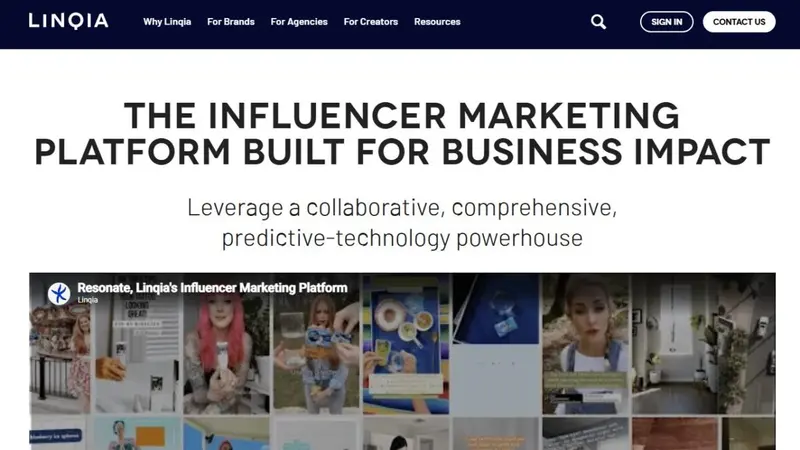
Linqia operates as a full-service, tech-enabled influencer marketing agency designed for brands that want to run structured programs without building internal infrastructure.
Instead of offering a purely self-serve tool, Linqia combines proprietary technology with hands-on execution, positioning itself as a partner that manages influencer marketing from strategy through to performance optimization.
Their proprietary platform, Resonate, is built around delivering measurable business outcomes rather than isolated campaign outputs, with a strong emphasis on data, content quality, and paid amplification.
Linqia’s program model centers on end-to-end execution supported by the Resonate platform. The process typically begins with strategy development, where campaign goals are defined and mapped to creator personas using large-scale data inputs.
From there, Linqia handles:
Read More
Linqia
Linqia is the leading independent influencer marketing agency in the U.S., specializing in data-driven campaigns for major brands, combining influencer marketing, paid media, and content production. They are well known for their "guaranteed resul...

50+

San Francisco, Chicago, New York, Colombia
Best for:
Fortune 500 Brands
Linqia
Linqia is the leading independent influencer marketing agency in the U.S., specializing in data-driven campaigns for major brands, combining influencer marketing, paid media, and content production. They are well known for their "guaranteed resul...
2. Creator.co Review
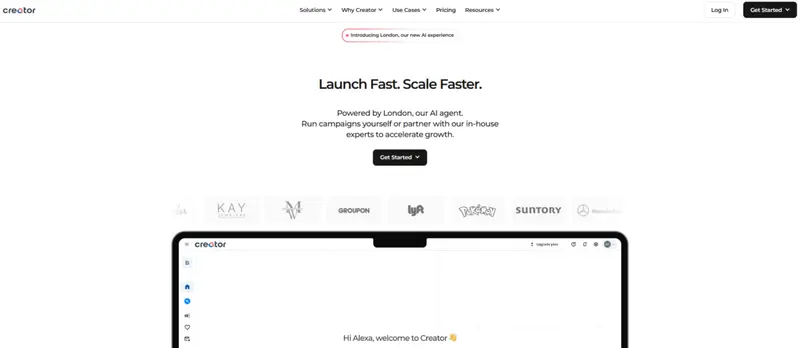
Creator.co offers a marketplace-driven approach to influencer marketing, enabling brands to quickly discover, activate, and manage creators at scale. The platform is designed for flexibility, allowing teams to launch campaigns and recruit influencers without the need for long-term program infrastructure.
The model is particularly useful for brands that want to test different creators, content formats, and audiences before committing to more structured, long-term programs.
Creator.co’s program operates through a combination of marketplace access and campaign workflows. Brands can create campaigns, define requirements, and invite creators to participate, or browse and reach out directly.
Core program components include:
Read More
Key Features: Search/Discovery, Automated Recruiting, Influencer Relationship Management, Influencer Marketplace, Content Review, Content Library, Campaign Management, Campaign Reporting, Influencer Analysis, Audience Analysis, E-commerce Tools, Product/Gifting Tools, Fake Follower/Fraud Detection, Payment Processing, Social Listening, Competitor Research, Creator Marketplace,
Channels: Instagram, YouTube, TikTok, Tiktok Shop
3. Upfluence
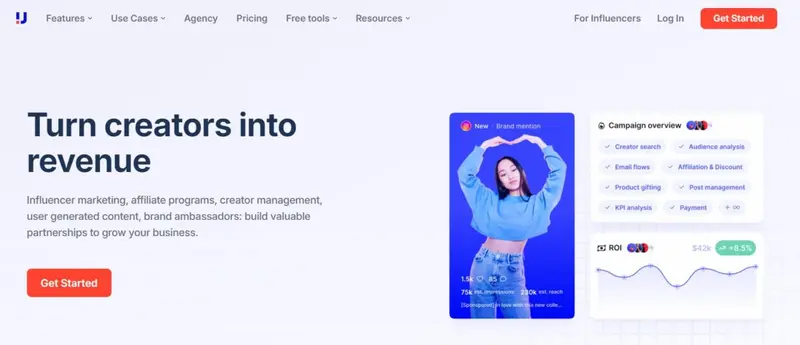
Upfluence is a platform built around running influencer marketing programs that are tightly connected to eCommerce performance. Rather than focusing purely on content or reach, it enables brands to turn creators into revenue-driving partners through affiliate structures, customer data integration, and automated workflows.
The platform is designed to help brands move from one-off influencer collaborations to always-on programs that generate trackable sales, making it particularly relevant for DTC and Shopify-first businesses.
Upfluence’s program model is centered on integrating influencer marketing directly into a brand’s existing customer and sales data. The platform connects with eCommerce systems such as Shopify, allowing brands to identify potential influencers within their own customer base and activate them as creators.
Core program components include:
Read More4. Aspire
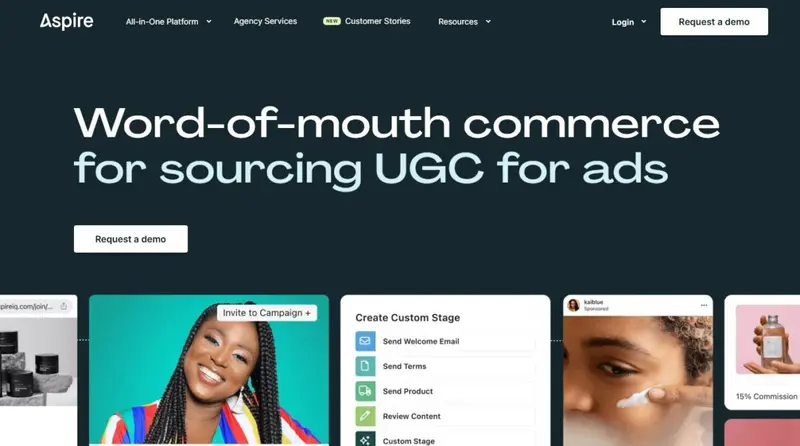
Aspire is designed to help brands build long-term creator relationships rather than relying on one-off collaborations. The platform focuses on turning influencer marketing into a community-driven program, where creators are recruited, nurtured, and activated continuously across campaigns.
Instead of treating influencers as transactional partners, Aspire positions them as part of an extended brand ecosystem. This approach supports ongoing content production, stronger brand alignment, and more consistent audience engagement over time.
Aspire’s program model centers on creator relationship management and structured collaboration workflows. Brands can recruit creators into ongoing programs and manage them through a centralized system that supports communication, content, and performance tracking.
Core program components include:
Read More5. Impact.com
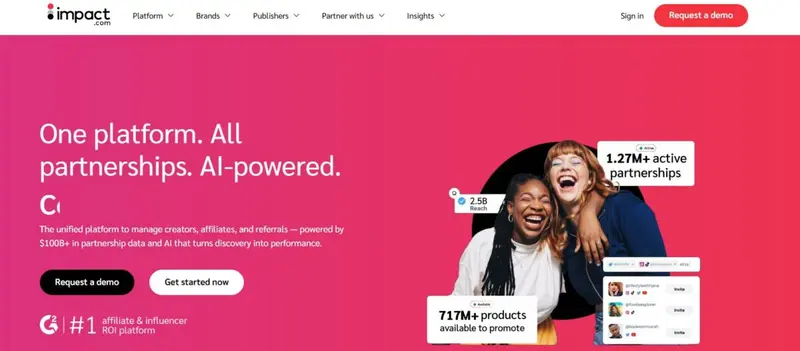
Impact.com extends influencer marketing into a broader partnership ecosystem, where creators, affiliates, publishers, and other partners are managed within a single performance-driven program.
Rather than treating influencer marketing as a standalone channel, the platform positions it as part of a unified approach to revenue generation.
The system is designed for brands that prioritize measurable outcomes and want to consolidate different partnership types under one framework, including influencer, affiliate, and content partnerships.
Impact.com’s program model is built around partner lifecycle management and revenue attribution. Brands can recruit influencers alongside other partners and manage them through a centralized platform that tracks performance across the entire funnel.
Core program components include:
Read MoreHow to Choose the Right Influencer Marketing Program
Choosing the right influencer marketing program depends on how influencer marketing fits within a brand’s broader growth strategy. Each platform supports a different operating model, and selecting the wrong one can limit performance or create unnecessary operational friction.
Define Your Primary Objective
Start with a clear understanding of what the program needs to deliver. Influencer marketing can serve multiple roles, but most programs are optimized for a specific outcome.
- Revenue-focused strategies align with affiliate and performance-driven platforms
- Content-driven strategies require strong UGC workflows and asset management
- Brand-building efforts benefit from ambassador and community-based programs
Alignment between the objective and the program type is critical. Without it, even the most advanced platform will underperform.
Evaluate Internal Resources
Execution capacity plays a major role in program success. Some models require hands-on management, while others are designed to reduce operational burden.
- Lean teams often benefit from managed programs that handle execution end-to-end
- In-house teams can take advantage of self-serve platforms for greater control
- Hybrid approaches work when the internal strategy is supported by external execution
Matching program complexity to team capacity ensures consistency over time.
Consider Scale and Growth Plans
Different platforms are built to support different levels of scale. Some are optimized for rapid creator activation, while others focus on structured, long-term growth.
- Marketplace platforms enable quick scaling and testing
- Affiliate-driven programs scale efficiently through performance incentives
- Enterprise solutions support multi-channel, high-volume programs
Selecting a platform that aligns with growth expectations reduces the need for future transitions.
Assess Measurement and Attribution Needs
Performance visibility varies significantly across program types. Some platforms prioritize revenue attribution, while others focus on content output and engagement.
- Affiliate and partnership platforms provide clear conversion tracking
- Content-focused programs may require additional measurement layers
- Advanced platforms offer deeper attribution and reporting capabilities
Measurement should align with how success is defined internally, whether that is revenue, engagement, or content performance.
Align Budget With Program Structure
Budget constraints influence which program models are viable. Each approach carries a different cost structure and level of risk.
- Performance-based programs reduce upfront investment
- Managed programs require higher budgets but simplify execution
- Marketplace models provide flexibility for testing and iteration
A sustainable program balances cost, output, and expected return over time.
Influencer Marketing Programs That Actually Scale Results
Influencer marketing programs have shifted from experimental campaigns to structured growth systems. Platforms now enable brands to recruit creators, manage relationships, produce content, and measure performance in a way that is repeatable and scalable.
No single approach fits every brand. The right program depends on objectives, internal resources, and how influencer marketing fits within the broader growth strategy. Brands that prioritize structure, consistency, and measurement are more likely to see sustainable results.
As influencer marketing continues to mature, the advantage will shift toward companies that treat it as an integrated, always-on channel rather than a series of isolated campaigns. Programs built with the right platform and operating model can deliver not only reach, but also predictable performance and long-term value.
Frequently Asked Questions
What are influencer marketing programs?
Influencer marketing programs are structured, ongoing systems that brands use to manage creator partnerships, produce content, and track performance at scale.
How are influencer marketing programs different from campaigns?
Campaigns are short-term and tied to specific launches, while programs are continuous and designed to deliver consistent results over time.
What types of influencer marketing programs exist?
Common types include affiliate programs, ambassador programs, UGC content programs, marketplace-driven programs, and managed influencer programs.
Which influencer marketing program is best for eCommerce brands?
Affiliate-driven programs are often the best fit for eCommerce brands because they tie influencer activity directly to sales and revenue.
Do influencer marketing programs require a platform?
Most scalable programs rely on platforms to handle creator discovery, outreach, content management, payments, and performance tracking.
How much do influencer marketing programs cost?
Costs vary depending on the program type. Performance-based programs reduce upfront costs, while managed programs typically require higher investment.
Can small businesses run influencer marketing programs?
Yes, marketplace platforms and self-serve tools make it possible for small businesses to run influencer programs without large budgets or teams.
Are influencer marketing programs worth it?
Programs can deliver strong results when structured correctly, especially when aligned with clear goals, the right platform, and consistent execution.


