
Social media strategies evolve quickly. New platforms emerge, algorithms change, campaigns end, and audience behavior shifts over time.
The pace of change is reflected in consumer expectations. According to Sprout Social, 93% of consumers believe brands should keep up with online culture, while 90% say it's important for brands to stay current with online trends and conversations.
As such, staying relevant requires regularly evaluating whether your channels, content, and messaging still align with what your audience expects.
That's where a social media audit comes in.
Rather than guessing what's working, a social media audit gives you a structured way to evaluate every account, measure performance, identify opportunities, and build a clear action plan for improvement.
Whether you're managing a single brand or multiple client accounts, conducting regular audits helps ensure your social media strategy stays aligned with your objectives.
In this guide, we'll walk you through the IMH 7-Step Social Media Audit Framework, a repeatable process for auditing your social channels, prioritizing improvements, and turning your findings into measurable results.
Along the way, you can use our free template to document every step and build an audit you can revisit throughout the year.
- What Is a Social Media Audit?
- Why Conduct a Social Media Audit?
- The IMH 7-Step Social Media Audit Framework
- Step 1: Define Your Audit Goals
- Step 2: Inventory Your Social Media Accounts
- Step 3: Audit Your Brand Presence
- Step 4: Measure Content & Account Performance
- Step 5: Benchmark Your Competitors
- Step 6: Prioritize Improvement Opportunities
- Step 7: Build Your Action Plan
- How Often Should You Conduct a Social Media Audit?
- Recommended Social Media Audit Tools
- Make Social Media Audits Part of Your Marketing Routine
- Frequently Asked Questions
📥 Get the Free Social Media Audit Template
A successful audit starts with a structured framework.
Download the IMH Social Media Audit Template to record your accounts, evaluate performance, benchmark competitors, prioritize opportunities, and create an actionable improvement plan as you work through this guide.
What Is a Social Media Audit?
A social media audit is a structured review of your brand's social media presence. It involves evaluating every account you manage to understand what's performing well, what needs improvement, and whether your current social strategy is still aligned with your business objectives.
A comprehensive audit goes beyond reviewing follower counts or engagement rates. It examines the health of your entire social media operation, including your profiles, branding, content, audience, posting consistency, and competitive position.
The goal of a social media audit is to uncover insights that help you make better strategic decisions. By identifying strengths, weaknesses, and opportunities across your social channels, you can confidently decide where to invest more effort, which tactics to refine, and which activities no longer deserve your resources.
Whether you conduct an audit quarterly or annually, the process creates a benchmark that makes it easier to measure progress over time.
Social Media Audit vs. Similar Marketing Activities
Although the terms are sometimes used interchangeably, a social media audit serves a different purpose than other forms of marketing analysis.
| Activity | Primary Purpose | Typical Outcome |
| Social Media Audit | Evaluate the overall health of your social media presence | Improvement roadmap |
| Social Media Analytics | Monitor ongoing performance metrics | Performance insights |
| Competitive Analysis | Compare your social strategy against competitors | Competitive opportunities |
| Content Audit | Evaluate existing social content | Content optimization recommendations |
Together, these activities provide a complete picture of your social media performance, but the audit acts as the foundation that brings everything together.
Why Conduct a Social Media Audit?
Regular audits help ensure your social media strategy continues to support your broader marketing objectives rather than simply maintaining an active presence online.
An effective social media audit helps you:
- Identify your highest-performing platforms and content.
- Spot outdated or inactive accounts.
- Ensure branding remains consistent across every channel.
- Measure audience growth and engagement.
- Evaluate whether each platform supports your business goals.
- Benchmark your performance against competitors.
- Prioritize improvements based on measurable data.
- Create a repeatable process for continuous optimization.
Instead of relying on assumptions, you'll have the evidence needed to make smarter decisions about where to focus your time, budget, and creative resources.
The IMH 7-Step Social Media Audit Framework
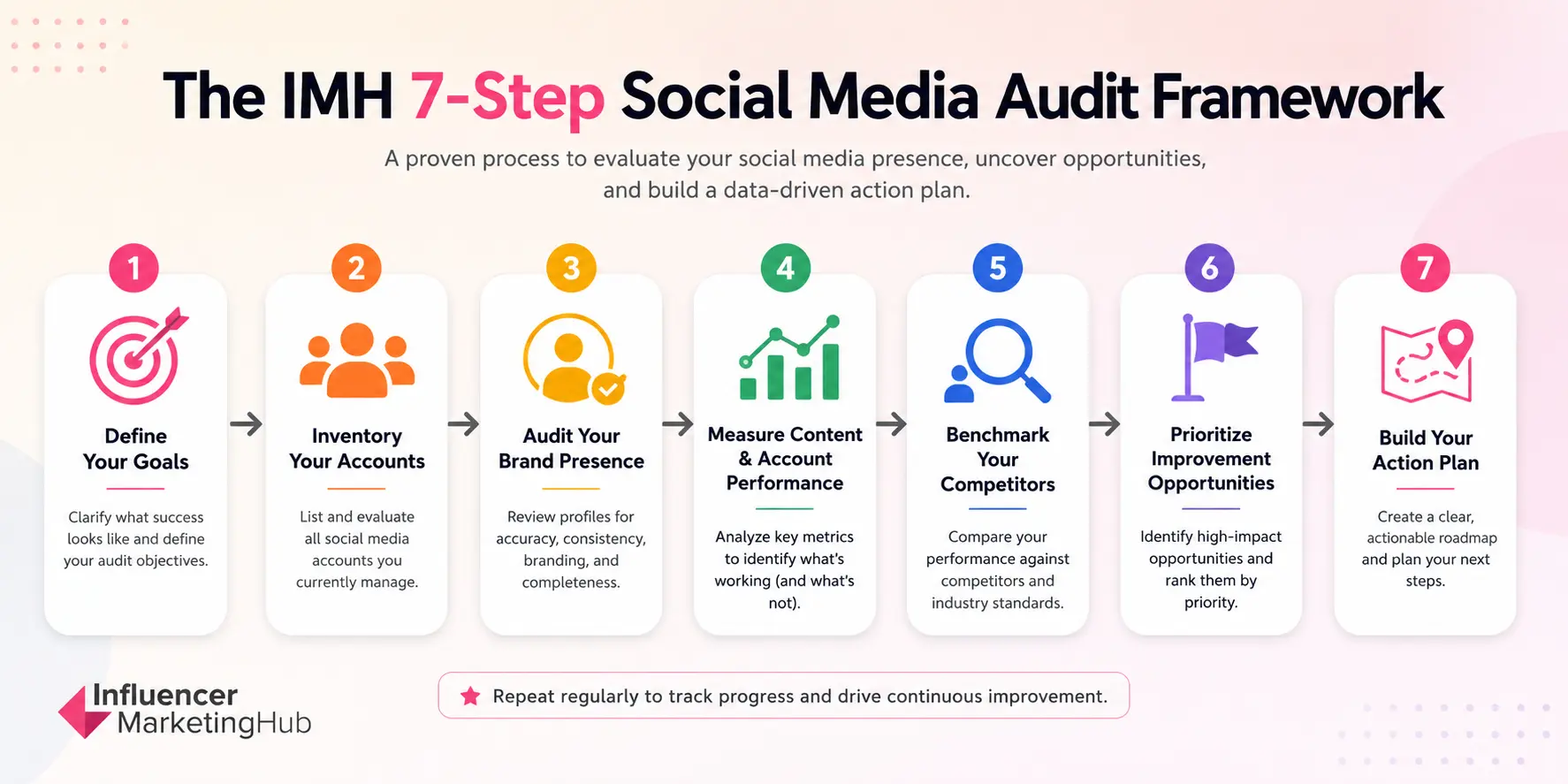
Conducting a social media audit can quickly become overwhelming if you jump between platforms, metrics, and reports without a clear process. A structured framework keeps the audit focused while ensuring every important area is evaluated consistently.
The IMH 7-Step Social Media Audit Framework breaks the process into seven practical stages, each building on the previous one. By the end of the framework, you'll have more than a collection of performance metrics—you'll have a prioritized action plan for improving your social media strategy.
| Stage | Primary Question | Outcome |
| 1. Define Your Audit Goals | What are we trying to improve? | Clear audit objectives |
| 2. Inventory Your Social Media Accounts | What accounts do we currently manage? | Complete account inventory |
| 3. Audit Your Brand Presence | Are our profiles accurate and consistent? | Brand consistency review |
| 4. Measure Content & Account Performance | Which channels and content perform best? | Performance benchmark |
| 5. Benchmark Your Competitors | How do we compare within our market? | Competitive insights |
| 6. Prioritize Improvement Opportunities | Which issues deserve immediate attention? | Prioritized recommendations |
| 7. Build Your Action Plan | What should we do next? | Strategic roadmap |
Each step corresponds with a section of the free audit template, making it easy to document your findings as you progress through the framework.
Step 1: Define Your Audit Goals
Before reviewing metrics or evaluating individual platforms, establish what you want your audit to achieve. Without clear objectives, it's easy to collect large amounts of data without uncovering insights that improve your social media strategy.
Your audit should answer specific business questions rather than simply report on performance.
For example, are you trying to identify your highest-performing channels? Improve engagement? Increase conversions? Decide whether certain platforms are still worth maintaining?
Defining your objectives upfront ensures every metric you review has a clear purpose and makes it much easier to prioritize improvements later in the audit.
Align Your Audit With Business Objectives
Your social media goals should support broader business priorities.
For example:
| Business Goal | Social Media Audit Focus |
| Increase brand awareness | Reach, impressions, follower growth |
| Generate leads | Click-through rate, conversions, landing page traffic |
| Build community | Engagement rate, comments, shares, saves |
| Improve customer support | Response time, resolution rate, customer satisfaction |
| Drive sales | Revenue attribution, conversion rate, social commerce performance |
By connecting social media metrics to business outcomes, your audit becomes a strategic exercise instead of a reporting task.
Decide Which Platforms to Evaluate
Not every business needs to invest equally across every social network.
Begin by listing every active platform your brand manages, including:
- TikTok
- X (formerly Twitter)
- YouTube
- Threads
- Any niche or industry-specific platforms
Even if you expect to reduce activity on certain channels, include them in the audit. The data you collect will help determine whether they're still worth the investment.
Identify Your Success Metrics
Every audit should establish a consistent set of metrics before any analysis begins.
Common KPIs include:
- Audience growth
- Reach and impressions
- Engagement rate
- Click-through rate
- Website traffic
- Video views
- Conversion rate
- Follower demographics
- Posting consistency
Using the same KPIs during every audit makes it easier to compare performance over time and identify meaningful trends.
Outcome: Clearly defined audit objectives, selected platforms, and a consistent set of performance metrics that will guide the rest of the audit.
Step 2: Inventory Your Social Media Accounts
With your objectives established, the next step is creating a complete inventory of your social media presence. While this may seem straightforward, many organizations discover inactive profiles, duplicate accounts, or outdated branding during this stage.
A complete inventory ensures you're evaluating every account that represents your brand—not just the ones you actively manage.
Record Every Official Account
Create a master list of every social profile your business owns.
For each account, record:
- Platform
- Profile URL
- Username or handle
- Account owner
- Business unit (if applicable)
- Account status (Active, Inactive, Archived)
This becomes the foundation of your audit template and gives your team a centralized view of your social media ecosystem.
Look for Duplicate or Unused Profiles
Brands often accumulate forgotten social accounts over time.
These may include:
- Profiles created for old campaigns.
- Regional accounts that are no longer maintained.
- Duplicate business pages.
- Accounts created by former employees.
- Test profiles that were never removed.
Inactive accounts can create confusion for customers and dilute your brand presence. During your audit, identify whether these accounts should be updated, consolidated, archived, or removed.
Assign Clear Ownership
Every active social media account should have a clearly defined owner.
Document who is responsible for:
- Content creation
- Publishing
- Community management
- Reporting
- Account administration
Clear ownership improves accountability and reduces the risk of abandoned profiles or inconsistent publishing.
Outcome: A complete inventory of every social media account, including ownership, account status, and platform coverage.
🧱 Build a Stronger Content Strategy
Once you've identified which social accounts deserve your attention, the next step is creating a publishing system that keeps them active and aligned with your marketing goals.
Explore these resources to turn your audit findings into a more organized content strategy:
Step 3: Audit Your Brand Presence
Once you've confirmed which accounts you manage, the next step is evaluating how consistently your brand is represented across every platform.
Your social media profiles are often the first touchpoint for potential customers, partners, and job candidates. Even if your content performs well, inconsistent branding, outdated information, or incomplete profiles can undermine credibility and create friction before users engage with your business.
A brand audit helps ensure every account delivers a consistent experience regardless of where someone discovers your business.
Review Profile Completeness
Start by checking whether every profile includes the essential information users expect.
Review each account for:
- Business name
- Username and handle
- Profile photo
- Cover image (where applicable)
- Bio or description
- Website URL
- Contact information
- Business category
- Location details (if relevant)
Incomplete profiles can reduce trust and make it harder for users to understand who you are and what you offer.
Check for Brand Consistency
Your audience should immediately recognize your brand across every platform.
Compare your profiles to ensure consistency in:
- Brand name and spelling
- Profile and cover images
- Brand colors
- Tone of voice
- Messaging
- Calls to action
- Website links
Some adjustments may be necessary to accommodate each platform's unique features, but the overall brand identity should remain consistent.
Verify Links and Profile Information
Small errors often go unnoticed until an audit uncovers them.
Take time to verify:
- Website links
- Landing pages
- Email addresses
- Phone numbers
- Store locations
- Link-in-bio destinations
- Pinned posts
- Featured Stories or Highlights
Removing outdated links and refreshing featured content is one of the quickest improvements you can make during an audit.
Outcome: Fully optimized social media profiles that accurately represent your brand and provide a consistent experience across every platform.
Step 4: Measure Content & Account Performance
With your profiles reviewed, it's time to evaluate how effectively your social media strategy is performing.
The objective isn't to identify a single "best" metric. Instead, you want to understand how each platform contributes to your marketing objectives and which content consistently drives meaningful results.
Looking beyond vanity metrics helps you focus on the activities that actually move your business forward.
Measure the Metrics That Matter
The KPIs you prioritize should reflect the goals you established in Step 1.
Depending on your objectives, consider measuring:
| Goal | Metrics to Track |
| Brand Awareness | Reach, impressions, follower growth |
| Engagement | Engagement rate, comments, shares, saves |
| Website Traffic | Link clicks, CTR, sessions |
| Lead Generation | Conversions, form submissions, qualified leads |
| Video Performance | Views, watch time, completion rate |
| Community Growth | Audience growth, returning followers, mentions |
Tracking the same metrics during every audit creates a reliable benchmark for measuring progress over time.
Identify Your Highest-Performing Content
Performance trends often reveal more than individual posts.
Review your top-performing content and look for patterns such as:
- Content format (video, carousel, image, text)
- Topic or content pillar
- Publishing time
- Call to action
- Creative style
- Campaign type
Rather than asking which post performed best, ask why it performed well. Those insights can shape future campaigns and improve your publishing strategy.
Look Beyond Individual Platforms
A social media audit should also compare performance across your entire channel mix.
Questions worth asking include:
- Which platform generates the highest engagement?
- Which platform drives the most website traffic?
- Where do conversions originate?
- Which channels consume the most resources relative to results?
- Are there platforms that consistently underperform?
This broader perspective helps determine where your team should focus its time and budget moving forward.
Outcome: A complete performance benchmark highlighting your strongest channels, highest-performing content, and the opportunities with the greatest potential for improvement.
💡 Want to Increase Engagement After Your Audit?
A successful audit tells you what is working. The next step is understanding when to publish that content for maximum visibility.
Explore our platform-specific research to discover the best posting times for every major social network:
Step 5: Benchmark Your Competitors
Evaluating your own performance only tells part of the story. A social media audit becomes far more valuable when you understand how your results compare with competitors in your industry.
Competitive benchmarking helps answer an important question: Are your social media efforts performing well, or do they simply look good in isolation?
By comparing your brand against similar businesses, you can identify content gaps, discover new opportunities, and uncover strategies worth adapting for your own channels.
Identify Your Benchmark Competitors
Start by selecting three to five competitors that target a similar audience.
These might include:
- Direct business competitors.
- Industry leaders.
- Emerging brands with strong social media growth.
- Organizations known for exceptional content or community engagement.
Avoid comparing your performance exclusively against global brands with vastly different budgets and audiences. Instead, focus on businesses that provide realistic benchmarks.
Compare the Metrics That Matter
You don't need access to your competitors' internal analytics to identify meaningful trends.
Review publicly available metrics such as:
| Category | What to Evaluate |
| Audience | Followers, audience growth, community size |
| Publishing | Posting frequency and consistency |
| Engagement | Likes, comments, shares, estimated engagement |
| Content | Formats, themes, campaigns, creative quality |
| Brand Presence | Profile optimization and visual consistency |
| Community | Response activity and audience interaction |
The goal isn't to copy competitors but to understand where your brand stands within the market.
Look for Content Opportunities
Numbers only tell part of the story.
Pay close attention to the types of content competitors publish consistently.
Questions worth asking include:
- Which content pillars appear most frequently?
- What formats receive the highest engagement?
- Which campaigns generate the strongest audience response?
- Are there topics your competitors cover that your brand rarely discusses?
- What opportunities are your competitors missing?
These observations often reveal content opportunities that performance metrics alone won't uncover.
Outcome: A clear understanding of how your social media presence compares with competitors and where your greatest competitive opportunities exist.
📥 Get the Free Social Media Competitor Analysis Template
Benchmarking is only the first step. If you want to understand why competitors outperform you, and identify the strategies worth replicating, you'll need a more structured competitive analysis.
Download our Free Social Media Competitor Analysis Template to compare content strategies, posting frequency, engagement, audience growth, and campaign performance across multiple competitors in one organized workspace.
Step 6: Prioritize Improvement Opportunities
By this stage, you've gathered a significant amount of information. The challenge now is deciding what deserves attention first.
Trying to fix everything simultaneously often leads to slow progress and scattered priorities. Instead, group your findings into clear improvement opportunities that can be addressed systematically.
Categorize Your Findings
A simple prioritization framework helps separate quick wins from long-term initiatives.
| Priority | Typical Improvements |
| High Priority | Broken links, incomplete profiles, inconsistent branding, inactive accounts |
| Medium Priority | Posting cadence, content mix, engagement improvements, audience targeting |
| Long-Term | Platform expansion, large-scale content strategy changes, resource planning |
This approach makes it easier to allocate time and budget while ensuring the highest-impact issues are addressed first.
Separate Operational Issues From Strategic Issues
Not every finding requires the same type of solution.
Operational improvements typically include:
- Updating profile information.
- Standardizing branding.
- Fixing outdated links.
- Improving publishing consistency.
Strategic improvements may involve:
- Shifting investment toward higher-performing platforms.
- Changing content pillars.
- Refining audience targeting.
- Launching new campaign types.
- Adjusting social media objectives.
Distinguishing between these categories helps create a more realistic implementation plan.
Outcome: A prioritized list of improvement opportunities ranked by business impact and implementation effort.
Step 7: Build Your Action Plan
A social media audit only creates value if the findings lead to meaningful action.
Rather than treating the audit as a reporting exercise, use it to build a practical roadmap that guides your team's next quarter of social media activity.
Every recommendation should have a clear owner, timeline, and expected outcome.
Turn Insights Into Action Items
For every high-priority finding, define:
- What needs to change.
- Why it's important.
- Who owns the task.
- When it should be completed.
- How success will be measured.
Keeping actions specific makes progress easier to track and reduces the likelihood that important improvements are overlooked.
Schedule Your Next Audit
Social media platforms, audience behavior, and business priorities continue to evolve throughout the year. And consistency is one of the main reasons recurring audits matter.
HubSpot found that 77% of social media marketers use a posting schedule or content calendar to maintain consistency and plan ahead. Regular audits ensure those publishing plans continue supporting your business goals instead of becoming outdated routines.
Rather than waiting until problems become obvious, establish a recurring audit schedule.
A practical approach is to:
- Review content performance monthly.
- Conduct a focused audit each quarter.
- Complete a comprehensive social media audit annually.
Regular audits allow you to measure progress against previous benchmarks while continuously refining your strategy.
Outcome: A clear, actionable roadmap that transforms audit insights into measurable improvements.
🧱 Build Your Complete Social Media Toolkit
A social media audit shows you where you stand today, but improving performance requires the right frameworks and templates to turn those insights into action.
Continue building your social media strategy with these free IMH resources:
- Social Media Marketing Plan Template – Build a structured marketing plan that aligns your campaigns with business objectives.
- Social Media Strategy Template – Define your goals, audience, content pillars, and channel strategy in one place.
- Social Media Budget Planner – Allocate your marketing budget more effectively based on the insights uncovered during your audit.
How Often Should You Conduct a Social Media Audit?
A social media audit shouldn't be a one-time project. Regular reviews help you identify trends, measure progress, and ensure your strategy continues supporting your business objectives as platforms and audience behavior evolve.
A practical audit schedule looks like this:
| Frequency | Recommended Activity |
| Monthly | Review content performance, engagement, and audience growth. |
| Quarterly | Conduct a focused audit to evaluate platforms, branding, content, and competitor activity. |
| Annually | Complete a comprehensive social media audit and update your overall strategy. |
By auditing your social media presence consistently, you'll build a reliable benchmark that makes future improvements easier to identify and measure.
Recommended Social Media Audit Tools
While your audit template provides the structure, analytics and management tools can make collecting data significantly easier.
Depending on your workflow, consider using:
| Tool | Best For |
| Native Platform Analytics | Reviewing platform-specific performance metrics. |
| Google Analytics | Measuring website traffic and conversions from social media. |
| Google Search Console | Identifying branded search growth and referral opportunities. |
| Social media scheduling platforms | Tracking publishing consistency and content performance. |
| Social listening tools | Monitoring brand mentions, audience sentiment, and competitor activity. |
The right combination of tools depends on your business objectives, but your audit process should remain consistent regardless of the software you use.
Make Social Media Audits Part of Your Marketing Routine
A social media audit is more than an annual reporting exercise—it's an opportunity to evaluate what's working, uncover new opportunities, and ensure every social media effort supports your broader marketing goals.
By following the IMH 7-Step Social Media Audit Framework, you can move beyond collecting metrics and build a repeatable process for optimizing your social media strategy. From auditing your accounts and benchmarking competitors to prioritizing improvements and creating an action plan, every stage of the framework helps transform data into better decisions.
Download the IMH Social Media Audit Template to simplify your next audit and create a structured process you can repeat throughout the year.
Frequently Asked Questions
What is a social media audit?
A social media audit is a structured review of your social media accounts, content, audience, and performance. It helps identify strengths, weaknesses, and opportunities so you can improve your overall social media strategy.
How often should you conduct a social media audit?
Most businesses should review performance monthly, complete a focused audit quarterly, and perform a comprehensive social media audit annually.
What should a social media audit include?
A comprehensive audit should evaluate your social media accounts, branding, audience, content performance, engagement, competitor activity, and improvement opportunities before creating an action plan.
Why is a social media audit important?
A social media audit helps ensure your social media efforts remain aligned with your business objectives by identifying high-performing channels, content gaps, branding issues, and opportunities for improvement.
What's the difference between a social media audit and competitor analysis?
A social media audit evaluates your own social media performance, while competitor analysis compares your strategy against other brands to identify market opportunities and performance gaps.
Which metrics should I track during a social media audit?
The most important metrics depend on your goals but commonly include reach, impressions, engagement rate, follower growth, website traffic, conversions, click-through rate, and content performance.
Can I perform a social media audit without paid tools?
Yes. Native analytics platforms, Google Analytics, and Google Search Console provide enough data for most businesses to complete a comprehensive social media audit.


![How to Create a Social Media Marketing Plan in 9 Steps [+ Free Template]](https://s.influencermarketinghub.com/imaginary/resize?width=400&height=200&type=webp&url=https://influencermarketinghub.com/wp-content/uploads/2019/10/1aacb9d4-how-to-create-a-social-media-marketing-plan-in-9-steps-free-template.jpg)