
Influencer marketing partnerships work best when expectations are clearly defined before any legal content is created.
While emails, campaign briefs, and conversations help establish the foundation of a collaboration, an influencer contract turns those discussions into a formal agreement. It outlines each party's responsibilities, establishes timelines, defines payment terms, and reduces the risk of misunderstandings once a campaign is underway.
Whether you're partnering with a nano creator for a product seeding campaign or signing a long-term ambassador agreement with a macro influencer, a well-written contract protects both the brand and the creator.
More importantly, it creates clarity around deliverables, content ownership, approvals, usage rights, disclosure requirements, and compensation before work begins.
This guide explains the essential clauses every influencer agreement should include, how to customize them for different campaigns, and the common mistakes to avoid when drafting contracts. You'll also be able to download a free, editable influencer contract template together with additional resources to help you build agreements that fit your specific campaigns.
Disclaimer: This guide and the accompanying templates are provided for educational purposes only and do not constitute legal advice. Every influencer partnership is different, and you should consult qualified legal counsel before using or modifying any contract.
📥 Get the Free Influencer Contract Kit
Creating an influencer agreement from scratch can be time-consuming, especially when every campaign requires different deliverables, payment structures, usage rights, and approval processes.
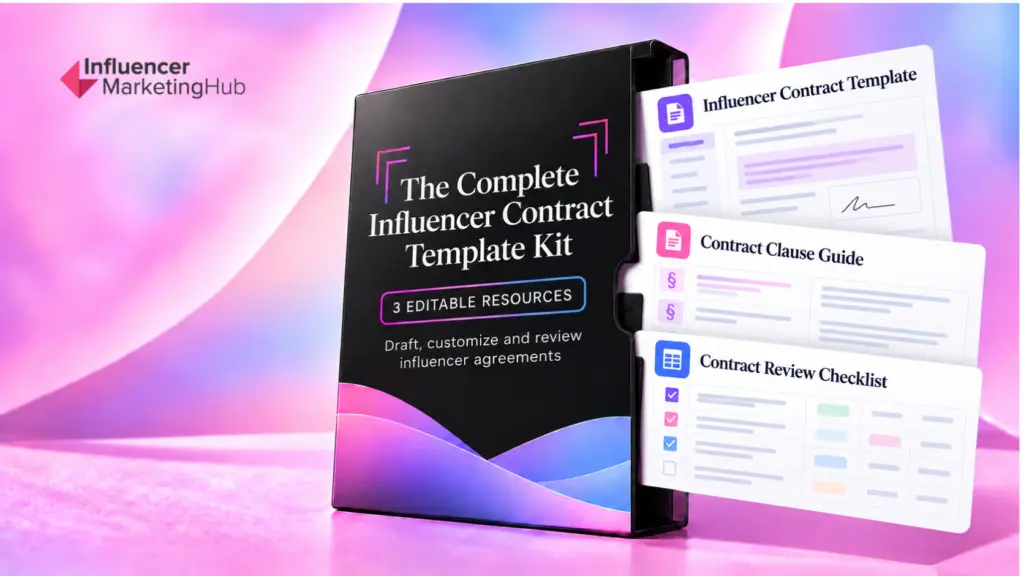
The IMH Influencer Contract Kit provides editable resources you can customize for your own partnerships while helping ensure important clauses aren't overlooked.
Inside the kit, you'll get:
- Influencer Contract Template (Google Docs): A professionally formatted, editable agreement covering the essential clauses found in most influencer marketing contracts.
- Influencer Contract Clause Guide (Google Docs): Alternative clause examples and drafting guidance for payment, content ownership, exclusivity, confidentiality, approvals, FTC compliance, cancellations, and more.
- Contract Review Checklist (Google Sheets): A practical checklist to help verify every agreement before it's shared for review or signature.
Use these resources as a starting point for building agreements that reflect your campaign objectives, business requirements, and applicable laws.
- Why Every Influencer Campaign Needs a Contract
- The Anatomy of an Influencer Contract
- Essential Clauses Every Influencer Contract Should Include
- Additional Clauses That Protect Both Parties
- How to Customize This Influencer Contract Template
- Build Better Partnerships with Better Agreements
- Frequently Asked Questions
Why Every Influencer Campaign Needs a Contract
Influencer marketing is built on collaboration, but even the strongest partnerships can suffer when expectations aren't documented.
Verbal agreements, email threads, or direct messages may seem sufficient for smaller campaigns, yet they often leave important details open to interpretation. Questions around payment timing, content revisions, ownership rights, approval processes, or campaign deadlines can quickly become points of disagreement if they haven't been formally addressed.
A written contract eliminates much of that uncertainty.
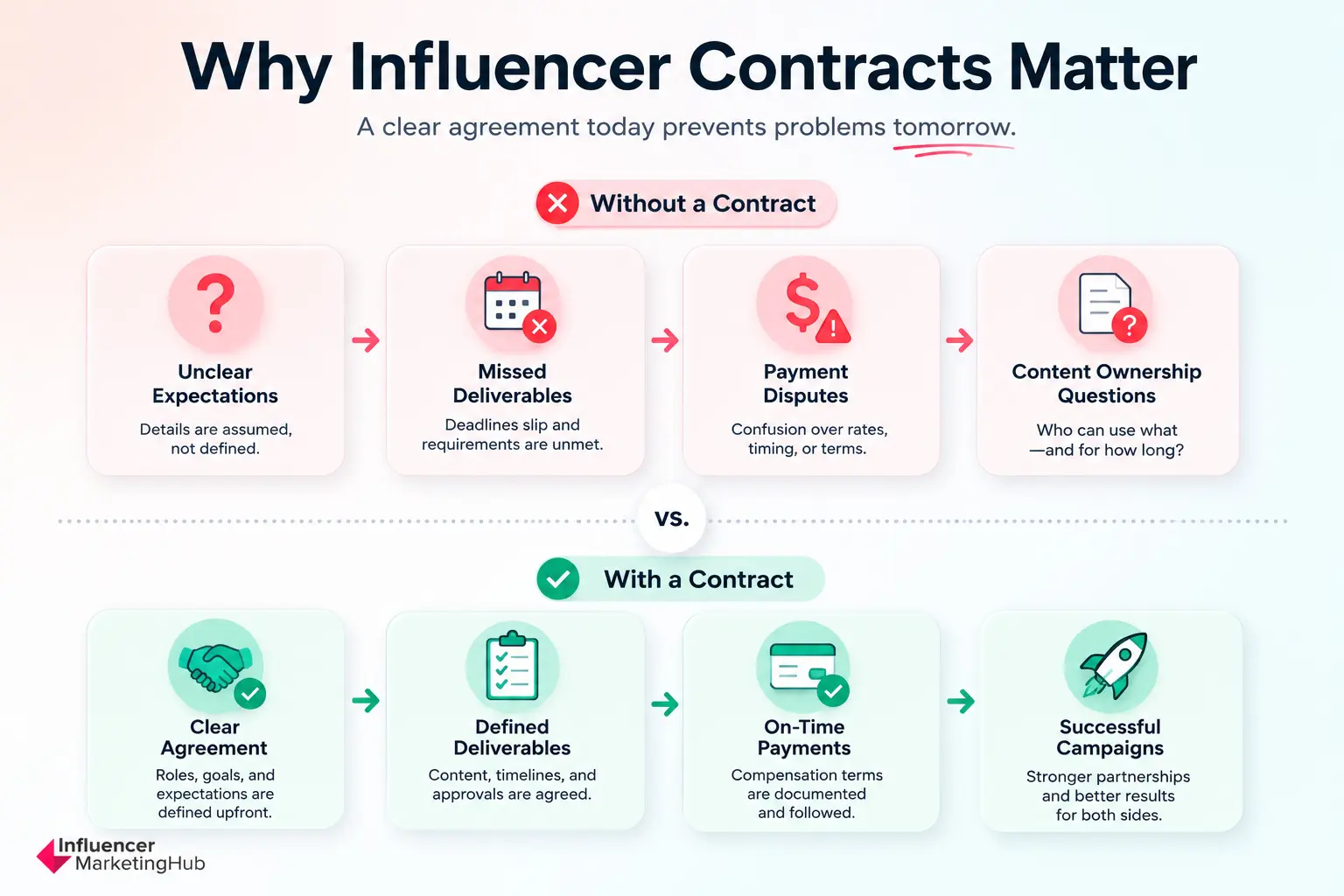
For brands, it provides confidence that agreed deliverables, timelines, disclosure requirements, and usage rights are clearly documented. For creators, it establishes how and when they'll be paid, what content they're expected to produce, and the responsibilities they retain throughout the partnership.
Contracts also encourage better communication before a campaign begins. Drafting an agreement forces both parties to discuss topics that might otherwise be overlooked, helping identify potential issues before they become costly disputes.
Rather than viewing contracts as legal formalities, think of them as project planning tools. A well-written influencer agreement creates alignment, protects both parties, and provides a shared reference point throughout the collaboration.
The Anatomy of an Influencer Contract
Every influencer agreement is unique, but most successful contracts follow a similar structure.
Rather than trying to anticipate every possible scenario, the goal is to define the key terms that govern the partnership. Each section should answer a specific question about how the collaboration will operate, ensuring both parties understand their obligations before any work begins.
A comprehensive influencer contract will typically cover:
- The parties entering the agreement.
- The scope and purpose of the collaboration.
- Campaign deliverables and deadlines.
- Compensation and payment terms.
- Content approval requirements.
- Intellectual property and usage rights.
- Exclusivity and confidentiality obligations.
- FTC and advertising disclosure responsibilities.
- Contract termination conditions.
- Legal provisions such as governing law and force majeure.
Some campaigns may require only a straightforward agreement, while others—particularly long-term ambassador programs or multi-platform campaigns—may benefit from more detailed clauses covering content licensing, performance incentives, or ongoing partnership terms.
The sections throughout this guide explain each clause individually, why it matters, and how you can adapt it to fit different influencer marketing campaigns.
| Contract Section | Purpose | Included in Template |
| Parties to the Agreement | Identifies everyone entering the contract |
✓ |
| Scope of Work |
Defines the collaboration |
✓ |
| Deliverables | Specifies required content and deadlines |
✓ |
| Compensation | Documents payment structure and timing |
✓ |
| Approval Process | Establishes review and revision expectations |
✓ |
| Usage Rights | Defines how content can be used |
✓ |
| Exclusivity | Limits competing partnerships where applicable |
✓ |
| Confidentiality |
Protects non-public information |
✓ |
| FTC Compliance | Clarifies disclosure responsibilities |
✓ |
| Termination |
Explains how the agreement can end |
✓ |
| Legal Provisions | Covers governing law, force majeure, and related clauses |
✓ |
Essential Clauses Every Influencer Contract Should Include
No two influencer agreements are exactly alike, but most successful contracts are built around the same core clauses.
Each clause serves a specific purpose, whether it's defining campaign deliverables, establishing payment terms, or clarifying who owns the content after it's published. Together, these provisions help reduce ambiguity and create a shared understanding before work begins.
The sections below explain the clauses you'll find in most influencer agreements, why they matter, and how they can be adapted to suit different campaigns.
Parties to the Agreement
Every contract should begin by identifying the parties entering into the agreement.
This typically includes the legal name and address of the brand, business, or agency commissioning the work, together with the legal name and address of the influencer or creator. If either party is operating through a registered business entity, that information should also be included.
Clearly identifying the parties ensures there is no uncertainty about who is legally responsible for fulfilling the obligations outlined in the agreement.
- Example wording
This Influencer Marketing Agreement ("Agreement") is entered into on [Date] between [Brand Name], located at [Address], and [Influencer Name], located at [Address], collectively referred to as the "Parties."
Scope of Work
The scope of work defines what the partnership is intended to achieve.
Rather than relying on informal conversations or campaign briefs, use this section to summarize the purpose of the collaboration and the services the influencer has agreed to provide. This gives both parties a shared understanding of the overall campaign before moving into the specific deliverables.
Keep the language broad enough to describe the partnership while leaving the finer details to the deliverables section.
- Example wording
The Influencer agrees to create promotional content featuring [Product or Service] across the agreed social media platforms in accordance with the campaign requirements described in this Agreement.
Deliverables
Deliverables are often the most important part of an influencer contract.
This section should clearly define exactly what content will be produced, where it will be published, and when it is expected to go live. The more specific you are, the less room there is for misunderstanding later.
Depending on the campaign, deliverables might include:
- Instagram posts
- Reels or TikTok videos
- Stories
- YouTube videos
- Live streams
- Blog articles
- User-generated content (UGC)
- Short-form video assets for paid advertising
If the campaign includes multiple pieces of content or detailed creative requirements, consider attaching a separate Schedule of Services rather than including everything within the body of the agreement.
- Example wording
The Influencer agrees to publish one Instagram Reel, three Instagram Stories, and one TikTok video promoting the Campaign during the agreed campaign period. All content must comply with the campaign brief attached as Schedule A.
Campaign Timeline
Every agreement should establish when the partnership begins, when deliverables are due, and when the contract ends.
Clearly defined timelines help both parties coordinate campaign planning, product shipments, content approvals, and publication schedules. They also provide a reference point if deadlines need to be adjusted or extended.
Where appropriate, specify milestone dates rather than relying solely on a final campaign deadline.
- Example wording
Content must be submitted for review by [Date], with final publication scheduled no later than [Date]. This Agreement shall remain in effect until all contractual obligations have been fulfilled unless terminated earlier under the provisions of this Agreement.
Compensation and Payment Terms
Compensation should leave as little room for interpretation as possible.
Whether the influencer is receiving a flat fee, affiliate commission, free products, performance bonuses, or a combination of payment methods, the agreement should explain exactly how compensation will be calculated and when payment will be made.
It is also good practice to include payment deadlines, accepted payment methods, invoicing requirements, and any conditions that must be satisfied before payment is released.
| Compensation Model | Best Used For | Typical Payment Structure |
| Flat Fee | Sponsored campaigns | Fixed payment per campaign or deliverable |
| Product Gifting | Product seeding | Products provided in exchange for consideration, with or without required content |
| Affiliate Commission | Performance campaigns | Percentage or fixed commission per sale |
| Performance Bonus | Conversion campaigns | Additional payment for achieving agreed KPIs |
| Hybrid | Long-term partnerships | Combination of flat fee, products, and commissions |
- Example wording
The Brand agrees to pay the Influencer [Amount] within [Number] days of receiving a valid invoice and completion of the agreed deliverables. Payment shall be made via [Payment Method].
Content Approval Process
Not every campaign requires formal content approval, but when it does, the expectations should be documented.
Specify whether content must be submitted before publication, how many revision rounds are included, who is responsible for providing feedback, and how quickly approvals will be issued.
Clearly defining the approval workflow helps prevent unnecessary delays while allowing both parties to plan their work accordingly.
At the same time, avoid approval processes that unnecessarily restrict a creator's authenticity. Most successful influencer campaigns strike a balance between protecting brand guidelines and allowing creators to communicate naturally with their audiences.
- Example wording
The Influencer shall submit draft content to the Brand at least [Number] business days before publication. The Brand may request up to [Number] reasonable revisions before granting final approval.
Usage Rights and Intellectual Property
Publishing content and owning content are not the same thing.
One of the most common sources of disagreement in influencer marketing involves how brands may use creator content after the campaign has ended. Your contract should clearly define who owns the intellectual property and whether the brand receives a license to reuse the content.
Depending on the agreement, usage rights may include:
- Republishing content on owned social media channels.
- Using content in paid advertising.
- Running Spark Ads or whitelisting campaigns.
- Displaying content on websites or product pages.
- Including content in future marketing materials.
The agreement should also specify how long those rights remain valid, whether additional compensation is required for extended usage, and whether any geographic or platform restrictions apply.
| Usage Right | Typical Use Case |
| Organic Social Media | Brand reposts creator content on owned channels |
| Website & Product Pages | Content appears on landing pages or ecommerce listings |
| Paid Advertising | Content used in social media or display ads |
| Spark Ads / Whitelisting | Brand promotes content through the creator's account |
| Perpetual License | Brand may use content indefinitely, subject to contract terms |
- Example wording
The Influencer retains ownership of all original content created under this Agreement. The Brand is granted a non-exclusive, worldwide license to use the content for [Purpose] for a period of [Time Period], unless otherwise agreed in writing.
Additional Clauses That Protect Both Parties
While the clauses covered so far form the foundation of most influencer agreements, several additional provisions help protect both the brand and the creator if circumstances change during the partnership.
These clauses may not be necessary for every campaign, but they're worth considering—particularly for high-value collaborations, long-term partnerships, or campaigns involving paid media and licensed content.
Exclusivity
Exclusivity clauses prevent influencers from promoting competing products or services during a specified period.
For example, a sportswear brand may require an influencer not to collaborate with another athletic apparel company for 60 days before and after the campaign. Without this protection, competing campaigns could dilute the impact of your marketing investment.
At the same time, exclusivity should be reasonable. Restricting an influencer from working with an entire industry for an extended period may discourage them from accepting the partnership or require additional compensation.
Clearly define:
- Which competitors are included.
- The duration of the exclusivity period.
- Whether the restriction applies before, during, or after the campaign.
- Any exceptions.
Example wording:
During the term of this Agreement and for [Number] days following the final publication date, the Influencer agrees not to promote products or services that directly compete with [Brand Name] without the Brand's prior written consent.
Confidentiality
Campaigns often involve information that should remain private before launch.
Brands may share product announcements, marketing strategies, pricing, campaign briefs, or other commercially sensitive information that should not be disclosed outside the partnership.
A confidentiality clause helps ensure both parties understand which information is considered confidential and how it should be handled during and after the campaign.
If the collaboration involves embargoed product launches or unreleased campaigns, this clause becomes particularly important.
- Example wording
The Influencer agrees to keep all confidential information received from the Brand strictly confidential and not disclose such information to any third party without prior written permission, except where required by law.
FTC Disclosure and Regulatory Compliance
Influencer marketing is subject to advertising and consumer protection regulations in many jurisdictions.
Both the brand and the creator should understand their responsibilities for clearly disclosing sponsored relationships and complying with applicable advertising standards.
Rather than referencing only one country's regulations, consider using broader language that requires compliance with all applicable laws and platform policies.
This is especially useful for campaigns involving creators from different countries.
- Example wording
The Influencer agrees to clearly disclose all sponsored content and comply with all applicable advertising laws, regulations, platform policies, and disclosure requirements throughout the duration of the campaign.
Contract Termination
Not every campaign goes according to plan.
A termination clause explains how either party may end the agreement if obligations are not fulfilled or circumstances change unexpectedly.
Common reasons for termination include:
- Failure to deliver agreed content.
- Breach of contract.
- Failure to meet payment obligations.
- Reputational or brand safety concerns.
- Mutual agreement to end the partnership.
Defining these situations in advance reduces uncertainty and provides a structured process for ending the relationship if necessary.
- Example wording
Either Party may terminate this Agreement by providing written notice if the other Party materially breaches its obligations and fails to remedy the breach within [Number] days of receiving written notice.
Force Majeure
Some events fall outside the control of both parties.
Natural disasters, government restrictions, platform outages, public emergencies, or other unforeseen circumstances may make it impossible to complete the campaign as originally planned.
A force majeure clause acknowledges these situations and explains how contractual obligations will be handled if they occur.
Although these events are uncommon, including this clause can prevent unnecessary disputes if extraordinary circumstances interrupt the collaboration.
- Example wording
Neither Party shall be liable for delays or failure to perform its obligations where such failure results from events beyond its reasonable control, including but not limited to natural disasters, government actions, war, or widespread service disruptions.
Governing Law and Dispute Resolution
If a disagreement cannot be resolved informally, the agreement should explain how disputes will be handled.
Most contracts identify the jurisdiction whose laws govern the agreement and outline whether disputes will be resolved through negotiation, mediation, arbitration, or court proceedings.
For international collaborations, this clause becomes particularly important because the brand and creator may be located in different countries.
To keep the template flexible, use placeholders that can be customized based on the parties involved.
- Example wording
This Agreement shall be governed by the laws of [Jurisdiction]. Any disputes arising under this Agreement shall first be resolved through good-faith negotiation before either Party pursues any further legal remedies.
Additional Terms
No template can anticipate every type of influencer campaign.
Depending on the partnership, you may wish to include additional clauses covering topics such as:
- AI-generated or AI-assisted content.
- Content revision limits.
- Product returns.
- Travel and event expenses.
- Insurance requirements.
- Brand safety or morality provisions.
- Accessibility requirements.
- Performance incentives or bonus payments.
Think of your contract as a framework rather than a fixed document. Start with the essential clauses, then add or modify provisions based on the campaign, platform, and relationship you're building.
📥 Get the Influencer Contract Clause Guide
The template included with this guide covers the clauses found in most influencer agreements, but many campaigns require additional customization.
The IMH Influencer Contract Clause Guide expands on the template with alternative clause wording, optional provisions, and practical drafting guidance to help you adapt agreements for different campaign types, payment models, and content licensing arrangements.
Inside the guide you'll find:
- Alternative payment and compensation clauses.
- Multiple usage rights and licensing options.
- Exclusivity clause variations.
- Confidentiality and non-disclosure examples.
- Approval and revision clauses.
- AI-generated content provisions.
- Morality and brand safety clauses.
- Termination and cancellation language.
- Force majeure examples.
- Practical guidance on when each clause should be used.
Whether you're drafting a simple product seeding agreement or a complex long-term ambassador contract, the Clause Guide helps you tailor your agreement without starting from scratch.
How to Customize This Influencer Contract Template
The template included with this guide is designed to provide a strong starting point, but it should always be tailored to reflect the scope of your campaign, the nature of the partnership, and any legal requirements that apply to your business or jurisdiction.
Before sharing the agreement with a creator, review each section carefully and replace the placeholders with campaign-specific information.
Pay particular attention to:
- Deliverables and publishing deadlines.
- Compensation amounts and payment schedules.
- Content approval timelines.
- Usage rights and licensing periods.
- Exclusivity requirements.
- Confidentiality obligations.
- FTC disclosure requirements.
- Termination conditions.
Not every clause will apply to every campaign. For example, a simple product gifting collaboration may not require an exclusivity provision, while a long-term ambassador agreement may need additional language covering ongoing deliverables, content licensing, and performance incentives.
If you're unsure whether a clause should be included—or if your campaign involves significant budgets, intellectual property, or international partnerships—have the final agreement reviewed by qualified legal counsel before it's signed.
A well-written contract should protect both parties while remaining clear, balanced, and practical to follow throughout the collaboration.
📥 Get the Contract Review Checklist
Before sending any influencer agreement for signature, it's worth taking a few minutes to verify that every important detail has been addressed.
The IMH Contract Review Checklist helps marketing teams review agreements consistently, reducing the risk of missing important clauses or campaign details before work begins.
The checklist covers:
- Party information verification.
- Campaign scope confirmation.
- Deliverables and deadlines.
- Compensation and payment terms.
- Content approval workflow.
- Usage rights and licensing.
- Exclusivity requirements.
- FTC disclosure obligations.
- Confidentiality provisions.
- Termination clauses.
- Legal review status.
- Final approval before signing.
Whether you're reviewing one agreement or managing dozens of influencer partnerships, the checklist provides a repeatable quality assurance process before every contract is finalized.
Build Better Partnerships with Better Agreements
An influencer contract does far more than satisfy a legal requirement—it creates clarity from the very beginning of a partnership.
By documenting expectations around deliverables, payment, approvals, content ownership, and campaign responsibilities, both brands and creators gain a shared understanding of how the collaboration will operate. That clarity helps reduce misunderstandings, improve communication, and establish stronger professional relationships.
While no template can account for every possible campaign, starting with a well-structured agreement makes it significantly easier to customize contracts for different creators, platforms, and marketing objectives.
Use the resources included in this guide as a foundation for your own agreements, adapt them to fit your campaigns, and whenever necessary, seek qualified legal advice before signing. A thoughtful contract doesn't just protect your business—it helps create more successful influencer partnerships.
Frequently Asked Questions
What is an influencer contract?
An influencer contract is a legal agreement between a brand and a creator that defines the terms of their partnership, including deliverables, payment, timelines, content ownership, and other responsibilities.
What should an influencer contract include?
Most influencer agreements include the parties involved, scope of work, campaign deliverables, deadlines, compensation, approval process, usage rights, confidentiality, exclusivity, FTC disclosure requirements, termination clauses, and governing law.
Is an influencer contract legally binding?
Yes. Once signed by both parties, an influencer contract is generally a legally binding agreement, subject to the applicable laws of the chosen jurisdiction.
Who owns influencer content after a campaign?
Content ownership depends on the terms of the agreement. Some contracts allow creators to retain ownership while granting the brand a license to use the content, while others may transfer ownership entirely.
Do product gifting campaigns require contracts?
While not always required, even product seeding campaigns can benefit from a written agreement that outlines expectations, disclosure requirements, content usage rights, and any agreed deliverables.
Should influencer contracts include FTC disclosure requirements?
Yes. Contracts should clearly state that sponsored content must comply with applicable advertising regulations and platform disclosure requirements, including FTC guidelines where relevant.
Can I use a free influencer contract template for every campaign?
A template provides a useful starting point, but every agreement should be customized to reflect the specific campaign, creator, compensation model, and legal requirements involved.
Should an influencer contract be reviewed by a lawyer?
If the agreement involves significant budgets, complex licensing arrangements, international collaborations, or long-term partnerships, it's advisable to have the final contract reviewed by qualified legal counsel before signing.