How much do YouTubers make? The short answer is anywhere from a few dollars per month to millions of dollars per year. Some creators earn less than $100 monthly from ads, while others build full-scale media businesses around YouTube through sponsorships, affiliate marketing, memberships, merchandise, and digital products.
On average, YouTube creators typically earn between $1 and $30 per 1,000 views through ad revenue alone, though the exact amount varies significantly depending on factors like niche, audience location, watch time, and content format.
Finance, business, and software channels often earn far higher rates than entertainment or gaming channels because advertisers are willing to pay more to reach those audiences.
Subscriber count also doesn’t tell the full story anymore. A creator with 50,000 highly engaged subscribers in a high-paying niche can easily out-earn a channel with 500,000 subscribers generating mostly Shorts views or low-RPM traffic.
Geography matters too. Channels with viewers in the US, UK, Canada, and Australia generally earn more than channels whose audiences are concentrated in lower-ad-spend regions.
At the same time, ad revenue is only one piece of the puzzle. Many full-time creators now rely more heavily on sponsorships, affiliate income, online courses, memberships, and creator-led brands than YouTube ads themselves. That’s especially true as YouTube Shorts continues reshaping how creators grow audiences and monetize attention.
Calculate Your YouTube Earnings
To help estimate potential earnings, use our YouTube Earnings Calculator below.
It provides estimated daily, monthly, and yearly revenue projections based on video views and engagement rates. While no calculator can predict exact payouts, it offers a useful benchmark for understanding how YouTube monetization scales across different creator sizes and niches.
In addition, we've collaborated with HypeAuditor to introduce their YouTube Channel Analytics Tool, which offers marketers and channel owners a reliable way of gaining insights over their YouTube revenue.

 Video total
 Most recent video
 Subscribers growth
 Avg engagements per video
 Reactions
 Comments
 Estim. earnings per video
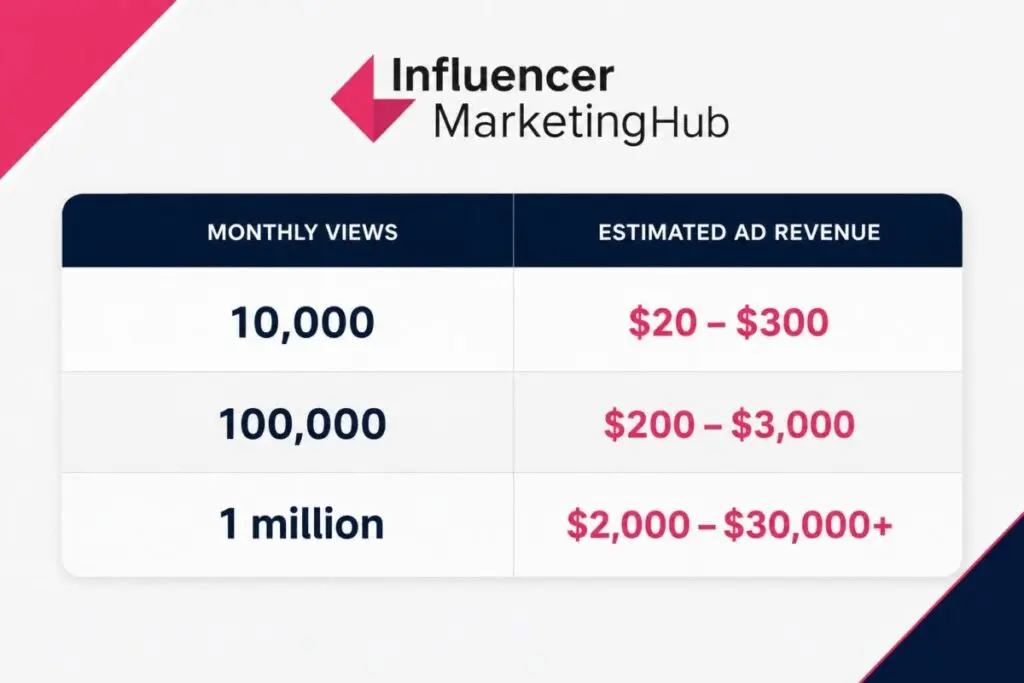
Based on our data, here's an overview of how much money you can make on YouTube based on monthly views:
- How Much Do YouTubers Make Per View??
- How Much Do YouTubers Make at Different Subscriber Levels?
- Why Subscriber Count Is Misleading
- How Much Do YouTubers Make From Shorts?
- How Do YouTubers Earn Money: YouTube Revenue Streams
- Can Small YouTubers Make Money?
- Highest-Paying YouTube Niches
- What the World’s Biggest YouTubers Actually Earn From
- YouTube Income Is Bigger Than Views Alone
- Frequently Asked Questions
How Much Do YouTubers Make Per View??
There’s no fixed amount YouTube pays creators per view. Some YouTubers earn less than $1 per 1,000 views, while others in high-paying niches like finance, software, and business can earn $20 to $40+ per 1,000 views through ad revenue alone.
Most monetized creators typically earn somewhere between $1 and $30 RPM (revenue per mille), which represents how much the creator actually keeps per 1,000 views after YouTube takes its share. YouTube’s standard long-form revenue split gives creators 55% of ad revenue generated on their videos.
How Much Does YouTube Pay Per 1,000 Views?
The table below shows estimated YouTube ad revenue ranges based on RPM levels across different niches and audience types.
| Views | Low RPM ($1-$3) | Average RPM ($5-$10) | High RPM ($20-$30+) |
|---|---|---|---|
| 1,000 views | $1-$3 | $5-$10 | $20-$30+ |
| 10,000 views | $10-$30 | $50-$100 | $200-$300+ |
| 100,000 views | $100-$300 | $500-$1,000 | $2,000-$3,000+ |
| 1 million views | $1,000-$3,000 | $5,000-$10,000 | $20,000-$30,000+ |
The reason earnings vary so dramatically is that YouTube advertising works on an auction system. Advertisers bid more aggressively in industries where customers are more valuable.
That’s why finance, software, AI, and B2B business channels consistently report much higher RPMs than gaming, entertainment, or meme-focused content.
For example, a creator covering investing or business software may earn 5 to 10 times more per 1,000 views than a general entertainment creator with a similar audience size.
How Much Do YouTubers Make Per Million Views?
One million views can generate anywhere from a few thousand dollars to well over $30,000, depending on the niche, audience geography, and content format.
Here’s how estimated earnings often break down across different categories:
| Niche | Estimated Earnings Per Million Views |
|---|---|
| Finance & Investing | $15,000-$40,000+ |
| Software & AI | $10,000-$30,000 |
| Business & Marketing | $8,000-$25,000 |
| Tech & Gadgets | $5,000-$15,000 |
| Education | $4,000-$12,000 |
| Gaming | $2,000-$8,000 |
| Entertainment & Vlogs | $1,500-$5,000 |
Finance-related YouTube channels often generate some of the platform’s highest RPMs because advertisers in banking, investing, insurance, and fintech compete heavily for qualified audiences. Recent creator RPM reports show finance RPMs continuing to rise due to increased advertiser demand. OutlierKit estimates RPM in the finance niche ranges from $10 to $25.
At the other end of the spectrum, entertainment channels may generate massive view counts but lower revenue per viewer because advertisers generally pay less in those categories.
It’s also important to understand that “1 million views” doesn’t automatically mean “viral success” financially.
A creator with 1 million Shorts views may earn substantially less than a creator with 1 million long-form views because Shorts monetization works differently and generally produces lower RPMs. YouTube currently gives Shorts creators 45% of the allocated revenue pool for eligible Shorts content.
Why YouTube Earnings Per View Vary So Much
Several factors influence how much money YouTubers make per view.
Factors Affecting YouTube Earnings
- Audience Geography
Creators with audiences in the US, UK, Canada, and Australia typically earn significantly higher RPMs because advertisers spend more to reach consumers in those regions. Meanwhile, creators whose audiences are concentrated in lower-ad-spend regions often report substantially lower earnings.
- Niche
The niche is one of the biggest revenue drivers on YouTube. Finance, software, AI, business, and B2B topics usually command higher CPMs because those industries have high customer acquisition costs. Gaming and entertainment often generate lower RPMs despite attracting massive audiences.
- Watch Time and Video Length
Long-form videos generally earn more than short videos because creators can place multiple ads throughout longer content. Videos with strong retention and watch time also tend to perform better financially because viewers see more ads.
- Content Format
YouTube Shorts typically generate lower RPMs than long-form content because Shorts revenue comes from a pooled ad-sharing model rather than direct ad placements on individual videos. Shorts RPMs frequently land below traditional long-form RPMs.
- Seasonality
Advertising demand changes throughout the year. RPMs often spike during Q4 as brands increase spending around Black Friday, holiday shopping, and end-of-year campaigns. Finance and tax-related channels also commonly experience RPM increases during the first quarter of the year.
- Monetization Mix
Ad revenue is only one part of the picture. Many creators significantly increase their earnings through sponsorships, affiliate marketing, memberships, digital products, and merchandise. In many cases, those revenue streams eventually become more important than YouTube ads themselves.
How Much Do YouTubers Make at Different Subscriber Levels?
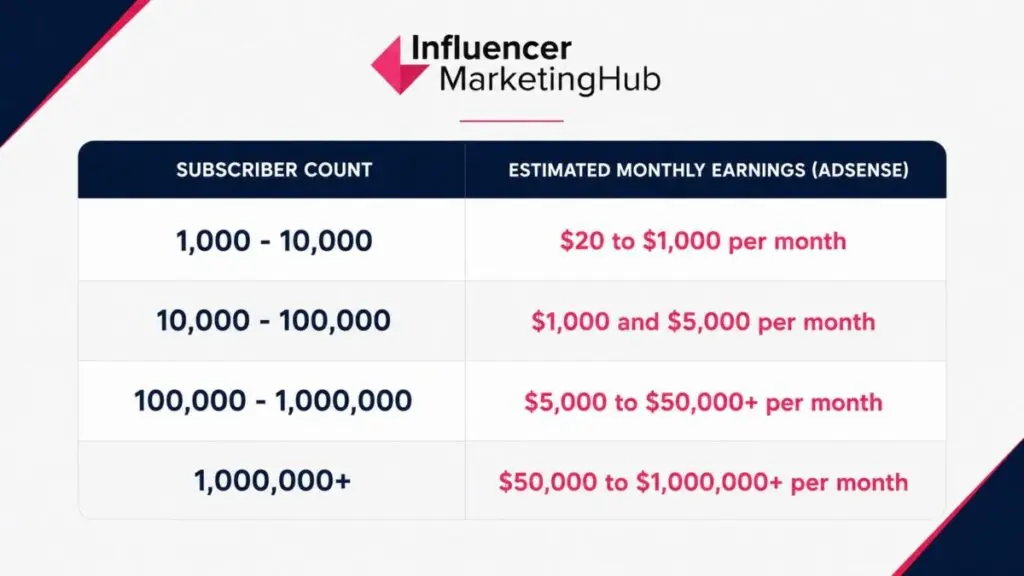
Subscriber count still plays a major role in YouTube earnings, but it’s no longer the most accurate predictor of creator income. Two channels with the same subscriber count can generate dramatically different revenue depending on their niche, audience location, watch time, upload consistency, and monetization strategy.
Still, subscriber milestones remain useful benchmarks because monetization opportunities tend to evolve as channels grow.
| Subscriber Range | Typical Monthly Views | Common Revenue Streams |
|---|---|---|
| 1,000-10,000 | 10K-100K | AdSense, affiliate links |
| 10,000-100,000 | 100K-1M | Sponsorships, memberships |
| 100,000-1 million | 1M-10M | Merch, products, recurring brand deals |
| 1 million+ | 10M+ | Businesses, licensing, commerce, media ventures |
How Much Do YouTubers Make With 1,000 to 10,000 Subscribers?
Most creators begin earning meaningful revenue only after crossing YouTube’s monetization threshold, which currently requires at least 1,000 subscribers and either 4,000 public watch hours in the past 12 months or 10 million Shorts views in the last 90 days.

At this stage, many creators earn anywhere from $20 to $1,000 per month from ads, though earnings vary heavily based on views and niche. Channels with highly targeted audiences in business, software, or finance often monetize more effectively than broad entertainment channels with similar subscriber counts.
Most small creators at this level rely on a mix of:
- AdSense
- affiliate links
- Sponsorship freebies
- Audience donations
- Memberships or Patreon support
For many, affiliate marketing becomes the first meaningful monetization stream before YouTube ads generate substantial income. Product review channels, software tutorials, and educational creators often monetize especially well through affiliate programs because viewers are already searching for purchase advice.
At the same time, income at this stage is highly inconsistent. A single video can temporarily spike revenue, while months with lower uploads or weaker performance may generate little income at all.
How Much Do YouTubers Make With 10,000 to 100,000 Subscribers?
This is typically where creators begin transitioning from hobbyist creators into small creator businesses.
Channels in this range often earn between $1,000 and $5,000 per month, depending on:
- Monthly views
- RPM
- Sponsorship activity
- Upload consistency
- Audience quality
AdSense revenue becomes more stable at this level, but sponsorships increasingly drive earnings growth. Many brands begin working with mid-sized creators because they often deliver stronger engagement rates and more niche-focused audiences than larger celebrity channels.
For example, creators in certain niches like software or personal finance spaces frequently secure sponsorships worth hundreds or thousands of dollars per video, even before reaching 100,000 subscribers.
Many of these partnerships are facilitated through managed creator platforms and influencer marketing agencies that connect brands with niche creators based on audience demographics and performance data rather than subscriber count alone.
This is also the stage where many creators begin diversifying into:
- Memberships
- Paid communities
- Consulting
- Templates
- Digital downloads
- Courses
For creators with highly specialized audiences, those revenue streams often outpace YouTube ads themselves.
How Much Do YouTubers Make With 100,000 to 1 Million Subscribers?
Once creators cross into six-figure subscriber territory, YouTube often becomes a full-scale business rather than simply a content platform.
Channels in this range commonly generate:
- Recurring sponsorship income
- Affiliate revenue
- Merchandise sales
- Memberships
- Digital product revenue
- Speaking or consulting opportunities
AdSense earnings alone can range anywhere from $5,000 per month to well over $50,000, depending on niche and viewership volume.
Creators at this level also gain stronger negotiating power with sponsors. Rather than accepting one-off brand deals, many shift toward long-term ambassadorships or licensing arrangements where brands place high value on trusted audiences.
Many creators in this tier also begin building teams to manage editing, sponsorship outreach, thumbnail design, content creation operations, and channel management.
As channels scale, the business infrastructure behind the creator often scales alongside it.
How Much Do YouTubers Make With Over 1 Million Subscribers?
Channels with more than 1 million subscribers operate very differently from smaller creators. At this level, many YouTubers function more like media companies than solo creators.
While ad revenue alone can generate substantial income, the largest creators rarely depend on YouTube ads as their primary business model anymore. Instead, they monetize through large-scale sponsorships, live events, publishing, creator-owned brands, commerce partnerships, and much more.
Looking at the numbers, YouTubers with over a million subscribers can earn anywhere from $50,000 to well over $1,000,000 per month.
MrBeast is one of the clearest examples of this evolution. While his YouTube channels generate massive ad revenue, much of his business growth now comes from ventures like Feastables and large-scale brand partnerships rather than YouTube ads alone.
This shift reflects a broader trend across the creator economy. The biggest YouTubers increasingly use YouTube as:
- An audience acquisition engine
- A distribution platform
- A marketing channel for owned businesses
...rather than relying solely on platform payouts.
At the same time, reaching 1 million subscribers does not automatically guarantee financial stability. Large audiences still require consistent uploads, operational costs, staff, production budgets, and audience retention.
Many high-level creators reinvest heavily into production, which can significantly reduce profit margins despite large view counts.
Why Subscriber Count Is Misleading
Subscriber count still matters on YouTube, but it’s no longer the best way to estimate how much a creator earns. Nowadays, views, audience quality, watch time, and monetization strategy matter far more than raw subscriber numbers.
That’s why two channels with similar subscriber counts can generate completely different income levels. One creator may earn a few dollars a month, while another with a smaller audience earns thousands through high-RPM content, memberships, sponsorships, or strong viewer retention.
Real creator discussions on Reddit highlight this gap constantly.
In one thread, a creator with 70,000 subscribers reported earning only around $28 per month, while another creator with just 9,000 subscribers said they made roughly $4,500 in a single month after improving long-form video performance and increasing view consistency.
Views Matter More Than Subscribers
YouTube’s recommendation system prioritizes viewer behavior more than subscriber totals. A channel with fewer subscribers but strong click-through rates, watch time, and returning viewers can outperform much larger channels financially.
This is one of the biggest reasons subscriber counts can be misleading.
For example, one creator in the Reddit discussion explained they had:
- Around 9,000 subscribers
- 1 million total views
- Several videos above 50,000 views
…and generated approximately $3,500 to $4,500 monthly through long-form interview content.
Meanwhile, another creator reported:
- 70,000 subscribers
- Only about $28 monthly revenue
The difference wasn’t subscriber size. It was consistent viewership, long-form watch time, monetized traffic, and audience engagement.
A YouTube creator can build a large subscriber base over several years, but if viewers stop returning regularly, monetization often stagnates.
Shorts Changed Subscriber Growth
YouTube Shorts dramatically changed how creators gain subscribers.
Short-form videos can generate millions of views very quickly, allowing channels to gain subscribers at a much faster pace than traditional long-form content. However, Shorts monetization generally produces lower RPMs than long-form videos, which means large subscriber growth does not always translate into equally large earnings.
One Reddit creator explained they built a Shorts-heavy gaming channel that reached:
- nearly 10,000 subscribers
- over 130 million Shorts views
The channel generated roughly $12,000 across the year, but revenue fluctuated heavily month to month, depending on whether videos went viral.
Another creator shared that they combined:
- 3 Shorts per week
- 1 long-form video weekly
and generated roughly $7,000 over 2 months after several videos crossed 1 million views.
These examples reflect a broader trend on YouTube today that:
- Shorts are excellent for discovery and audience growth
- Long-form videos are still generally stronger for monetization stability
That’s why many creators now use Shorts as a funnel into higher-value long-form content rather than relying entirely on short-form revenue.
Master YouTube Shorts
Looking to become a YouTube Shorts pro? Check out our guide that looks at how to Transform Long-Form Content into Shorts for maximum impact.
Audience Quality Impacts Revenue More Than Audience Size
Advertisers care more about audience intent than audience size alone.
A creator covering finance, business, software, investing, or AI niches will often earn significantly more per 1,000 views than a broad entertainment or meme channel because advertisers in those industries pay higher CPMs to reach potential customers.
One creator in the Reddit thread reported earning roughly $400 from just 17,700 monthly views because their audience consisted largely of highly engaged viewers over the age of 65 in a niche with strong retention and advertiser demand.
Another creator reported RPMs of around $12 to $15, which they noted was considered “on the high side.”
Many creators in the Reddit discussions also described earning meaningful income through:
- Memberships
- Patreon
- Consulting
- Merchandise
- Sponsorships
rather than relying purely on YouTube ads.
One creator with roughly 100,000 monthly views explained they had generated:
- About $14,000 in AdSense
- Around $700 monthly from Patreon
- Nearly $2,900 in merch profits
over time through a diversified monetization strategy.
That diversification is becoming increasingly common across YouTube. The platform itself is often just the starting point. The strongest creator businesses monetize audience trust across multiple revenue streams rather than depending entirely on subscriber growth alone.
How Much Do YouTubers Make From Shorts?
YouTubers usually make far less from Shorts than they do from long-form videos. The exact payout varies by audience, country, niche, and engaged views, but creator-reported examples often place Shorts revenue somewhere around a few dollars to a few hundred dollars per 1 million views.
That means Shorts can be powerful for reach, but they are usually weaker as a direct ad-revenue engine.
A Reddit creator who shared a Shorts earnings screenshot reported 100,000+ views, 245 new subscribers, and only $4.92 in estimated revenue. Another creator in the same discussion said a Short with 854,000 views generated about $25, while another reported 7.7 million views and $520 in lifetime earnings from one Short.
That does not mean Shorts are worthless. It means they serve a different role. Shorts are often better for discovery, subscriber growth, and testing content ideas than for predictable monthly income.
How Shorts Monetization Works
YouTube Shorts do not monetize the same way as long-form videos. With long-form content, ads are attached more directly to videos before, during, or after playback. With Shorts, YouTube pools revenue from ads shown between videos in the Shorts Feed, then distributes a share of that pool to eligible creators.
To qualify for full YouTube Partner Program monetization through Shorts, creators need 1,000 subscribers and 10 million valid public Shorts views in the last 90 days, or they can qualify through the long-form route with 1,000 subscribers and 4,000 valid public watch hours in the last 12 months.
YouTube also notes that Shorts views from the Shorts Feed do not count toward the 4,000 public watch hours threshold.
Creators also need to accept the Shorts Monetization Module before they can earn from ads and YouTube Premium in the Shorts Feed. YouTube states that Shorts views earned before accepting the module are not eligible for Shorts ad revenue sharing.
How Much Do YouTube Shorts Pay Per 1,000 Views?
Creator-reported Shorts RPMs vary widely, but many examples fall far below long-form RPMs. In one Reddit discussion, a creator doing tech reviews reported a Shorts RPM of about $0.20 per 1,000 views, which would equal around $20 for 100,000 views.
Another Shorts-focused creator said they averaged 500,000 to 700,000 views per day and earned about $40 to $50 daily from almost exclusively Shorts.
A separate Reddit discussion shows why the range can feel so inconsistent. One creator said 1.3 million Shorts views earned only $15, while another creator with a mostly US audience reported around $0.25 RPM for Shorts and estimated much higher earnings from the same view count.
Others pointed to niche, audience geography, duration, and viewer demographics as likely reasons for the difference.
Between available benchmark data and online discussions, we can safely conclude that YouTube Shorts pays out between $0.01 and $0.06 per 1,000 views.
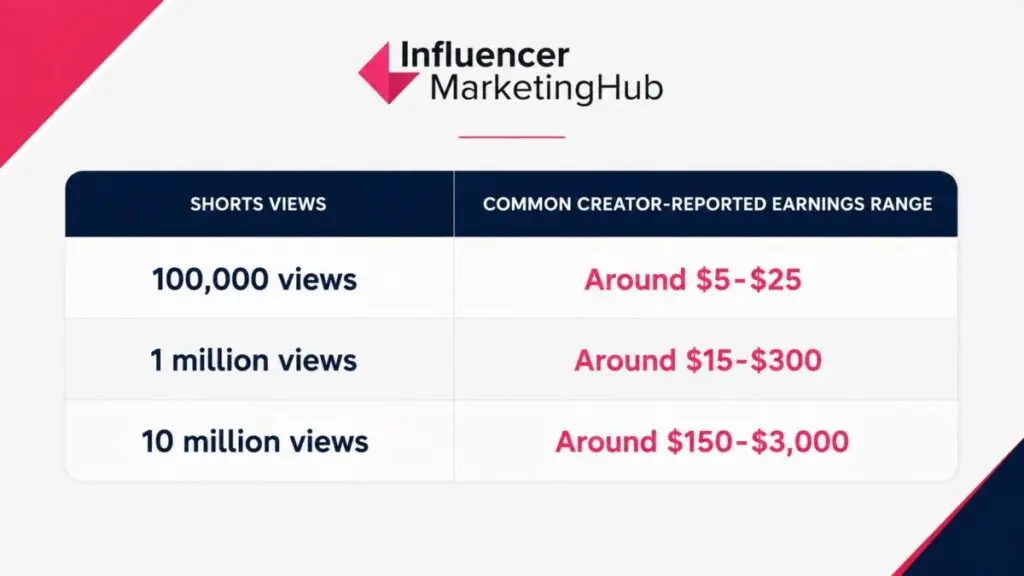
Note: These are not guaranteed payout ranges. They are practical benchmarks based on creator disclosures and should be treated as rough estimates rather than fixed YouTube rates.
How Do YouTubers Earn Money: YouTube Revenue Streams
For many creators, YouTube ad revenue is only one part of the business. While AdSense often provides the first meaningful income stream, many established YouTubers eventually earn more from external streams.
That shift becomes increasingly important as channels grow because ad revenue can fluctuate heavily based on seasonality, upload consistency, and advertiser demand.
Sponsorships and Brand Deals
Sponsorships are one of the largest revenue streams for many YouTubers because brands are paying for audience trust rather than just views.
A creator like Marques Brownlee, for example, earns ad revenue from millions of views, but much of the business value around his channel comes from long-term partnerships with major tech brands, product launches, and sponsored integrations.
For example, Marques is a Ridge creative partner, and he actually has his own line of products.

In a 2024 podcast interview, Marques publicly disclosed that he makes 60% of his income from sponsorships and brand deals, 30% from AdSense, with 10% "other."
In the same video, he says that AdSense was 90% of his income nine years ago.
Tech creators are particularly attractive to advertisers because their audiences are already in a buying mindset when watching reviews or comparisons.
Finance YouTubers operate similarly. Graham Stephan has publicly discussed how sponsorships and affiliate partnerships became major parts of his income alongside YouTube ads.
In high-RPM niches like investing and personal finance, even mid-sized creators can command substantial sponsorship fees because advertisers are competing for high-intent audiences.
This dynamic also appears throughout smaller creator communities. In the Reddit discussions, several creators earning relatively modest AdSense revenue explained that memberships, sponsorships, and external monetization streams helped stabilize their overall income.
Affiliate Marketing
Affiliate marketing is another major revenue source, especially for creators who review products, software, or online tools.
Instead of being paid directly for views, creators earn commissions when viewers purchase products through tracked links placed in video descriptions. This is extremely common in:
- Tech
- Software
- Gaming
- Ecommerce
- Finance
One of the clearest examples is Ali Abdaal. His channel generates millions of views through productivity and creator-focused content, but affiliate partnerships with tools, software platforms, and educational products have become a major part of his broader business ecosystem.

Affiliate monetization works especially well for tutorial-based channels because videos can continue generating commissions long after publication. A software tutorial uploaded today may still generate purchases years later if it continues ranking in YouTube and Google search.
That’s one reason many smaller educational creators can monetize surprisingly well despite not having massive audiences.
Memberships and Fan Support
Many YouTubers also build recurring monthly income directly from their audiences through memberships and fan-supported communities.
Platforms like Patreon and YouTube Memberships allow viewers to pay monthly in exchange for bonus content, livestreams, Discord access, or behind-the-scenes updates.
Podcast creators often rely heavily on this model. Sam Harris, for example, has used paid memberships and subscriber-supported content as a core part of his business strategy for years rather than depending entirely on advertising revenue.

Several Reddit creators also described memberships becoming meaningful secondary income streams. One creator earning roughly $200 to $400 monthly through AdSense explained that memberships added extra recurring income, while another reported generating around $700 monthly through Patreon alongside YouTube revenue and merchandise sales.
Recurring support systems like these are valuable because they are less dependent on algorithms or viral performance.
YouTube creators also earn through YouTube's Super Chats, which allows viewers to pay to have their messages highlighted during a live stream. They also set up a tipping jar for your audience to donate an amount of their choice during live streams.
Another similar feature is Super Stickers. Viewers send animated stickers to show their support during a live stream, and a portion of the revenue goes to the creator.
Merchandise, Products, and Creator Businesses
As audiences become more loyal, many creators expand into products and businesses beyond YouTube itself.
MrBeast is one of the clearest examples. While his channels generate enormous ad revenue, much of the long-term business value now comes from ventures like Feastables and other commercial partnerships. YouTube functions primarily as the audience engine powering those businesses.
A similar evolution happened with Emma Chamberlain, whose media presence helped launch Chamberlain Coffee into a widely recognized ecommerce brand.
@chamberlaincoffee Emma’s love for coffee began in cafes - and now, that passion has come full circle. With the support of @Shopify, we launched Chamberlain Coffee online and built a foundation that’s allowed us to grow thoughtfully, from digital to our very first Chamberlain Coffee cafe. Watch episode 4 of Barista Bootcamp on YouTube.
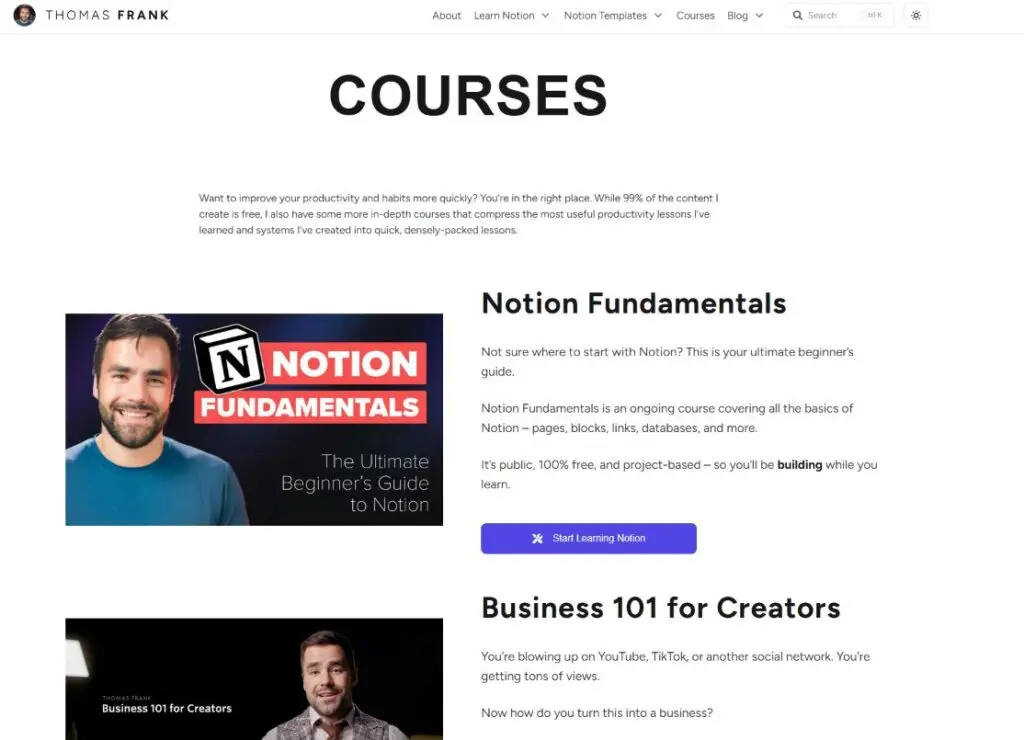
Educational creators frequently follow a similar path. Thomas Frank expanded beyond YouTube ads into courses, templates, productivity systems, and creator tools targeted directly at his audience.
This broader shift reflects how the creator economy has evolved. For many successful YouTubers today, the platform itself is no longer the final business model. Instead, YouTube acts as:
- an audience acquisition channel
- a trust-building platform
- a marketing engine for larger monetization opportunities
That’s why total creator income often extends far beyond what YouTube ads alone can generate.
Can Small YouTubers Make Money?
Yes, but usually not right away.
One of the biggest misconceptions about YouTube is that monetization happens quickly once creators start uploading videos. In reality, many small creators spend months or even years building audiences before generating meaningful income. Some never reach monetization at all.
The Reddit discussions around YouTube earnings showed just how wide the gap can be. Some creators reported earning thousands of dollars within their first year, while others with hundreds of uploads said they still earned little or nothing from the platform.
Most Small Channels Earn Very Little Initially
For most creators, the early stages of YouTube are slow financially.
Several creators in the Reddit discussions described spending years uploading content before earning meaningful revenue.
One gaming creator said they had uploaded more than 400 videos over two and a half years and still had not reached monetization. Another creator with over 900 uploads explained they still earned no revenue because inconsistent posting and mixed content topics prevented the channel from building stable watch hours.
Even creators who successfully reach monetization often start with relatively small payouts. One creator said their first month generated roughly $19 after getting approved for the YouTube Partner Program, while another reported earning around $30 monthly after two years and more than 100 uploads.
That reality is important because many new creators compare themselves to viral success stories without realizing how much variance exists across YouTube.
Some Small Creators Grow Much Faster
At the same time, smaller creators can absolutely build a meaningful income surprisingly quickly when the content, niche, and audience alignment are strong.
One creator said they monetized their gaming channel within 3 months and were earning roughly $4,000 monthly shortly afterward with around 22,000 subscribers. Another creator reported making approximately $5,100 after uploading only 5 restoration videos, thanks to strong watch time and more than 1 million views.
A restoration-focused creator shared especially notable numbers:
- 5 long-form videos
- 1.3 million views
- 407,000 hours of watch time
- roughly $22,000 earned
despite having only around 13,000 subscribers at the time.
Those examples reinforce what we've been saying all along, that views matter more than subscribers, retention matters more than upload volume alone, and that niche and audience quality heavily influence monetization.
Several creators also mentioned finding success after identifying underserved content opportunities rather than competing directly in oversaturated categories.
Consistency and Audience Fit Matter Most
Across the Reddit discussions, the creators who experienced the strongest growth patterns usually shared a few things in common:
- Consistent uploads
- Clear niche positioning
- Long-form content with strong watch time
- Continuous testing of titles and thumbnails
One gaming creator explained they spent hours every week studying competitors, improving hooks, and refining thumbnails before eventually qualifying for monetization within 2 months.
Another creator said growth accelerated once they began analyzing their own data more seriously and focusing on what viewers consistently responded to.
Several creators also emphasized that YouTube rewards clarity. Channels covering too many unrelated topics often struggled to build momentum because viewers and the algorithm had difficulty understanding the audience fit.
At the same time, many smaller creators stressed that enjoying the process mattered just as much as monetization. One lifestyle creator earning roughly $200 to $400 monthly described YouTube as “a paid hobby” rather than a full-time job because the production workload remained significant despite the income.
That balance is important to understand. Even successful smaller channels often require scripting, editing, thumbnails, research, audience management, and consistent publishing before revenue becomes meaningful.
Small Creators Often Monetize Beyond AdSense First
One surprising trend from the discussions was how many smaller creators earned money outside traditional YouTube ads before their AdSense revenue became substantial.
Many respondents to the thread reported using memberships, Patreon, consulting, merchandise, and affiliate links to supplement relatively small ad payouts.
That’s why small YouTubers can absolutely make money, but the most successful creators usually treat YouTube less like a lottery ticket and more like a long-term audience-building platform.
Highest-Paying YouTube Niches
Not all YouTube views are worth the same amount of money.
Industries with high customer acquisition costs, such as investing, SaaS, business software, and online education, typically produce much higher RPMs than broad entertainment content. That’s because advertisers in those categories are willing to spend aggressively to reach viewers who are likely to purchase expensive products or long-term subscriptions.
The table below shows estimated RPM ranges commonly reported across major YouTube niches. These are broad benchmarks rather than guaranteed payouts, but they reflect the monetization patterns repeatedly discussed by creators and industry tracking platforms.
| Niche | Estimated RPM Range | Estimated Earnings Per 1M Views |
|---|---|---|
| Finance & Investing | $15-$40+ | $15,000-$40,000+ |
| Software & AI | $10-$30 | $10,000-$30,000 |
| Business & Marketing | $8-$25 | $8,000-$25,000 |
| Tech Reviews | $5-$15 | $5,000-$15,000 |
| Education | $4-$12 | $4,000-$12,000 |
| Lifestyle & Vlogs | $2-$8 | $2,000-$8,000 |
| Gaming | $2-$6 | $2,000-$6,000 |
| Entertainment & Memes | $1-$5 | $1,000-$5,000 |
| Shorts-Heavy Channels | Below $1-$3 | Hundreds to low thousands |
What the World’s Biggest YouTubers Actually Earn From
The largest YouTubers in the world rarely rely on AdSense alone. The creators below are among the most-followed individual YouTubers in the world as of 2026. Subscriber counts and earnings estimates vary by source and year, but the broader monetization patterns are remarkably consistent across top creators.
| Creator | Estimated Subscribers | Main Monetization Streams | Estimated Annual Earnings |
|---|---|---|---|
| MrBeast | 400M+ | Ads, sponsorships, Feastables, licensing, Amazon deals, merchandise | ~$85M+ annually |
| PewDiePie | 110M+ | Ads, merch, sponsorships, publishing, memberships | Estimated multi-million annual business income |
| Like Nastya | 120M+ | Kids entertainment, licensing, toys, sponsorships, merchandise | Tens of millions annually |
| Vlad and Niki | 140M+ | Ads, licensing, toys, streaming partnerships, merch | Tens of millions annually |
| Ryan Kaji | 40M+ | Toys, licensing, Walmart retail deals, sponsorships | ~$25M+ annually in peak years |
| Dhar Mann | 25M+ | Brand storytelling studio, Facebook monetization, sponsorships | ~$50M+ creator business estimates |
| Mark Rober | 70M+ | Sponsorships, engineering products, educational programs | ~$20M+ creator business estimates |
| Jake Paul | 20M+ | Boxing, sponsorships, gambling/media ventures, YouTube | ~$50M estimated annual creator-related earnings |
| Logan Paul | 24M+ | Prime Hydration, WWE, podcasts, sponsorships | Tens of millions annually |
| Khaby Lame | 10M+ on YouTube | Brand deals, fashion partnerships, licensing, creator campaigns | ~$20M estimated creator earnings |
One of the clearest patterns among top YouTubers is that platform ads eventually become only one part of a much larger business ecosystem.
Large YouTubers also command sponsorship deals that smaller creators cannot access. A single integration on a channel with tens of millions of loyal viewers can generate massive exposure for advertisers.
But perhaps the most important takeaway is that many elite creators no longer treat YouTube itself as the end business model. At the highest level, YouTube increasingly functions as:
- a distribution engine
- an audience acquisition channel
- a trust-building platform
rather than the sole source of creator income.
That’s why subscriber counts alone rarely tell the full financial story. Some creators generate enormous wealth through businesses built around their audiences, while others rely far more heavily on YouTube ad revenue itself.
YouTube Income Is Bigger Than Views Alone
YouTube earnings vary dramatically depending on niche, watch time, audience location, and monetization strategy. While some creators struggle to earn meaningful revenue after years of uploads, others build profitable channels surprisingly quickly by focusing on high-retention content and underserved audiences.
The biggest shift is that successful creators rarely rely on AdSense alone. Top YouTubers like MrBeast and Emma Chamberlain have turned their channels into full-scale businesses powered by sponsorships, products, memberships, ecommerce brands, and affiliate partnerships.
That’s why subscriber count alone rarely tells the full story. On modern YouTube, long-term success depends less on going viral once and more on building an audience that supports multiple revenue streams over time.
Frequently Asked Questions
Who are the highest-earning YouTubers?
Some of the highest-earning YouTubers are Mr Best, Jake Paul, Markiplier, Like Nastya, Unspeakable, and Ryan Kaji.
How do YouTubers get paid?
YouTubers get paid through the platform for their YouTube Partner Program earnings, which are based on ad revenue from their videos. The platform pays every 21st or 26th of the month. For brand deals, YouTubers get paid through external channels.
How much does a YouTuber with a million subscribers make?
A YouTuber with a million subscribers can make anywhere from $10,000 to $100,000 per year. However, this figure is highly dependent on the type of content and engagement rate.
How much does a YouTuber with 100k subscribers make?
The average income for a YouTuber with 100k subscribers can range from $5,000 to $15,000 per month. They can supplement their AdSense earnings with other income streams like affiliate marketing, merchandise sales, and sponsorships.
How much does YouTube pay for 1 million views?
Based on the calculation of $0.018 per view, YouTube can pay around $18,000 for 1 million views. However, this figure is an estimate and may be lower depending on the type of ads, video length, audience demographics, and other factors.
Do YouTubers get paid monthly?
YouTubers get paid on a monthly basis, but they need to hit the $100 threshold to receive their payment. Once they reach the threshold, the platform pays them every 21st or 26th of the month. For example, if you reach $100 in March, you'll receive your payment on April 21st or 26th.
How much does a small YouTuber make?
Small YouTubers, or those with less than 10,000 subscribers, typically make very little from AdSense revenue alone. However, they can still earn money through other streams like sponsorships. Depending on their niche and income streams, it's possible for small YouTubers to make a few hundred to $1,000 per month.
How much do average YouTubers make?
According to our calculations, YouTubers make $0.018 per view or $18 per 1,000 views. At 50,000 views per year, an average YouTuber can potentially make around $900 per year. Zip Recruiter reports that an average YouTube channel in the US makes $68,714 a year.
Does YouTube pay for Shorts?
Youtubers in the YouTube Partner Program get paid for shorts, but the payment is lower than for regular videos. YouTube pays around $0.03 to $0.07 per 1,000 views for Shorts. For a million views, this only equals anywhere from $30 to $70.
How hard is it to monetize YouTube?
You need at least 4,000 watch hours and 1,000 subscribers in the past 12 months to be eligible for monetization on YouTube. While this milestone may seem daunting, it's not impossible to achieve. Just be consistent with posting and build a community around your channel.

![YouTube Money Calculator: Calculate Your YouTube Earnings [Free Calculator]](https://s.influencermarketinghub.com/imaginary/resize?width=400&height=200&type=webp&url=https://influencermarketinghub.com/wp-content/uploads/2016/12/YouTube-Money-Calculator.png)