
Scrolling through competitor TikTok accounts is easy. Turning what you see into a competitive advantage is much harder.
Many brands mistake competitor analysis for collecting viral videos or tracking follower counts. While those observations can be useful, they rarely explain why certain creators consistently outperform others.
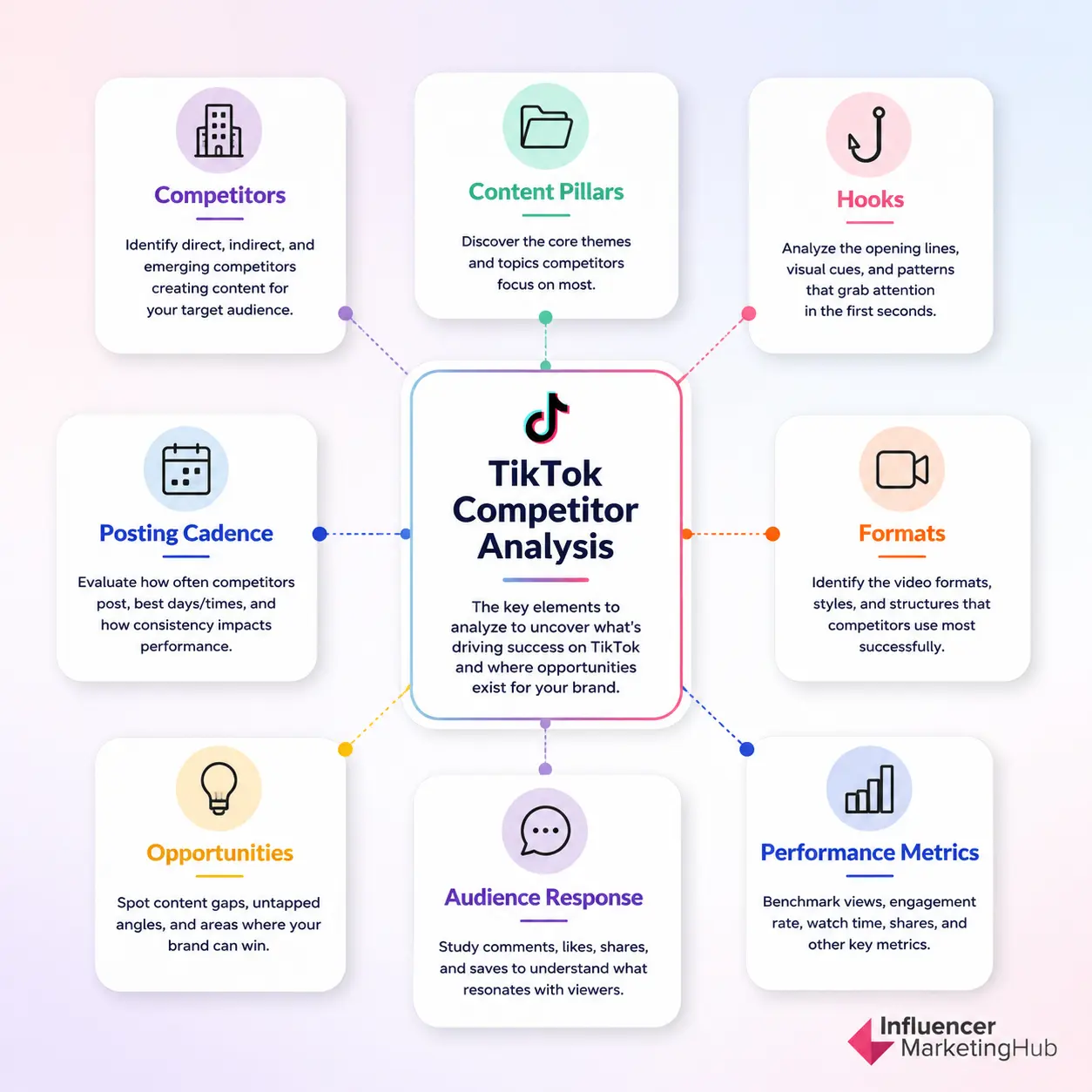
On TikTok, success is driven by a combination of creative decisions (topics, hooks, storytelling, video formats, posting cadence, audience interaction, and timing) that work together to earn distribution.
The importance of identifying those patterns is reflected in broader platform trends. According to Dash Social's TikTok Industry Benchmark Report, brands are now posting a record eight times per week on TikTok, yet those publishing fewer than six times per week achieve 93% higher engagement.
The takeaway is that success depends on understanding what to publish, when to publish it, and why certain content resonates more consistently than others.
This playbook introduces the IMH TikTok Competitor Analysis Framework, a repeatable process for analyzing competitors, benchmarking performance fairly, uncovering creative opportunities, and turning those insights into a practical content strategy.
Instead of asking, "What went viral?", you'll learn how to answer the more valuable question: "What keeps working, and how can we build on it?"
- Why TikTok Competitor Analysis Matters
- Step 1: Define Your Competitive Question
- Step 2: Build the Right Competitor Set
- Step 3: Capture Comparable TikTok Data
- Step 4: Decode Creative Patterns
- Step 5: Benchmark Performance Fairly
- Step 6: Prioritize the Opportunities That Matter Most
- Step 7: Turn Insights Into a 30-Day TikTok Action Plan
- Common TikTok Competitor Analysis Mistakes
- How Often Should You Refresh Your TikTok Competitor Analysis?
- Turn Competitor Analysis Into a Competitive Advantage
- Frequently Asked Questions
Run Your TikTok Competitor Analysis With IMH
Watching competitor videos is easy. Turning those observations into a structured competitive advantage is much harder.
Use our Social Media Competitive Analysis Playbook and Competitor Analysis Spreadsheet to give you both the strategic framework and the practical workspace to benchmark competitors, organize findings, identify winning content patterns, and build a repeatable TikTok strategy.
With these resources, you can:
- Build a balanced TikTok competitor shortlist.
- Track account, content, and creative performance consistently.
- Compare topics, hooks, formats, and posting trends.
- Separate paid and organic performance.
- Prioritize opportunities and build a 30-day testing roadmap.

Why TikTok Competitor Analysis Matters
TikTok has changed what competitive analysis looks like.
On many social platforms, audience size is the strongest predictor of reach. TikTok works differently.
Its recommendation engine evaluates individual pieces of content, allowing creators of almost any size to reach large audiences when a video resonates. As a result, brands can't rely on follower counts alone to understand who's winning or why.
That shift means competitor analysis should focus less on who is publishing content and more on how they're earning attention.
A structured TikTok competitor analysis helps you answer questions such as:
- Which content pillars consistently generate strong engagement?
- Which hooks capture attention in the first few seconds?
- What video formats perform best within your niche?
- How frequently do competitors publish new content?
- Which calls to action encourage meaningful audience participation?
- Where are competitors leaving opportunities your brand can own?
It also helps reduce unnecessary experimentation. Rather than producing content based solely on assumptions, you can benchmark successful patterns, identify gaps in your market, and build future content around proven audience behavior.
The objective is to understand the strategic decisions behind their performance and use those insights to create content that's original, differentiated, and aligned with your own brand.
The IMH TikTok Competitor Analysis Framework
Successful TikTok competitor analysis is about asking better questions.
Many brands collect dozens of examples from competing accounts but struggle to translate those observations into meaningful action. Without a consistent process, it's easy to focus on isolated viral successes, overlook broader creative patterns, or compare accounts that aren't truly comparable.
The IMH TikTok Competitor Analysis Framework provides a repeatable methodology for turning competitor research into strategic decisions. Each stage answers a specific business question and produces one clear outcome before moving to the next.
| Stage | Business Question | Outcome |
| Define | What are we trying to learn? | Clear research objective |
| Discover | Which competitors should we analyze? | Balanced competitor shortlist |
| Capture | What data should we collect? | Structured competitor dataset |
| Decode | What creative patterns are emerging? | Actionable content insights |
| Benchmark | How do we compare performance fairly? | Meaningful performance benchmarks |
| Prioritize | Which opportunities matter most? | Ranked opportunity list |
| Activate | What should we test next? | 30-day TikTok action plan |
Rather than treating competitor analysis as a one-time exercise, the framework helps you build an ongoing intelligence process that evolves alongside your market.
Step 1: Define Your Competitive Question
Before selecting competitors or collecting data, define exactly what you're trying to learn.
This is one of the biggest mistakes brands make when conducting competitor analysis. They begin saving videos, tracking engagement, or comparing follower counts without establishing a clear research objective. The result is a collection of interesting observations that rarely influence future content decisions.
Instead, start with the business question you're trying to answer.
For example, you might want to understand:
- Which content pillars consistently generate the highest engagement?
- Which hooks encourage viewers to stop scrolling?
- How often do successful competitors publish new content?
- Which TikTok Shop content drives the strongest audience response?
- What video formats dominate your niche?
- Which calls to action generate the most comments or shares?
Each objective changes the type of data you'll collect and the insights you'll prioritize later in the process.
Define Success Before You Analyze
A useful competitor analysis begins with a narrow focus rather than a broad review of everything competitors publish.
Ask yourself:
- What decision will this analysis help us make?
- Which business goal are we trying to improve?
- Which competitors are most relevant to that objective?
- What evidence would confirm or challenge our assumptions?
For example, if your objective is to improve video retention, you'll pay closer attention to opening hooks, pacing, video length, and storytelling structure. If your goal is increasing TikTok Shop sales, you'll instead focus on product demonstrations, purchase triggers, creator partnerships, and conversion-focused calls to action.
By defining the question first, every metric and observation you collect later becomes more meaningful.
Outcome: A clearly documented research objective that guides the rest of your competitor analysis.
Step 2: Build the Right Competitor Set
The quality of your insights depends on the quality of the competitors you choose.
Many brands only monitor businesses that sell similar products. While direct competitors are important, they rarely provide the complete picture. Some of the most valuable creative ideas come from brands competing for the same audience rather than the same product category.
Building a balanced competitor set helps you benchmark performance realistically while exposing your team to a wider range of content strategies.
Build a Balanced Competitor Mix
Aim to include four types of competitors:
| Competitor Type | Why They Matter |
| Direct Competitors | Establish realistic performance benchmarks within your market. |
| Category Leaders | Reveal proven creative approaches and operational best practices. |
| Audience Competitors | Show how other brands engage the same audience, even if they sell different products. |
| Emerging Challengers | Highlight new formats, trends, and content strategies before they become mainstream. |
Together, these groups create a more representative view of your competitive landscape than monitoring a single category alone.
Prioritize Comparable Accounts
When selecting competitors, look beyond follower count.
Consider factors such as:
- Target audience
- Product or service category
- Content style
- Posting frequency
- Business model
- Geographic market
- Campaign objectives
A smaller account serving the same audience may offer more useful insights than a much larger brand operating under completely different conditions.
The goal is to build a competitor set that helps you answer the research question you defined in the previous step.
Outcome: A balanced competitor shortlist that provides meaningful, comparable benchmarks for the rest of your analysis.
Step 3: Capture Comparable TikTok Data
Once you've selected your competitors, the next step is collecting data in a way that produces meaningful comparisons.
This is where many competitor analyses lose value. Brands often save a handful of interesting videos or record basic metrics like views and likes, but without a consistent structure, it's difficult to identify patterns across multiple competitors or time periods.
Instead of collecting everything, focus on the data that helps answer your research question. Every competitor should be evaluated using the same fields so you're comparing like with like.
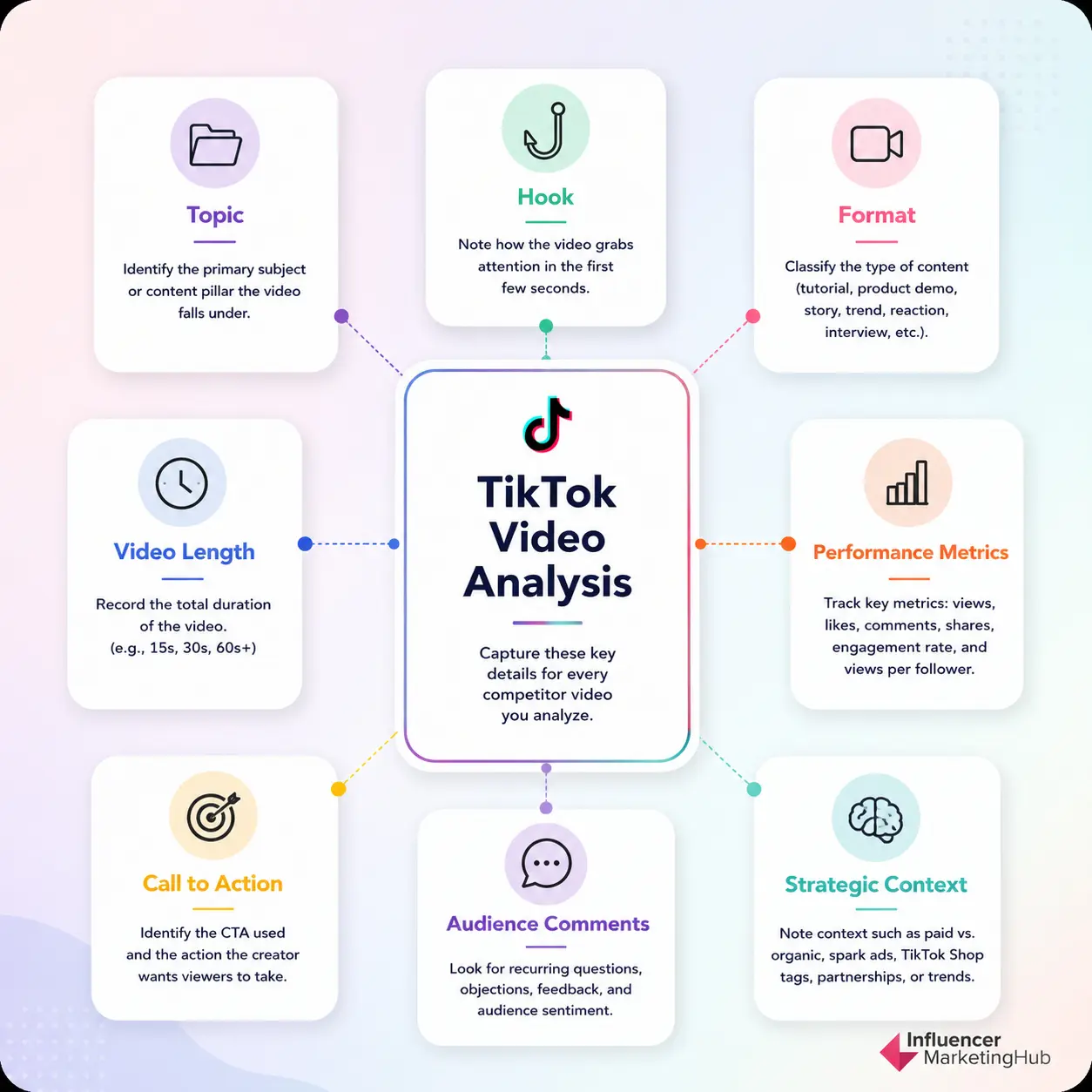
Capture Four Types of Data
A complete TikTok competitor analysis combines quantitative metrics with qualitative observations.
1. Account Metrics
These provide context for interpreting overall performance.
Track:
- Follower count
- Posting frequency
- Primary content niche
- Account age (where relevant)
- Estimated posting consistency
These metrics help explain how active competitors are and establish a baseline for later comparisons.
2. Content Performance Metrics
These reveal how audiences respond to individual videos.
Track:
- Views
- Likes
- Comments
- Shares
- Engagement rate
- Views per follower (where appropriate)
Avoid judging competitors based on a single viral post. Instead, look for consistent performance across multiple videos.
3. Creative Variables
This is where the most valuable competitive intelligence usually comes from.
For every video, record elements such as:
- Primary topic
- Opening hook
- Video format
- Video length
- Creator presence (face-to-camera, voiceover, product-only, etc.)
- Call to action
- Sound or trend used
- Overall production style
Over time, these tags reveal repeatable creative patterns that raw engagement metrics can't explain.
4. Strategic Context
Finally, capture factors that influence performance but aren't reflected in standard metrics.
Examples include:
- Organic or paid-supported content
- Spark Ads (where identifiable)
- TikTok Shop integration
- Brand or creator partnerships
- Recency of publication
- Recurring audience questions or themes in the comments
These contextual details help explain why certain videos outperform others and prevent misleading comparisons.
The objective is to create a consistent dataset that allows meaningful analysis.
Outcome: A structured TikTok dataset that combines performance metrics with creative and strategic context.
📥 Organize Your Analysis With the IMH Competitor Analysis Spreadsheet
Keeping competitor data in screenshots, browser bookmarks, or scattered notes makes it difficult to identify long-term patterns.
The IMH Competitor Analysis Spreadsheet gives you a structured workspace to capture account metrics, benchmark content performance, categorize creative variables, and document strategic observations in one place.
Use it to:
- Build and manage your TikTok competitor shortlist.
- Record standardized performance metrics.
- Tag topics, hooks, formats, and calls to action.
- Separate organic and paid-supported content.
- Compare competitors over time and identify emerging opportunities.
Step 4: Decode Creative Patterns
Collecting data is only half the process. The real value comes from understanding what the data is telling you.
Many marketers stop after identifying high-performing videos. A stronger approach is to look for recurring creative patterns that appear across multiple competitors and over longer periods of time.
Rather than asking, "Which video went viral?", ask:
- Which topics appear repeatedly among top-performing content?
- Which hooks consistently capture attention?
- Which formats are used most often?
- Which calls to action generate the strongest audience response?
When the same creative choices continue appearing across different competitors, they often indicate audience preferences rather than isolated successes.
Build a Creative Coding System
To make comparisons consistent, classify every video using the same creative categories.
| Category | What to Track |
| Topic | The primary subject or content pillar. |
| Hook | How the video captures attention in the opening seconds. |
| Format | Tutorial, product demo, interview, story, trend, reaction, etc. |
| Length | Overall video duration. |
| Call to Action | Follow, comment, shop, visit profile, download, etc. |
| Production Style | UGC, studio-quality, talking head, montage, screen recording, etc. |
Over time, these categories reveal which combinations repeatedly outperform others within your niche.
For example, you may discover that educational product demonstrations consistently outperform trend-based videos, or that question-led hooks generate more comments than direct promotional openings.
These are the kinds of insights that directly influence future content planning.
Mine the Comments for Competitive Intelligence
Comments are often the most overlooked source of competitor research.
They reveal how audiences respond after watching the video and frequently highlight opportunities that engagement metrics alone can't uncover.
Pay attention to recurring:
- Questions
- Objections
- Product comparisons
- Purchase intent
- Requests for follow-up content
- Common language and phrases
For example, CeraVe is currently facing a lawsuit over cancer risk allegations, and it reflects on their socials. Their comment sections are filled with unhappy customers, and that presents an opportunity for a competitor to create content that better serves the audience.
Customers are also unhappy with allegations of animal testing.
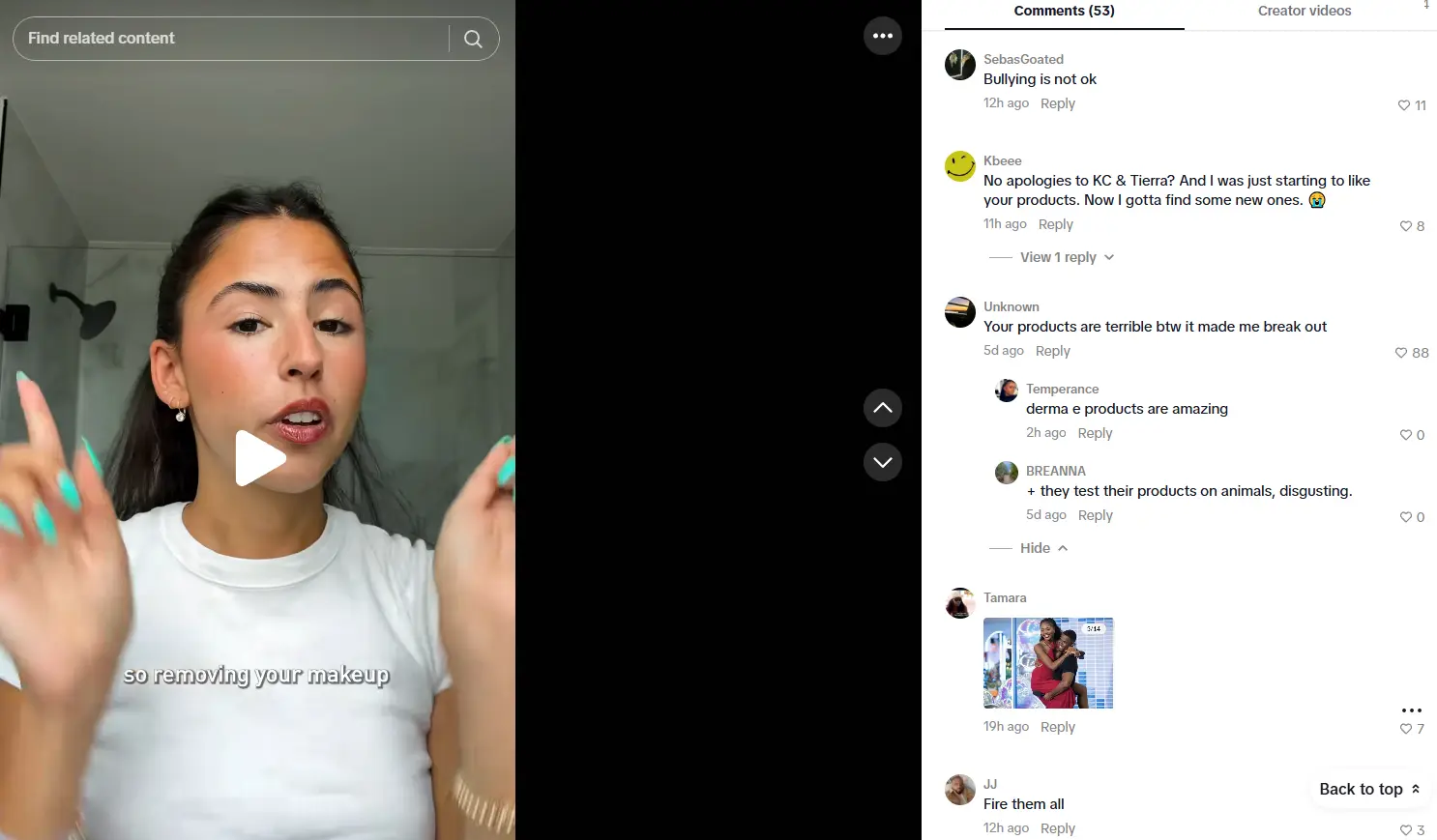
Combined with your creative coding system, comment analysis helps explain not just what performs well, but why audiences respond the way they do.
Outcome: A library of repeatable creative patterns and audience insights that can inform future TikTok content strategy.
Step 5: Benchmark Performance Fairly
Collecting competitor data is valuable, but comparing it incorrectly can lead to poor strategic decisions.
One of the most common mistakes brands make is assuming that the account with the most followers, or the highest view count, is automatically setting the benchmark. On TikTok, where individual videos are distributed based on audience response, those assumptions often fall apart.
A fair benchmark compares competitors within the right context rather than relying on raw numbers alone.
Look Beyond Vanity Metrics
Follower count and total views only tell part of the story.
A video with 200,000 views from an account with 20,000 followers represents a very different level of performance than 200,000 views from a creator with two million followers.
Instead of focusing solely on absolute numbers, compare metrics that better reflect content efficiency and consistency.
| Metric | Why It Matters |
| Median Views | Shows typical content performance without being distorted by one viral hit. |
| Views per Follower | Indicates how efficiently content reaches audiences relative to account size. |
| Engagement Rate | Measures how actively audiences interact with content. |
| Posting Frequency | Provides context around publishing consistency and content volume. |
| Content Mix | Reveals which topics and formats competitors prioritize most often. |
| Hit Rate | Shows how frequently competitors produce above-average performing videos. |
These benchmarks provide a much clearer picture than simply comparing the highest-performing posts.
Separate Organic and Paid Performance
One of the easiest ways to misinterpret competitor performance is treating every successful video as an organic success.
Many brands amplify high-performing TikTok content through Spark Ads or other paid promotion. Those videos can accumulate significantly more views than content distributed organically, making them poor benchmarks for creative performance alone.
Where possible, identify whether content appears to be:
- Fully organic
- Supported by Spark Ads
- Part of a paid creator partnership
- Connected to TikTok Shop campaigns
- Promoted through broader paid media initiatives
Separating paid-supported content from organic performance allows you to evaluate creative effectiveness without confusing media spend with audience demand.
Compare Similar Competitors
Not every competitor belongs in the same benchmark group.
Rather than ranking every account together, compare competitors with similar characteristics, including:
- Audience size
- Industry
- Business model
- Geographic market
- Posting frequency
- Content style
A growing niche brand may offer far more useful benchmarks than an established enterprise account operating under completely different conditions.
The objective is to understand what strong performance looks like for competitors operating under similar circumstances.
Outcome: Fair, context-aware benchmarks that accurately reflect competitor performance rather than inflated vanity metrics.
Step 6: Prioritize the Opportunities That Matter Most
A completed competitor analysis is only valuable if it influences future decisions.
After benchmarking competitors, you'll likely uncover dozens of possible ideas: new topics to explore, different hook styles, emerging formats, content gaps, and untapped audience questions.
Trying to pursue every opportunity at once usually leads to scattered execution. Instead, prioritize the ideas most likely to create meaningful business impact.
Build an Opportunity Matrix
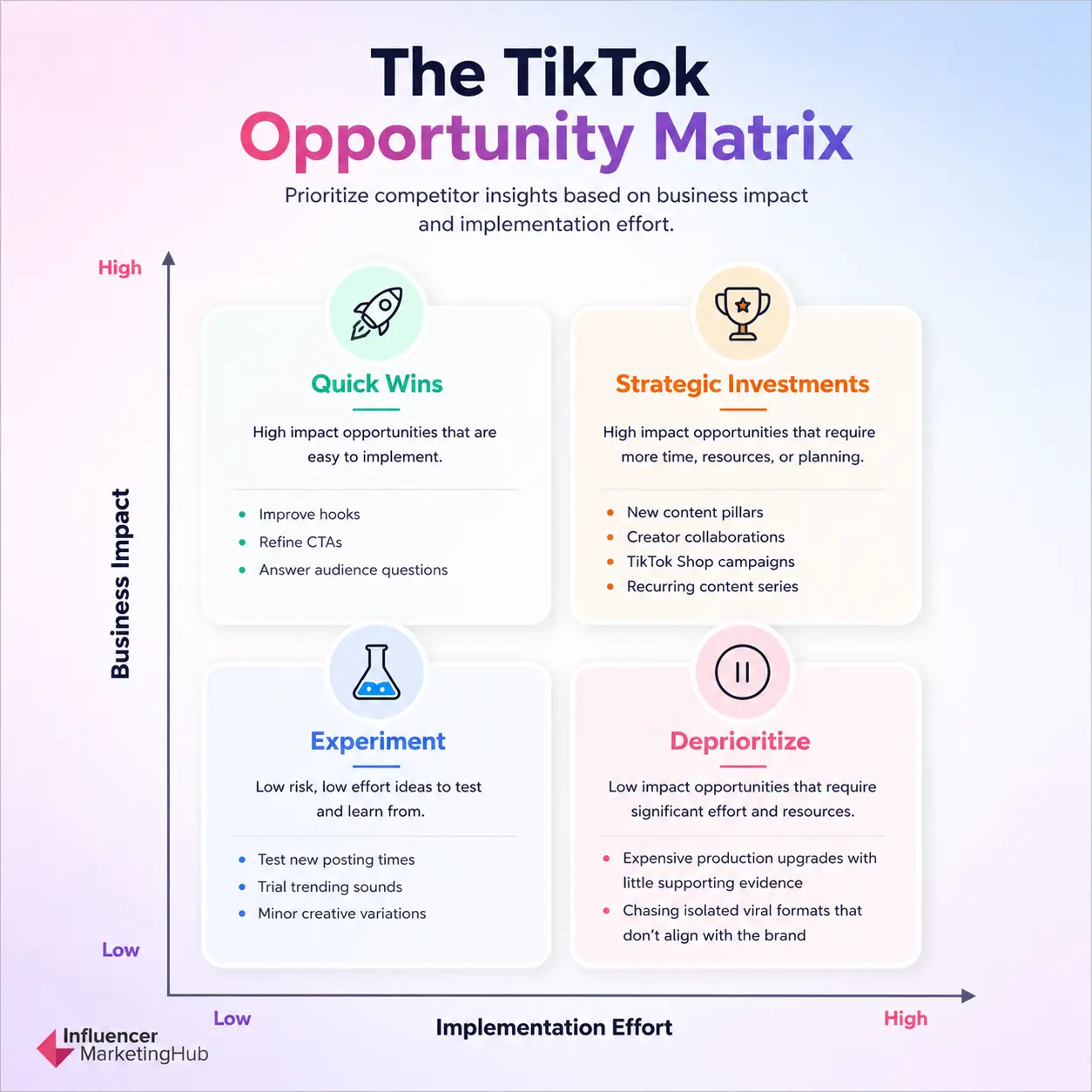
Evaluate every opportunity using four criteria.
| Evaluation Factor | Key Question |
| Audience Demand | Is there clear evidence that audiences respond positively to this topic or format? |
| Brand Fit | Does this opportunity align naturally with our positioning and expertise? |
| Execution Difficulty | How much time, budget, or production effort will it require? |
| Competitive Advantage | Can we realistically create something better or more distinctive? |
The strongest opportunities typically combine high audience demand with a strong brand fit and relatively low implementation effort.
Look for Patterns, Not Individual Ideas
Competitor analysis should reveal repeatable opportunities rather than isolated tactics.
For example, you may discover that several competitors consistently succeed with:
- Educational product demonstrations
- Myth-versus-fact videos
- Customer reaction content
- Behind-the-scenes production footage
- Creator collaborations
- TikTok Shop tutorials
Instead of copying individual videos, identify the underlying pattern driving audience engagement and adapt it to your own brand voice.
Turn Insights Into Priorities
Once opportunities have been evaluated, organize them into clear action categories.
Quick Wins
High-impact ideas that require minimal effort.
Examples:
- Testing stronger opening hooks
- Updating calls to action
- Responding to recurring audience questions
- Refreshing existing content formats
Strategic Initiatives
Longer-term opportunities that require greater investment.
Examples:
- Launching new content pillars
- Building creator partnerships
- Expanding TikTok Shop content
- Developing recurring video series
- Improving production quality
By separating immediate improvements from larger strategic projects, your team can make steady progress while continuing to invest in long-term growth.
Outcome: A prioritized list of TikTok content opportunities ranked by impact, feasibility, and strategic value.
Step 7: Turn Insights Into a 30-Day TikTok Action Plan
Competitor analysis only creates value when it changes what your team does next.
By this stage, you've defined your objective, selected the right competitors, captured comparable data, decoded creative patterns, benchmarked performance fairly, and prioritized the opportunities that matter most.
Now it's time to put those insights into action.
Rather than attempting to overhaul your entire TikTok strategy overnight, focus on building a structured 30-day testing plan. Small, measurable experiments are easier to evaluate, helping you identify what genuinely resonates with your audience before committing to larger strategic changes.
Turn Findings Into Content Experiments
Your competitor analysis should produce clear hypotheses rather than assumptions.
For example, you might discover that:
- Educational videos consistently outperform promotional content.
- Question-led hooks generate more comments than direct product introductions.
- Videos under 30 seconds achieve stronger completion rates.
- Behind-the-scenes content encourages more saves and shares.
- TikTok Shop demonstrations consistently drive higher engagement.
Instead of copying these formats directly, translate them into experiments tailored to your own brand.
| Competitor Insight | Test for Your Brand |
| Educational videos outperform | Launch a weekly educational series. |
| Question-based hooks increase engagement | Test question-led openings across multiple content pillars. |
| Short-form videos dominate | Compare 20-second videos against 45-second versions. |
| Product demonstrations perform well | Introduce more hands-on product walkthroughs. |
| Comment-driven content generates discussion | Create videos answering recurring customer questions. |
Each experiment should have a clearly defined objective and measurable success criteria.
Build a Balanced Testing Calendar
A successful TikTok strategy rarely depends on a single breakthrough video.
Instead, allocate your monthly content across multiple experiment categories.
For example:
- Content Pillars: Test one or two new topics.
- Hooks: Compare different opening styles.
- Formats: Introduce one new video format.
- Calls to Action: Rotate different audience prompts.
- Publishing Schedule: Test alternative posting days or times.
Running multiple controlled experiments simultaneously helps you improve steadily without losing consistency.
Review, Learn, Repeat
Competitor analysis isn't a one-time project.
TikTok trends evolve quickly, new creators emerge regularly, and audience preferences shift over time. The brands that consistently improve treat competitor research as an ongoing feedback loop rather than a quarterly exercise.
At the end of each review cycle, ask:
- Which competitor patterns continued to perform well?
- Which assumptions proved incorrect?
- Which experiments should become permanent?
- What new opportunities have appeared since the last review?
Those answers become the starting point for your next analysis cycle.
Outcome: A structured 30-day testing roadmap that transforms competitor insights into measurable improvements.
Common TikTok Competitor Analysis Mistakes
Even experienced marketing teams can undermine competitor analysis by focusing on the wrong signals or drawing conclusions from incomplete data.
Avoid these common mistakes.
Comparing Follower Counts Instead of Content
Follower count provides context, but it rarely explains why a video succeeds.
Evaluate content quality, audience response, and creative execution before drawing conclusions.
Chasing Individual Viral Videos
One successful video doesn't necessarily represent a repeatable strategy.
Look for patterns that appear consistently across multiple posts and multiple competitors.
Mixing Organic and Paid Performance
Videos supported by Spark Ads or broader paid campaigns shouldn't be benchmarked against purely organic content.
Whenever possible, separate paid-supported content from organic performance.
Ignoring Audience Comments
Comments often reveal what audiences found valuable, confusing, or worth discussing.
Ignoring them means overlooking one of the richest sources of competitive insight available on TikTok.
Tracking Too Many Competitors
Monitoring dozens of accounts often creates more noise than clarity.
A carefully selected group of direct competitors, category leaders, audience competitors, and emerging challengers usually produces stronger insights.
Treating Competitor Analysis as a One-Time Exercise
TikTok evolves too quickly for annual or one-off reviews.
Regular analysis helps you identify changing trends before they become industry standards.
How Often Should You Refresh Your TikTok Competitor Analysis?
The right review cadence depends on how quickly your market changes.
For most brands, a monthly review strikes the best balance between maintaining fresh insights and avoiding unnecessary work.
| Review Frequency | Best For |
| Weekly | Fast-moving campaigns, product launches, seasonal promotions, or rapidly changing industries. |
| Monthly | Ongoing content strategy, campaign planning, and competitor benchmarking. |
| Quarterly | High-level strategic reviews, performance audits, and long-term planning. |
Regardless of frequency, consistency matters more than volume.
A structured monthly review often provides more value than an extensive analysis performed once a year.
Turn Competitor Analysis Into a Competitive Advantage
Watching competitors is easy. Learning from them systematically is what creates a competitive advantage.
The strongest TikTok strategies aren't built by copying viral videos or chasing every emerging trend. They're built by identifying repeatable patterns, benchmarking performance fairly, testing ideas deliberately, and refining your approach over time.
The IMH TikTok Competitor Analysis Framework provides a repeatable process for doing exactly that. Combined with the Social Media Competitive Analysis Playbook and Competitor Analysis Spreadsheet, it gives your team everything needed to move beyond observation and build a data-informed TikTok strategy that improves with every review cycle.
Frequently Asked Questions
What’s the fastest no-cost way to sanity-check a rival’s TikTok performance?
Use native account forensics and layer free TikTok analytics to validate posting cadence, video length bands, and engagement shapes without adding paid software.
Can we estimate what a creator might be earning per post to prioritize outreach?
Treat estimates as directional by running their handle through the TikTok Money Calculator and combining that with your CPM/CPA assumptions and actual conversion telemetry.
Which tool categories help formalize competitor tracking beyond spreadsheets?
Shortlist suites that provide alerting, traffic sources, and keyword overlap; a good starting index of competitor analysis software will map options by capability and budget.
How do we extend TikTok benchmarking to a wider channel view?
Anchor your approach in a cross-channel framework of positioning, messaging, and media mix using this digital marketing competitor analysis reference to avoid social-only tunnel vision.
What’s the best way to vet creators before commissioning UGC?
Screen audience quality, brand safety, and growth velocity with purpose-built influencer analytics tools, then reconcile with your first-party performance briefs.
Which utilities streamline day-to-day TikTok production and optimization?
Consolidate workflow around scheduling, captions, trend discovery, and editing from curated TikTok marketing tools to reduce cycle time between insight and publish.
How do we spot momentum shifts during a launch window?
Instrument pulse checks with real-time social analysis to detect sentiment inflections, hashtag adoption, and SOV drift while creative is still adjustable.
How do we translate insights into a differentiated content roadmap?
Run a structured content gap analysis to isolate under-served topics and map them to TikTok-native formats that your rivals aren’t consistently owning.