

User-generated content is no longer a novelty in influencer marketing. For many brands, it has become a primary output of their influencer efforts, not just a supporting asset.
Evidence of this is the fact that 56% of brands now prioritize generating UGC through influencer campaigns, reflecting a clear shift toward content that feels credible, relatable, and grounded in real customer experiences.
This shift is especially visible on TikTok. Across the platform’s highest-performing content, UGC-style videos account for 55.7% of what resonates, outperforming polished brand creatives in both attention and engagement.
As a result, UGC is no longer just about authenticity. It has become a performance lever.
This article focuses on UGC examples brands can learn from, spotlighting real campaigns that achieved measurable success. Rather than treating UGC as a creative trend, we break down how each campaign was executed, distributed, and optimized, and which strategic choices ultimately drove results. So before we dive in, ask yourself this:
- Are my UGC campaigns generating content but falling short on performance?
- Am I testing creators and formats without clarity on what actually moves conversions?
The case studies ahead aim to answer those questions by showing what worked and why.
- 1. How Peelz Citrus Used UGC to Reposition an Entire Category
- 2. How Amazon Music Used UGC to Scale a Time-Bound Offer Fast
- 3. How a Skincare Brand Increased ROAS by 50% While Scaling Spend With UGC
- 4. How Azha Perfumes Used UGC to Translate Scent Into Social Discovery
- 5. How e.l.f. Cosmetics Turned Creator Authority Into a Record-Breaking Launch
- 6. How Emotion-Led UGC Helped Sell Out the Nike Melbourne Marathon Early
- What These High-Impact UGC Examples Have in Common?
- How Brands Can Apply These UGC Strategies
- UGC That Performs Is Rarely Accidental
- Frequently Asked Questions
1. How Peelz Citrus Used UGC to Reposition an Entire Category
Peelz Citrus operates in a category that rarely sparks cultural excitement. Mandarins are typically positioned as wholesome, kid-friendly snacks, leaving little room for differentiation. Peelz wanted to challenge that perception and reposition itself as a bold, modern snack for adults.
To do that, the brand partnered with The Shelf to use creator-led UGC as a brand repositioning tool rather than a simple awareness tactic.
UGC Campaign Strategy and Execution
The campaign ran across TikTok and Instagram, with a strong emphasis on short-form video. The Shelf activated 28 creators across micro to mega tiers, prioritizing creative fit and personality over follower count.
Content was organized around three creative lanes that encouraged humor, bold visuals, and experimentation, giving creators structure without restricting authenticity.
Notable creators included @akana_official, whose humor-driven TikTok videos became the campaign’s top performers, @360val with high-energy transitions and vibrant visuals, and @itskimtish, whose cinematic Instagram Reel reached 1.2 million organic views.
Reels, TikToks, and Stories formed the core of the content mix, ensuring assets blended naturally into native feeds.
@akana_official ✨School Lunch with @peelzcitrus ✨ Click the link in my bio to find them near you! ✨ #peelzpartner #peelzcitrus #parody #comedy
Distribution and Performance
Organic content was used to identify winning creative before scaling through allowlisting and Meta paid amplification. The campaign delivered 41.1 million impressions, exceeding its goal by 59%, and generated 1.7 million engagements.
Video was the clear driver, with 69% of video assets outperforming impression benchmarks. Instagram Stories emerged as a standout format, delivering engagement rates 2.5 times higher than the benchmark.
Paid results reinforced the creative strategy. Allowlisted ads achieved a blended engagement rate of 4.58% at a $1.84 CPM, nearly double typical paid media norms.
Key Takeaway From This Campaign
This UGC example worked because Peelz treated creator content as a vehicle for cultural relevance. By leaning into personality, humor, and bold storytelling, the brand reshaped how audiences perceived an everyday product and turned UGC into a category-level differentiator.
2. How Amazon Music Used UGC to Scale a Time-Bound Offer Fast
Amazon Music regularly competes in a crowded streaming market where trial offers are common, and attention windows are short. For a New Year push, the brand needed rapid visibility and sustained engagement around a three-month trial offer, with a clear focus on reach and awareness rather than long-term brand storytelling.
To execute at speed, Amazon Music partnered with Clicks Talent to deliver creator-led UGC across multiple platforms.
UGC Campaign Strategy and Execution
The campaign ran for one month across TikTok, Instagram, and YouTube, activating 23 influencers to produce approximately 90 short-form and video-first assets. Creators were briefed to promote the New Year trial through a link-in-bio mechanic, with content designed to feel native to each platform rather than overtly promotional.
Instead of relying on a small number of high-production ads, the campaign emphasized volume and format diversity. Influencers adapted the offer into their usual content styles, allowing Amazon Music to appear repeatedly across feeds without creative fatigue.
This approach prioritized speed, consistency, and repetition during a time-sensitive promotional window.
@ashleykeno17 I love this mix so much. Get Amazon Music totally FREE for 3 MONTHS with the link in my bio! 🎵 #amazonmusicpartner #ad #music #teamclicks
Distribution and Performance
The campaign delivered large-scale visibility in a short period, generating reported reach in excess of 136 million and nearly 150 million views across platforms. Engagement metrics exceeded internal benchmarks, indicating strong audience interaction relative to expectations for brand promo content.
From a paid efficiency standpoint, the campaign reported an exceptionally low CPM of $0.20, highlighting the cost advantages of using creator-led UGC to distribute promotional messaging at scale. Performance was driven primarily by short-form video, with TikTok and Instagram acting as the primary engines of reach.
Key Takeaway From This Campaign
This UGC example shows how creator content can be used as a rapid distribution system for time-bound offers. By prioritizing volume, platform-native execution, and creator adaptability, Amazon Music was able to scale awareness efficiently without relying on heavy production or long lead times.
3. How a Skincare Brand Increased ROAS by 50% While Scaling Spend With UGC
In early 2024, a direct-to-consumer skincare brand wanted to scale paid media but faced a familiar constraint. While the brand had invested heavily in professional photoshoots and high-end video assets, account-wide ROAS was underperforming.
This limited confidence in increasing budgets and made scaling inefficient. The brand partnered with Brighter Click to unlock growth without sacrificing profitability.
UGC Campaign Strategy and Execution
Rather than producing more polished brand creative, Brighter Click shifted the account’s creative center of gravity toward UGC. The team built a 90-day testing roadmap grounded in audience and competitor research, using UGC as the primary vehicle for experimentation.
Creators were selected based on alignment with the brand’s audience and storytelling style, combining existing creator relationships with newly sourced talent.
Each brief included multiple hooks and calls to action to enable structured testing. Assets were launched iteratively, with performance feedback informing revisions, rotations, and scaling decisions.
The focus was not volume for its own sake, but repeatable creative learning. UGC was treated as a testing system that could quickly surface winning messages and formats across placements.
@tamlynpinzon reasons why i smell good: @Ua Body Hawaii tysm ua ohana!! use code tamlyn for 15% off 🫶🏼 #uaaffiliate #uahawaii #uaohana
Distribution and Performance
The shift to UGC delivered measurable improvements across the account. Overall ROAS increased by more than 50%, while monthly ad spend scaled by over 3x without eroding profitability. Revenue increased by 108% during the period.
From a creative perspective, the top-performing UGC asset outpaced the account’s average ROAS by 16%, outperforming static ads, professionally produced videos, and dynamic product ads.
This validated UGC as the primary performance driver, not a supporting format.
Key Takeaway From This Campaign
This UGC example demonstrates how authentic, audience-first creative can unlock scale. By replacing high-production assets with structured UGC testing, the brand improved efficiency first, then used that confidence to grow spend sustainably.
4. How Azha Perfumes Used UGC to Translate Scent Into Social Discovery
Azha Perfumes operates in one of the hardest categories to market on social media. Fragrance is experiential by nature, yet social platforms remove the ability to smell, test, or sample. Traditional ads often fail to bridge that gap, especially with Gen Z and Millennial audiences who value authenticity over polish.
To break through, Azha partnered with House of Marketers to introduce the brand through creator-led storytelling rather than product-led promotion.
UGC Campaign Strategy and Execution
The campaign focused on translating scent into emotion and everyday experience. Instead of scripted messaging, creators were encouraged to share genuine reactions, personal associations, and lifestyle-driven narratives that connected fragrance with mood, memory, and identity.
Content ran across TikTok, Instagram, and YouTube, with TikTok emerging as the primary discovery channel. House of Marketers prioritized platform-native formats and personality-led delivery, selecting fragrance and lifestyle creators whose audiences already engaged with sensory storytelling.
Paid amplification was used selectively, scaling only the strongest organic content to preserve trust and credibility.
Over a 10-month period, 90 creator-led assets were published, blending reviews, reactions, and lifestyle moments rather than overt product demonstrations.
Distribution and Performance
The campaign generated more than 3.3 million video views globally, with TikTok driving 78% of total momentum. Engagement averaged 6.1%, outperforming the fragrance industry benchmark of 3.8% by approximately 60%.
Performance concentrated around creator quality rather than scale alone. More than 75% of total views came from top-performing creators, while mid-tier creators consistently delivered the most reliable engagement, reinforcing the value of scalable creator partnerships.
Key Takeaway From This Campaign
This UGC example shows how creator storytelling can solve category-level limitations. By focusing on emotion and personal experience instead of product claims, Azha Perfumes made fragrance discoverable on social and turned UGC into a powerful trust-building and awareness engine.
5. How e.l.f. Cosmetics Turned Creator Authority Into a Record-Breaking Launch
e.l.f. Cosmetics faced a rare but risky challenge: how to recreate momentum after a viral sell-out. One year earlier, the e.l.f. x Mikayla Marriage Material Lip Duo had sold out in minutes. For the August 2024 anniversary restock, the brand set an even higher bar, aiming to sell significantly more units without relying on a once-in-a-lifetime event.
To do this, e.l.f. partnered with Viral Nation to design a social-first launch built entirely around creator trust.
UGC Campaign Strategy and Execution
The campaign centered on a bold idea: appointing Mikayla Nogueira as “CEO for a Day.” Rather than positioning Mikayla as a spokesperson, the brand elevated her role to leadership, aligning with her credibility and deep connection to e.l.f.’s community.
Launch content unfolded like a storyline. A humorous TikTok skit featured Mikayla calling e.l.f.’s CEO to advocate for the product’s return, followed by step-by-step application videos, creator-style reactions, and an Instagram carousel framed as a “Letter from the CEO.”
Additional on-trend formats and earned media moments amplified reach while keeping the content unmistakably creator-led.
@mikaylanogueira new CEO of @e.l.f. Cosmetics coming in hot 👀 BRB… ADDING CEO TO MY RESUME 👀👀👀 #ceo #makeup #beauty #elf #elfxmikayla #elfceo
Distribution and Performance
The results were immediate and measurable. Fifty thousand units sold out in 10 hours, pushing the product to the number one spot on TikTok Shop in the US across all categories. The campaign generated $857K in earned media value and delivered 18.9 million views within 24 hours from just 10 posts.
Key Takeaway From This Campaign
This UGC example worked because it transferred authority, not just attention. By empowering a trusted creator to lead the narrative, e.l.f. transformed a restock into a cultural event. The campaign shows how creator-led storytelling, when rooted in genuine community trust, can drive both massive demand and direct commerce outcomes at speed.
6. How Emotion-Led UGC Helped Sell Out the Nike Melbourne Marathon Early
The Nike Melbourne Marathon has long had strong demand for its flagship races. The bigger challenge was driving registrations for shorter distances like the 10 km, 5 km, and 3 km races, where the value proposition is less obvious. To unlock demand across the full event lineup, the organizers worked with Sticki, alongside sister agency DataSauce and event partner IMG.
UGC Campaign Strategy and Execution
The campaign centered on participant-led storytelling rather than traditional event promotion. Instead of focusing on distance or logistics, UGC creators were briefed to share the emotions behind training, anticipation, and crossing the iconic MCG finish line. Content leaned heavily into IG Reels and TikToks, emphasizing how the event feels rather than what it includes.
Messaging was paced deliberately across the funnel. Early-stage content focused on hype and community momentum, while later phases introduced urgency-driven angles as capacity filled up.
Importantly, UGC supported both awareness and conversion objectives, challenging the assumption that emotional storytelling is only effective at the top of the funnel.
@melbournemarathonfest Be part of history at the LARGEST Nike Melbourne Marathon Festival ever! Only limited spots remain for the 5km and 3km. #fyp #nikemelbournemarathon
Distribution and Performance
The results were decisive. For the first time, all five races sold out, with more than 40,000 tickets purchased. Both the full and half marathon events reached capacity 14 weeks before race day, with an additional 17.5K runners joining the waitlist.
Paid performance on Meta achieved a 14.92 ROAS, nearly three times the original target, while CPA averaged $2.98. Year over year, sign-ups increased by 66% at a 28% lower cost, and early-stage content accounted for 57.7% of total Meta-attributed revenue.
Key Takeaway From This Campaign
This UGC example shows how emotion-driven storytelling can directly influence conversions. By centering real participant experiences and pacing creative across campaign phases, Sticki turned community energy into measurable demand, proving that UGC can sell experiences, not just products.
What These High-Impact UGC Examples Have in Common?
At first glance, these UGC campaigns look very different. They span beauty, food, music, fragrance, events, and sport. They use different creators, platforms, budgets, and timelines.
Yet when you strip away the surface details, the same structural decisions appear again and again. These campaigns did not win because UGC was used. They won because UGC was used deliberately.
First, UGC Was Treated As a Strategic System, Not a Creative Deliverable.
None of these campaigns relied on a single hero asset or one-off creator post. Each one was built to generate multiple pieces of content, test audience response, and then double down on what worked.
Whether the goal was repositioning a brand, scaling paid media, or selling out tickets, UGC functioned as a learning engine that improved performance over time.
Second, Creator Credibility Mattered More Than Creator Reach.
Across the case studies, creators were selected for fit, trust, and storytelling ability rather than follower count alone. Mid-tier creators repeatedly delivered stronger and more consistent engagement than larger accounts.
When creators felt believable in the context of the product or experience, audiences responded. When they did not, scale alone could not compensate.
This pattern aligns with industry research from CreatorIQ, which shows that follower count is no longer a primary decision factor for brands. In its latest report, CreatorIQ found that follower count ranked last among creator selection criteria, while brand suitability emerged as the top priority.
Factors like content performance, creator fit, and brand affinity now outweigh raw audience size, reflecting a broader shift toward performance- and safety-driven influencer programs.
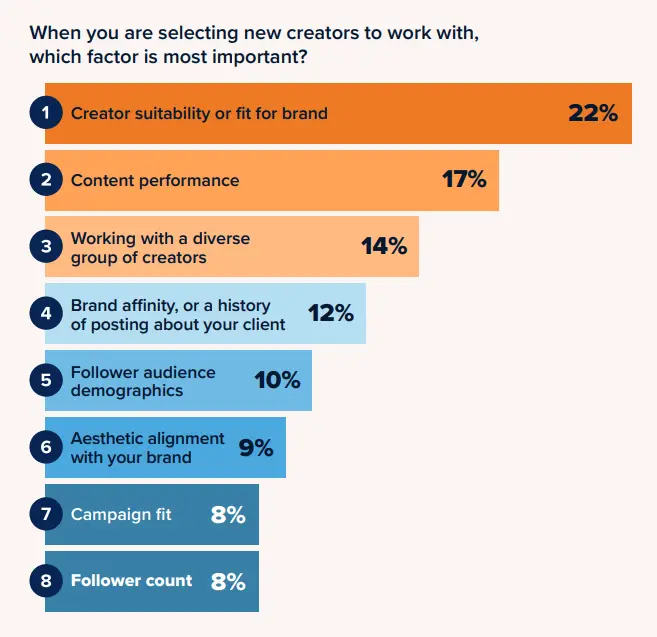
The campaigns highlighted in this article mirror that shift. Their success was driven by creators who felt credible, culturally aligned, and trusted by their audiences, proving that in modern UGC campaigns, credibility consistently outperforms reach.
Third, Storytelling Consistently Outperformed Promotion.
High-performing content focused on emotion, humor, identity, or lived experience instead of product features. Fragrance became memory. Fruit became culture. A race became belonging.
Even time-bound offers were framed through the creator's perspective rather than brand messaging. These campaigns understood that UGC works best when it mirrors how people already communicate on social platforms.
Fourth, Platform-Native Execution Was Non-Negotiable.
Short-form video dominated results across TikTok, YouTube, Instagram Reels, and Stories. Content that blended seamlessly into feeds consistently outperformed polished brand creative, not because it was less produced, but because it matched how people actually consume content on each platform.
High-performing campaigns did not reuse the same video everywhere. Instead, they adapted pacing, structure, and emphasis per channel. For example:
- TikTok rewarded faster hooks and informal delivery
- Reels benefited from clearer captions and visual framing
- Shorts performed best with direct, linear storytelling
These adjustments allowed algorithms to surface the right creative to the right audience.
Across the case studies, UGC succeeded when it respected platform context. When creators and brands treated each channel as its own environment rather than a distribution outlet, content earned attention instead of interrupting it.
Finally, Amplification Followed Proof, Not Assumptions.
Paid media was used to scale what audiences had already validated organically. Allowlisting and selective boosting extended reach without stripping creators of credibility. This sequence, test first, then scale, showed up in every campaign that achieved efficiency alongside growth.
Taken together, these patterns show that high-impact UGC is rarely accidental. It is engineered through creator fit, iterative testing, emotional storytelling, and disciplined distribution. When those elements align, UGC stops being content and starts becoming a growth mechanism.
How Brands Can Apply These UGC Strategies
These UGC examples show that strong results come from structure, not spontaneity. For brands looking to replicate this performance, the priority should be how UGC is planned, tested, and scaled across channels.
UGC Campaign Execution Framework
Start by Defining Outcomes, Not Deliverables
Rather than commissioning a fixed number of creator posts, brands should be clear about what success looks like. Whether the goal is repositioning, trial, registrations, or direct sales, UGC performs best when creators understand the outcome they are meant to influence, not just the content they are expected to produce.
Build Campaigns Around Iteration, Not Perfection
High-impact UGC campaigns assume that some creatives will underperform. Brands should plan for multiple hooks, formats, and creator perspectives from the outset, then use early performance data to guide optimization. This allows winning messages to emerge naturally and scale with confidence.
Select Creators for Fit and Credibility, Not Reach Alone
Brand suitability consistently outperforms follower count. Creators who feel authentic in the context of the product or experience generate stronger engagement and trust. This approach also reduces brand risk while improving consistency across campaigns.
Adapt Content to Each Platform’s Behavior
Brands should avoid distributing identical assets across channels. TikTok, Instagram Reels, Stories, and Shorts reward different pacing and presentation. Adjusting creative per platform helps content feel native and increases the likelihood of sustained performance.
Scale What Audiences Validate
Paid amplification should follow proof. Allowlisting and selective boosting work best when they extend creator content that has already resonated organically, preserving authenticity while improving efficiency.
When brands treat UGC as a system rather than a one-off tactic, it becomes a reliable engine for growth, not just a source of content.
UGC That Performs Is Rarely Accidental
The UGC examples in this article make one thing clear: high-impact campaigns are not driven by trends, luck, or aesthetics alone. They succeed because brands treat UGC as a strategic system built around creator fit, platform-native storytelling, and disciplined testing and scaling.
Across industries, the strongest results came from campaigns that prioritized credibility over reach, emotion over promotion, and iteration over perfection. UGC worked best when it was allowed to behave like real social content, informed by data but powered by human storytelling.
For brands evaluating UGC partners or planning future campaigns, the lesson is simple. Look beyond how content looks and focus on how it is designed to perform. When UGC is engineered with intent, it stops being an experiment and starts becoming a repeatable growth lever.
Frequently Asked Questions
How do brands typically manage UGC at scale across multiple campaigns?
Brands that run UGC consistently rely on dedicated user-generated content platforms to source creators, manage rights, organize assets, and track performance across campaigns without relying on spreadsheets or manual workflows.
Can UGC be effective for explaining complex or unfamiliar products?
Yes. Many brands use UGC product demos to show real people using products in everyday contexts, which helps reduce friction and answer questions that polished brand videos often fail to address.
How does UGC perform on YouTube Shorts compared to other platforms?
UGC adapted for short-form vertical video performs well on YouTube Shorts, especially when creators focus on clear hooks and authentic delivery, which is why brands increasingly experiment with UGC video makers designed specifically for Shorts formats.
What tools help brands edit UGC quickly without losing authenticity?
To keep turnaround times fast while preserving a native look, brands often rely on UGC video editing tools that include built-in music libraries and templates optimized for social platforms.
What actually qualifies as user-generated content in marketing?
In a marketing context, user-generated content refers to creator- or customer-produced assets that feel organic and platform-native, even when they are commissioned or amplified through paid media.
When should brands consider working with a UGC agency?
Brands typically turn to UGC agencies when they need help sourcing creators, building repeatable creative systems, or scaling UGC across paid and organic channels without increasing internal headcount.
How should UGC fit into a broader influencer marketing budget?
Rather than treating UGC as a standalone expense, many brands factor it into overall influencer budget allocation, balancing spend between content creation, amplification, and performance testing.
Does UGC need to change for seasonal or holiday campaigns?
Yes. High-performing brands adjust messaging, hooks, and pacing for peak moments, often using tailored UGC ad creatives to reflect seasonal intent without abandoning authenticity.

SUGGESTED

Common UGC Brief Mistakes (And How To Fix Them)
Improve UGC performance by fixing common brief mistakes that hurt hooks clarity platform...

How To Create A User-Generated Content Campaign For Your Brand
User-Generated Content Campaigns can help you grow your social media presence. Read on to...

Top UGC Ads That Prove Creator-Led Campaigns Outperform Traditional Creative
Explore the top UGC ads that outperform traditional creative by using real people...