
Affiliate marketing has quietly become one of the most scalable ways to turn content into revenue. As more consumer journeys shift to mobile, where 62% of smartphone users have already completed at least one purchase, the link between content and conversion has never been shorter.
At the same time, the affiliate marketing industry has matured into a core performance channel. The global market is now valued at over $23 billion, with annual revenue growth hovering around 20%. Adoption reflects that momentum, with 81% of brands actively running affiliate marketing programs to drive sales, traffic, and customer acquisition.
The proof, as they say, is in the pudding. Affiliate marketing sits at the intersection of content, commerce, and performance, enabling creators, publishers, and businesses to monetize attention with measurable outcomes.
In this guide, we break down exactly what affiliate marketing is, how it works, how to get started, and what it takes to scale it into a reliable revenue stream.
- What Is Affiliate Marketing?
- How Does Affiliate Marketing Work?
- Why Affiliate Marketing Matters
- Affiliate Marketing For Beginners: How To Start
- How Affiliate Marketers Make Money
- Affiliate Marketing Strategy: What Actually Drives Revenue
- Common Affiliate Marketing Mistakes To Avoid
- Affiliate Marketing Is a System, Not a Shortcut
- Frequently Asked Questions
What Is Affiliate Marketing?
Affiliate marketing is a performance-based marketing model where a business rewards third-party partners for driving sales, leads, or traffic through tracked referral links.
In simple terms, you promote a product, someone clicks your unique link, and you earn a commission when they take a defined action, most commonly a purchase.
At its core, affiliate marketing is a revenue-sharing system. Brands use affiliates to extend their reach without paying upfront for advertising, while affiliates monetize their audience by recommending relevant products or services. This alignment is what makes the model scalable and sustainable.
Most affiliate setups involve three core roles:
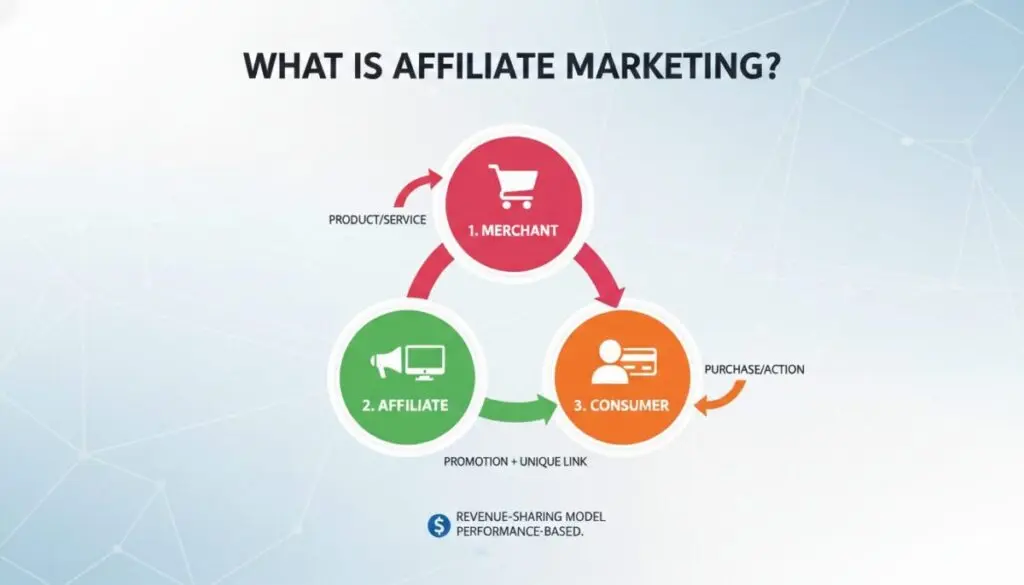
- The merchant: the company selling the product or service
- The affiliate: the individual or publisher promoting it
- The consumer: the end user who completes the action
Some ecosystems also include affiliate networks, which act as intermediaries by handling tracking, reporting, and payments between brands and affiliates.
What distinguishes affiliate marketing from traditional advertising is its accountability. Every click, conversion, and commission is tracked, making it one of the most measurable forms of digital marketing.
How Does Affiliate Marketing Work?
Affiliate marketing runs on a simple, trackable process that connects content, clicks, and conversions.
At a high level, it works in three steps:
- You share a unique affiliate link within your content
- A user clicks that link and visits the merchant’s website
- The action is tracked, and you earn a commission if a conversion happens
Behind this simplicity is a structured system that ensures every interaction is measurable.
The Tracking Layer
Each affiliate link contains a unique identifier tied to you. When a user clicks it, a tracking cookie is stored in their browser. This allows the merchant or affiliate platform to attribute any future purchase or action back to your referral, even if it doesn’t happen immediately.
Cookie durations vary by program. Some last 24 hours, while others extend to 30 days or more, directly impacting your earning potential.
The Role of Affiliate Platforms
In many cases, affiliate marketing platforms or networks sit between brands and affiliates. They handle:
- Link generation and tracking
- Performance reporting
- Commission payouts
- Fraud prevention
This infrastructure is what makes affiliate marketing scalable. Instead of managing individual partnerships manually, both sides operate within a centralized system.
Where Conversions Actually Happen
Affiliate marketing doesn’t happen on the merchant’s site alone. It starts in content environments where purchase intent is built:
- Blog posts answering specific queries
- YouTube reviews demonstrating products
- Social content driving discovery
- Email campaigns targeting engaged audiences
The affiliate’s role is not just to drive clicks, but to influence decisions before the click happens. That’s where most of the value is created.
Why Affiliate Marketing Matters
Affiliate marketing has evolved from a niche monetization tactic into a core growth channel for both brands and creators.
At a business level, it solves one of the biggest challenges in digital marketing: paying for outcomes instead of assumptions.
Brands only incur costs when a measurable action happens, whether that’s a sale, lead, or click. This performance-based structure is why affiliate marketing now sits alongside paid media and SEO as a primary acquisition channel.
Adoption reflects that shift. Today, 81% of brands actively run affiliate marketing programs as part of their growth strategy, using partners to extend reach into audiences they cannot access directly.
For creators and publishers, the appeal is different but equally compelling.
Affiliate marketing removes the operational complexity of selling.
There is no need to manage inventory, logistics, or customer support. Instead, the focus shifts entirely to content and audience building. Once content is published and ranking or circulating, it can continue generating commissions over time.
This is where the model becomes scalable.
Unlike one-off campaigns, affiliate content compounds. A single high-performing article, video, or email sequence can drive revenue long after it is created, especially when aligned with high-intent search or evergreen demand.
At the same time, affiliate marketing has expanded beyond blogs into a multi-platform ecosystem. You now see it embedded in:
- YouTube product reviews
- TikTok recommendations
- Email newsletters
- Pinterest product discovery
- Comparison and review websites
This expansion has shortened the path from discovery to purchase. Content is directly driving transactions.
Understanding this shift is key. Affiliate marketing is about building a system where content, traffic, and monetization work together in a measurable way.
For part-time creators, affiliate commissions can also form one part of a wider revenue stack alongside paid UGC, campaign fees, and view-based earnings.
Affiliate Marketing For Beginners: How To Start
Getting started with affiliate marketing is simple in structure, but the difference between earning sporadic commissions and building a scalable revenue stream comes down to how deliberately you approach each step.
This is not just about signing up for a program and dropping links but about building a system that connects audience, content, and conversion.
Below is a complete breakdown of how to start, with multiple paths depending on your goals, resources, and experience level.
Step 1: Choose A Niche That Can Actually Monetize
Your affiliate niche determines everything: the products you promote, the audience you attract, and the revenue potential.
Strong affiliate niches share three characteristics:
- Commercial intent: People are already searching for products or solutions
- Product depth: Multiple products, price tiers, and brands exist
- Content opportunities: You can create reviews, comparisons, and guides
Examples of viable niches:
- Software and SaaS
- Personal finance and investing
- Fitness and supplements
- Beauty and skincare
- Tech and gadgets
- Home and lifestyle
Avoid niches where:
- There are no affiliate programs
- Products are too low-priced with minimal commissions
- Content demand is limited
The more specific your niche, the easier it is to build authority and convert traffic.
Step 2: Choose Your Affiliate Marketing Model
There is no single way to do affiliate marketing. Your approach depends on how you want to generate traffic and influence decisions.
Here are the main models:
Content-Driven Affiliate Marketing (SEO)
This is the most sustainable model.
You create content that ranks on search engines for high-intent queries like:
- “best project management software”
- “top credit cards for travel”
Content formats:
- Product reviews
- Comparison articles
- “Best of” lists
- Tutorials with embedded recommendations
This model compounds over time and is ideal for long-term growth.
A clear example of this approach in action is Emily Krause’s blog A Mom Explores. In her “Best Travel Essentials for Women” guide, she curates a list of products tailored to a specific audience and use case. Each recommendation is paired with affiliate links, allowing her to earn a commission when readers make a purchase.
Importantly, she includes clear disclosures alongside her recommendations, maintaining transparency while still monetizing the content. This balance between utility and trust is what makes content-driven affiliate marketing effective over the long term.
Social Media Affiliate Marketing (Short Form)
You use platforms like TikTok or Instagram to promote products.
Common formats:
- Short-form product demos
- Before and after transformations
- Quick recommendations
- Trend-based content
This model can scale quickly but is dependent on algorithms and consistency.
Another clear example of social media affiliate marketing is where product-focused creators build entire content strategies around specific use cases. Instead of traditional reviews, they create short videos like “things you didn’t know you needed” or “Amazon finds that actually work,” showcasing products in real-life scenarios.
Because TikTok and other social media platforms don't support clickable links directly within video content, affiliate monetization typically happens outside the video itself. Creators direct viewers to their profile, where they include affiliate links in their bio or use link-in-bio tools to house multiple product recommendations.

This creates a two-step conversion flow: content drives interest, and the profile captures intent. When executed well, it can generate high-volume traffic and rapid sales, especially for visually demonstrable products.
YouTube Affiliate Marketing (Long Form)
You create long-form video content that builds trust and demonstrates products.
High-converting formats:
- In-depth reviews
- Comparisons
- “Best tools for…” videos
- Tutorials
YouTube works particularly well for:
- Tech
- Clothing
- Software
- High-consideration purchases
Affiliate marketing on YouTube works similarly to other platforms. Creators create content around products or services and add their link in the description. From there, viewers are taken to the product page, where they choose to purchase.
Unlike affiliate marketing on TikTok or Instagram, the platform does allow links in descriptions, making YouTube affiliate marketing that much easier. However, affiliate marketing on YouTube is highly competitive, having been around for much longer.
The benefit is YouTube's long-form nature, with creators able to produce longer and more in-depth content to fully explain the benefits and use cases of the items they're promoting.
Email-First Affiliate Marketing
You build an email list and promote products directly to subscribers.
How it works:
- Offer a lead magnet (guide, template, checklist)
- Capture emails
- Send value-driven newsletters
- Introduce affiliate offers naturally
This is one of the highest-converting channels because you own the audience.
Paid Ads Affiliate Marketing
You run ads (Google, Facebook, TikTok) to affiliate offers.
This model requires:
- Budget
- Testing
- Strong understanding of unit economics
It is best suited for:
- High-ticket affiliate marketing
- Lead generation offers
Pinterest Affiliate Marketing (Visual Search)
Pinterest functions as a visual search engine, making it ideal for discovery-driven niches.
Best for:
- Home decor
- Fashion
- DIY
- Lifestyle
You create pins that link directly to:
- Blog content
- Affiliate landing pages

Step 3: Join Affiliate Marketing Programs
Once you have a niche and a clear content or traffic model, the next step is selecting the right affiliate programs. This is where monetization actually begins.
Not all programs are equal. Commission rates, tracking reliability, cookie duration, and product-market fit can significantly impact your results. Choosing the right mix early on will save you from rebuilding later.
You have three primary ways to enter affiliate marketing:
- Affiliate Networks
Affiliate networks act as centralized platforms that connect affiliates with multiple brands. Instead of applying to individual companies one by one, you can browse a wide range of programs within a single dashboard.
Platforms like Awin, CJ Affiliate, Impact, and ClickBank aggregate thousands of offers across industries, making them a practical starting point, especially if you are still exploring your niche.

What makes networks valuable is the infrastructure they provide. They handle tracking, reporting, and payouts, allowing you to manage multiple partnerships without dealing with separate systems.
The tradeoff is that commissions can sometimes be slightly lower, as the network takes a share. Still, for most beginners and even intermediate affiliates, the operational simplicity outweighs that downside.
- Direct Affiliate Programs
Many brands operate their own affiliate programs independently of networks. These are typically accessible through a quick search or by checking a company’s website footer.
Working directly with a brand often unlocks better economics.
Without a network acting as an intermediary, companies can offer higher commissions or more flexible terms. In some cases, this also leads to closer relationships, which can translate into exclusive offers, custom landing pages, or performance-based bonuses.
For example, if you’re using Shopify or Elementor to power your website, you could join their affiliate programs.

- Source: shopify.com


- Source: elementor.com

With that said, direct programs require more evaluation. You need to assess how well the product converts, whether the brand is reputable, and how reliable their tracking and payouts are. Unlike networks, there is no standardized system, so due diligence becomes more important.
- Amazon Affiliate Marketing
Amazon Associates is one of the most common entry points into affiliate marketing, largely because of its accessibility and scale.
With millions of products across nearly every category, it allows you to monetize content without needing to build individual brand partnerships. This makes it particularly useful in the early stages, when speed and simplicity matter more than maximizing margins.
Another advantage is conversion. Because users already trust Amazon, they are more likely to complete a purchase once they land on the platform. In many cases, affiliates also earn commissions on additional items added to the cart, not just the original product.
The tradeoff is lower commission rates and shorter cookie durations, which can limit earnings compared to more specialized programs.
The Amazon Associates commission page tells you what the fees are for specific product categories. Luxury beauty items offer a 10% fixed commission rate, which is the highest on the platform. On the other hand, PC or PC components, for example, offer much lower rates at 2.5%.
Over time, many affiliates move beyond Amazon toward higher-paying partnerships, but it remains a reliable foundation.
How To Choose The Right Programs
At this stage, the goal is not to join as many programs as possible. It is to select partnerships that align with your audience and the type of content you create.
A practical approach is to start with a mix. Use affiliate networks to explore opportunities, Amazon for broad coverage, and gradually introduce direct partnerships as you identify products that consistently convert.
As your content grows and your data becomes clearer, your program selection should become more focused. The highest-performing products and partners should shape the direction of your affiliate strategy moving forward.
How Affiliate Marketers Make Money
Affiliate marketing is fundamentally a performance-based revenue model. You do not get paid for publishing content or generating impressions. You earn when your audience takes a measurable action.
That action can be a purchase, a sign-up, a click, or an install, depending on the program. What makes affiliate marketing powerful is that every step of this process is tracked, allowing revenue to be directly tied to your content and traffic.
To understand how affiliate marketers actually make money, you need to look at three layers: commission models, product economics, and conversion dynamics.
The Core Commission Models
Most affiliate programs use one of four payout structures. Each one changes how you approach content, traffic, and scale.
Affiliate Marketing Commission Models
- Pay-Per-Sale (PPS) is the most widely used model. You earn a percentage of the product price or a fixed fee when a user completes a purchase through your link. This is the foundation of most affiliate businesses, particularly in ecommerce, software, and digital products.
- Pay-Per-Lead (PPL) rewards you for generating qualified actions rather than immediate sales. These actions can include signing up for a free trial, submitting a form, or requesting a quote. This model is common in industries with longer sales cycles, such as finance, insurance, and SaaS.
- Pay-Per-Click (PPC) compensates you for driving traffic, regardless of whether a conversion happens. Because this model carries higher risk for advertisers, it is less common today, but still appears in large-scale publishing and awareness-driven campaigns.
- Pay-Per-Install (PPI) is used primarily in app ecosystems. You earn when users download and install a product through your link. This model is often volume-driven, with lower payouts per action but higher scalability in the right niches.
Each model requires a different strategy. High-intent, decision-stage content performs best for pay-per-sale, while broader reach and volume can work better for lead or install-based programs.
High-Ticket vs Low-Ticket Affiliate Marketing
One of the biggest strategic decisions in affiliate marketing is whether to focus on volume or value.
Low-ticket affiliate marketing centers around products with lower price points and smaller commissions. This is common with large marketplaces like Amazon, where conversion rates are high but earnings per sale are relatively modest. The advantage is consistency. These products are easier to sell and require less persuasion.
High-ticket affiliate marketing, on the other hand, focuses on products or services with significantly higher payouts. These can include software subscriptions, online courses, financial products, or B2B services. A single conversion can generate $100, $300, or even more.
The tradeoff is complexity. High-ticket products require more trust, deeper content, and often a longer decision cycle. You are not just recommending a product. You are helping the user justify a higher-cost decision.
Most scalable affiliate businesses use a combination of both. Low-ticket products provide a steady baseline income, while high-ticket offers drive profitability.
The Mechanics Behind Affiliate Earnings
Affiliate income is not random. It is the result of a simple but powerful equation:
Traffic × Intent × Conversion Rate × Commission
Each of these variables plays a distinct role.
- Traffic determines how many people see your content. Without sufficient visibility, even the best strategy will not generate meaningful revenue.
- Intent determines how ready your audience is to take action. A user searching for “best CRM software for small business” is far more valuable than someone casually browsing.
- Conversion rate reflects how effectively your content turns interest into action. This is influenced by clarity, trust, positioning, and how well the product matches the user’s needs.
- Commission determines how much you earn per successful action. Even small improvements here can significantly impact overall revenue.
This is why affiliate marketing rewards precision. A smaller, high-intent audience can outperform a large but unfocused one.
Where Earnings Actually Come From
In practice, affiliate revenue tends to concentrate around a small number of high-performing assets.
These are typically:
- Articles targeting high-intent keywords
- Videos addressing specific product use cases
- Email sequences recommending proven products
- Comparison pages that simplify decision-making
Instead of every piece of content generating revenue, a handful of pages or videos often drive the majority of commissions.
Once you identify what works, you can replicate that structure across similar topics, products, or audiences.
The Reality of Affiliate Marketing Income
Affiliate marketing offers uncapped earning potential, but it is not immediate.
Early stages are often inconsistent. Content takes time to rank, audiences take time to build, and conversion data takes time to accumulate. This is where most beginners underestimate the effort required.
Over time, however, the model becomes more predictable. As you build a portfolio of content and refine your strategy, revenue starts to stabilize and compound.
The goal is not to rely on one link or one platform. It is to build a system where content, traffic, and monetization work together, creating multiple pathways to generate income.
Affiliate Marketing Strategy: What Actually Drives Revenue
Most affiliate marketing guides stop at setup. They explain how to choose a niche, join programs, and create content. But those steps do not explain why some affiliates generate consistent, compounding revenue while others struggle to earn anything meaningful.
Why do some affiliates make $500/month and others $50,000/month? - That's the question we aim to answer!
The difference, to put it plainly, is strategy.
Affiliate marketing is all about aligning three variables: intent, content, and monetization. When those three work together, revenue becomes predictable. When they do not, traffic alone will not translate into earnings.
Intent-Driven Content Beats Volume
Not all traffic has the same value.
A page that attracts 1,000 visitors who are actively comparing products will often outperform a page with 10,000 casual readers. This is because affiliate marketing rewards decision-stage intent, not general awareness.
High-performing affiliates prioritize keywords and topics that signal buying behavior:
- “Best influencer marketing tools for small business”
- “Shopify vs WooCommerce pricing”
- “Is [product] worth it?”
These queries indicate that the user is already evaluating options. Your role is not to introduce the product, but to help them choose.
In contrast, purely informational content may drive traffic but rarely converts at the same rate. It can still play a role, but primarily as a top-of-funnel entry point rather than a direct revenue driver.
Product-Market Fit Is The Hidden Lever
One of the most overlooked drivers of affiliate revenue is how well the product matches the audience.
Even strong content will underperform if the offer does not align with user expectations, budget, or level of experience.
For example, promoting enterprise-level software to beginners will result in low conversions, regardless of traffic. Similarly, recommending low-quality products may generate short-term clicks but will erode trust and reduce long-term performance.
Top affiliates focus on relevance:
- Matching product complexity to audience expertise
- Aligning pricing with user expectations
- Recommending products that solve a clear, immediate problem
This is where affiliate marketing shifts from promotion to curation. The more accurately you match products to intent, the higher your conversion rates.
Content Types That Actually Convert
Certain content formats consistently outperform others because they reduce decision friction.
Comparison-driven and evaluation-focused content tends to generate the highest affiliate revenue. This includes:
- “Best X for Y” lists
- Product comparisons
- In-depth reviews
- Use-case-driven tutorials
These formats work because they simplify the decision-making process. Instead of forcing users to research multiple options, you consolidate information and guide them toward a clear outcome.
For example, a well-structured comparison article does more than list features. It highlights tradeoffs, identifies who each product is best for, and removes uncertainty.
The more clarity your content provides, the more likely users are to act.
Distribution Strategy: Channels Have Different Roles
Not all traffic sources serve the same purpose, and treating them as interchangeable limits growth.
High-performing affiliate strategies assign specific roles to each channel:
- Search (SEO) captures existing demand and drives consistent, high-intent traffic
- Social media generates discovery and expands reach
- YouTube builds trust through demonstration and depth
- Email converts and retains your audience over time
It's all about understanding how each channel contributes to the system.
For example, SEO might bring in first-time visitors, YouTube reinforces credibility, and email captures and monetizes that audience repeatedly. Together, they create a feedback loop rather than isolated traffic streams.
Conversion Optimization Is The Real Multiplier
Traffic gets attention, but conversion drives revenue.
Small improvements in how users interact with your content can significantly increase earnings without increasing traffic. This is where many affiliate marketers underperform.
Key factors that influence conversion include:
- Link placement: Positioning links where users are most likely to take action
- Call-to-action clarity: Making the next step obvious and frictionless
- Trust signals: Demonstrating experience, transparency, and credibility
- Content structure: Organizing information in a way that leads to decisions
For example, placing a comparison table near the top of an article can dramatically increase click-through rates. Similarly, clearly stating who a product is best for reduces hesitation.
At scale, even small improvements compound. Increasing a conversion rate from 2% to 3% can result in a 50% increase in revenue from the same traffic.
Diversification Protects Revenue
Affiliate marketing is inherently dependent on external systems. Search algorithms change, social platforms shift reach, and affiliate programs adjust commissions or shut down entirely.
Relying on a single traffic source or program introduces risk.
Top affiliates mitigate this by diversifying:
- Promoting multiple products within a niche
- Partnering with multiple affiliate programs
- Building presence across more than one channel
This means avoiding single points of failure.
A diversified setup ensures that if one channel or program underperforms, the overall system continues to generate revenue.
Compounding Is The Real Advantage
The long-term advantage of affiliate marketing is not speed, but accumulation.
Unlike paid advertising, where traffic stops when spending stops, affiliate content can continue generating traffic and commissions long after it is published. A single high-performing article or video can produce consistent revenue for months or years.
Over time, this creates a compounding effect:
- More content increases total traffic
- More data improves decision-making
- Better optimization increases conversion rates
As this system grows, revenue becomes less dependent on individual pieces of content and more on the overall structure.
This is why experienced affiliates focus on building assets rather than chasing short-term wins.
What Most Beginner Guides Miss
Affiliate marketing is often presented as a simple formula: create content, add links, earn commissions.
In reality, the model only works when there is alignment between what users want, what your content delivers, and what the product offers.
It is not about adding more links or generating more traffic. It is about building a system where:
- The right audience finds your content
- The content answers their exact question
- The product fits their needs
When those elements align, affiliate marketing becomes predictable, scalable, and sustainable.
Common Affiliate Marketing Mistakes To Avoid
Affiliate marketing is often presented as a straightforward path to earning online, but most beginners struggle not because the model does not work, but because they make predictable mistakes early on.
These mistakes are rarely about effort. They are usually about misalignment between strategy, content, and monetization.
Targeting The Wrong Type Of Traffic
One of the most common issues is focusing on traffic volume instead of traffic intent.
Content that attracts general interest, such as broad educational topics, may generate visits but rarely converts into revenue. Affiliate marketing works best when content targets users who are already evaluating products or solutions.
If your content is not aligned with decision-stage queries, even high traffic numbers will not translate into earnings.
Promoting Products That Do Not Match The Audience
Affiliate marketing is about recommending the right products to the right audience.
When there is a mismatch between the product and the user’s needs, conversions drop. This often happens when beginners choose offers based on commission size rather than relevance.
High-performing affiliates prioritize fit over payout. A lower commission product that converts well will outperform a higher commission product that does not.
Relying On A Single Channel
Many beginners build their entire strategy around one platform, often SEO or social media.
While this can work initially, it creates risk. Algorithm updates, platform changes, or shifts in user behavior can significantly impact traffic and revenue.
A more sustainable approach is to diversify across channels, allowing each to play a role in discovery, trust-building, and conversion.
Ignoring Conversion Optimization
Driving traffic is only part of the equation. If users are not clicking or converting, the problem is often within the content itself.
Common issues include:
- Poor link placement
- Weak or unclear calls to action
- Lack of trust signals
- Overly generic recommendations
Even small improvements in how content is structured can lead to meaningful increases in revenue.
Expecting Immediate Results
Affiliate marketing is frequently misunderstood as a quick way to generate income.
In reality, most strategies, especially those based on content and SEO, take time to produce results. Early stages often involve experimentation, content creation, and gradual traffic growth.
Those who treat affiliate marketing as a long-term system tend to outperform those looking for immediate returns.
Not Building Trust With The Audience
Trust is the foundation of affiliate marketing.
If your audience does not believe your recommendations, they will not act on them. Over-promoting products, recommending low-quality offers, or lacking transparency can quickly erode credibility.
Clear disclosures, honest reviews, and consistent value-driven content are what sustain long-term performance.
The Pattern Behind These Mistakes
Most of these mistakes stem from the same issue: focusing on tactics instead of systems.
Affiliate marketing works when traffic, content, and monetization are aligned. When one of these elements is missing or misaligned, results become inconsistent.
Avoiding these mistakes does not guarantee success, but it removes the most common barriers that prevent it.
Affiliate Marketing Is a System, Not a Shortcut
Affiliate marketing has evolved into one of the most reliable performance channels in digital marketing, with reports showing it drives up to 16% of all global ecommerce sales, putting it on par with email and paid search as a revenue driver.
But success is not about links or traffic alone. It comes from building a system where intent, content, and monetization are tightly aligned.
For beginners, the opportunity is real, but so is the need for patience and precision. The affiliates who win are not the ones chasing quick tactics, but those building assets that compound over time.
Start focused, stay consistent, and optimize what works. That is how affiliate marketing scales from side income to a sustainable revenue engine.
Frequently Asked Questions
What is affiliate marketing and how does it work?
Affiliate marketing is a performance-based model where you promote products or services using unique tracking links and earn a commission when users take an action, such as making a purchase or signing up.
It works by connecting three parties: the merchant, the affiliate, and the consumer, with tracking systems attributing each conversion to the correct source.
how do i start affiliate marketing as a beginner?
To start affiliate marketing, you need to choose a niche, pick a platform such as a blog, YouTube, or social media, and join relevant affiliate marketing programs. From there, you create content that targets specific user needs and include affiliate links naturally within that content. Over time, traffic and optimization drive results.
Which are the best affiliate marketing programs to join?
The best affiliate marketing programs depend on your niche and audience. Beginners often start with broad platforms like Amazon Associates, while more advanced affiliates join networks like Awin, CJ Affiliate, or Impact. Direct brand programs can offer higher commissions and better long-term opportunities.
How much money can you make with affiliate marketing?
Affiliate marketing income varies widely. Some beginners earn a few hundred dollars per month, while experienced affiliates build six-figure revenue streams. Earnings depend on traffic quality, conversion rates, and commission structures rather than effort alone.
What is high ticket affiliate marketing?
High ticket affiliate marketing focuses on promoting products or services with higher payouts, often ranging from $100 to $500 or more per conversion. These typically include software, online courses, or financial products. While conversions are less frequent, the revenue per sale is significantly higher.
Can you do affiliate marketing without a website?
Yes, affiliate marketing can be done without a website. Many creators use platforms like TikTok, Instagram, YouTube, or email newsletters to promote affiliate products. In these cases, links are often placed in bios, descriptions, or landing pages rather than traditional blog content.
What are the best platforms for affiliate marketing?
The best affiliate marketing platforms depend on your strategy. Blogs are ideal for SEO-driven traffic, YouTube works well for product reviews, social media drives discovery, and email marketing offers the highest conversion potential. Many successful affiliates use a combination of channels.
How long does it take to make money with affiliate marketing?
Affiliate marketing typically takes time to generate consistent income, especially with content-driven strategies like SEO. It can take several months to see results, but once content starts ranking or gaining traction, revenue can compound over time.


