

If you want to use an Instagram fake followers checker, it is usually because you want to verify whether an account’s audience is genuine. This has become increasingly important as influencer marketing continues to grow.
According to research from SocialVault analyzing 100,000 Instagram accounts, 37.2% of followers were classified as fake or suspicious, including 14.8% identified as likely fraudulent accounts showing clear signs of bot activity or purchased followers.
For brands and marketers running influencer campaigns, this represents a significant risk. A creator may appear influential based on follower count, but a large share of that audience could consist of inactive or artificial accounts that generate little real engagement.
Use the tool below to analyze an Instagram account and learn how to detect fake followers, interpret authenticity signals, and avoid influencer fraud before launching a campaign.
Free Instagram Fake Follower Checker
To help you evaluate audience authenticity, Influencer Marketing Hub has partnered with HypeAuditor to provide a free Instagram Fake Followers Checker.
This tool analyzes an account’s follower base, engagement patterns, and growth trends to estimate the percentage of real, suspicious, and likely fake followers. By running a quick audit, brands and marketers can better understand whether an influencer’s audience is genuine before moving forward with collaborations or campaigns.
Join the Planet’s largest community of Creators & Influencers
Registration includes
- Free usage of over 40 Influencer Tools
- Access to Complimentary Premium Online Courses
- Unlimited Articles and Resources
Already A Member? Sign In


How to Use the Instagram Fake Followers Checker
Using the Instagram Fake Followers Checker takes only a few seconds.
- Enter the Instagram username of the account you want to analyze (without the @ symbol).
- Complete the captcha verification to confirm the request.
- Run the check to generate the audience analysis.
The tool will then scan the account and estimate the percentage of authentic, suspicious, and likely fake followers, helping you quickly assess the quality of an influencer’s audience.
- Free Instagram Fake Follower Checker
- What Are Fake Instagram Followers?
- Why Fake Followers Matter for Brands and Marketers
- Why People Buy Instagram Followers
- Signs an Instagram Influencer Has Fake Followers
- Tools That Help Detect Fake Instagram Followers
- 1. Modash
- 2. Upfluence
- 3. SocialAuditor
- What Percentage of Instagram Followers Are Fake?
- How to Remove Fake Followers From Your Instagram Account
- Why Authentic Audiences Matter More Than Follower Counts
- Frequently Asked Questions
What Are Fake Instagram Followers?
Fake Instagram followers are accounts that do not represent real, engaged users. These followers are typically created by bots, purchased through follower marketplaces, or generated through automated growth services designed to inflate an account’s audience size.
While they may increase the visible follower count on a profile, fake followers provide no real value. They rarely interact with posts, do not contribute meaningful engagement, and cannot influence purchasing decisions or brand perception.
Instagram Fake Follower Types
Fake followers generally fall into three main categories:
Bot Accounts
Automated accounts created in large numbers to follow profiles and artificially boost follower counts.
Inactive or Abandoned Accounts
Real accounts that are no longer active on Instagram but still remain in follower lists. These followers rarely interact with content.
Purchased Followers
Accounts acquired through follower-buying services. These followers are often low-quality accounts or bots designed to make a profile appear more popular than it actually is.
Because these followers do not engage with content, they often create unusual engagement patterns, such as a large follower count paired with very low likes, comments, or shares.
This is why brands and marketers increasingly rely on tools like an Instagram fake followers checker to evaluate audience authenticity before partnering with influencers.
Why Fake Followers Matter for Brands and Marketers
Fake followers are not just a cosmetic issue on Instagram. They can distort performance metrics, weaken campaign results, and create real risks for brands investing in influencer marketing.
As the creator economy has expanded, detecting audience authenticity has become a critical part of influencer vetting.
Distorted Engagement Metrics
One of the biggest problems with fake followers is how they skew engagement data. When a significant portion of an influencer’s audience consists of bots or inactive accounts, engagement rates decline because these followers do not interact with posts. Moreover, a study shows that as much as 24% of influencers have falsely manipulated their engagement numbers.
This often results in accounts that show large follower numbers but unusually low likes, comments, or shares. For brands, this makes it difficult to accurately evaluate the real reach and impact of a creator.
The Scale of Instagram Influencer Fraud
Influencer fraud related to fake followers is more widespread than many marketers realize. Research indicates that about 37.2% of Instagram influencer followers are classified as suspicious accounts, meaning they show patterns associated with bots, inactive profiles, or artificially generated followers.
Other studies suggest that roughly 22% of Instagram influencers have some level of fake or suspicious followers in their audience, highlighting how common audience inflation has become across the platform.
Misleading Campaign Performance
Fake followers can significantly distort campaign performance expectations. An influencer with 500,000 followers may appear capable of delivering large-scale reach, but if a large portion of that audience consists of fake or inactive accounts, the actual exposure and engagement will be much lower.
This can lead to overestimated reach, weaker engagement, and reduced return on investment for influencer marketing campaigns.
Reputational Risk for Brands
Partnering with influencers who artificially inflate their audiences can also damage brand credibility. Consumers and industry professionals are increasingly aware of fake follower practices, and collaborations with inauthentic creators may raise concerns about transparency and trust.
Surveys show that 63% of marketers report encountering influencer fraud in past campaigns, with fake followers being one of the most common warning signs.
Why Audience Audits Are Now Standard Practice
Because of these risks, many brands now conduct influencer audits before launching partnerships. Running a quick analysis with an Instagram fake followers checker allows marketers to evaluate audience quality, identify suspicious follower patterns, and ensure that collaborations are built on genuine influence rather than inflated numbers.
Why People Buy Instagram Followers
Despite the risks and growing awareness of influencer fraud, many Instagram users still buy followers to inflate their audience size. The motivation usually comes down to one factor: social proof.
On social media, follower count is often seen as a quick indicator of popularity and credibility.
Accounts with large audiences appear more influential, attract more attention, and are sometimes more likely to secure brand partnerships. As a result, some users try to accelerate their growth by purchasing followers instead of building an audience organically.
There are several common reasons why people resort to buying followers.
Creating the Appearance of Popularity
A high follower count can make an account look more established and trustworthy. Some creators believe that appearing popular will encourage real users to follow them, assuming that people are more likely to trust accounts that already have a large audience.
Attracting Brand Partnerships
Brands often look at follower numbers when evaluating potential influencers. Some creators try to boost their follower count artificially in hopes of appearing more attractive to marketers and securing sponsorship deals.
Gaining Algorithmic Visibility
Some users believe that larger accounts are favored by social media algorithms. By inflating follower numbers, they hope to increase the perceived authority of their account and improve visibility.
However, buying followers rarely produces meaningful results. Fake followers typically do not interact with content, which leads to low engagement rates and suspicious audience patterns.
Over time, these discrepancies become easy to identify, especially when brands or agencies run an Instagram fake followers checker to evaluate audience authenticity before partnering with an influencer.
We have an article that looks at the reasons why you shouldn't buy Instagram followers - give it a read.
Signs an Instagram Influencer Has Fake Followers
While tools like the Instagram Fake Followers Checker can quickly analyze an account’s audience quality, there are also several manual signals that can help you identify suspicious followers.
Fake audiences tend to leave detectable patterns across follower ratios, engagement activity, profile quality, and growth trends.
To illustrate what a healthy account looks like, we can look at the Instagram analytics of MrBeast, one of the largest creators on the platform. When we run his account through the HypeAuditor-powered checker, the analysis shows:
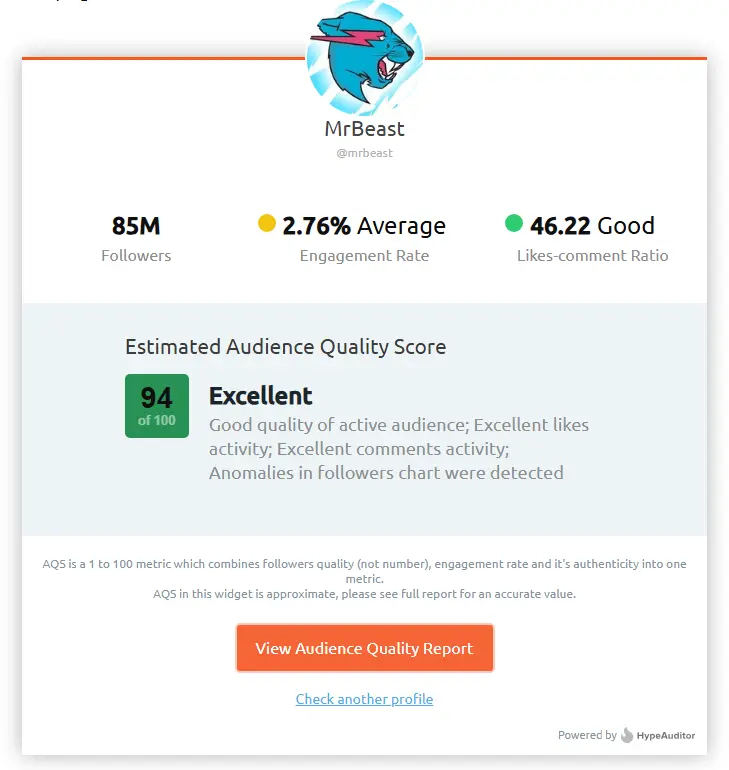
- 85.1M followers
- 2.76% engagement rate
- 316K average likes
- 6.8K average comments
- Audience Quality Score: 94/100 (Excellent)
These metrics help establish what authentic engagement patterns look like when evaluating influencer accounts.
Common Warning Signals of Influencer Fake Followers
Below are some common warning signs to look for when evaluating an account’s followers:
1. Unusual Follower and Following Ratios
Genuine Instagram accounts tend to show recognizable patterns when it comes to the number of followers they have compared to the number of accounts they follow. Fake or low-quality accounts often follow thousands of profiles while having very few followers themselves, a common tactic used by bot networks attempting to appear active.
There is an important caveat when evaluating influencers and brands. Large creators often have extremely unbalanced follower-to-following ratios because they rarely follow back the people who follow them.
For example, the HypeAuditor analysis of @mrbeast shows:
- 85.1M followers
- 916 accounts followed
Follower-to-following ratio: ~92,954:1
At first glance, this ratio may appear unusual, but it is perfectly normal for major creators and celebrity accounts.
This is why follower ratios alone cannot determine authenticity. They must be evaluated alongside engagement rates and audience quality signals.
A much stronger red flag is when an account has a very large audience but extremely low engagement. If an influencer has hundreds of thousands of followers yet receives only a few hundred likes per post, it may indicate that a significant portion of their followers are fake or inactive.
2. Sudden Spikes in Follower Growth
Organic audience growth on Instagram tends to occur gradually. Even highly successful creators usually gain followers at a relatively steady pace unless a specific piece of content goes viral.
Fake followers are often added in large batches, which creates sudden spikes in follower numbers over a short period of time.
For instance, when analyzing the follower growth chart for @mrbeast, the data shows steady increases in followers across time periods. In one recent 30-day period, his account grew by approximately 0.47%, which HypeAuditor classifies as a healthy growth rate compared to similar large accounts.
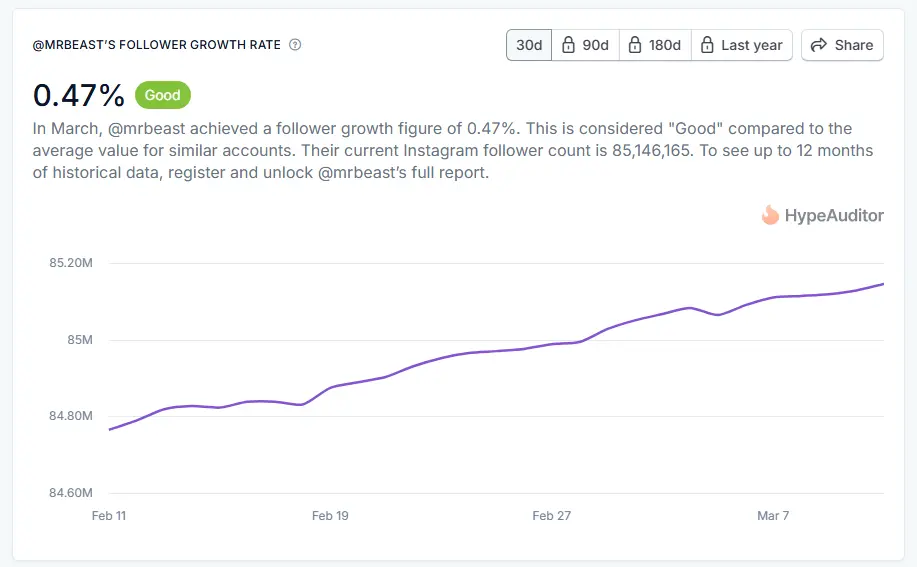
By contrast, accounts that purchase followers often display sudden jumps of thousands of followers overnight without corresponding increases in engagement or content performance.
When reviewing an influencer, abnormal growth spikes can be one of the strongest indicators that followers were artificially acquired.
3. Empty, Hidden, or Copied Profiles
Fake follower accounts often have incomplete or poorly constructed profiles. Because many of these accounts are created automatically in large volumes, their profiles frequently contain minimal information.
Common warning signs include:
- Missing or generic profile photos
- Very few or no posts
- Empty or copied bio descriptions
- Recently created accounts with little activity
Authentic Instagram users typically show a history of activity across posts, comments, and interactions. Even casual users usually have some form of profile personalization.
Influencers with a high percentage of these types of followers may have artificially inflated audiences. Tools such as the Instagram Fake Followers Checker help identify this by analyzing follower quality and detecting patterns across thousands of accounts.
4. Spammy or Generic Comments
Another signal of fake followers is the presence of repetitive or meaningless comments. Many bot accounts attempt to simulate engagement by posting simple phrases across multiple profiles.
Examples include comments like:
- “Nice pic”
- “Amazing content”
- “Great post”
These comments technically increase engagement counts, but they do not represent genuine interaction.
In contrast, authentic audiences typically leave contextual comments related to the content itself.
Looking again at the @mrbeast analysis, the account receives an average of 6.8K comments per post, and the tool reports a likes-to-comments ratio of 46.22, which is considered healthy for an account of this size.
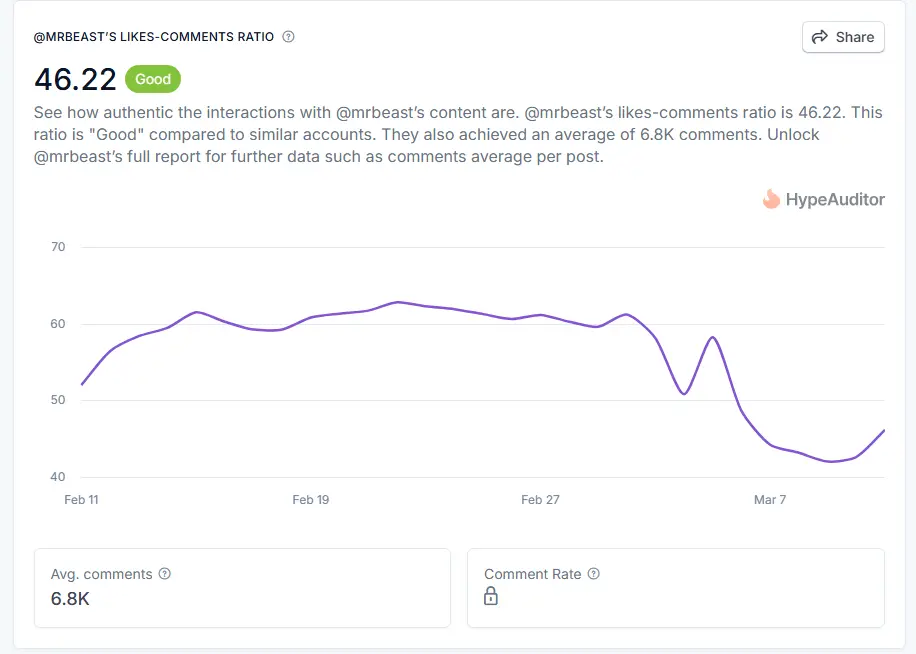
This type of engagement pattern indicates real audience interaction rather than automated activity.
5. Irregular Engagement Behavior
Fake followers also create unusual engagement patterns. Some accounts may like dozens of posts in a short period of time, leave identical comments across multiple profiles, or interact in ways that appear automated.
When evaluating influencer accounts, engagement should generally scale with audience size.
For example, with 85M followers, MrBeast’s Instagram account averages more than 316K likes per post, producing an engagement rate of 2.76%. For a creator with an audience this large, that level of engagement is considered average but still healthy.
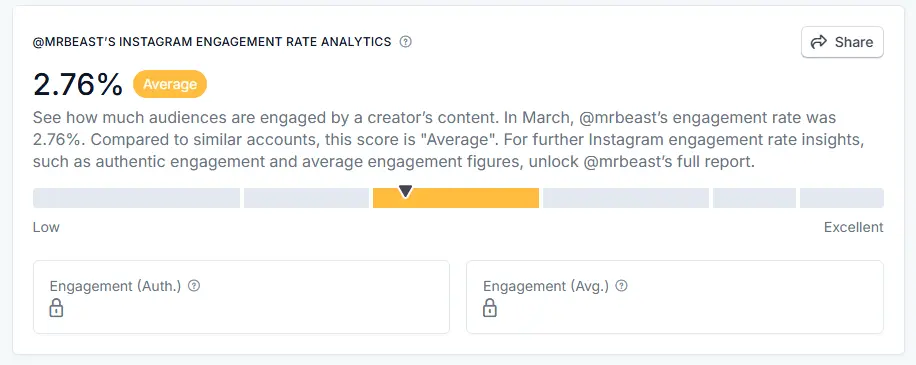
If an account with a similar follower count only receives a few thousand likes or very few comments, it may indicate that much of the audience consists of fake or inactive followers.
Because manually reviewing thousands or millions of followers is impossible, many brands rely on tools like an Instagram fake followers checker to quickly evaluate audience authenticity and detect suspicious patterns before partnering with influencers.
Tools That Help Detect Fake Instagram Followers
Manually reviewing follower lists can reveal suspicious patterns, but doing this at scale is almost impossible.
This is why many marketers rely on Instagram fake followers checker tools that analyze audience quality automatically. These tools evaluate engagement patterns, follower growth trends, and audience characteristics to estimate how many followers may be fake, inactive, or suspicious.
Below are some widely used tools that help brands and agencies audit influencer audiences before starting collaborations.
1. Modash
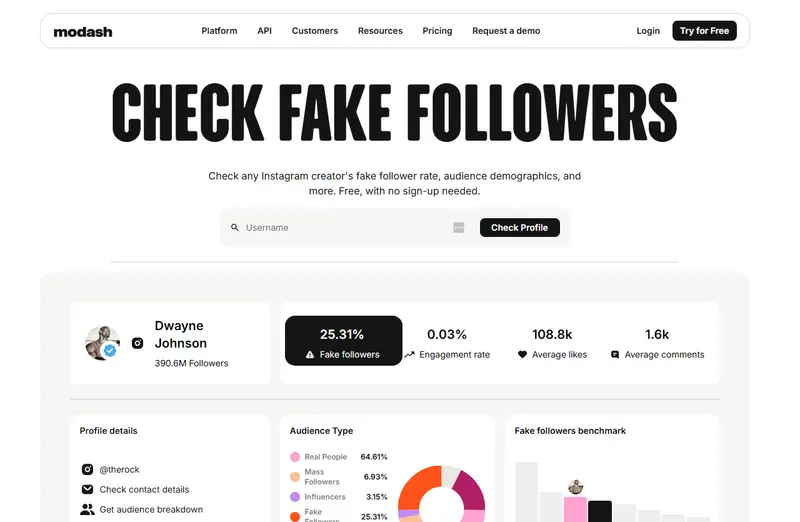
The Modash Fake Follower Checker is a free tool that allows users to quickly estimate the percentage of fake followers on any public Instagram account. The tool does not require sign-up. Users simply enter a creator’s Instagram username to generate an audience analysis.
Once the profile is analyzed, Modash provides several key metrics, including:
- Estimated fake follower percentage
- Engagement rate
- Average likes and comments
- Audience location breakdown
- Audience type classification
One of the most useful features is the audience type distribution, which categorizes followers into segments such as real users, suspicious accounts, bot accounts, mass followers, and influencers.
This breakdown helps marketers quickly identify whether an audience contains an unusual amount of low-quality followers.
For example, in one sample analysis shared by Modash, Dwayne Johnson’s (The Rock) Instagram account with millions of followers showed the following audience composition:
- 64.6% real people
- 25.3% fake followers
- 17.9% bot accounts
- 7.4% suspicious accounts
This type of analysis helps brands understand the true quality of an influencer’s audience rather than relying solely on follower counts.
The tool also provides engagement benchmarks, noting that Instagram engagement rates typically fall within the 1% to 3% range, depending on account size and niche. When engagement falls significantly below expected benchmarks, it may indicate that a large portion of the audience is inactive or artificial.
While the fake follower checker itself is free, it is part of the broader Modash influencer marketing platform, which includes tools for influencer discovery, campaign tracking, and audience analytics across hundreds of millions of creator profiles.

Key Features: Campaign Management, Influencer Discovery, Influencer Analytics, Influencer Campaign Monitoring, Influencer Management,
2. Upfluence
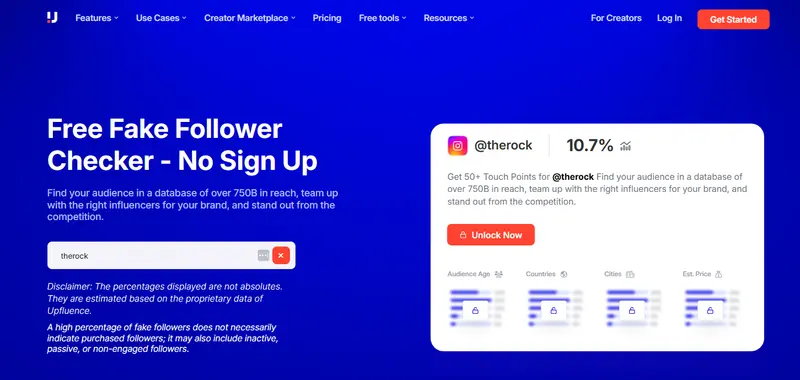
The Upfluence Instagram Fake Follower Checker is another free tool that helps brands and marketers estimate how many followers in an Instagram audience may be fake, inactive, or suspicious.
Like many modern audit tools, it works by analyzing engagement signals and follower behavior patterns rather than relying solely on raw follower counts.
To run a check, users simply enter the Instagram username (without the @), and the tool returns an estimated percentage of fake followers. Upfluence emphasizes that the percentage is an estimate based on proprietary data, meaning the results should be interpreted as a directional signal rather than an exact measurement.
The analysis typically highlights:
- Estimated fake follower percentage
- Engagement indicators
- Audience reach estimates
- Additional audience insights available in the full platform
For example, in one sample analysis of @therock, the Upfluence checker estimated that around 10.7% of followers may be fake or inactive. The platform notes that this number does not necessarily indicate purchased followers.
It may also include passive users, inactive accounts, or followers who simply do not engage regularly.
This distinction is important because almost every large Instagram account accumulates some inactive followers over time, especially as accounts grow into the millions.
The free checker is built on Upfluence’s influencer marketing platform, which indexes a massive creator database covering hundreds of billions of social media reach. Within the full platform, marketers can unlock additional insights such as:
- Audience demographics
- Geographic distribution
- Estimated collaboration pricing
- Influencer performance analytics
For brands running influencer campaigns, tools like the Upfluence checker provide a quick way to screen influencer audiences before deeper vetting, helping ensure collaborations are built around creators with authentic and engaged communities.
Key Features: Influencer Search & Discovery, Relationship Management, Campaign Management, Third Party Analytics, Automated Recruiting, Influencer Lifecycle Management, Team Collaboration Tools, Content Review, Campaign Reporting, Audience Analysis, E-commerce Tools, Product/Gifting Tools, Payment Processing, Social Listening, Affiliate Management, Affiliate Campaigns,
Channels: Instagram, Youtube, Facebook, Twitch, Tiktok, Twitter, Pinterest, Blogs
3. SocialAuditor
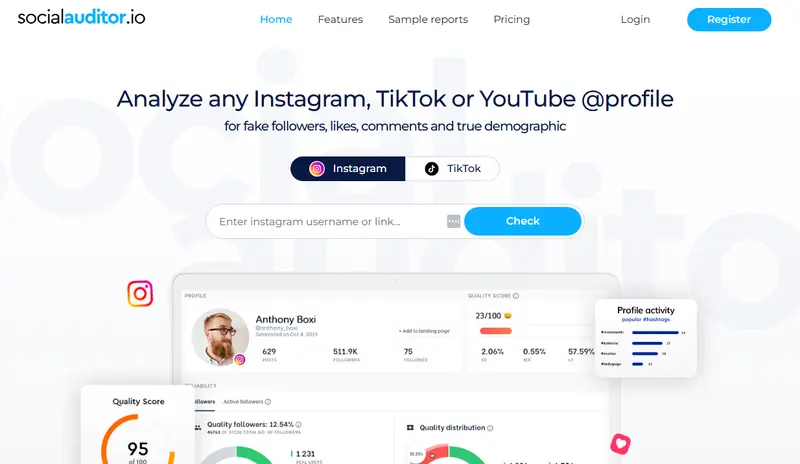
SocialAuditor is an influencer analytics tool designed to audit social media audiences for authenticity across platforms like Instagram, TikTok, and YouTube. The platform focuses on identifying fake followers, suspicious engagement activity, and demographic insights that help brands evaluate potential influencer partnerships.
To analyze an account, users simply enter a creator’s handle, and the system generates a report examining the profile’s audience quality and engagement patterns.
One of SocialAuditor’s core features is fan base analysis, which reviews an influencer’s entire follower list to detect suspicious accounts.
The platform identifies mass followers, which are profiles that follow extremely large numbers of accounts, often more than 1,500. These accounts are not always fake, but they are typically considered low-quality followers because they are unlikely to see or engage with the influencer’s content.
SocialAuditor also evaluates engagement authenticity by scanning likes and comments for patterns associated with bots or automated engagement systems. This helps brands determine whether interactions are genuine or artificially generated.
Another key feature is the platform’s audience demographic analysis, which provides insights into follower characteristics such as age, gender, country, and language. For marketers, these insights can be critical when assessing whether an influencer’s audience aligns with a campaign’s target market.
While SocialAuditor offers free sample reports, full access to detailed analytics typically requires a paid report.
What Percentage of Instagram Followers Are Fake?
One of the most common questions brands and creators ask is how many fake followers are considered normal on Instagram. The reality is that almost every account has some fake, inactive, or suspicious followers, especially as accounts grow over time.
Several studies show that fake followers are a widespread issue across the platform. We've already mentioned the study that found that 22% of Instagram influencer followers are classified as suspicious accounts, including bots, inactive profiles, or automated engagement accounts.
Other industry analyses suggest that roughly 14–15% of followers across social media audiences may be bots or inactive accounts, which reflects the natural accumulation of spam profiles and dormant users as accounts grow.
So that begs the question, what percentage is considered "normal"?
What Is Considered a Normal Fake Follower Percentage?
Because fake followers appear naturally over time, marketers typically evaluate influencer audiences within certain ranges:
- 0–10% fake followers: Generally considered very healthy
- 10–20% fake followers: Common for many growing accounts
- 20–30% fake followers: Typical for very large accounts with millions of followers
- 30%+ fake followers: Often considered a warning sign that audience inflation may be occurring
Large influencers naturally accumulate more inactive or bot accounts because their profiles attract spam accounts, mass followers, and dormant users. This is why percentage matters more than raw numbers when evaluating audience authenticity.
Ultimately, the best way to determine whether an influencer’s audience is healthy is to combine engagement metrics with audience analysis tools such as an Instagram fake followers checker, which estimates suspicious followers based on engagement patterns, follower behavior, and account quality signals.
How to Remove Fake Followers From Your Instagram Account
Identifying fake followers is only the first step. Once you know that suspicious or inactive accounts exist in your audience, the next goal is to reduce their impact on your engagement and credibility.
While it is impossible to completely eliminate fake followers, there are several steps creators and brands can take to clean up their audience and maintain a healthier follower base.
Remove Suspicious Followers Manually
Instagram allows users to remove followers directly from their accounts. If you identify suspicious profiles, you can remove them without blocking the user.
To do this:
- Open your Instagram profile.
- Tap Followers.
- Locate the suspicious account.
- Tap Remove next to their username.
This method works well for removing obvious bot accounts, especially those with empty profiles, generic usernames, or spam activity.
Use Audit Tools to Identify Low-Quality Followers
Manually reviewing followers becomes difficult once an account grows into the thousands or millions. Tools such as an Instagram fake followers checker can analyze an audience and identify suspicious accounts based on engagement patterns, follower behavior, and profile characteristics.
Running periodic audits allows brands and creators to quickly identify whether a follower base contains large clusters of suspicious accounts and take action accordingly.
Avoid Services That Promise Fast Growth
Many fake followers originate from growth services that promise rapid audience expansion. These services often rely on automation networks, bot accounts, or mass-follow tactics that create low-quality audiences.
While these tactics may temporarily increase follower counts, they typically reduce engagement rates and damage credibility with brands and audiences over time.
Focus on Real Audience Growth
The most reliable way to reduce the impact of fake followers is to focus on attracting genuine audiences through consistent, high-quality content.
Creators who build audiences organically typically see:
- More meaningful engagement
- Higher comment quality
- Stronger brand partnerships
- Better long-term audience growth
For brands evaluating influencer partnerships, verifying audience authenticity with tools like an Instagram fake followers checker can help ensure campaigns reach real users rather than automated accounts.
Why Authentic Audiences Matter More Than Follower Counts
Fake followers remain one of the biggest challenges in influencer marketing. Large audience numbers may look impressive, but without genuine engagement, they offer little real value to brands or creators.
Inflated follower counts can distort campaign performance, reduce credibility, and make it harder to measure the true impact of influencer partnerships.
This is why verifying audience authenticity has become a critical step in influencer vetting. Using tools such as an Instagram fake followers checker allows marketers to quickly analyze engagement patterns, audience quality, and follower growth trends before committing to collaborations.
Ultimately, successful influencer marketing is not built on follower totals alone. It depends on real communities, authentic engagement, and audiences that genuinely trust the creator behind the account.
Frequently Asked Questions
How can you check if Instagram followers are fake?
You can check whether Instagram followers are fake by analyzing engagement patterns, follower growth trends, and audience quality metrics.
Tools such as an Instagram fake followers checker estimate the percentage of suspicious or inactive accounts by reviewing follower behavior, engagement rates, and profile characteristics.
What percentage of fake followers is normal on Instagram?
It is generally considered industry-wide that having less than 10% of fake followers is normal on Instagram. On the opposite side, having 25-30%+ of fake followers is a sign of concern.
Can fake followers hurt influencer marketing campaigns?
Yes. Fake followers can reduce engagement rates and distort campaign performance metrics. If a large portion of an influencer’s audience consists of bots or inactive accounts, sponsored content may reach far fewer real users than expected, reducing the effectiveness of the campaign.
Are Instagram fake follower checkers accurate?
Fake follower checkers provide estimates rather than exact numbers. These tools analyze engagement patterns, follower behavior, and audience characteristics to identify suspicious activity.
While no tool can guarantee perfect accuracy, they are widely used by brands and agencies to assess audience authenticity before influencer collaborations.
Can influencers remove fake followers from their accounts?
Yes. Influencers can manually remove suspicious followers directly from their follower list on Instagram. Regularly auditing followers and removing bot accounts can help improve engagement rates and maintain a more authentic audience.

SUGGESTED

Why Buying Instagram Followers is a Really Bad Idea
Buying Instagram followers is not the same as the followers you genuinely earn through...
How to Run an Influencer Audit: Metrics and Tools Marketers Use
Learn how to perform an influencer audit evaluate engagement and audience authenticity...
Top 10 Instagram Followers Trackers for 2025
Looking for the Best Instagram Followers Tracker? Check out our guide to the top 10 apps...