

Influencer campaigns are often evaluated by reach, engagement, clicks, and conversions. For e-commerce brands, however, those metrics only tell part of the story. A creator can generate thousands of qualified visits and a healthy number of purchases while the campaign still underperforms commercially if most customers buy only one low-priced product.
That makes average order value (AOV) an important metric when evaluating influencer-driven revenue. The opportunity with influencer marketing for ecommerce isn't simply generating more traffic. It's designing the post-click experience so the trust created by an influencer translates into higher-value transactions.
That requires looking beyond creator selection and considering what happens across the entire customer journey, from the influencer's content and landing page to product recommendations, bundles, commissions, and retargeting.
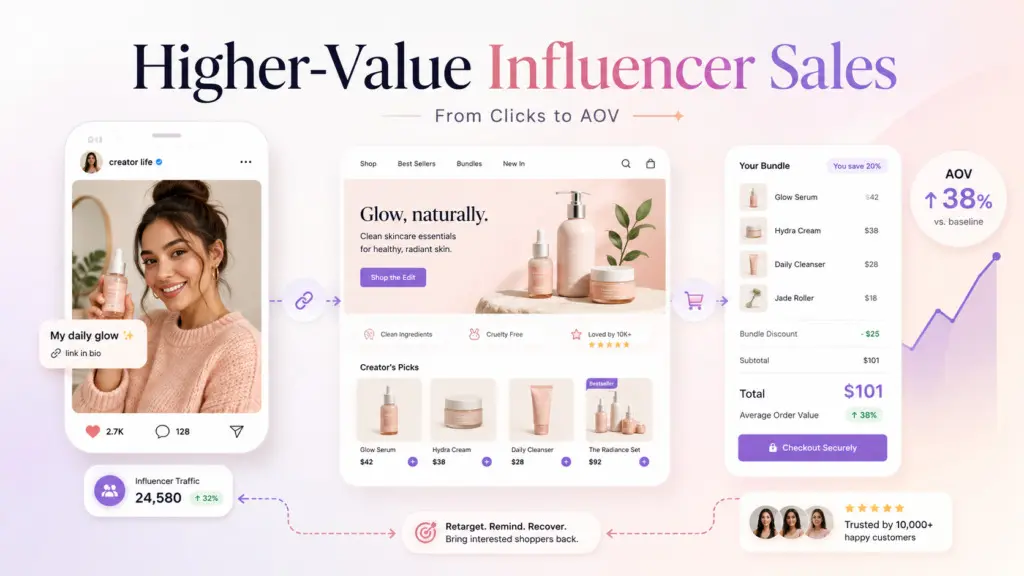
Why Influencer Traffic Behaves Differently Than Paid Ads
Not every acquisition channel produces visitors with the same level of brand awareness. Someone arriving through a retargeting campaign, for example, may already have visited the store, viewed several products, or abandoned a cart.
Influencer-referred visitors can behave differently. They may have high trust in the recommendation but relatively little familiarity with the brand or its wider product catalog. A creator demonstrates or recommends a specific product, and that product becomes the primary reason for clicking.
For e-commerce marketers, this creates both an advantage and a limitation. The creator has already provided social proof and reduced some of the uncertainty associated with discovering an unfamiliar brand. But the retailer still needs to introduce the customer to related products and communicate why purchasing more than the featured item makes sense.
A conventional product page isn't always designed to accomplish that. Stores that treat influencer referrals like every other traffic source may therefore miss opportunities to increase cart value while purchase intent is high.
Brands can investigate this behavior within their own analytics by segmenting traffic using creator-specific UTM parameters.
Useful metrics to compare include:
- Conversion rate
- Average order value
- Items per transaction
- Revenue per visitor
- Product-page engagement
- New versus returning customer rate
- Assisted conversions
The objective isn't simply to determine whether an influencer generates sales. It is to understand the economic quality of those sales.
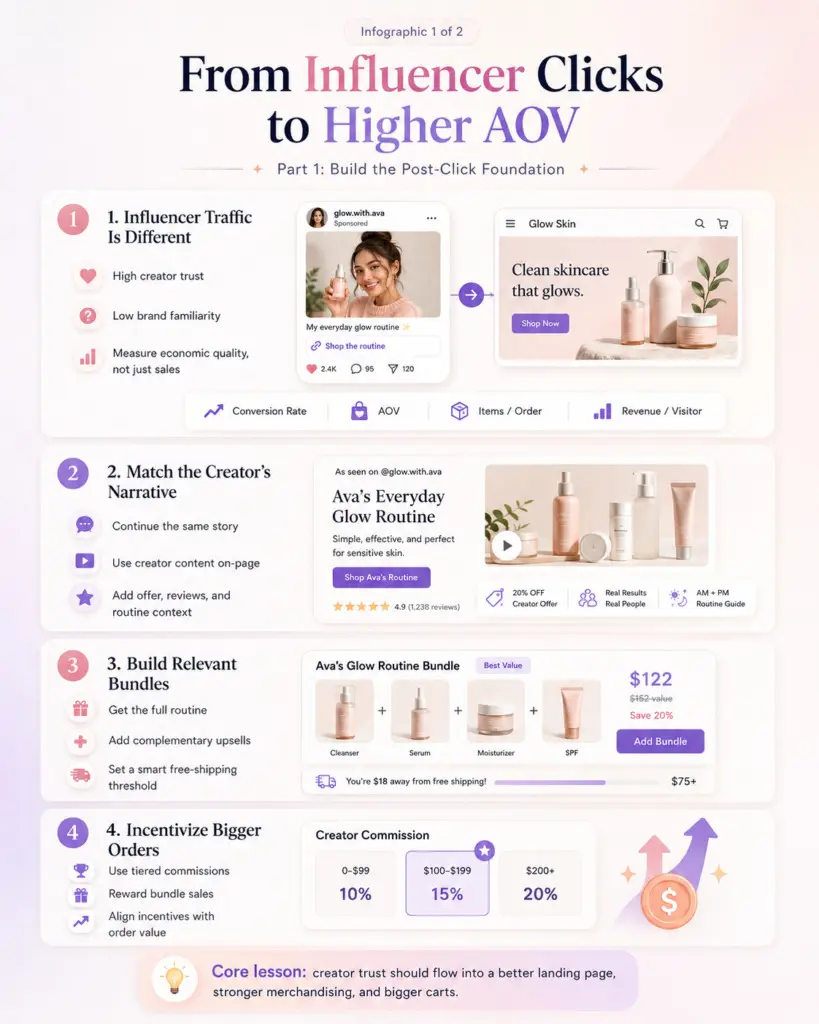
Matching the Creator's Narrative to the Product Page
One of the biggest sources of friction in influencer campaigns can occur between the creator's content and the brand's landing experience.
Consider a beauty creator who spends several minutes explaining how a serum fits into their six-week skincare routine. A viewer becomes interested, clicks the creator's link, and arrives on a standard product page containing a generic description, conventional product photography, and no reference to the routine they just watched.
The customer has moved from a highly contextual recommendation to a relatively context-free shopping experience. That narrative gap can interrupt purchasing momentum.
One approach is to create dedicated landing experiences for important creator campaigns. With the appropriate usage rights, brands can incorporate creator content into these pages, explain the routine or use case demonstrated by the influencer, answer common questions, and present the other products involved.
The landing page then becomes an extension of the creator campaign rather than an unrelated destination.
For example, a creator-specific page could include:
- The featured creator content
- The primary product demonstrated
- Supporting product information
- Products used alongside the featured item
- Reviews and other forms of social proof
- A creator-specific offer or discount
- A complete bundle based on the demonstrated routine
This creates a more coherent conversion funnel from content discovery through checkout. It can also give marketers a cleaner environment for measuring the commercial performance of individual partnerships.
Building Bundles Around the Creator's Recommendation
Product bundling can be particularly relevant to influencer campaigns because creators frequently demonstrate products as part of a larger routine, collection, outfit, recipe, or use case.
The key is relevance.
Suppose a skincare creator demonstrates a cleanser, serum, and moisturizer as a three-step morning routine. Instead of sending viewers to the serum product page and hoping they discover the other products independently, the brand could offer the complete routine as a bundle.
This matches the purchase opportunity with the content that generated the customer's interest. A generic starter kit containing products the creator never discussed may be less persuasive because influencer-referred customers are responding to a specific recommendation, rather than necessarily arriving with the intention of browsing the entire catalog.
Brands can experiment with several approaches:
- "Get the full routine" bundles that mirror what the creator demonstrated
- Replenishment add-ons positioned around products customers are likely to purchase repeatedly
- Complementary product upsells connected directly to the creator's use case
- Multi-packs for frequently consumed products
- Free-shipping thresholds positioned slightly above the typical influencer-referred cart value
Tools like Bundly can help automate this kind of product grouping, so you're not manually building new bundle pages for every partnership.
The broader principle is to capitalize on the trust transfer between creator and brand while making the next purchase decision easier for the customer.
Commission Structures That Incentivize Bigger Orders
Influencer compensation can also affect the type of sales a campaign generates. Many affiliate-style influencer programs use a percentage of sales, fixed commission, cost-per-acquisition payment, or hybrid compensation model.
Brands looking to increase order value can consider whether their incentive structure encourages the desired customer behavior. If a creator receives the same fixed commission regardless of whether the customer purchases a single entry-level item or a larger product set, there may be little economic incentive for the creator to spend time explaining bundles or premium options.
Tiered incentives provide an alternative. For example, a program could offer one commission level for standard orders and a higher rate once referred order values cross a predetermined threshold.
Brands could also provide bonuses based on:
- Revenue targets
- Average order value
- New-customer acquisition
- Bundle sales
- Subscription sign-ups
- Campaign-specific performance goals
The appropriate structure will depend on margins, product category, customer lifetime value, and the brand's broader influencer strategy.
More importantly, the compensation structure should reflect the outcome the company actually wants creators to generate. If revenue quality matters more than raw transaction volume, the incentive model should account for that.
Retargeting the Influencer Audience After the First Visit
Influencer campaigns shouldn't necessarily end when the original social post stops generating clicks. Some customers will discover a product through a creator without purchasing immediately. These visitors have already demonstrated interest and arrived through a recommendation from someone they follow, making them a potentially valuable audience for subsequent marketing.
Creator-specific UTM parameters can help brands build and analyze these audiences. Instead of placing all non-converting visitors into the same retargeting campaign, marketers can segment influencer-referred visitors and maintain continuity with the message that originally generated their interest.
Where advertising permissions and platform policies allow, retargeting creative might reinforce the campaign, featured product, offer, or creator partnership rather than switching immediately to generic product advertising. This preserves the original trust signal throughout more of the customer journey.
Email and SMS capture can serve a similar function. A creator-specific landing page could encourage visitors to subscribe in exchange for an offer or useful content connected to the campaign.
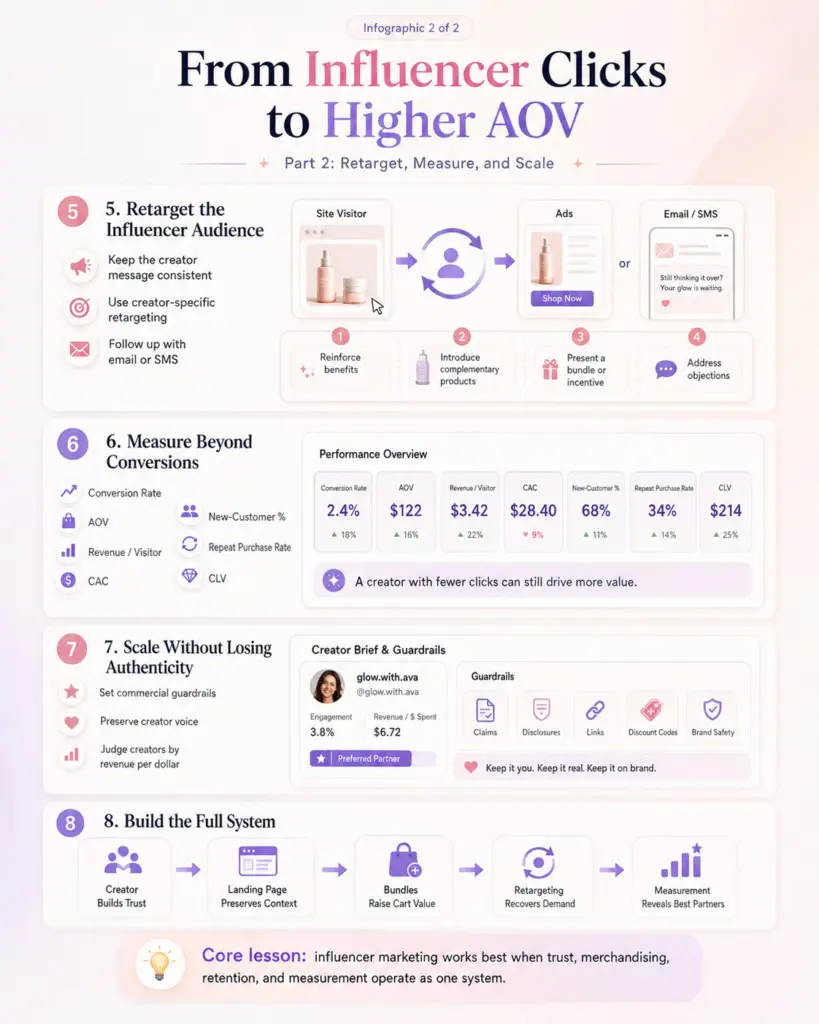
A follow-up sequence might then:
- Reinforce the product benefits or use case highlighted by the creator.
- Introduce complementary products.
- Present a bundle or incentive.
- Address common purchase objections.
Brands should test these sequences against their standard welcome flows rather than assuming one approach will automatically perform better for influencer-sourced leads. That comparison can reveal whether influencer-referred visitors require a different lifecycle marketing strategy.
Measuring Influencer Campaigns Beyond Conversions
Conversion rate alone can create an incomplete picture of influencer performance.
Imagine two creators each generate 100 orders. Creator A generates an average order value of $45, while Creator B generates an average order value of $80. Even before considering margins, repeat purchases, and acquisition costs, those partnerships clearly have different commercial value.
E-commerce brands can therefore expand their influencer reporting to include:
| Metric | What It Helps Measure |
|---|---|
| Conversion rate | How effectively traffic becomes customers |
| Average order value | Revenue generated per transaction |
| Revenue per visitor | Overall traffic quality |
| Items per order | Cross-sell and bundle effectiveness |
| Customer acquisition cost | Efficiency of acquiring customers |
| New-customer percentage | Incremental customer acquisition |
| Repeat purchase rate | Longer-term customer quality |
| Customer lifetime value | Potential long-term campaign value |
This moves influencer measurement away from engagement metrics alone and toward contribution to e-commerce revenue. It can also change which creators appear to be the strongest performers.
A creator generating fewer clicks but higher-value customers may ultimately be more valuable than one producing significantly more traffic with smaller transactions.
Scaling Without Losing Authenticity
Once a brand identifies a successful influencer campaign structure, the natural next step is scaling it. However, operational consistency shouldn't require every creator to produce identical content.
Creators build audiences partly because they have a recognizable voice, format, and relationship with their followers. Overly prescriptive campaign briefs can undermine those characteristics.
A more scalable approach is to establish creative freedom within clear commercial guardrails. Those guardrails might cover product claims, disclosure requirements, campaign links, discount codes, key product information, and brand-safety requirements. The creator can retain greater control over how the product appears within their content.
The same principle applies when choosing creator sizes. Micro-influencers can be attractive to e-commerce brands because their smaller audiences may allow for more focused communities and closer creator-follower relationships. However, follower count alone shouldn't determine creator selection.
Brands should compare creators based on metrics such as:
- Audience relevance
- Engagement quality
- Click-through rate
- Conversion rate
- Average order value
- Revenue per visitor
- Customer acquisition cost
- Repeat purchases from referred customers
Ultimately, revenue per dollar spent is more commercially meaningful than audience size in isolation.
Putting It All Together
Influencer marketing performance doesn't stop at creator selection, reach, or even conversion rate. For e-commerce brands, the post-click experience can determine how much commercial value each creator partnership ultimately produces.
Dedicated landing pages can maintain continuity between creator content and the store. Relevant bundles can turn a single-product recommendation into a larger purchase. Better-aligned commission structures can encourage creators to communicate higher-value offers. Retargeting and lifecycle marketing can capture demand that doesn't convert during the initial visit. And better measurement can reveal which creators are producing valuable customers rather than simply generating attention.
None of these tactics needs to operate independently. Combined, they create an influencer commerce strategy in which the creator generates trust, the landing experience preserves it, merchandising expands the purchase opportunity, and measurement tracks the resulting revenue.
For e-commerce marketers, that is the shift that matters: treating influencer marketing not simply as a source of traffic, but as an acquisition channel that can be optimized all the way from creator content to order value.

SUGGESTED

How to Retarget Influencer Campaign Audiences After They Don't Convert
Track creator referrals segment visitors by intent and sequence retargeting ads to...

What is Influencer Marketing? The Ultimate Strategy Guide for 2026
Learn how influencer marketing drives brand awareness engagement and sales with our...

What Is an Influencer? Definition, Types, and How Influencers Work
What is an influencer? Learn how influencers build trust grow audiences work with brands...